


08 Nov India’s Forex Reserves Decline to $717 Billion: UPSC Economy
✎ India's foreign exchange reserves, managed by the RBI, comprise Foreign Currency Assets, Gold, SDRs, and RTP with the IMF, serving as a crucial buffer against external shocks and for currency stability.
Subject Relevance — Where This Topic Fits
- GS Paper III — Indian Economy and issues relating to Planning, Mobilization of Resources, Growth, Development and Employment; Government Budgeting; Balance of Payments
- Prelims: Foreign Exchange Reserves, Reserve Bank of India (RBI), Foreign Currency Assets (FCA), Gold Reserves, Special Drawing Rights (SDRs), Reserve Tranche Position (RTP), Balance of Payments, Exchange Rate Management, FCNR(B) deposits
- Essay: The role of robust macroeconomic indicators in fostering economic stability and growth, India’s economic resilience in a volatile global financial landscape
Quick Revision: India’s foreign exchange reserves, managed by the RBI, comprise Foreign Currency Assets, Gold, SDRs, and RTP with the IMF, serving as a crucial buffer against external shocks and for currency stability.
Why is this in the news?
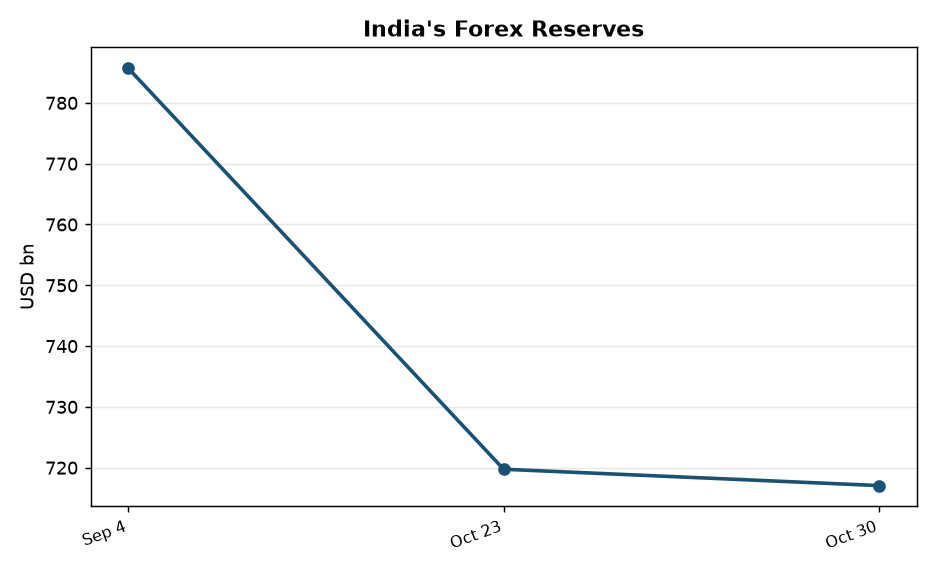
India’s foreign exchange reserves experienced a decline of USD 2.691 billion, reaching USD 717.056 billion during the week ending October 30. This marks a continued reduction from an all-time high observed in early September, primarily attributed by experts to the deployment of Foreign Currency Non-Resident (Bank) [FCNR(B)] resources and the Reserve Bank of India’s (RBI) interventions in the currency market to defend the Indian Rupee.
Background
- Foreign exchange reserves are external assets held by the central bank in foreign currencies, gold, and other international financial instruments.
- The Reserve Bank of India (RBI) is responsible for managing and maintaining India’s foreign exchange reserves.
- A significant portion of India’s forex reserves is held in Foreign Currency Assets (FCA), which are denominated in non-US units like the Euro, Pound, and Yen, alongside US dollars.
- The value of these reserves can fluctuate due to changes in the exchange rates of non-US currencies against the US dollar, in addition to actual inflows and outflows.
- The FCNR(B) scheme allows Non-Resident Indians (NRIs) to hold deposits in foreign currencies with Indian banks, which are then swapped into rupees by the banks with the RBI, contributing to forex reserves.
- Currency defence by the RBI involves selling US dollars from its reserves to absorb excess rupee liquidity or to prevent excessive depreciation of the rupee, thereby influencing the exchange rate.
What are Foreign Exchange Reserves?
- Foreign exchange reserves are assets held by a nation’s central bank or monetary authority, primarily in foreign currencies, but also including gold, Special Drawing Rights (SDRs), and Reserve Tranche Position (RTP) with the International Monetary Fund (IMF).
- These reserves serve multiple critical functions, including supporting and maintaining confidence in the national currency, providing liquidity to manage balance of payments imbalances, and acting as a buffer against external shocks.
- The composition of India’s forex reserves typically includes Foreign Currency Assets (FCA), Gold Reserves, Special Drawing Rights (SDRs), and the Reserve Tranche Position (RTP) with the IMF.
- Foreign Currency Assets (FCA) constitute the largest component, held in major international currencies, and their value is influenced by both actual transactions and the appreciation or depreciation of non-US currencies against the US dollar.
- Gold reserves are held as a store of value and a hedge against inflation and currency fluctuations, contributing to the overall stability of the reserves.
- Special Drawing Rights (SDRs) are an international reserve asset created by the IMF, whose value is based on a basket of five major currencies: the US dollar, Euro, Chinese Yuan, Japanese Yen, and British Pound.
- The Reserve Tranche Position (RTP) represents the portion of a country’s quota in the IMF that can be withdrawn without charges or conditions, effectively serving as a liquid reserve asset.
- Fluctuations in forex reserves can be attributed to various factors, including trade balances, capital flows (e.g., Foreign Direct Investment, Foreign Portfolio Investment), external debt servicing, and the central bank’s interventions in the foreign exchange market.
Key Features
| Feature | Significance |
|---|---|
| Total Forex Reserves | India’s total foreign exchange reserves stood at USD 717.056 billion as of October 30, 2026. |
| Weekly Decline | A reduction of USD 2.691 billion was observed during the week ended October 30, 2026. |
| Previous Week’s Trend | The preceding week also registered a decline of USD 1.269 billion, indicating a sustained downward trend. |
| All-time High | Reserves reached a peak of USD 785.706 billion during the week ended September 4, 2026. |
| Foreign Currency Assets (FCA) | FCA, the largest component, decreased by USD 2.088 billion to USD 591.118 billion. |
| Gold Reserves | The value of gold reserves declined by USD 559 million to USD 102.591 billion. |
Why it Matters
Economic Stability
- Robust foreign exchange reserves provide a buffer against external shocks, such as global economic downturns or sudden capital outflows, thereby safeguarding macroeconomic stability.
- They enhance investor confidence in the economy’s ability to meet its external obligations and manage currency volatility, attracting foreign direct investment and portfolio investment.
- Adequate reserves facilitate the financing of essential imports, particularly critical goods like crude oil and capital machinery, ensuring uninterrupted economic activity.
Monetary Policy Tool
- The Reserve Bank of India (RBI) utilises forex reserves for currency defence, intervening in the foreign exchange market to manage the Indian Rupee’s exchange rate against major global currencies.
- Interventions, such as selling dollars, can mitigate excessive depreciation of the rupee, which helps in controlling imported inflation and stabilising import costs.
- The level of reserves influences the RBI’s capacity to conduct independent monetary policy, as it reduces vulnerability to external financial pressures.
External Sector Management
- Forex reserves are crucial for managing India’s balance of payments, providing the necessary liquidity to cover current account deficits and external debt servicing.
- They act as a measure of a country’s external vulnerability, with higher reserves generally indicating a stronger external position and reduced risk of a balance of payments crisis.
- The composition of reserves, including foreign currency assets, gold, Special Drawing Rights (SDRs), and the reserve position with the IMF, reflects a diversified approach to managing external assets.
Challenges
1. Currency Volatility Management
- Sustained declines in forex reserves can limit the RBI’s capacity to intervene effectively in the foreign exchange market, potentially leading to increased volatility of the Indian Rupee.
- Excessive rupee depreciation can exacerbate imported inflation, particularly for essential commodities like crude oil, impacting domestic prices and consumer purchasing power.
UPSC Link: GS Paper III: Indian Economy and issues relating to planning, mobilization, of resources, growth, development and employment.
2. Impact on External Debt Servicing
- A significant reduction in reserves could raise concerns about the nation’s ability to meet its external debt obligations, potentially affecting sovereign credit ratings.
- Higher external debt servicing costs, especially if the rupee depreciates, can strain government finances and reduce resources available for developmental expenditures.
UPSC Link: GS Paper III: Government Budgeting.
3. Investor Confidence Erosion
- A consistent downward trend in forex reserves may signal underlying economic vulnerabilities to international investors, potentially leading to capital outflows.
- Reduced investor confidence can hinder foreign direct investment (FDI) and foreign portfolio investment (FPI), which are crucial for economic growth and job creation.
UPSC Link: GS Paper III: Investment models.
4. Monetary Policy Constraints
- Depleting reserves can constrain the RBI’s flexibility in conducting monetary policy, forcing it to prioritise exchange rate stability over other objectives like growth or inflation targeting.
- The need to replenish reserves might necessitate measures that could impact domestic liquidity or interest rates, potentially affecting economic activity.
UPSC Link: GS Paper III: Monetary policy.
Challenges — UPSC Perspective
| Issue | Concern |
|---|---|
| Decline in Foreign Currency Assets (FCA) | Reduces the primary liquid component available for market intervention and import financing. |
| Decrease in Gold Reserves | Impacts the overall value and diversification of the reserve portfolio, potentially affecting investor perception. |
| Deployment of FCNR(B) Resources | Utilisation of these resources, often for specific purposes, can contribute to the overall decline in headline reserves. |
| Currency Defence by RBI | Dollar sales by the RBI to stabilise the rupee directly reduce the foreign currency component of reserves. |
| Impact of Non-US Currency Movements | Appreciation or depreciation of non-US units (Euro, Pound, Yen) against the dollar affects the dollar-denominated value of FCA, even without actual transactions. |
Way Forward
- Implement prudent fiscal policies to manage government expenditure and reduce fiscal deficit, thereby mitigating pressures on the current account.
- Promote export diversification and competitiveness to enhance foreign exchange earnings and reduce reliance on specific sectors.
- Attract stable foreign capital inflows, such as Foreign Direct Investment (FDI), through a conducive policy environment and ease of doing business.
- Strengthen macroprudential regulations to manage capital flows and prevent excessive volatility in financial markets.
- Maintain a flexible exchange rate regime, allowing market forces to determine the rupee’s value while intervening judiciously to curb excessive volatility.
- Diversify the composition of foreign exchange reserves to include a balanced mix of assets, reducing concentration risk.
- Monitor global economic developments and adjust domestic policies proactively to mitigate external shocks and maintain reserve adequacy.
UPSC Value Addition
Keywords for Mains Answer-Writing
Foreign Exchange Reserves · Balance of Payments · Exchange Rate Management · Capital Flows · Monetary Policy · Currency Intervention · External Sector Vulnerability · RBI’s Role · Global Economic Shocks · FCNR(B) Deposits
Concept Flow
Global economic conditions and capital flows influence India’s balance of payments. → RBI intervenes in the foreign exchange market to manage rupee volatility. → Dollar sales by RBI to defend the rupee lead to a reduction in foreign currency assets. → Changes in the value of non-US currencies held in reserves affect the overall dollar-denominated value. → Deployment of specific foreign currency resources (e.g., FCNR(B)) also contributes to reserve movements. → Cumulative effect results in a net change in India’s total foreign exchange reserves. → Reserve levels impact macroeconomic stability, investor confidence, and future policy options.
Prelims Practice Questions
Q1. Consider the following statements regarding India’s Foreign Exchange Reserves:
1. Foreign Currency Assets (FCAs) constitute the largest component of India’s forex reserves.
2. Gold reserves are valued in US Dollars and are subject to changes based on international gold prices.
3. Special Drawing Rights (SDRs) are a reserve asset created by the International Monetary Fund (IMF) and can be exchanged for freely usable currencies.
4. India’s Reserve Tranche Position (RTP) with the IMF represents the portion of its quota that it can withdraw without conditionality.
How many of the above statements are correct?
- Only one
- Only two
- Only three
- All four
Answer: All four — Statement 1 is correct: FCAs typically form the major portion of India’s forex reserves. Statement 2 is correct: Gold reserves are indeed valued in US Dollars and their value fluctuates with global gold prices. Statement 3 is correct: SDRs are an international reserve asset created by the IMF to supplement its member countries’ official reserves. Statement 4 is correct: The Reserve Tranche Position (RTP) is a part of a country’s quota in the IMF that can be drawn upon freely and unconditionally.
Q2. Which of the following factors can lead to a decline in a country’s foreign exchange reserves?
1. Increased imports without a corresponding increase in exports.
2. Foreign portfolio investment outflows.
3. Central bank intervention to defend the domestic currency.
4. Repayment of external debt.
Select the correct answer using the code given below:
- 1 and 2 only
- 2, 3 and 4 only
- 1, 3 and 4 only
- 1, 2, 3 and 4
Answer: 1, 2, 3 and 4 — 1. Increased imports without a corresponding increase in exports leads to a current account deficit, requiring more foreign currency to be spent, thus depleting reserves. 2. Foreign portfolio investment outflows mean foreign investors are pulling money out of the country, leading to demand for foreign currency and a decline in reserves. 3. Central bank intervention to defend the domestic currency involves selling foreign currency (typically USD) from its reserves to absorb excess domestic currency, thereby reducing reserves. 4. Repayment of external debt requires the use of foreign currency, leading to a reduction in reserves.
Mains Practice Question
✍ Critically examine the significance of robust foreign exchange reserves for India’s economic stability. Discuss the various factors that influence the fluctuations in these reserves, with particular reference to recent trends. (15 Marks)
Approach: INTRODUCTION: Define foreign exchange reserves and state their current status (e.g., recent decline as per news).
BODY PART 1: Significance of robust forex reserves:
– External sector stability: Cushion against external shocks (e.g., global financial crises, commodity price volatility).
– Exchange rate management: Ability of RBI to intervene in the forex market to prevent excessive volatility of the Rupee.
– Import cover: Provides confidence for financing essential imports (e.g., crude oil, capital goods).
– International confidence: Enhances creditworthiness, attracts foreign investment, and lowers borrowing costs.
– Monetary policy autonomy: Reduces vulnerability to ‘sudden stops’ of capital flows.
BODY PART 2: Factors influencing fluctuations in reserves:
– Current Account Balance: Trade balance (exports vs. imports), remittances, services trade.
– Capital Account Balance: Foreign Direct Investment (FDI), Foreign Portfolio Investment (FPI), External Commercial Borrowings (ECBs), Non-Resident Indian (NRI) deposits (e.g., FCNR(B) flows mentioned in the news).
– Valuation Changes: Appreciation/depreciation of non-US dollar reserve currencies (Euro, Pound, Yen) and changes in gold prices.
– RBI Intervention: Dollar sales/purchases to manage Rupee volatility.
– External Debt Repayments.
– Recent Trends (as per news): Mention the recent decline, attributing it to factors like FCNR(B) deployment and currency defence by RBI through dollar sales. Contrast with previous peaks driven by capital inflows.
CONCLUSION: Summarise the critical role of forex reserves in maintaining macroeconomic stability and the need for prudent management amidst global uncertainties.
Source: theprint.in
Generated by AanyaAi for educational purpose.
Related guides on our sites
- Best economics optional coaching for upsc
- Best economics optional teacher for upsc
- How to prepare for GS paper 1 for UPSC CSE mains exam
- Best UPSC coaching for IFOS exam

- India’s Forex Reserves Decline to $717 Billion: UPSC Economy - November 8, 2026
- आईएमएफ: एआई निवेश में कमी का ब्याज दरों पर प्रभाव - November 8, 2026
- IMF on AI Growth Slowdown: Implications for Central Banks - November 8, 2026

No Comments