


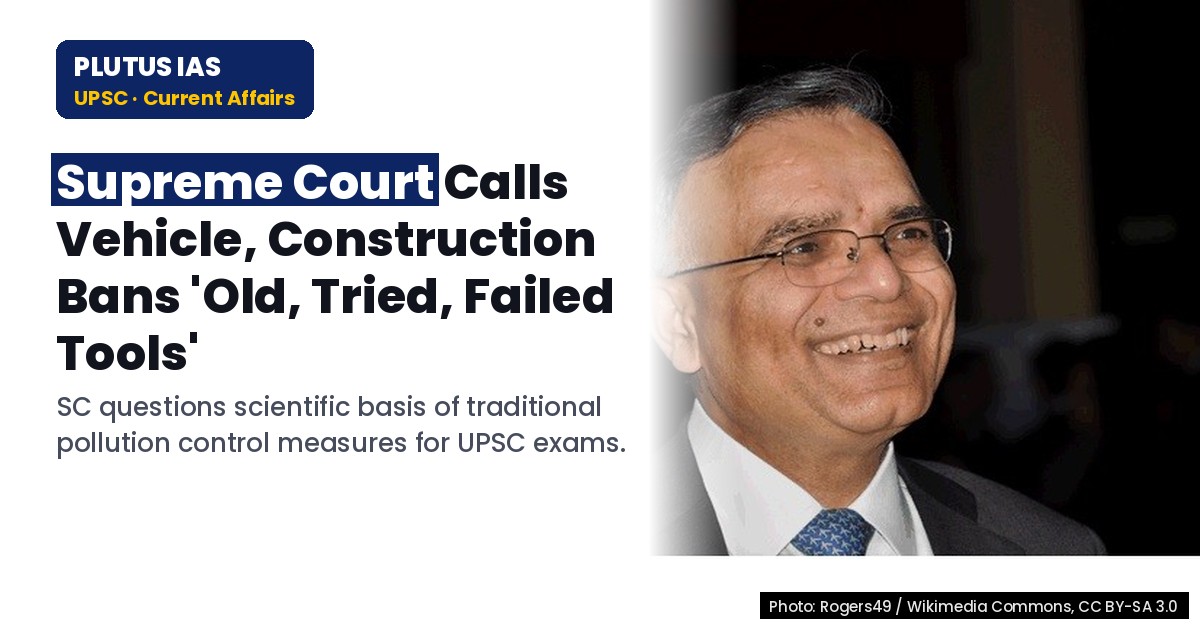
09 Nov SC on Pollution Control: Old Tools Deemed Ineffective
✎ The Supreme Court's critique of existing air pollution control measures, particularly GRAP, highlights the imperative for scientifically robust and sustainable strategies beyond temporary restrictions to address the persistent…
Subject Relevance — Where This Topic Fits
- GS Paper II — Governance, Constitution, Polity, Social Justice | GS Paper III — Environment, Ecology, Disaster Management
- Prelims: Air Quality Index (AQI), Graded Response Action Plan (GRAP), Commission for Air Quality Management (CAQM), Supreme Court of India, Environmental Pollution (Prevention and Control) Authority (EPCA), National Green Tribunal (NGT), Vehicular Emissions, Stubble Burning
- Essay: Environmental Governance and Sustainable Development, Balancing Economic Activity with Environmental Protection
Quick Revision: The Supreme Court’s critique of existing air pollution control measures, particularly GRAP, highlights the imperative for scientifically robust and sustainable strategies beyond temporary restrictions to address the persistent air quality challenges in the Delhi-NCR region.
Why is this in the news?
The Supreme Court of India recently expressed reservations regarding the effectiveness of traditional measures, such as banning vehicles and construction activities, in mitigating air pollution in the National Capital Region (NCR). The Court termed these interventions as ‘old, tried, and failed tools,’ prompting a critical examination of the current strategies, including the Graded Response Action Plan (GRAP), and a call for more scientifically robust and sustainable solutions from the Union government and the Commission for Air Quality Management (CAQM).
Background
- Air pollution in the Delhi-NCR region frequently reaches ‘severe’ and ‘very severe’ categories, particularly during the post-monsoon and winter months, necessitating emergency measures.
- The Graded Response Action Plan (GRAP) was formulated to implement progressively stricter measures based on the ambient air quality, aiming to prevent the deterioration of air quality to emergency levels.
- The Commission for Air Quality Management (CAQM) in National Capital Region and Adjoining Areas was established to coordinate efforts and implement measures for air pollution control across the region.
- Vehicular emissions, industrial pollution, construction dust, stubble burning in neighbouring states, and meteorological factors are identified as major contributors to air pollution in Delhi-NCR.
- The Supreme Court and the National Green Tribunal (NGT) have historically intervened in matters of air pollution, issuing directives to governmental agencies for its control and mitigation.
- Despite various interventions, the Air Quality Index (AQI) in Delhi-NCR often remains alarmingly high, indicating persistent challenges in achieving sustainable air quality improvements.
- The Supreme Court highlighted the issue of ‘commodification and commercialisation’ of festivals, leading to increased pollution, and the unregulated entry of vehicles from other states into Delhi as exacerbating factors.
- The Court also questioned the scientific basis and long-term efficacy of current emergency measures, urging for innovative and comprehensive approaches beyond temporary restrictions.
What is the Graded Response Action Plan (GRAP)?
- The Graded Response Action Plan (GRAP) is a set of emergency measures implemented to combat air pollution in the Delhi-NCR region.
- It was notified by the Ministry of Environment, Forest and Climate Change in 2017, following a Supreme Court order.
- GRAP categorises air quality into four stages: Moderate to Poor, Very Poor, Severe, and Severe+ (Emergency), with corresponding escalating restrictions.
- The measures under GRAP include restrictions on construction activities, entry of trucks, use of diesel generator sets, and, in severe stages, odd-even schemes for vehicles and closure of educational institutions.
- The plan is implemented by the Commission for Air Quality Management (CAQM) in collaboration with various state government agencies and local bodies.
- The objective of GRAP is to prevent the air quality from deteriorating further into the ‘severe’ or ‘severe+’ categories by taking pre-emptive and emergency actions.
- GRAP is a dynamic plan, with measures intensifying or relaxing based on the real-time Air Quality Index (AQI) forecasts and readings.
- The Supreme Court’s recent observations underscore a need to evaluate the long-term effectiveness and scientific basis of GRAP’s current interventions, particularly the reliance on temporary bans.
Key Features
| Feature | Significance |
|---|---|
| Judicial Scrutiny of Anti-Pollution Measures | Highlights the Supreme Court’s active role in environmental governance and its critical assessment of existing policy tools for air quality management. |
| Effectiveness of Graded Response Action Plan (GRAP) | The Court’s observations question the efficacy of GRAP’s emergency measures, particularly in achieving sustained improvements in Air Quality Index (AQI). |
| Vehicular Emissions as a Major Contributor | Emphasises the persistent challenge posed by vehicle proliferation and interstate vehicular movement in exacerbating air pollution in the National Capital Region (NCR). |
| Socio-economic Dimensions of Pollution | Acknowledges that pollution disproportionately affects vulnerable populations, linking environmental degradation to socio-economic disparities. |
| Need for Scientific and Sustainable Solutions | Underscores the imperative for the Union government and the Commission for Air Quality Management (CAQM) to develop innovative, evidence-based strategies beyond conventional restrictions. |
Why it Matters
Environmental Governance
- The Supreme Court’s intervention reinforces the judiciary’s role as a guardian of environmental rights, pushing for more effective and sustainable policy responses to air pollution.
- It prompts a re-evaluation of the current policy framework, specifically the Graded Response Action Plan (GRAP), to ascertain its long-term effectiveness and adaptability.
Public Health
- Persistent high Air Quality Index (AQI) levels, particularly in the ‘severe’ and ‘very severe’ categories, pose significant public health risks, including respiratory and cardiovascular diseases.
- The Court’s observations highlight the failure to protect citizens’ right to clean air, a fundamental aspect of the right to life.
Urban Planning and Development
- The issue of vehicular congestion and interstate vehicle movement points to deficiencies in regional urban planning and transportation infrastructure that contribute to pollution.
- It necessitates integrated planning across states within the NCR to manage urbanisation and its environmental consequences effectively.
Economic Impact
- Restrictions on economic activities like construction and transportation, while aimed at pollution control, can have adverse economic impacts on daily wage earners and various industries.
- The need for sustainable solutions that balance environmental protection with economic activity is highlighted.
Challenges
1. Effectiveness of Emergency Measures
- The Supreme Court’s critique indicates that measures like banning vehicles and construction, while immediate, have not yielded sustained improvements in air quality.
- These measures are often reactive rather than proactive, failing to address the root causes of pollution comprehensively.
UPSC Link: Environmental Pollution & Degradation
2. Multi-sectoral and Inter-state Coordination
- Air pollution is a transboundary issue, requiring coordinated efforts across multiple states (e.g., Delhi, Haryana, Uttar Pradesh) and sectors (transport, industry, agriculture).
- Challenges in enforcement and harmonisation of policies across jurisdictions hinder effective pollution control.
UPSC Link: Government Policies & Interventions
3. Vehicular Emission Management
- The sheer volume of vehicles, including those from other states, and difficulties in monitoring fuel quality and vehicle fitness, make controlling vehicular emissions a formidable task.
- Existing mechanisms appear insufficient to manage the rapid expansion of human activities and associated emissions.
UPSC Link: Conservation, Environmental Pollution
4. Behavioural Change and Public Participation
- The Court’s observation on the ‘commodification and commercialisation’ of festivals indicates a challenge in fostering public responsibility and behavioural change towards environmental protection.
- Sustainable solutions require active public participation and a shift in societal consumption patterns.
UPSC Link: Human Values in Society
5. Scientific and Technological Solutions
- There is a perceived lack of ‘significant scientific methods’ beyond traditional restrictions, indicating a gap in innovative, technology-driven solutions for air quality management.
- Investment in research and development for cleaner technologies and real-time monitoring is crucial.
UPSC Link: Science and Technology- Developments
Challenges — UPSC Perspective
| Issue | Concern |
|---|---|
| Reactive Policy Frameworks | Current measures often respond to severe pollution events rather than implementing long-term preventative strategies. |
| Enforcement Gaps | Difficulty in consistently enforcing restrictions across a vast and densely populated region, particularly concerning interstate vehicles and construction activities. |
| Data-driven Decision Making | Need for more robust scientific data and predictive modelling to inform policy interventions, moving beyond ‘tried and failed tools’. |
| Socio-economic Disparities | Pollution’s disproportionate impact on the poor underscores the need for equitable environmental policies that do not exacerbate existing inequalities. |
| Urbanisation and Population Growth | Rapid urban expansion and increasing population density in the NCR strain existing infrastructure and amplify pollution sources. |
Government Initiatives — Must-Memorise for Prelims
- Graded Response Action Plan (GRAP)
Way Forward
- Implement a comprehensive, long-term regional air quality management plan for the National Capital Region (NCR) with specific, measurable targets.
- Invest in advanced scientific research and technology for real-time pollution monitoring, source apportionment, and innovative emission control solutions.
- Strengthen inter-state coordination mechanisms and establish a unified authority with enforcement powers for effective pollution control across the NCR.
- Promote sustainable urban planning, including integrated public transport systems, electric vehicle infrastructure, and green building codes.
- Incentivise the adoption of cleaner technologies in industries, agriculture (e.g., alternatives to stubble burning), and construction sectors.
- Launch public awareness campaigns to foster behavioural change, encourage sustainable consumption patterns, and promote active citizen participation in pollution mitigation efforts.
- Develop economic instruments, such as pollution taxes or emission trading schemes, to internalise the environmental costs of polluting activities.
- Ensure equitable distribution of environmental benefits and burdens, protecting vulnerable populations from disproportionate impacts of pollution and mitigation measures.
UPSC Value Addition
Keywords for Mains Answer-Writing
Air Pollution · Graded Response Action Plan (GRAP) · Supreme Court Directives · Environmental Governance · Sustainable Urban Development · Vehicular Emissions · Construction Dust · Air Quality Management · Public Health · Environmental Policy Efficacy · Inter-State Pollution · Judicial Activism
Constitutional & Policy Linkages
- Article 21: Right to Life (includes right to clean environment)
- Article 48A: Protection and improvement of environment
- Article 51A(g): Duty to protect and improve natural environment
Concept Flow
High human activity + festive season + stubble burning → Increased emissions and particulate matter → Deterioration of Air Quality Index (AQI) to ‘severe’/’very severe’ → Implementation of emergency measures (e.g., GRAP-III) → Supreme Court’s observation on ‘failed tools’ and demand for scientific methods → Call for re-evaluation of current policies and development of sustainable solutions
Prelims Practice Questions
Q1. Consider the following statements regarding the Graded Response Action Plan (GRAP):
1. GRAP is a set of emergency measures implemented to combat air pollution in the National Capital Region (NCR).
2. The plan is enforced by the Commission for Air Quality Management (CAQM).
3. GRAP measures are primarily reactive, triggered by specific Air Quality Index (AQI) thresholds.
How many of the above statements are correct?
- Only one
- Only two
- All three
- None
Answer: All three — Statement 1 is correct: GRAP outlines emergency measures for air pollution in NCR. Statement 2 is correct: CAQM is responsible for implementing and enforcing GRAP. Statement 3 is correct: GRAP is indeed reactive, with measures escalating as AQI deteriorates, categorised into ‘Poor’, ‘Very Poor’, ‘Severe’, and ‘Severe Plus’ levels.
Q2. Which of the following bodies is primarily responsible for coordinating actions to improve air quality in the National Capital Region (NCR) and adjoining areas?
- Central Pollution Control Board (CPCB)
- National Green Tribunal (NGT)
- Commission for Air Quality Management (CAQM)
- Ministry of Environment, Forest and Climate Change (MoEFCC)
Answer: Commission for Air Quality Management (CAQM) — The Commission for Air Quality Management (CAQM) was established by an Act of Parliament in 2021 to address air pollution in the NCR and adjoining areas, superseding the Environment Pollution (Prevention and Control) Authority (EPCA). It is the primary body for coordination and implementation of air quality measures in the region.
Mains Practice Question
✍ The Supreme Court recently characterised traditional measures like banning vehicles and construction to curb air pollution as ‘old, tried, and failed tools’. Critically examine the efficacy and limitations of such emergency measures in addressing chronic air pollution in urban agglomerations like the National Capital Region. (15 Marks)
Approach: MODEL-ANSWER SKELETON:
1. **Introduction:** Briefly define the problem of chronic urban air pollution and the context of the Supreme Court’s observation.
2. **Efficacy of Emergency Measures (e.g., GRAP):**
* **Short-term impact:** Temporary reduction in pollutant concentrations during severe episodes.
* **Preventive role:** Avert ‘Severe Plus’ situations by triggering pre-emptive actions.
* **Public awareness:** Raise consciousness about air quality issues.
* **Legal backing:** Provide a framework for enforcement and accountability (e.g., CAQM).
3. **Limitations and Criticisms:**
* **Reactive nature:** Primarily address symptoms rather than root causes.
* **Economic disruption:** Impact livelihoods, particularly daily wage earners in construction and transport sectors.
* **Limited long-term impact:** Pollutant levels often rebound post-relaxation of curbs.
* **Enforcement challenges:** Monitoring compliance across a vast region and multiple sectors.
* **Inter-state issues:** Inability to fully control external factors like stubble burning or vehicular influx from neighbouring states.
* **Lack of scientific precision:** Blanket bans may not always target the most significant contributors effectively.
* **Public inconvenience:** Cause significant disruption to daily life and economic activity.
4. **Root Causes of Chronic Air Pollution:**
* Vehicular emissions (old vehicles, fuel quality, traffic congestion).
* Industrial emissions (thermal power plants, small-scale industries).
* Construction and demolition activities (dust).
* Stubble burning in agricultural areas.
* Biomass burning (domestic heating, cooking).
* Geographical and meteorological factors (wind patterns, temperature inversions).
* Rapid urbanisation and population growth.
5. **Way Forward/Alternative Approaches:**
* **Long-term, systemic solutions:** Transition to cleaner fuels, promotion of public transport, electric vehicles.
* **Sustainable urban planning:** Green infrastructure, waste management, dust control at source.
* **Technological interventions:** Air purifiers, smog towers (with critical evaluation).
* **Regional cooperation:** Coordinated efforts with adjoining states for stubble burning and industrial emissions.
* **Behavioural change:** Public participation, discouraging firecracker use.
* **Research and development:** Investment in advanced monitoring and prediction models.
* **Economic incentives/disincentives:** For industries and individuals to adopt cleaner practices.
6. **Conclusion:** Emphasise the need for a comprehensive, multi-sectoral, and sustained approach that moves beyond reactive emergency measures to address the structural causes of air pollution.
Source: The Hindu
Generated by AanyaAi for educational purpose.
Related guides on our sites
- Best PSIR optional coaching in delhi for UPSC
- Best PSIR optional coaching for upsc
- Best PSIR optional teacher for upsc
- Best teacher of PSIR optional for upsc

- AQI Limitations & India’s Air Pollution Crisis Explained - November 11, 2026
- CII पार्टनरशिप समिट: भारत की वैश्विक आर्थिक भूमिका - November 11, 2026
- Garh Ganga Mela: Yogi’s Directives for ‘Mini Kumbh’ - November 11, 2026

No Comments