


09 Nov RBI’s Forward Dollar Position & Rupee Appreciation
✎ The Reserve Bank of India's substantial net short forward dollar position is a key factor influencing the Rupee's exchange rate, necessitating future dollar accumulation and limiting its appreciation despite FPI inflows.
Subject Relevance — Where This Topic Fits
- GS Paper III — Indian Economy and issues relating to Planning, Mobilization of Resources, Growth, Development and Employment | GS Paper III — Government Budgeting | GS Paper III — Balance of Payments
- Prelims: Reserve Bank of India (RBI), Forward Dollar Position, Foreign Portfolio Investment (FPI), Rupee Appreciation/Depreciation, Balance of Payments (BoP), Foreign Exchange Reserves, FCNR (B) Scheme, Currency Swaps, Sterilisation
- Essay: The role of central banks in managing currency stability and economic growth in an open economy., Challenges and opportunities for India’s external sector in a volatile global financial landscape.
Quick Revision: The Reserve Bank of India’s substantial net short forward dollar position is a key factor influencing the Rupee’s exchange rate, necessitating future dollar accumulation and limiting its appreciation despite FPI inflows.
Why is this in the news?
A recent report highlights that the Reserve Bank of India’s substantial net short position of USD 239 billion in the forward market is anticipated to constrain the appreciation of the Indian Rupee, notwithstanding a resurgence in foreign portfolio investor (FPI) inflows. This forward book reflects the central bank’s commitment to provide dollars upon the maturity of existing buy-sell swaps, necessitating future dollar accumulation and thereby influencing the USD/INR exchange rate dynamics.
Background
- The Reserve Bank of India (RBI) actively intervenes in the foreign exchange market to manage volatility, maintain orderly market conditions, and influence the external value of the Rupee.
- Foreign Portfolio Investment (FPI) refers to investments made by foreign entities in Indian financial assets, such as stocks and bonds, which can significantly impact capital inflows and the Rupee’s value.
- A ‘forward dollar position’ involves commitments to buy or sell dollars at a predetermined exchange rate on a future date, used by central banks for managing future foreign exchange flows.
- The FCNR (B) scheme (Foreign Currency Non-Resident Bank Account) allows Non-Resident Indians (NRIs) to hold deposits in foreign currencies, which can be a source of foreign currency inflows for banks.
- Balance of Payments (BoP) is a statement of all transactions made between entities in one country and the rest of the world over a specified period, comprising the current account and capital account.
- Foreign exchange reserves are assets held by a central bank in foreign currencies, used to back liabilities and influence monetary policy, and provide a buffer against external shocks.
Understanding RBI’s Forward Dollar Position and its Implications
- A ‘net short position’ in the forward market signifies that the RBI has committed to sell more dollars in the future than it has committed to buy, primarily through ‘buy-sell swaps’.
- Buy-sell swaps involve the RBI buying dollars in the spot market and simultaneously selling them in the forward market, or vice-versa, to manage liquidity and exchange rate.
- The reported USD 239 billion net short position indicates a future obligation for the RBI to provide dollars, which will require it to accumulate dollars as capital inflows improve, thereby limiting Rupee appreciation.
- This large forward position also constrains the RBI’s capacity to sell dollars in the spot market, as its ability to sterilise such sales through additional buy-sell swaps is reduced.
- Sterilisation refers to a central bank’s actions to offset the monetary impact of its foreign exchange interventions, often by buying or selling government securities.
- The longer-duration positions within the forward book are largely linked to the FCNR (B) scheme, indicating commitments related to these foreign currency deposits.
- The report suggests that without RBI’s swap windows, the underlying Balance of Payments (BoP) might have shown a deficit, implying that these swap operations have been crucial in attracting inflows.
- A decline in ‘unencumbered foreign exchange reserves’ (excluding the forward book) and import cover highlights potential pressures on India’s external balances, necessitating careful management by the central bank.
Key Features
| Feature | Significance |
|---|---|
| RBI’s Net Short Forward Dollar Position | Reflects the central bank’s commitment to provide dollars upon maturity of buy-sell swaps, necessitating dollar accumulation as capital inflows improve, thereby limiting rupee appreciation. |
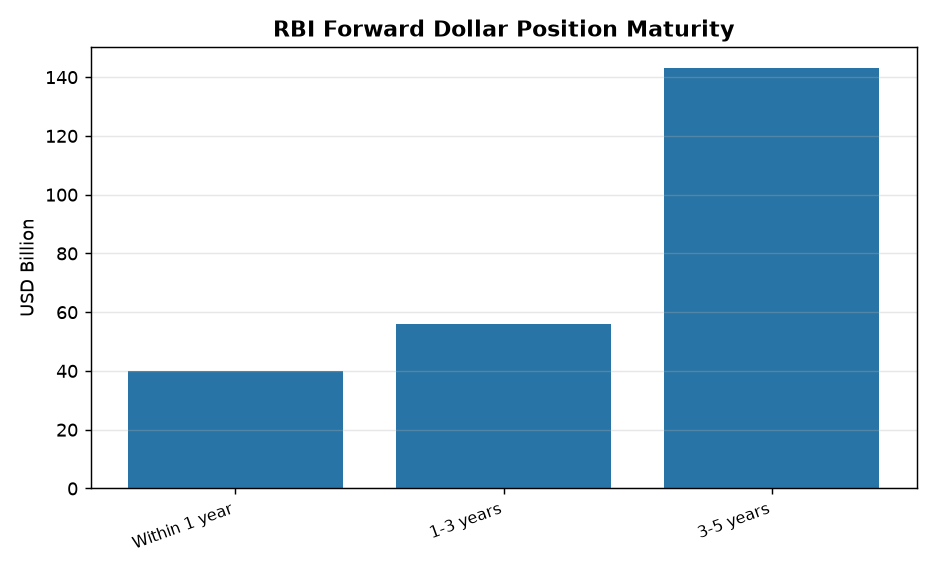
| Maturing Forward Positions | A significant portion of the short position matures within one to five years, with longer-duration positions linked to the FCNR (B) scheme, indicating future dollar demand. |
| Impact on Spot Market Operations | The substantial forward position constrains the RBI’s capacity to sell dollars in the spot market due to limitations in sterilising such sales through additional buy-sell swaps. |
| Balance of Payments (BoP) Dynamics | Despite a reported BoP surplus, an underlying deficit would exist without the RBI’s swap windows, highlighting the reliance on these mechanisms for external balance management. |
| Unencumbered Foreign Exchange Reserves | A decline in unencumbered reserves, which exclude the forward book, indicates a reduced import cover, raising concerns about external vulnerability. |
Why it Matters
Economic Stability
- The RBI’s forward market operations are crucial for managing exchange rate volatility and maintaining external sector stability, which are vital for investor confidence and economic growth.
- Effective management of the forward book helps in mitigating the impact of global economic fluctuations on the domestic economy, ensuring a predictable business environment.
Monetary Policy Implications
- The need to accumulate dollars to meet forward commitments influences the RBI’s liquidity management operations, potentially affecting domestic interest rates and credit conditions.
- The central bank’s capacity to intervene in the spot market is linked to its forward book, which impacts its ability to conduct independent monetary policy aimed at price stability.
External Sector Management
- The forward dollar position and its maturity profile are key indicators of India’s external vulnerability and the sustainability of its balance of payments.
- The reliance on swap windows for attracting capital inflows underscores the importance of these unconventional tools in bolstering foreign exchange reserves and managing external financing needs.
Challenges
1. Exchange Rate Management
- Limiting rupee appreciation despite FPI inflows can be challenging, as it requires careful calibration of intervention strategies to balance competitiveness and inflation concerns.
- The large forward book restricts the RBI’s flexibility in managing the spot exchange rate, potentially leading to unintended consequences for trade and capital flows.
UPSC Link: Indian Economy and issues relating to planning, mobilization of resources, growth, development and employment.
2. Foreign Exchange Reserve Adequacy
- The decline in unencumbered foreign exchange reserves, when excluding the forward book, raises concerns about the adequacy of import cover and the country’s ability to withstand external shocks.
- Managing the forward book while ensuring sufficient spot reserves for unforeseen contingencies is a delicate balancing act for the central bank.
UPSC Link: Government Budgeting.
3. Capital Flow Volatility
- Sustained competition for global capital and elevated US Treasury yields can lead to volatile FPI inflows, complicating the RBI’s task of managing the exchange rate and external balances.
- The need to absorb capital inflows to meet forward commitments can exacerbate the challenges associated with managing large and often unpredictable capital movements.
UPSC Link: Effects of liberalization on the economy, changes in industrial policy and their effects on industrial growth.
4. Monetary Policy Autonomy
- The extensive use of forward contracts and swap windows can intertwine exchange rate management with monetary policy, potentially limiting the RBI’s autonomy in pursuing domestic objectives.
- Sterilisation operations associated with forward market interventions can have implications for domestic liquidity and interest rates, affecting the transmission of monetary policy.
UPSC Link: Indian Economy and issues relating to planning, mobilization of resources, growth, development and employment.
Challenges — UPSC Perspective
| Issue | Concern |
|---|---|
| RBI’s Net Short Forward Dollar Position | Limits rupee appreciation despite FPI inflows, potentially affecting export competitiveness and import costs. |
| Maturity Profile of Forward Book | Large dollar commitments maturing over the next few years necessitate significant dollar accumulation, influencing future exchange rate dynamics. |
| Constrained Spot Market Intervention | Reduced ability of RBI to sell dollars in the spot market due to limited sterilisation capacity, impacting exchange rate stability. |
| Underlying Balance of Payments Deficit | Reliance on swap windows to achieve BoP surplus indicates structural vulnerabilities in external financing without these mechanisms. |
| Declining Unencumbered Foreign Exchange Reserves | Reduced import cover raises concerns about external sector resilience and vulnerability to global shocks. |
Government Initiatives — Must-Memorise for Prelims
- FCNR (B) scheme
Way Forward
- Gradually reduce the net short forward dollar position to enhance flexibility in exchange rate management and reduce future dollar commitments.
- Strengthen underlying external sector fundamentals to reduce reliance on temporary swap windows for balance of payments stability.
- Diversify sources of foreign exchange inflows beyond FPIs to mitigate risks associated with capital flow volatility.
- Enhance transparency and communication regarding forward market operations to manage market expectations and improve policy credibility.
- Develop robust domestic financial markets to absorb capital inflows more efficiently, reducing the need for extensive central bank intervention.
- Continuously monitor global economic developments and adjust intervention strategies to respond effectively to external shocks.
- Prioritise policies that boost export competitiveness and reduce import dependence to achieve a more sustainable current account balance.
UPSC Value Addition
Keywords for Mains Answer-Writing
Reserve Bank of India (RBI) · Forward dollar position · Rupee appreciation · Foreign Portfolio Investment (FPI) · Balance of Payments (BoP) · Foreign Exchange Reserves · Monetary policy tools · Exchange rate management · Capital inflows · Sterilisation operations · External sector vulnerability · FCNR (B) scheme
Concept Flow
RBI maintains a net short forward dollar position. → This position commits RBI to provide dollars upon swap maturity. → RBI needs to accumulate dollars as capital inflows improve. → Dollar accumulation by RBI limits rupee appreciation. → Constrains RBI’s ability to sell dollars in the spot market. → Impacts exchange rate stability and external sector management.
Prelims Practice Questions
Q1. Consider the following statements regarding the Reserve Bank of India’s (RBI) forward dollar position:
1. A net short position in the forward market implies the RBI’s commitment to provide dollars at a future date.
2. A large negative forward book can limit the central bank’s ability to sell dollars in the spot market.
3. The FCNR (B) scheme is often linked to longer-duration forward positions.
How many of the above statements are correct?
- Only one
- Only two
- Only three
- None
Answer: Only three — Statement 1 is correct: A net short forward position means the RBI has committed to sell dollars in the future. Statement 2 is correct: A large negative forward book implies future dollar commitments, constraining the RBI’s capacity to sell dollars in the spot market without creating further commitments or impacting reserves. Statement 3 is correct: The FCNR (B) scheme, which attracts foreign currency deposits, often involves longer-term swaps, contributing to longer-duration forward positions.
Q2. Which of the following measures are typically employed by the Reserve Bank of India (RBI) to manage the exchange rate and external sector stability?
1. Intervention in the spot foreign exchange market.
2. Utilisation of forward currency contracts.
3. Adjusting interest rates through monetary policy.
4. Implementing swap windows for specific capital inflows.
Select the correct answer using the code given below:
- 1 and 2 only
- 2, 3 and 4 only
- 1, 3 and 4 only
- 1, 2, 3 and 4
Answer: 1, 2, 3 and 4 — All four statements describe tools or measures used by the RBI for exchange rate management and external sector stability. Spot market intervention directly influences demand/supply. Forward contracts manage future currency flows. Interest rate adjustments can influence capital flows. Swap windows, like FCNR (B) swaps, are specific mechanisms to attract or manage foreign currency inflows.
Mains Practice Question
✍ Critically examine the implications of a substantial net short forward dollar position maintained by the Reserve Bank of India on rupee appreciation and overall external sector management. Discuss the challenges and strategies associated with unwinding such positions. (15 Marks)
Approach: INTRODUCTION: Define RBI’s forward dollar position and its purpose (e.g., managing capital flows, sterilising interventions). State the current context of a large net short position.
IMPLICATIONS ON RUPEE APPRECIATION:
* LIMITING APPRECIATION: Explain how a large net short forward book necessitates future dollar accumulation by RBI, absorbing capital inflows and preventing significant rupee appreciation.
* SPOT MARKET CONSTRAINTS: Discuss how it limits the RBI’s flexibility to sell dollars in the spot market due to constrained sterilisation capacity.
IMPLICATIONS ON EXTERNAL SECTOR MANAGEMENT:
* FOREIGN EXCHANGE RESERVES: Impact on unencumbered reserves and import cover, as future commitments are not part of headline reserves.
* BALANCE OF PAYMENTS (BoP): How swap windows (e.g., FCNR (B)) can mask underlying deficits by attracting borrowed dollars, creating future repayment obligations.
* MONETARY POLICY AUTONOMY: Potential constraints on independent monetary policy due to the need to manage exchange rate stability.
CHALLENGES IN UNWINDING:
* MARKET DISTORTIONS: Risk of market volatility if unwinding is abrupt.
* TIMING AND SCALE: Difficulty in timing the unwinding to minimise market impact.
* CAPITAL FLOW DYNAMICS: Dependence on sustained capital inflows to facilitate gradual reduction.
STRATEGIES FOR UNWINDING:
* GRADUAL REDUCTION: Emphasise a phased approach to minimise market disruption.
* DIVERSIFICATION OF TOOLS: Utilising a mix of spot intervention, forward market operations, and other macro-prudential measures.
* MACROECONOMIC STABILITY: Maintaining a stable macroeconomic environment to attract genuine, long-term capital inflows.
* POLICY COMMUNICATION: Clear communication with market participants to manage expectations.
CONCLUSION: Summarise the delicate balance RBI must strike between exchange rate stability, reserve management, and facilitating capital flows, especially in a volatile global economic landscape.
Source: orissapost.com
Generated by AanyaAi for educational purpose.
Related guides on our sites
- Best PSIR optional coaching for upsc
- Best economics optional coaching for upsc
- Best PSIR optional teacher for upsc
- Best teacher of PSIR optional for upsc

- RBI’s Forward Dollar Position & Rupee Appreciation - November 9, 2026
- INDIAN NAVY TO CONDUCT PASSING OUT PARADE OF LARGEST BATCH OF AGNIVEERS AT INS CHILKA - November 9, 2026
- Theatre Commands: Government’s Role in Resolving Tri-Service Debate - November 9, 2026

No Comments