


09 Nov 8th Pay Commission: One Year On, Salary Hike & Fitment Factor Update
✎ Central Pay Commissions are constituted by the Government of India to recommend revisions to the salary, allowances, and pension structure for central government employees, with their recommendations subject to government…
Subject Relevance — Where This Topic Fits
- GS Paper II — Governance, Constitution, Polity, Social Justice and International Relations | GS Paper III — Economy, Science and Technology, Environment, Security and Disaster Management
- Prelims: Central Pay Commission, Fitment Factor, Salary Hike, Dearness Allowance (DA), House Rent Allowance (HRA), Travel Allowance (TA), Union Cabinet, Government Employees, Fiscal Policy, Inflation
- Essay: The role of public administration in national development., Fiscal prudence and employee welfare: Striking a balance in public finance.
Quick Revision: Central Pay Commissions are constituted by the Government of India to recommend revisions to the salary, allowances, and pension structure for central government employees, with their recommendations subject to government approval and having significant fiscal implications.
Why is this in the news?
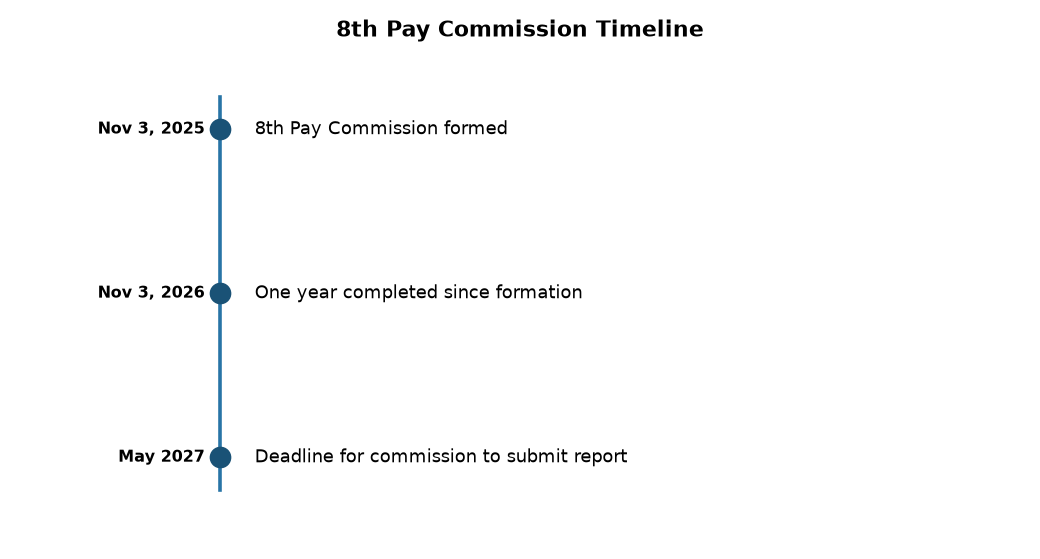
The Eighth Central Pay Commission (8th CPC) was constituted by the Union Government on November 3, 2025, and has completed one year of its mandated 18-month period for submitting recommendations. Central government employees are awaiting clarity regarding the revised salary structure, potential salary hikes, and the implementation timeline, including the effective date and the disbursement of arrears, as discussions within the commission are ongoing regarding various demands, including an increase in the fitment factor.
Background
- Pay Commissions are constituted by the Government of India to review and recommend changes to the salary structure, allowances, and pension benefits for central government employees and pensioners.
- These commissions are typically formed every ten years, with their recommendations having significant fiscal implications for the national exchequer.
- The recommendations of a Pay Commission are not automatically implemented; they undergo scrutiny by the government, which then decides whether to accept them fully, with modifications, or reject certain aspects.
- The implementation of revised pay scales usually involves an effective date, often retrospective, followed by a period for government approval and subsequent disbursement of arrears.
- The ‘fitment factor’ is a crucial component in salary revision, used to multiply the basic pay in the previous pay matrix to arrive at the new basic pay, ensuring a uniform increase across all pay levels.
- The Seventh Pay Commission, for instance, recommended a fitment factor of 2.57, leading to an average salary hike of approximately 23-25% for central government employees.
What is a Central Pay Commission?
- A Central Pay Commission is an administrative body established by the Government of India, typically under the Ministry of Finance, to examine and recommend revisions to the remuneration structure of central government employees.
- Its primary mandate includes reviewing the existing pay scales, allowances, and other benefits, and proposing a new structure that is fair, equitable, and competitive, taking into account economic conditions, inflation, and the cost of living.
- The commission’s recommendations cover various aspects such as basic pay, dearness allowance (DA), house rent allowance (HRA), travel allowance (TA), and pension benefits for retired employees.
- The formation of a Pay Commission is a significant event, as its recommendations impact millions of central government employees and pensioners, influencing their financial well-being and the government’s fiscal policy.
- The commission conducts extensive consultations with various stakeholders, including employee associations, government departments, and economic experts, to gather inputs and perspectives.
- Upon submission, the commission’s report is deliberated by the Union Cabinet, which then makes a final decision on the implementation of the recommendations, often with modifications.
- The implementation of a new pay commission’s recommendations typically involves a substantial financial outlay from the government, impacting budgetary allocations and potentially influencing macroeconomic indicators.
Key Features
| Feature | Significance |
|---|---|
| 8th Pay Commission Formation | Mandated review of central government employees’ emoluments, allowances, and pension structure. |
| 18-month Reporting Deadline | Establishes a timeframe for the Commission to submit its recommendations, ensuring a structured process. |
| Fitment Factor | A crucial multiplier applied to basic pay to determine revised salaries, reflecting the overall pay hike. |
| Effective Date vs. Implementation Date | Highlights the distinction between the date from which revised pay is applicable and when it is actually disbursed. |
| Government Scrutiny | Emphasises the executive’s role in reviewing and approving the Commission’s recommendations, potentially with modifications. |
Why it Matters
Economic Implications
- Significant impact on government expenditure, as revised salaries and pensions constitute a substantial portion of the Union Budget.
- Potential for increased consumer demand and economic activity due to enhanced disposable income among central government employees.
- Inflationary pressures could arise if the pay hike is substantial and not matched by productivity gains, affecting overall price stability.
Administrative Governance
- Aims to maintain a competitive and fair compensation structure for central government employees, crucial for attracting and retaining talent.
- Addresses disparities and anomalies in pay scales across various government departments and cadres, promoting equity.
- Enhances employee morale and motivation, which can positively influence public service delivery and administrative efficiency.
Social Impact
- Affects a large segment of the population, including serving employees and pensioners, influencing their economic well-being.
- Sets a benchmark for state government pay revisions, often leading to similar demands and adjustments at the state level.
- Contributes to social stability by addressing economic grievances of a significant workforce segment.
Challenges
1. Fiscal Burden
- Implementing pay commission recommendations often entails a substantial increase in government expenditure, potentially impacting fiscal deficit targets.
- Balancing the need for employee welfare with fiscal prudence is a persistent challenge for the government.
UPSC Link: Government Budgeting, Fiscal Policy
2. Inflationary Pressures
- Large-scale pay revisions can inject significant liquidity into the economy, potentially leading to increased demand-pull inflation.
- Managing the macroeconomic impact of such revisions requires careful monetary and fiscal policy coordination.
UPSC Link: Inflation, Monetary Policy
3. Expectation Management
- Managing the expectations of central government employees regarding the quantum and timing of pay hikes is crucial to avoid discontent.
- Delays in implementation or perceived inadequacy of revisions can lead to industrial relations challenges.
UPSC Link: Industrial Relations, Public Administration
4. Timely Implementation
- Ensuring the timely submission of the commission’s report and subsequent government approval is critical for effective planning and employee satisfaction.
- Procedural delays can lead to uncertainty and accumulation of arrears, complicating financial management.
UPSC Link: Public Policy Implementation
Challenges — UPSC Perspective
| Issue | Concern |
|---|---|
| Delay in Report Submission | Prolongs uncertainty for employees and pensioners regarding revised emoluments. |
| Fitment Factor Determination | A critical component influencing the overall pay hike, subject to extensive deliberation and negotiation. |
| Arrears Management | Potential for significant financial outlay for the government if revisions are implemented retrospectively. |
| Impact on State Finances | State governments often follow central pay commission recommendations, leading to similar fiscal pressures at the state level. |
| Balancing Demands and Fiscal Prudence | Reconciling employee demands for higher pay with the government’s capacity to bear the financial burden. |
Way Forward
- Expeditious completion of the 8th Pay Commission’s deliberations and submission of its report within the stipulated timeframe.
- Transparent communication from the government regarding the progress and expected timelines for pay revision.
- Careful consideration of the fiscal implications of the recommendations, ensuring sustainability of public finances.
- Adoption of a balanced approach to fitment factor determination, considering both employee welfare and economic realities.
- Streamlined process for government review and approval of the commission’s recommendations to minimise implementation delays.
- Exploration of performance-linked incentives as part of the revised pay structure to enhance productivity.
- Regular review mechanisms for pay and allowances to avoid large, infrequent revisions and ensure continuous adjustments to economic conditions.
UPSC Value Addition
Keywords for Mains Answer-Writing
Central Pay Commission · Government Salary Revision · Fitment Factor · Public Finance Management · Fiscal Implications · Employee Welfare Policy · Inflationary Pressures · Economic Impact of Wage Hikes · Administrative Reforms · Expenditure Management Commission
Constitutional & Policy Linkages
- {‘Article 112’: ‘Annual Financial Statement (Union Budget)’}
- {‘Article 282’: ‘Discretionary grants by the Union’}
- {‘Article 309’: ‘Recruitment and conditions of service’}
- {‘Article 310’: ‘Tenure of office of persons serving the Union’}
Concept Flow
Central Government constitutes Pay Commission → Commission deliberates on pay, allowances, pensions → Commission submits recommendations to government → Government reviews and approves recommendations → Revised pay structure implemented, arrears paid → Impact on government expenditure and economy
Prelims Practice Questions
Q1. Consider the following statements regarding Central Pay Commissions in India:
1. A Central Pay Commission is a statutory body constituted under an Act of Parliament.
2. The recommendations of a Pay Commission are binding on the Central Government.
3. The primary objective of a Pay Commission is to review and recommend changes to the salary structure, allowances, and pension of Central Government employees.
How many of the above statements are correct?
- Only one
- Only two
- Only three
- None
Answer: Only one — Statement 1 is incorrect: Central Pay Commissions are executive bodies constituted by the Union Cabinet, not statutory bodies under an Act of Parliament. Statement 2 is incorrect: The recommendations of a Pay Commission are advisory in nature and not binding on the Central Government, which may accept, reject, or modify them. Statement 3 is correct: The primary objective is indeed to review and recommend changes to the emoluments and service conditions of Central Government employees and pensioners.
Q2. Which of the following factors are typically considered by a Central Pay Commission while formulating its recommendations?
1. Prevailing economic conditions and fiscal capacity of the government.
2. Principles of social justice and equity.
3. Comparability of remuneration with the private sector.
4. Impact on inflation and overall economic stability.
Select the correct answer using the code given below:
- 1 and 2 only
- 2, 3 and 4 only
- 1, 3 and 4 only
- 1, 2, 3 and 4
Answer: 1, 2, 3 and 4 — All the listed factors are typically considered by a Central Pay Commission. They include the government’s financial health, ensuring fair compensation, benchmarking with other sectors, and assessing the broader economic implications of wage revisions, particularly concerning inflation.
Mains Practice Question
✍ Examine the role and significance of Central Pay Commissions in India’s public administration and fiscal policy. Discuss the challenges associated with implementing their recommendations, particularly concerning fiscal sustainability and economic impact. (15 Marks)
Approach: Introduction: Briefly define Central Pay Commissions (CPCs) and their constitutional/executive basis. Role and Significance: Detail their function in revising emoluments, allowances, and pensions for Central Government employees; their contribution to employee morale and efficiency; their role in standardizing pay structures across government departments; and their indirect impact on state government pay scales. Challenges in Implementation: Discuss fiscal burden on the exchequer (e.g., increased revenue expenditure, potential for fiscal deficit); inflationary pressures from increased disposable income; administrative complexities in implementation; demands from various employee associations; and the challenge of balancing employee welfare with economic realities. Conclusion: Summarize the dual role of CPCs in ensuring fair compensation while necessitating prudent fiscal management.
Source: aajtak.in
Generated by AanyaAi for educational purpose.
Related guides on our sites
- Current affairs for upsc 2026
- Best PSIR optional coaching for upsc
- Best PSIR optional teacher for upsc
- Best teacher of PSIR optional for upsc

- 8th Pay Commission: One Year On, Salary Hike & Fitment Factor Update - November 9, 2026
- तमिलनाडु में शराब की बोतल वापसी योजना पर क्लबों की चुनौती - November 9, 2026
- RBI’s Forward Dollar Position & Rupee Appreciation - November 9, 2026

No Comments