


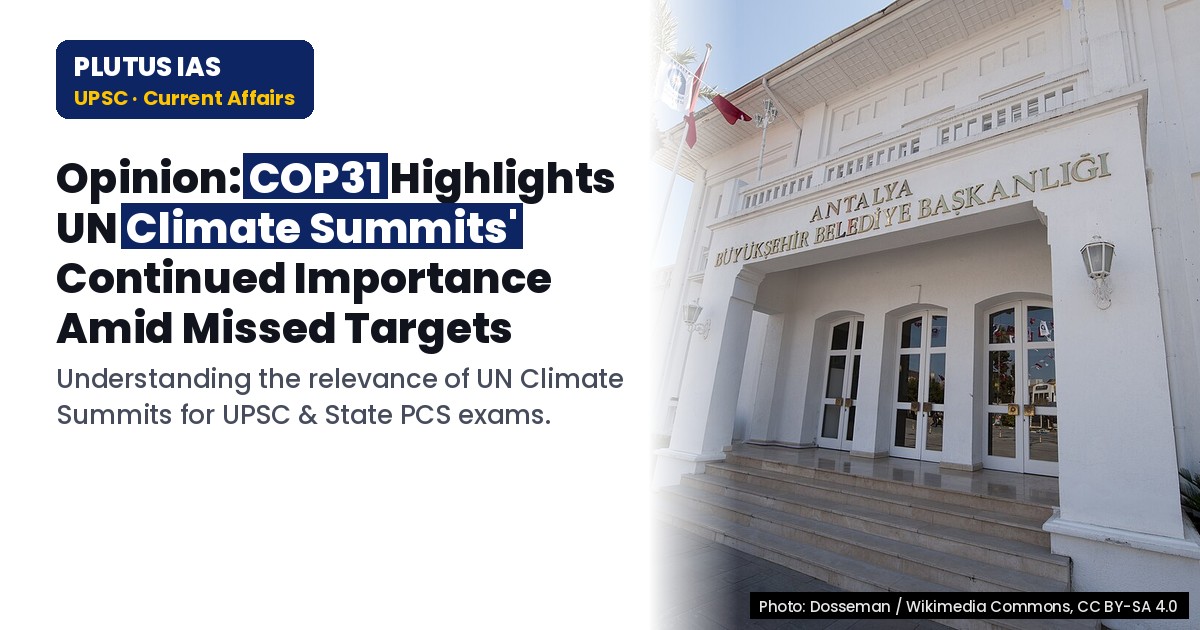
10 Nov COP31: Relevance of UN Climate Summits Amid Missed Targets
✎ UN Climate Change Conferences (COPs) are the annual decision-making bodies of the UNFCCC, crucial for global climate governance, setting targets like the 1.5°C limit, and driving international cooperation despite challenges in…
Subject Relevance — Where This Topic Fits
- GS Paper I — Geography (Environmental Geography) | GS Paper II — International Relations (International Institutions and Groupings) | GS Paper III — Environment (Conservation, Environmental Pollution and Degradation, Environmental Impact Assessment)
- Prelims: COP31, UNFCCC, Paris Agreement, 1.5°C target, UNEP Emissions Gap Report, Nationally Determined Contributions (NDCs)
- Essay: The role of international cooperation in addressing global challenges like climate change., Balancing economic development with environmental sustainability: A global imperative.
Quick Revision: UN Climate Change Conferences (COPs) are the annual decision-making bodies of the UNFCCC, crucial for global climate governance, setting targets like the 1.5°C limit, and driving international cooperation despite challenges in achieving ambitious outcomes.
Why is this in the news?
The 31st session of the Conference of the Parties (COP31) to the United Nations Framework Convention on Climate Change (UNFCCC) is currently underway in Antalya, Turkey. This annual summit is taking place amidst reports from the United Nations Environment Programme (UNEP) indicating that the window to limit global warming to 1.5°C above pre-industrial levels has effectively closed, with projections now suggesting a rise of 1.7-1.8°C. Despite the diminished prospects for achieving the 1.5°C target, the conference remains crucial for sustaining global climate action and ensuring accountability, particularly from developed nations.
Background
- The United Nations Framework Convention on Climate Change (UNFCCC) was adopted in 1992 at the Rio Earth Summit, establishing an international environmental treaty to combat ‘dangerous human interference with the climate system’.
- The Conference of the Parties (COP) is the supreme decision-making body of the UNFCCC, comprising all states that are Parties to the Convention. It meets annually to review the Convention’s implementation.
- The Paris Agreement, adopted at COP21 in 2015, established a global framework to avoid dangerous climate change by limiting global warming to well below 2°C, preferably to 1.5°C, compared to pre-industrial levels.
- Nationally Determined Contributions (NDCs) are at the heart of the Paris Agreement, representing each country’s efforts to reduce national emissions and adapt to the impacts of climate change.
- The United Nations Environment Programme (UNEP) periodically releases ‘Emissions Gap Reports’ which assess the gap between projected greenhouse gas emissions and the levels required to meet the Paris Agreement targets.
- The principle of ‘common but differentiated responsibilities and respective capabilities’ (CBDR–RC) underpins international climate negotiations, acknowledging that all countries have a shared responsibility to address climate change but their capacities and historical contributions to the problem differ.
What are UN Climate Change Conferences (COPs)?
- UN Climate Change Conferences, or COPs, are annual meetings held under the United Nations Framework Convention on Climate Change (UNFCCC).
- They serve as the formal meeting of the UNFCCC Parties to assess progress in dealing with climate change and to negotiate legally binding protocols and agreements.
- The primary objective of these conferences is to stabilize greenhouse gas concentrations in the atmosphere at a level that would prevent dangerous anthropogenic interference with the climate system.
- Key outcomes of past COPs include the Kyoto Protocol (COP3, 1997) and the Paris Agreement (COP21, 2015), which set global goals and frameworks for climate action.
- Decisions at COPs are made by consensus among all member countries, which can often lead to protracted negotiations and outcomes that reflect the lowest common denominator of ambition.
- Despite challenges in achieving ambitious targets, COPs play a crucial role in fostering international dialogue, promoting transparency, mobilising finance, and driving global decarbonisation efforts.
- These conferences also provide a platform for various stakeholders, including governments, civil society, businesses, and scientific communities, to engage in climate discussions and showcase solutions.
Key Features
| Feature | Significance |
|---|---|
| Annual United Nations Climate Change Conference (COP) | Primary global forum for multilateral climate negotiations under the UNFCCC framework. |
| Consensus-based decision making | Ensures broad participation and ownership of outcomes, but can lead to lowest common denominator agreements and slow progress. |
| 1.5°C Global Warming Target | Aspirational limit set by the Paris Agreement to prevent the most catastrophic impacts of climate change. |
| Decarbonisation and Energy Transition | Core objectives of global climate action, involving shifting away from fossil fuels to renewable energy sources. |
| Accountability of Developed Countries | A key principle in climate negotiations, emphasising historical responsibility and financial/technological support for developing nations. |
Why it Matters
Environmental Significance
- COPs serve as a crucial platform for assessing global progress towards climate goals, including the 1.5°C target, and highlighting the urgency of enhanced action.
- They facilitate the global discourse on decarbonisation and energy transition, driving the adoption of renewable energy technologies and climate-resilient practices worldwide.
- The ongoing negotiations, despite their limitations, are instrumental in preventing further backsliding on climate commitments and fostering incremental progress in reducing greenhouse gas emissions.
Diplomatic and Governance Significance
- COPs provide a unique forum for nearly all nations to engage in multilateral environmental diplomacy, fostering dialogue and cooperation on a shared global challenge.
- They are essential for maintaining the international framework for climate action, such as the Paris Agreement, and for developing the rules and mechanisms for its implementation.
- The conferences serve to hold developed countries accountable for their historical emissions and their commitments to provide climate finance and technology transfer to developing nations.
Policy and Action Significance
- Decisions made at COPs, even if incremental, guide national climate policies and strategies, influencing domestic legislation, investments, and sectoral transitions.
- The process encourages both state and non-state actors to undertake climate actions, contributing to a broader global movement towards sustainability.
- COPs facilitate the exchange of best practices and scientific knowledge, informing policy development and technological innovation in climate mitigation and adaptation.
Challenges
1. Failure to meet ambitious targets
- The global community is currently off-track to limit warming to 1.5°C above pre-industrial levels, with projections indicating a rise of 1.7-1.8°C.
- Years of inadequate climate action have rendered the 1.5°C target practically unattainable, despite its critical importance for planetary health.
UPSC Link: Environmental Pollution & Degradation
2. Gap between ambition and action
- There is a significant and widening disparity between the climate targets set in international agreements, such as the Paris Agreement, and the actual actions undertaken by individual nations.
- This gap is exacerbated by the absence of enforcement mechanisms to compel laggard nations to enhance their climate commitments and implementation.
UPSC Link: Conservation, Environmental Impact Assessment
3. Consensus-based decision-making limitations
- The requirement for consensus among nearly 200 nations often leads to outcomes that are the lowest common denominator, lacking the ambition needed to address the climate crisis effectively.
- This mechanism can be exploited by a few dissenting parties to obstruct more progressive climate policies and actions.
UPSC Link: International Institutions
4. Lack of breakthrough outcomes
- Recent COPs have largely produced low-ambition outcomes, focusing on incremental progress rather than transformative changes required to realign with critical climate targets.
- The conferences often struggle to generate new, impactful decisions that significantly accelerate decarbonisation and energy transition efforts.
UPSC Link: Environmental Pollution & Degradation
Challenges — UPSC Perspective
| Issue | Concern |
|---|---|
| 1.5°C Target Attainability | UNEP reports indicate the window for limiting global warming to 1.5°C has closed, with projections now at 1.7-1.8°C, signifying a failure of collective action. |
| Inadequate National Contributions | Individual countries’ Nationally Determined Contributions (NDCs) collectively fall short of the emissions reductions required to meet the Paris Agreement goals. |
| Slow Decarbonisation Progress | Despite growing awareness, the pace of global decarbonisation and transition to renewable energy sources remains insufficient to avert severe climate impacts. |
| Accountability and Enforcement | The absence of robust mechanisms to enforce climate commitments means nations can underperform without significant diplomatic or economic repercussions. |
| Climate Finance Mobilisation | Developed countries often fail to meet their commitments for climate finance, hindering developing nations’ ability to implement mitigation and adaptation measures. |
Way Forward
- Strengthen the ambition of Nationally Determined Contributions (NDCs) by encouraging countries to submit more aggressive emissions reduction targets aligned with scientific recommendations.
- Enhance mechanisms for transparency and accountability in reporting climate actions and finance flows, ensuring greater scrutiny of national commitments.
- Accelerate the global energy transition by significantly increasing investments in renewable energy infrastructure and phasing out fossil fuel subsidies.
- Develop innovative financial instruments and partnerships to mobilise greater climate finance, particularly for adaptation and loss and damage in vulnerable countries.
- Foster greater technological cooperation and transfer, enabling developing nations to access and deploy advanced climate mitigation and adaptation technologies.
- Promote multi-stakeholder engagement, involving sub-national governments, civil society, and the private sector, to drive comprehensive climate action.
- Integrate climate considerations into all sectoral policies, ensuring that development pathways are resilient and low-carbon.
UPSC Value Addition
Keywords for Mains Answer-Writing
UNFCCC · Conference of Parties (COP) · Paris Agreement · Nationally Determined Contributions (NDCs) · Climate Finance · Global Stocktake · Loss and Damage · Climate Action · Decarbonisation · Energy Transition · 1.5°C target · United Nations Environment Programme (UNEP)
Concept Flow
Rising Greenhouse Gas Emissions → Global Warming exceeding 1.5°C target → Increased frequency and intensity of extreme weather events → Pressure on International Climate Negotiations (COPs) → Calls for enhanced Decarbonisation and Energy Transition → Development and implementation of National Climate Policies
Prelims Practice Questions
Q1. Consider the following statements regarding the United Nations Climate Change Conferences (COPs):
1. COPs are annual meetings held under the framework of the United Nations Framework Convention on Climate Change (UNFCCC).
2. The Paris Agreement, which established global climate goals, was a significant outcome of a COP.
3. Decisions at COPs are typically made through a majority vote among member countries.
How many of the above statements are correct?
- Only one
- Only two
- Only three
- None
Answer: Only two — Statement 1 is correct: COPs are indeed annual meetings under the UNFCCC. Statement 2 is correct: The Paris Agreement was adopted at COP21 in 2015. Statement 3 is incorrect: Decisions at COPs are made through consensus, not majority vote.
Q2. Which of the following international bodies is responsible for releasing reports assessing the progress towards limiting global warming, as mentioned in the context of the 1.5°C target?
- Intergovernmental Panel on Climate Change (IPCC)
- United Nations Environment Programme (UNEP)
- World Meteorological Organization (WMO)
- International Energy Agency (IEA)
Answer: United Nations Environment Programme (UNEP) — The news article specifically mentions reports released by the United Nations Environment Programme (UNEP) this year regarding the 1.5°C target.
Mains Practice Question
✍ Despite their perceived shortcomings in achieving ambitious targets, United Nations Climate Change Conferences (COPs) remain vital for sustaining global climate action. Critically examine this statement, highlighting the enduring relevance of COPs and the challenges they face in fostering effective international cooperation. (15 Marks)
Approach: MODEL-ANSWER SKELETON:
1. **Introduction:** Briefly introduce COPs as annual meetings under UNFCCC and acknowledge the perceived gap between their outcomes and climate targets (e.g., 1.5°C goal).
2. **Enduring Relevance of COPs (Arguments for their vitality):**
* **Platform for Negotiation and Consensus Building:** Facilitate dialogue among diverse nations, leading to agreements like the Paris Agreement.
* **Setting Global Goals and Frameworks:** Establish overarching targets (e.g., 1.5°C, 2°C) and operational frameworks for climate action (e.g., NDCs).
* **Accountability and Transparency:** Provide a forum for countries to present their climate actions and for peer review, fostering a degree of accountability.
* **Mobilisation of Climate Finance:** Serve as a platform for discussions on financial mechanisms (e.g., Green Climate Fund, Loss and Damage Fund) and resource mobilisation from developed to developing nations.
* **Driving Decarbonisation and Energy Transition:** Despite slow progress, the COP process has catalysed global efforts towards renewable energy adoption and decarbonisation.
* **Engagement of Non-State Actors:** Provide a space for civil society, businesses, and indigenous communities to participate and influence climate policy.
* **Global Stocktake:** Mechanism for periodic assessment of collective progress towards Paris Agreement goals.
3. **Challenges Faced by COPs (Arguments for shortcomings):**
* **Consensus-Based Decision Making:** Can lead to lowest-common-denominator outcomes and slow progress due to veto power of individual nations.
* **Gap between Ambition and Action:** Persistent failure of NDCs to align with the 1.5°C or 2°C targets.
* **Climate Finance Deficit:** Inadequate and unfulfilled financial commitments from developed countries to support mitigation and adaptation in developing nations.
* **Lack of Enforcement Mechanism:** Absence of binding enforcement for non-compliance with commitments, leading to voluntary and often insufficient action.
* **Geopolitical Divides:** Tensions between developed and developing nations on historical responsibility, differentiated responsibilities, and equity.
* **Influence of Vested Interests:** Lobbying by fossil fuel industries and other powerful groups.
4. **Conclusion:** Summarise that while COPs face significant challenges and have not always delivered breakthroughs, they remain indispensable as the primary multilateral forum for global climate governance, providing a continuous impetus for action, even if incremental. Emphasise the need for enhanced ambition, equitable burden-sharing, and effective implementation mechanisms.
Source: The Indian Express
Generated by AanyaAi for educational purpose.
Related guides on our sites
- Anthropology VS PSIR
- Best PSIR optional coaching
- Best PSIR optional coaching online
- Best geography optional coaching

- COP31: Relevance of UN Climate Summits Amid Missed Targets - November 10, 2026
- गूगल की स्कूलों के लिए विवादित सर्च और एआई नीति: एक विश्लेषण - November 10, 2026
- Delhi’s Post-Diwali Pollution: ICCC’s War Room Efforts - November 10, 2026

No Comments