


11 Nov Elephants Return to Bandhavgarh: UPSC Environment Update
✎ The re-establishment of a wild elephant population in Bandhavgarh Tiger Reserve after a century highlights successful habitat restoration and the critical need for integrated human-wildlife conflict management strategies.
Subject Relevance — Where This Topic Fits
- GS Paper III — Environment, Ecology, Biodiversity, Wildlife Protection
- Prelims: Bandhavgarh Tiger Reserve, Elephant corridors, Human-wildlife conflict, Project Elephant, Wildlife Protection Act, 1972, Radio-collaring
- Essay: Balancing conservation imperatives with human developmental needs, The role of ecological restoration in biodiversity enhancement
Quick Revision: The re-establishment of a wild elephant population in Bandhavgarh Tiger Reserve after a century highlights successful habitat restoration and the critical need for integrated human-wildlife conflict management strategies.
Why is this in the news?
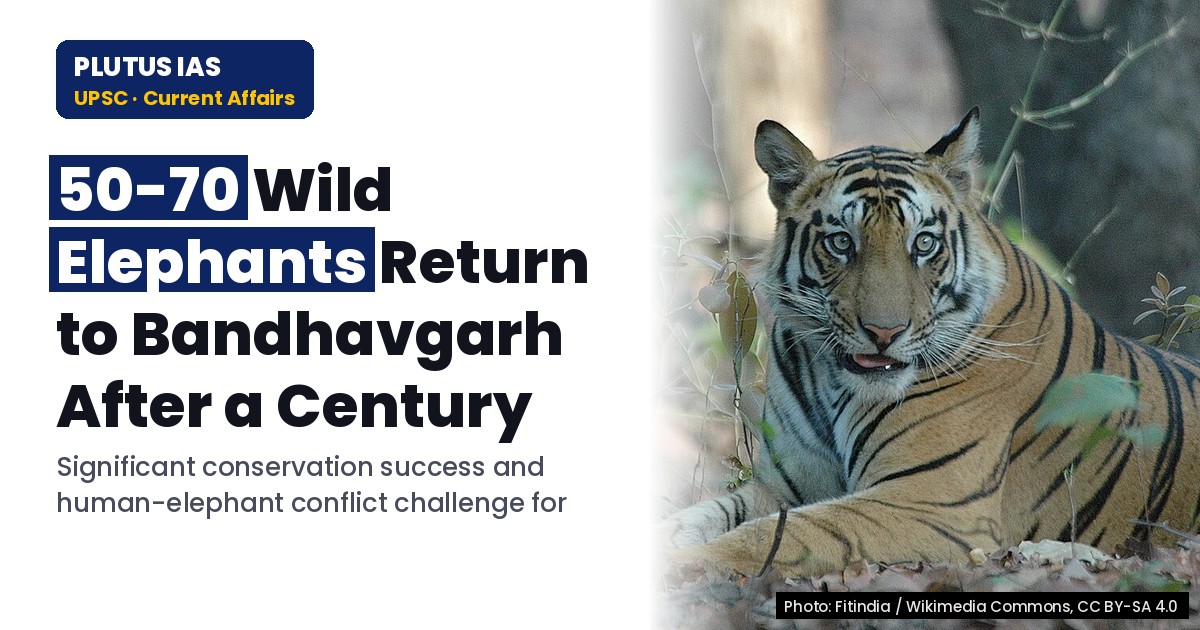
The Bandhavgarh Tiger Reserve in Madhya Pradesh has witnessed a significant and sustained return of wild elephants after approximately a century. Originating from Chhattisgarh in 2018, a herd of 30-35 elephants has now expanded to an estimated 50-70 individuals, establishing a permanent presence in the region. This ecological development signifies a restoration of historical wildlife patterns in Central India, simultaneously necessitating enhanced conservation strategies to mitigate potential human-elephant conflict.
Background
- Historically, elephants were prevalent across Central India, with historical records indicating their presence in regions like Malwa, Bundelkhand, and Baghelkhand.
- The permanent wild elephant population in Madhya Pradesh reportedly vanished around the 1920s, primarily due to habitat loss, agricultural expansion, hunting, and capture activities.
- The initial herd’s arrival in Bandhavgarh in 2018 was through the Shahdol forest landscape, traversing buffer zones and settling in areas offering adequate water and vegetation.
- The current elephant population is observed not only within Bandhavgarh but also in adjacent areas such as Sanjay-Dubri Tiger Reserve and near the Ban Sagar dam backwaters.
- The resurgence of elephants in Bandhavgarh underscores the dynamic nature of wildlife distribution and the potential for species re-establishment in suitable habitats.
- The increased elephant presence has heightened the imperative for robust human-elephant conflict mitigation measures, which the Forest Department is addressing through various scientific and community-based initiatives.
Elephant Conservation in India
- Elephants are classified under Schedule I of the Wildlife Protection Act, 1972, affording them the highest level of legal protection.
- India is home to the largest population of Asian elephants (Elephas maximus), which are listed as ‘Endangered’ on the IUCN Red List.
- Project Elephant, launched in 1992, is a centrally sponsored scheme aimed at protecting elephants, their habitats, and corridors, and addressing human-elephant conflict.
- Key objectives of Project Elephant include the ecological restoration of elephant habitats, mitigation of human-elephant conflict, and the welfare of captive elephants.
- Elephant corridors are crucial linear habitats that allow elephants to move between larger habitat patches, facilitating genetic exchange and reducing isolation.
- Human-elephant conflict arises from habitat fragmentation, encroachment on elephant corridors, and increasing proximity of human settlements to forest areas.
- Conservation strategies involve habitat improvement, community participation, awareness campaigns, early warning systems, and the use of technology like radio-collaring and mobile applications.
- The ‘Gaj Yatra’ campaign, initiated by the Wildlife Trust of India, aims to raise public awareness about elephant corridors and the importance of their conservation.
Key Features
| Feature | Significance |
|---|---|
| Elephant Return to Bandhavgarh | Re-establishment of a major megafauna species in a region where it was absent for approximately a century, indicating ecological recovery. |
| Increased Elephant Population | The presence of 50-70 elephants signifies a viable and growing population, suggesting suitable habitat conditions and potential for long-term survival. |
| Expansion of Habitat | Elephants are now observed in Bandhavgarh, Sanjay-Dubri Tiger Reserve, and near Ban Sagar backwater, indicating a broader ecological footprint and potential corridor usage. |
| Historical Context | The return echoes historical accounts of elephants in Central India, including regions like Malwa, Bundelkhand, and Baghelkhand, as documented by Mughal historians. |
| Biodiversity Enhancement | The addition of elephants diversifies the ecosystem, potentially influencing vegetation structure and contributing to seed dispersal, thereby enriching biodiversity. |
| Human-Elephant Conflict Mitigation | Implementation of measures like radio collars, Gajrakshak app, and Hathi Mitra Dal highlights proactive management strategies to address potential conflicts. |
Why it Matters
Ecological Significance
- The re-establishment of elephants as a keystone species can significantly alter the forest ecosystem, influencing vegetation patterns through grazing and browsing, and aiding in seed dispersal, thereby promoting forest regeneration.
- Their return signifies the improving health and connectivity of forest habitats in Central India, potentially indicating successful conservation efforts for other species as well.
- The presence of a large herbivore like the elephant contributes to the overall trophic structure and ecological balance of the protected area, enhancing its biodiversity.
Conservation Significance
- This event underscores the potential for natural range expansion and recolonisation by wildlife, even after prolonged absence, given suitable conditions and connectivity.
- It highlights the importance of trans-boundary conservation efforts, as the elephants migrated from Chhattisgarh, necessitating regional cooperation in wildlife management.
- The successful establishment of a new elephant population in a tiger reserve presents a unique opportunity for studying inter-species dynamics and developing integrated conservation strategies for co-occurring megafauna.
Socio-Economic Significance
- The presence of elephants can enhance the ecotourism potential of Bandhavgarh, attracting more visitors and generating revenue for local communities and conservation initiatives.
- Increased human-elephant interactions necessitate community engagement and awareness programs to foster coexistence and mitigate potential conflicts, thereby promoting sustainable livelihoods.
- The development of mitigation strategies like ‘Hathi Mitra Dal’ (Elephant Friends Group) empowers local communities to participate in conservation and conflict resolution, fostering a sense of ownership.
Challenges
1. Human-Elephant Conflict (HEC)
- The expansion of elephant habitats into areas adjacent to human settlements increases the likelihood of crop raiding, property damage, and potential loss of human lives.
- Managing HEC requires continuous monitoring, early warning systems, and effective response mechanisms to prevent escalation and ensure the safety of both humans and elephants.
UPSC Link: Environment: Conservation, environmental pollution and degradation
2. Habitat Fragmentation and Degradation
- Despite the return, ongoing pressures from deforestation, agricultural expansion, and infrastructure development can fragment elephant corridors and degrade their habitat quality, impacting long-term viability.
- Maintaining and restoring connectivity between protected areas is crucial for genetic exchange and the natural dispersal of elephant populations.
UPSC Link: Environment: Conservation, environmental pollution and degradation
3. Resource Competition
- As elephant numbers increase, competition for resources such as water and fodder within the reserve may intensify, potentially affecting other herbivores and the overall ecological balance.
- Sustainable management plans are required to ensure adequate resource availability for all species within the ecosystem.
UPSC Link: Environment: Conservation, environmental pollution and degradation
4. Disease Transmission
- Increased proximity between wild elephants, livestock, and humans can elevate the risk of disease transmission, posing threats to both wildlife and human health.
- Veterinary surveillance and health monitoring programs are essential to detect and manage potential disease outbreaks.
UPSC Link: Environment: Conservation, environmental pollution and degradation
5. Capacity Building and Training
- Forest department personnel and local communities require specialized training in elephant behavior, conflict mitigation techniques, and the use of technology for monitoring and management.
- Developing local expertise is critical for the effective long-term management of elephant populations.
UPSC Link: Environment: Conservation, environmental pollution and degradation
Challenges — UPSC Perspective
| Issue | Concern |
|---|---|
| Crop Raiding | Elephants foraging in agricultural fields lead to significant economic losses for farmers, exacerbating human-wildlife conflict. |
| Habitat Connectivity | Ensuring safe passage for elephants between fragmented forest patches is vital for genetic diversity and population viability, often hindered by human infrastructure. |
| Community Acceptance | Local communities, especially those affected by conflict, may develop negative perceptions towards elephants, complicating conservation efforts. |
| Resource Management | Balancing the needs of a growing elephant population with other wildlife and local communities for water and fodder resources within the protected area. |
| Illegal Activities | Poaching for ivory, though less prevalent in Central India, remains a potential threat, alongside other illegal activities like timber extraction that degrade habitat. |
| Climate Change Impacts | Changes in rainfall patterns and temperatures can affect water availability and vegetation, impacting elephant foraging and migration patterns. |
Way Forward
- Strengthen inter-state cooperation between Madhya Pradesh and Chhattisgarh for coordinated elephant conservation and management, including trans-boundary movement protocols.
- Implement and scale up early warning systems, such as radio collaring and ‘Gajrakshak’ app, to track elephant movements and alert communities in real-time, minimizing human-elephant conflict.
- Develop and maintain robust elephant corridors through land acquisition, habitat restoration, and community engagement to ensure safe passage and genetic exchange.
- Enhance community participation through ‘Hathi Mitra Dal’ and other local initiatives, providing training and incentives for conflict mitigation and coexistence.
- Promote sustainable land use practices in buffer zones and fringe villages to reduce dependency on forest resources and minimize agricultural encroachment.
- Invest in research and monitoring to understand elephant ecology, population dynamics, and habitat use patterns for adaptive management strategies.
- Integrate elephant conservation into broader landscape-level planning, considering the needs of other wildlife and local communities for a holistic approach.
- Explore innovative financing mechanisms and public-private partnerships to support long-term elephant conservation efforts and mitigate human-elephant conflict.
UPSC Value Addition
Keywords for Mains Answer-Writing
Human-Wildlife Conflict · Elephant Conservation · Bandhavgarh Tiger Reserve · Wildlife Protection Act 1972 · Project Elephant · Habitat Restoration · Ecosystem Management · Biodiversity Conservation · Radio Collaring · Community Participation
Constitutional & Policy Linkages
- {‘article’: ‘Article 48A’, ‘note’: ‘Protection and improvement of environment’}
- {‘article’: ‘Article 51A (g)’, ‘note’: ‘Duty to protect natural environment’}
Concept Flow
Historical elephant presence in Central India → Decline due to habitat loss and hunting → Re-colonisation from Chhattisgarh in 2018 → Establishment of stable population in Bandhavgarh → Increased human-elephant interaction and conflict → Implementation of mitigation strategies → Potential for long-term ecological restoration
Prelims Practice Questions
Q1. Consider the following statements regarding elephant conservation in India:
1. Project Elephant was launched in 1992 to provide financial and technical support to major elephant-bearing states.
2. The Asian Elephant is listed in Schedule I of the Wildlife Protection Act, 1972.
3. Elephant corridors are crucial for mitigating human-elephant conflict and facilitating genetic exchange.
How many of the above statements are correct?
- Only one
- Only two
- All three
- None
Answer: All three — Statement 1 is correct: Project Elephant was indeed launched in 1992. Statement 2 is correct: The Asian Elephant is listed in Schedule I of the Wildlife Protection Act, 1972, affording it the highest degree of protection. Statement 3 is correct: Elephant corridors are vital for connectivity and reducing conflict.
Q2. Which of the following protected areas is known for the recent return and establishment of a wild elephant population after approximately a century?
- Ranthambore National Park
- Bandhavgarh Tiger Reserve
- Jim Corbett National Park
- Sunderbans National Park
Answer: Bandhavgarh Tiger Reserve — The news report explicitly states the return of elephants to Bandhavgarh Tiger Reserve after a century, establishing a permanent presence.
Mains Practice Question
✍ The re-establishment of a wild elephant population in Bandhavgarh Tiger Reserve after a century highlights both ecological restoration and emerging challenges. Discuss the ecological significance of this phenomenon and critically examine the strategies required to mitigate human-elephant conflict in such evolving landscapes. (15 Marks)
Approach: MODEL-ANSWER SKELETON:
1. **Introduction:** Briefly mention the return of elephants to Bandhavgarh and its historical context (absence for a century).
2. **Ecological Significance:**
* **Keystone Species:** Explain the role of elephants as ‘ecosystem engineers’ (seed dispersal, forest regeneration, creation of waterholes).
* **Biodiversity Enhancement:** How their presence can enrich the overall biodiversity and health of the forest ecosystem.
* **Restoration of Historical Range:** Significance of re-establishing a species in its historical habitat, contributing to genetic diversity and resilience.
* **Indicator Species:** Their return as an indicator of improved habitat quality and connectivity.
3. **Challenges of Human-Elephant Conflict (HEC):**
* Crop raiding, property damage, human fatalities.
* Retaliatory killings of elephants.
* Impact on local livelihoods and community perception towards conservation.
4. **Mitigation Strategies (Critical Examination):**
* **Habitat Management:** Restoration and protection of elephant corridors (e.g., as per Project Elephant guidelines), ensuring water and fodder availability within protected areas to reduce outward movement.
* **Early Warning Systems:** Deployment of radio collars, Gaja Rakshak App, and other technological solutions for real-time tracking and alerting communities.
* **Community Engagement:** Formation of ‘Haathi Mitra Dal’ (Elephant Friends Groups), awareness campaigns, and involving local communities in monitoring and conflict resolution.
* **Crop Protection Measures:** Electric fences (solar-powered), bio-fences (chilli, beehives), trenches, and watchtowers.
* **Compensation Mechanisms:** Timely and adequate compensation for crop damage and loss of life/property.
* **Land Use Planning:** Regulating developmental activities in sensitive elephant habitats and corridors.
* **Capacity Building:** Training forest staff and local communities in HEC management.
5. **Conclusion:** Emphasize the need for an integrated, participatory, and science-based approach for harmonious coexistence, balancing conservation goals with socio-economic realities.
Source: amarujala.com
Generated by AanyaAi for educational purpose.
Related guides on our sites
- How to prepare for GS paper 1 for UPSC CSE mains exam
- Best UPSC coaching for IFOS exam
- Best geography optional coaching
- Best geography optional coaching

- Garh Ganga Mela: Yogi’s Directives for ‘Mini Kumbh’ - November 11, 2026
- दिल्ली में दिवाली प्रदूषण: पटाखों का 71%, वाहनों का 7% योगदान - November 11, 2026
- Elephants Return to Bandhavgarh: UPSC Environment Update - November 11, 2026

No Comments