


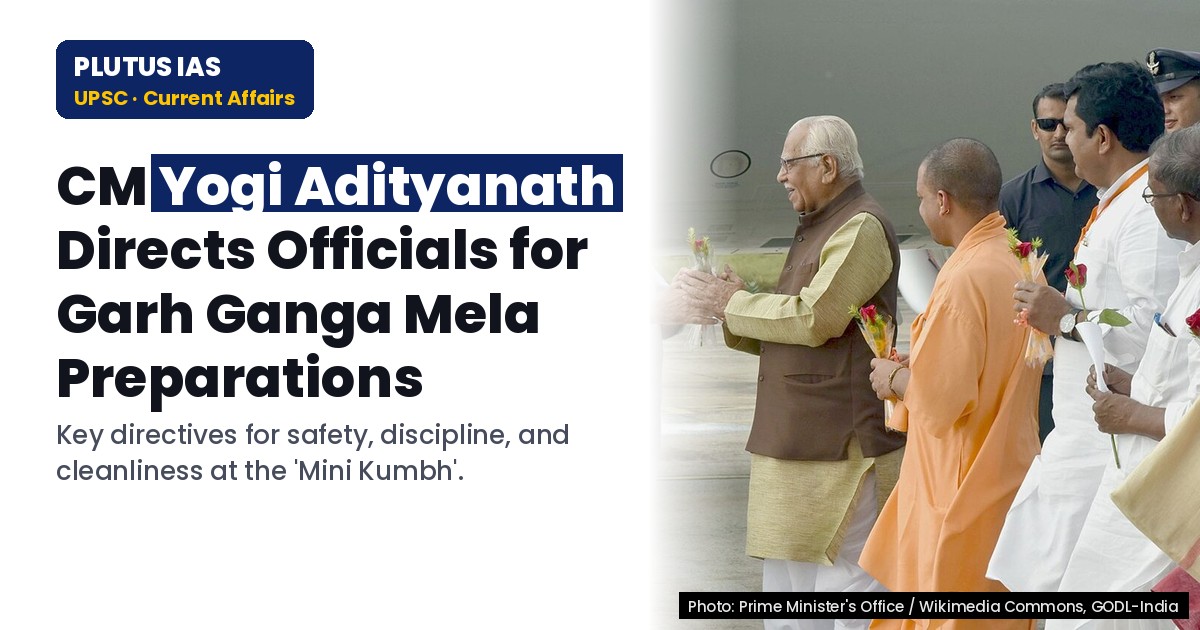
11 Nov Garh Ganga Mela: Yogi’s Directives for ‘Mini Kumbh’
✎ The Garhmukteshwar Ganga Mela is an annual pilgrimage on Kartik Purnima, significant for its religious observance and the extensive administrative efforts required for its safe and clean conduct.
Subject Relevance — Where This Topic Fits
- GS Paper I — Indian Heritage and Culture, Salient features of Indian Society | GS Paper II — Governance, Government policies and interventions for development in various sectors and issues arising out of their design and implementation | GS Paper III — Environment and Ecology (conservation, environmental pollution and degradation)
- Prelims: Garhmukteshwar Ganga Mela, Kartik Purnima, Religious tourism, Public event management, Environmental sanitation, Disaster management, Cultural preservation
- Essay: The role of cultural festivals in fostering social cohesion and national identity., Balancing economic development with environmental sustainability in religious tourism.
Quick Revision: The Garhmukteshwar Ganga Mela is an annual pilgrimage on Kartik Purnima, significant for its religious observance and the extensive administrative efforts required for its safe and clean conduct.
Why is this in the news?
The Garhmukteshwar Ganga Mela is scheduled to be held from November 17 to 26, coinciding with Kartik Purnima. High-level review meetings have been conducted by state authorities to ensure comprehensive preparations, with a particular emphasis on safety, discipline, and cleanliness, aiming for the event to exemplify these principles.
Background
- Garhmukteshwar, located in Hapur district of Uttar Pradesh, is a significant pilgrimage site on the banks of the River Ganga.
- The annual Garhmukteshwar Ganga Mela is one of the largest religious congregations in Western Uttar Pradesh, often referred to as a ‘Mini Kumbh’.
- The Mela attracts a substantial number of devotees who undertake a holy dip in the Ganga during Kartik Purnima, a day considered auspicious in Hindu tradition.
- The event necessitates extensive logistical and administrative arrangements, including crowd control, traffic management, sanitation, and provision of essential services.
- Historically, such large-scale gatherings have presented challenges related to public health, safety, and environmental impact, requiring robust governmental oversight.
- The emphasis on ‘Shraddha, Anushasan, and Swachhta’ (faith, discipline, and cleanliness) reflects a broader governmental focus on improving the management and environmental standards of religious festivals.
What is the Garhmukteshwar Ganga Mela?
- The Garhmukteshwar Ganga Mela is an annual Hindu pilgrimage fair held in Garhmukteshwar, Uttar Pradesh, on the banks of the River Ganga.
- It is primarily celebrated during the Hindu month of Kartik, culminating on Kartik Purnima, which typically falls in November.
- Devotees gather to take a sacred bath in the Ganga, believing it purifies sins and bestows spiritual merit.
- The Mela is a significant cultural event, featuring religious rituals, traditional markets, and community gatherings, attracting pilgrims from various parts of Uttar Pradesh and neighbouring states.
- It is often likened to a ‘Mini Kumbh’ due to the large congregation of pilgrims and its spiritual significance.
- The administration’s focus during the Mela includes ensuring public safety, maintaining hygiene, managing traffic, and providing medical facilities and other civic amenities for the large influx of attendees.
- Recent directives emphasize environmental sustainability, particularly the prohibition of single-use plastics and adequate waste management, aligning with national cleanliness initiatives.
Key Features
| Feature | Significance |
|---|---|
| Garh Ganga Mela | A significant religious congregation held annually on Kartik Purnima, often referred to as ‘Mini Kumbh’ for Western Uttar Pradesh, attracting a large number of devotees for ritualistic bathing in the Ganges. |
| Duration and Timing | Scheduled from November 17 to 26, coinciding with Kartik Purnima, a period considered auspicious for religious observances and holy dips. |
| Emphasis on ‘Shraddha, Anushasan, Swachhta’ | Directives issued by the Chief Minister underscore the importance of faith, discipline, and cleanliness, aiming to elevate the spiritual and civic standards of the event. |
| Multi-Departmental Coordination | Involves various government departments including Home, Public Works, Transport, Irrigation, Urban Development, Energy, Panchayati Raj, and Health, highlighting a comprehensive governance approach for large-scale public events. |
| Safety and Security Measures | Deployment of adequate police force, women police personnel, NDRF, and SDRF teams, along with public address systems, CCTV, and control rooms, to ensure pilgrim safety and crowd management. |
| Infrastructure and Civic Amenities | Provisions for temporary hospitals, medical staff, ambulances, potable water, uninterrupted power supply, adequate bathing facilities, and waste management, including a ban on single-use plastic. |
Why it Matters
Socio-Cultural Significance
- The Garh Ganga Mela serves as a vital platform for the continuation of traditional religious practices and cultural heritage, fostering community cohesion and spiritual enrichment among devotees.
- Such melas reinforce regional identities and cultural narratives, acting as repositories of local customs and folklore, thereby contributing to the intangible cultural heritage of the region.
Governance and Public Administration
- The meticulous planning and inter-departmental coordination required for managing large-scale events like the Garh Ganga Mela demonstrate the capabilities and challenges of public administration in ensuring public order, safety, and service delivery.
- Directives on cleanliness, traffic management, and emergency services highlight the government’s commitment to effective governance and citizen welfare during mass gatherings, setting precedents for future event management.
Environmental Management
- The emphasis on cleanliness, waste management, and the ban on single-use plastic at the Mela reflects a growing awareness and policy focus on environmental sustainability, particularly in ecologically sensitive areas like riverbanks.
- Efforts to channelize the river and ensure water availability underscore the importance of water resource management and maintaining ecological balance, especially in the context of large human congregations.
Challenges
1. Crowd Management and Safety
- Managing large influxes of devotees, particularly during peak bathing times, poses significant logistical and safety challenges, requiring robust crowd control mechanisms to prevent stampedes and ensure orderly movement.
- Ensuring the safety of pilgrims, especially women and children, from various hazards including drowning, theft, and anti-social elements, necessitates comprehensive security deployment and vigilance.
UPSC Link: General Studies Paper II: Governance, Public Order
2. Sanitation and Waste Management
- Maintaining high standards of hygiene and sanitation across the vast Mela grounds, especially with temporary settlements, is a perennial challenge, crucial for preventing disease outbreaks.
- Effective collection, segregation, and disposal of solid waste, including the enforcement of the single-use plastic ban, require substantial infrastructure and behavioral change among attendees.
UPSC Link: General Studies Paper III: Environment and Disaster Management
3. Infrastructure and Resource Provision
- Providing adequate temporary infrastructure such as bathing ghats, medical facilities, potable water, and uninterrupted power supply for the duration of the Mela is resource-intensive and complex.
- Ensuring sufficient transportation facilities, including additional buses and traffic diversion plans, is critical for smooth pilgrim movement and preventing congestion on approach roads.
UPSC Link: General Studies Paper II: Social Justice, Infrastructure
4. Disinformation and Public Order
- Combating the spread of misinformation and rumors through social media, which can incite panic or disrupt public order, requires proactive monitoring and communication strategies.
- Maintaining law and order amidst a diverse and transient population, while also promoting cultural activities, demands a balanced approach from law enforcement agencies.
UPSC Link: General Studies Paper II: Internal Security, Communication Networks
Challenges — UPSC Perspective
| Issue | Concern | ||||||||||||||||||||||||||||||||||||||||||||||||||||||||||||||||||||||||||||||||||||
|---|---|---|---|---|---|---|---|---|---|---|---|---|---|---|---|---|---|---|---|---|---|---|---|---|---|---|---|---|---|---|---|---|---|---|---|---|---|---|---|---|---|---|---|---|---|---|---|---|---|---|---|---|---|---|---|---|---|---|---|---|---|---|---|---|---|---|---|---|---|---|---|---|---|---|---|---|---|---|---|---|---|---|---|---|---|
| Overcrowding | Risk of stampedes, logistical bottlenecks, and strain on emergency services. | ||||||||||||||||||||||||||||||||||||||||||||||||||||||||||||||||||||||||||||||||||||
| Sanitation Deficiencies | Potential for waterborne diseases, environmental degradation, and health hazards. | ||||||||||||||||||||||||||||||||||||||||||||||||||||||||||||||||||||||||||||||||||||
| W | a | t | e | r | Q | u | a | l | i | t | y | ||||||||||||||||||||||||||||||||||||||||||||||||||||||||||||||||||||||||||
| M | a | i | n | t | a | i | n | i | n | g | p | o | t | a | b | l | e | w | a | t | e | r | s | u | p | p | l | y | a | n | d | e | n | s | u | r | i | n | g | r | i | v | e | r | w | a | t | e | r | q | u | a | l | i | t | y | f | o | r | b | a | t | h | i | n | g | r | i | t | u | a | l | s | . | |||||||||||
| Traffic Congestion | Disruption to local life, delays for pilgrims, and challenges for emergency vehicle access. | ||||||||||||||||||||||||||||||||||||||||||||||||||||||||||||||||||||||||||||||||||||
| Security Threats | Vulnerability to petty crime, organized theft, and potential for more serious security breaches. | ||||||||||||||||||||||||||||||||||||||||||||||||||||||||||||||||||||||||||||||||||||
| Environmental Impact | Accumulation of non-biodegradable waste, pollution of river ecosystems, and ecological disturbance. |
Way Forward
- Implement advanced crowd management technologies, including AI-powered surveillance and predictive analytics, to optimize pilgrim flow and prevent congestion at critical points.
- Establish a robust, multi-tiered waste management system with dedicated collection points, segregation facilities, and efficient disposal mechanisms, alongside public awareness campaigns on responsible waste disposal.
- Enhance inter-agency coordination through a unified command and control center, ensuring seamless communication and rapid response protocols among all participating departments.
- Prioritize environmental sustainability by promoting eco-friendly practices, strictly enforcing the ban on single-use plastics, and conducting regular water quality monitoring of the river.
- Augment temporary healthcare infrastructure with specialized medical teams, mobile clinics, and a comprehensive emergency referral system to address diverse health needs of pilgrims.
- Leverage public-private partnerships for infrastructure development and service delivery, drawing upon corporate social responsibility initiatives for sustainable Mela management.
- Strengthen community engagement by involving local volunteers and religious leaders in promoting discipline, cleanliness, and adherence to safety guidelines.
- Develop a comprehensive post-Mela environmental restoration plan to mitigate any ecological impact and ensure the pristine condition of the Mela grounds and riverine ecosystem.
UPSC Value Addition
Keywords for Mains Answer-Writing
Kartik Purnima · Ganga Mela · Cultural Heritage · Religious Tourism · Public Health Management · Disaster Management · Environmental Sustainability · Swachh Bharat Abhiyan · Infrastructure Development · Local Economy
Constitutional & Policy Linkages
- {‘article’: ‘Article 25’, ‘note’: ‘Freedom of conscience and religion’}
- {‘article’: ‘Article 21’, ‘note’: ‘Right to life and personal liberty’}
- {‘article’: ‘Article 48A’, ‘note’: ‘Protection and improvement of environment’}
- {‘article’: ‘Seventh Schedule (List II)’, ‘note’: ‘Public order, sanitation, public health’}
Concept Flow
Religious congregation on Kartik Purnima → Large influx of devotees for ritualistic bathing → Government directives for safety, discipline, cleanliness → Multi-departmental coordination for resource provision → Challenges in crowd, sanitation, infrastructure management → Implementation of measures for smooth, safe Mela → Promotion of cultural activities and environmental responsibility
Prelims Practice Questions
Q1. Consider the following statements regarding the Kartik Purnima festival:
1. It is celebrated primarily in North India.
2. It marks the end of the Chaturmas period.
3. Devotees often take a holy dip in sacred rivers on this day.
How many of the above statements are correct?
- Only one
- Only two
- Only three
- None
Answer: Only three — Statement 1 is incorrect; Kartik Purnima is celebrated across India, not just primarily in North India. Statement 2 is incorrect; Chaturmas ends on Prabodhini Ekadashi, not Kartik Purnima. Statement 3 is correct; taking a holy dip in sacred rivers is a significant ritual on Kartik Purnima.
Q2. Which of the following bodies is primarily responsible for coordinating disaster response during large-scale public gatherings like melas in India?
- National Disaster Management Authority (NDMA)
- State Disaster Management Authority (SDMA)
- District Disaster Management Authority (DDMA)
- All of the above
Answer: All of the above — The National Disaster Management Authority (NDMA) sets guidelines, while State Disaster Management Authorities (SDMAs) and District Disaster Management Authorities (DDMAs) are responsible for implementing and coordinating disaster response at their respective levels, making ‘All of the above’ the correct answer for comprehensive coordination.
Mains Practice Question
✍ Large-scale religious congregations, while embodying significant cultural and spiritual value, often pose substantial challenges for public administration and resource management. Discuss the multifaceted administrative and logistical challenges associated with organizing major religious festivals in India, and suggest measures for ensuring their sustainable and safe conduct. (15 Marks)
Approach: Introduction: Briefly acknowledge the cultural significance of religious festivals and their scale in India.
Administrative Challenges: Detail issues such as crowd control, law and order maintenance, traffic management, security threats (including terrorism and stampedes), and coordination among multiple government departments (e.g., police, health, public works, transport).
Logistical Challenges: Discuss provision of essential services like sanitation (waste management, public toilets), clean drinking water, temporary healthcare facilities, uninterrupted power supply, temporary housing, and communication infrastructure.
Environmental Concerns: Address the impact on local ecosystems, river pollution, and single-use plastic waste.
Sustainable and Safe Conduct Measures:
1. Pre-emptive Planning: Comprehensive disaster management plans (NDMA guidelines), risk assessment, and mock drills.
2. Technological Integration: Use of CCTV surveillance, drones, public address systems, and digital crowd management tools.
3. Infrastructure Development: Temporary and permanent infrastructure for sanitation, medical aid, and transport.
4. Public Awareness and Participation: Campaigns for cleanliness, discipline, and responsible behavior (e.g., Swachh Bharat Abhiyan principles).
5. Inter-agency Coordination: Establishing a unified command structure and clear roles for various agencies (e.g., NDRF, SDRF, local administration).
6. Environmental Protection: Strict enforcement of environmental norms, waste segregation, and plastic ban.
7. Community Engagement: Involvement of local communities and volunteers.
Conclusion: Summarize the importance of balancing cultural preservation with modern administrative efficiency and sustainability for successful festival management.
Source: amarujala.com
Uttar Pradesh PCS (UPPSC) — State PCS Practice
Prelims: Regarding the Garh Ganga Mela, which was held from November 17 to 26, 2023, and termed a ‘Mini Kumbh’ by Chief Minister Yogi Adityanath, consider the following statements:
1. The Chief Minister emphasized ‘Shraddha, Anushasan aur Swachhta’ (Devotion, Discipline, and Cleanliness) as the core principles for the successful organization of the Mela.
2. This Mela is primarily significant for its role in promoting tourism and cultural heritage specifically within the Garhwal region of Uttarakhand.
Which of the statements given above is/are correct?
- A. 1 only
- B. 2 only
- C. Both 1 and 2
- D. Neither 1 nor 2
Answer: A. 1 only — Statement 1 is correct as CM Yogi Adityanath highlighted ‘Shraddha, Anushasan aur Swachhta’. Statement 2 is incorrect as the Garh Ganga Mela is held in Garhmukteshwar, Hapur district, Uttar Pradesh, not Uttarakhand.
Mains: उत्तर प्रदेश के हापुड़ जिले में आयोजित गढ़ गंगा मेले को ‘मिनी कुंभ’ के रूप में संदर्भित करने के निहितार्थों पर चर्चा करें। राज्य सरकार द्वारा ‘श्रद्धा, अनुशासन और स्वच्छता’ पर दिए गए जोर को ध्यान में रखते हुए, उत्तर प्रदेश के धार्मिक पर्यटन और स्थानीय अर्थव्यवस्था को बढ़ावा देने में ऐसे आयोजनों की भूमिका का विश्लेषण करें।
Generated by AanyaAi for educational purpose.
Related guides on our sites
- Current affairs for upsc 2026
- How to prepare for GS paper 1 for UPSC CSE mains exam
- Best UPSC coaching for IFOS exam
- Best geography optional coaching

- Garh Ganga Mela: Yogi’s Directives for ‘Mini Kumbh’ - November 11, 2026
- दिल्ली में दिवाली प्रदूषण: पटाखों का 71%, वाहनों का 7% योगदान - November 11, 2026
- Elephants Return to Bandhavgarh: UPSC Environment Update - November 11, 2026

No Comments