


11 Nov Bharat Parv: Celebrating India’s Cultural Heritage
✎ Bharat Parv is an annual cultural festival organised by the Ministry of Tourism to promote national integration, cultural diversity, and local products under the 'Ek Bharat Shreshtha Bharat' initiative.
Subject Relevance — Where This Topic Fits
- GS Paper I — Indian Heritage and Culture | GS Paper II — Government Policies and Interventions | GS Paper III — Indian Economy (Promotion of Traditional Industries)
- Prelims: Bharat Parv, Ek Bharat Shreshtha Bharat, One District One Product (ODOP), Ministry of Tourism, National Unity Day, Cultural Heritage, Traditional Handicrafts, Indigenous Art Forms, Unity in Diversity
- Essay: The role of cultural festivals in fostering national integration and economic development., Preserving and promoting India’s diverse cultural heritage for future generations.
Quick Revision: Bharat Parv is an annual cultural festival organised by the Ministry of Tourism to promote national integration, cultural diversity, and local products under the ‘Ek Bharat Shreshtha Bharat’ initiative.
Why is this in the news?
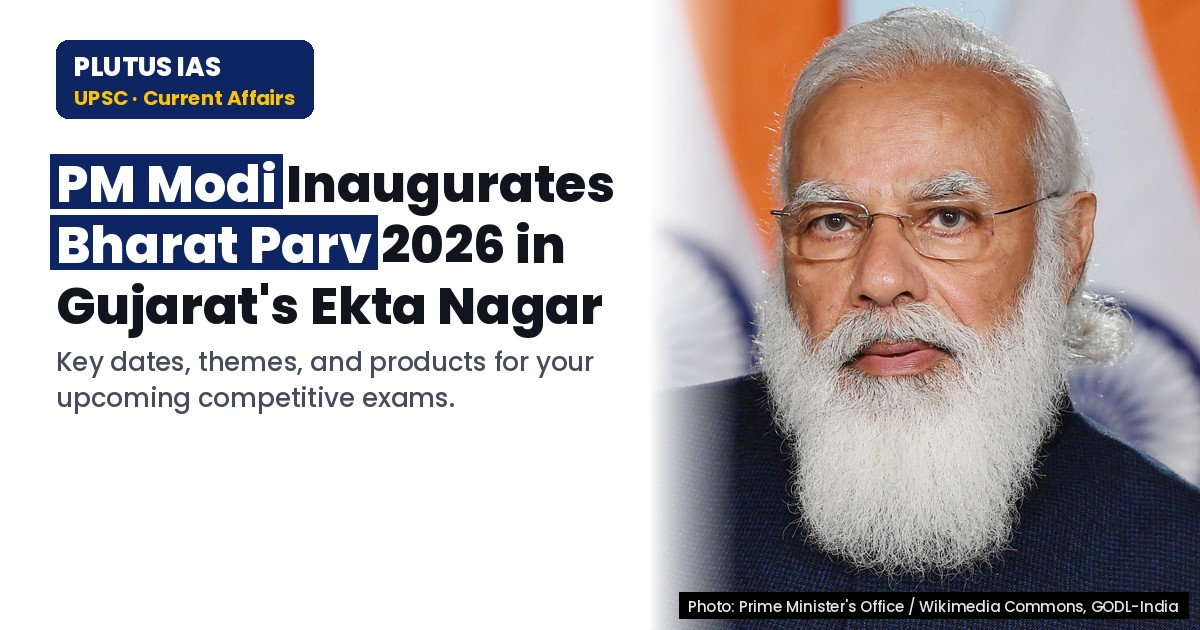
The ‘Bharat Parv 2026’ is currently underway in Ekta Nagar, Gujarat, organised by the Ministry of Tourism in collaboration with Gujarat Tourism and various states and Union Territories. Inaugurated by the Prime Minister on October 30, 2026, as part of the National Unity Day celebrations, the event aims to showcase India’s rich cultural heritage and diversity under the theme of ‘Ek Bharat Shreshtha Bharat’, continuing until November 15, 2026.
Background
- Bharat Parv is an annual event organised by the Ministry of Tourism, Government of India, to celebrate the spirit of ‘Ek Bharat Shreshtha Bharat’ and promote domestic tourism.
- The event typically coincides with significant national observances, such as Republic Day or National Unity Day, to enhance its thematic relevance.
- It serves as a platform for states and Union Territories to exhibit their unique cultural traditions, handicrafts, cuisines, and performing arts.
- The ‘One District One Product’ (ODOP) initiative is a key component, aiming to identify and promote a unique product from each district, thereby fostering local entrepreneurship and economic growth.
- The festival contributes to the broader objective of cultural exchange and understanding among different regions of India, reinforcing national unity.
- Ekta Nagar, Gujarat, a site associated with the ‘Statue of Unity’, often hosts events promoting national integration and cultural pride.
What is Bharat Parv?
- Bharat Parv is a national festival organised by the Ministry of Tourism, Government of India, to celebrate the cultural diversity and unity of India.
- Its primary objective is to promote the spirit of ‘Ek Bharat Shreshtha Bharat’ by bringing together diverse cultural expressions from across the nation.
- The event features thematic pavilions showcasing the participation of various states and Union Territories, along with central cottage industries.
- A significant highlight is the exhibition of ‘One District One Product’ (ODOP) items, traditional handicrafts, textiles, paintings, and agricultural products, promoting regional specialities.
- Live demonstrations by traditional artisans, such as Madhubani painting, Rogan art, Pattachitra, and Sozni art, offer visitors direct engagement with indigenous craftsmanship.
- Cultural performances, including folk and classical dances and musical traditions from different states, are integral to the festival, providing a vibrant display of India’s performing arts.
- The ‘Incredible India’ pavilion uses digital mediums to showcase the country’s heritage, culture, and festivals, enhancing visitor experience.
- The festival aims to provide a single platform for visitors to experience India’s cultural diversity, promote local artisans, and foster appreciation for traditional skills and products.
Key Features
| Feature | Significance |
|---|---|
| Cultural Diversity Showcase | Presents traditional arts, handicrafts, regional cuisines, folk traditions, music, dance, and indigenous craftsmanship from across India on a single platform. |
| Theme Pavilion | Features participation from 29 states and Union Territories, ‘Incredible India’, and Central Cottage Industries, highlighting artistic excellence and cultural identity. |
| One District One Product (ODOP) Exhibition | Displays over 100 ODOP products, including textiles, paintings, agricultural produce, and other unique regional items, promoting local skills and traditional craftsmanship. |
| Live Craft Demonstrations | Offers direct observation of indigenous craftsmanship, such as Assamese mask making, Madhubani painting, Rogan art, and Sozni art, connecting visitors with traditional techniques. |
| Cultural Performances | Includes a series of folk and classical performances like Kuchipudi, Bihu, Garba, Tholpavakoothu, Ravanhatha music, and Baul folk music, showcasing India’s performing arts heritage. |
Why it Matters
Cultural Preservation and Promotion
- Provides a national platform for traditional arts, crafts, and cultural performances, contributing to the preservation and promotion of India’s diverse heritage.
- Facilitates the intergenerational transfer of indigenous knowledge systems and traditional techniques by showcasing live demonstrations by artisans.
Economic Empowerment
- Promotes ‘One District One Product’ (ODOP) initiatives, thereby enhancing the visibility and market access for local artisans and their unique products.
- Generates economic opportunities for craftsmen, artists, and cultural performers by providing a direct interface with a wider audience and potential buyers.
National Integration
- Reinforces the spirit of ‘Ek Bharat Shreshtha Bharat’ by celebrating the unity in diversity across various states and Union Territories.
- Fosters mutual understanding and appreciation of different regional cultures among citizens, strengthening national cohesion.
Tourism Promotion
- Showcases India’s rich cultural and artistic heritage, attracting both domestic and international tourists to experience the country’s diversity.
- Highlights specific regions and their unique offerings, potentially increasing tourist footfall to these areas in the future.
Challenges
1. Market Access and Sustainability for Artisans
- Ensuring sustained market access and fair remuneration for artisans beyond the event duration.
- Addressing challenges related to raw material availability, design innovation, and scaling up production for traditional crafts.
UPSC Link: Indian Economy and issues relating to planning, mobilization of resources, growth, development and employment.
2. Preservation of Traditional Knowledge
- Preventing the erosion of traditional skills and knowledge due to modernization and lack of interest among younger generations.
- Documenting and digitizing traditional art forms and craft techniques to ensure their long-term survival.
UPSC Link: Indian culture will cover the salient aspects of Art Forms, Literature and Architecture from ancient to modern times.
3. Authenticity and Quality Control
- Maintaining the authenticity and traditional quality of products amidst commercialization pressures.
- Establishing robust mechanisms for quality assurance and geographical indication (GI) protection for unique regional products.
UPSC Link: Intellectual Property Rights.
4. Infrastructure and Logistics
- Ensuring adequate infrastructure for large-scale cultural events, including accommodation, transportation, and visitor management.
- Managing logistical complexities for transporting diverse products and performers from various regions.
UPSC Link: Infrastructure: Energy, Ports, Roads, Airports, Railways etc.
Challenges — UPSC Perspective
| Issue | Concern |
|---|---|
| Limited Reach of Traditional Crafts | Many indigenous crafts and products struggle to gain national and international recognition beyond their regional origins. |
| Economic Vulnerability of Artisans | Artisans often face challenges in securing fair prices for their products and ensuring a stable livelihood. |
| Threat to Traditional Skills | The younger generation may not be inclined to pursue traditional crafts due to perceived lack of economic viability or social prestige. |
| Inadequate Marketing and Branding | Many unique regional products lack effective marketing strategies and branding to compete in broader markets. |
| Standardization and Quality Control | Maintaining consistent quality and adhering to market standards can be challenging for diverse traditional products. |
Government Initiatives — Must-Memorise for Prelims
- One District One Product (ODOP)
- Ek Bharat Shreshtha Bharat
Way Forward
- Establish permanent digital platforms for showcasing and selling ODOP products and traditional crafts, ensuring continuous market access for artisans.
- Implement skill development and capacity-building programs for artisans, focusing on design innovation, quality control, and e-commerce literacy.
- Strengthen the Geographical Indication (GI) registration process for unique regional products to protect their authenticity and intellectual property.
- Integrate cultural tourism with local economies by developing circuits that highlight traditional arts, crafts, and culinary experiences.
- Promote cultural exchange programs and festivals at regional and national levels to foster deeper appreciation for India’s diverse heritage.
- Encourage public-private partnerships to invest in the promotion, marketing, and infrastructure development for traditional arts and crafts.
- Develop educational initiatives to introduce traditional art forms and craftsmanship in school curricula, fostering interest among younger generations.
UPSC Value Addition
Keywords for Mains Answer-Writing
Bharat Parv · Ek Bharat Shreshtha Bharat · Cultural Heritage · One District One Product (ODOP) · Traditional Handicrafts · Indigenous Art Forms · Cultural Tourism · Ministry of Tourism · Regional Craftsmanship · National Integration
Concept Flow
Cultural Festival (Bharat Parv) → Showcase of Diverse Arts and Crafts (ODOP, Live Demonstrations) → Promotion of ‘Ek Bharat Shreshtha Bharat’ (National Unity) → Economic Empowerment of Artisans (Market Access) → Preservation of Cultural Heritage (Traditional Knowledge) → Boost to Tourism (Incredible India)
Prelims Practice Questions
Q1. Consider the following statements regarding ‘Bharat Parv’:
1. It is organised by the Ministry of Culture in partnership with state tourism departments.
2. The ‘One District One Product’ (ODOP) initiative is a key component showcased at the event.
3. It aims to promote national integration through cultural exchange and display of diverse traditions.
How many of the above statements are correct?
- Only one
- Only two
- Only three
- None
Answer: Only two — Statement 1 is incorrect; Bharat Parv is organised by the Ministry of Tourism. Statement 2 is correct as ODOP products are a major attraction. Statement 3 is correct, aligning with the ‘Ek Bharat Shreshtha Bharat’ theme.
Q2. Match the following traditional art forms with their respective states/UTs as showcased in ‘Bharat Parv 2026’:
List I (Art Form)
1. Madhubani Painting
2. Rogan Art
3. Pattachitra Painting
4. Sozni Art
List II (State/UT)
A. Gujarat
B. Bihar
C. Odisha
D. Jammu & Kashmir
Which of the following pairs is correctly matched?
- 1-A, 2-B, 3-C, 4-D
- 1-B, 2-A, 3-C, 4-D
- 1-B, 2-C, 3-A, 4-D
- 1-A, 2-B, 3-D, 4-C
Answer: 1-B, 2-A, 3-C, 4-D — Madhubani Painting is from Bihar, Rogan Art is from Gujarat, Pattachitra Painting is from Odisha, and Sozni Art is from Jammu & Kashmir. Therefore, option B correctly matches these pairs.
Mains Practice Question
✍ Elucidate the significance of initiatives like ‘Bharat Parv’ in fostering national integration and promoting cultural tourism in India. Discuss how such events contribute to the ‘Ek Bharat Shreshtha Bharat’ objective. (15 Marks)
Approach: The answer should begin by defining ‘Bharat Parv’ and its objectives, as an initiative of the Ministry of Tourism. Subsequently, it should elaborate on its significance in fostering national integration, citing examples of cultural exchange, display of diverse art forms, and promotion of regional identities. The discussion should then transition to its role in promoting cultural tourism, highlighting aspects like showcasing ‘One District One Product’ (ODOP) and traditional handicrafts, which attract visitors and generate economic opportunities. Finally, the answer must explicitly connect these contributions to the overarching ‘Ek Bharat Shreshtha Bharat’ objective, emphasizing unity in diversity, mutual understanding, and appreciation of India’s rich cultural tapestry. Concrete examples from the news, such as specific art forms (e.g., Madhubani, Rogan, Pattachitra) and cultural performances (e.g., Kuchipudi, Bihu, Garba), should be integrated to substantiate the arguments.
Source: PIB (Press Information Bureau)
Gujarat PCS (GPSC) — State PCS Practice
Prelims: Which of the following locations in Gujarat recently hosted ‘Bharat Parv 2026’ to showcase India’s rich cultural heritage and diversity?
- A. Ahmedabad
- B. Vadodara
- C. Ekta Nagar
- D. Gandhinagar
Answer: C. Ekta Nagar — ‘Bharat Parv 2026’ was specifically held in Ekta Nagar, Gujarat, to highlight India’s cultural richness.
Mains: Discuss the significance of organizing events like ‘Bharat Parv’ in locations such as Ekta Nagar, Gujarat, for promoting national integration and cultural tourism within the state and across India. (10 marks)
Generated by AanyaAi for educational purpose.
Related guides on our sites
- How to prepare for GS paper 1 for UPSC CSE mains exam
- Best UPSC coaching for IFOS exam
- Best mentorship programme for upsc
- UPSC+BA degree

- Bharat Parv: Celebrating India’s Cultural Heritage - November 11, 2026
- मऊ में मेफेड्रोन प्रयोगशाला का भंडाफोड़: नशीले पदार्थों पर लगाम - November 11, 2026
- भारत-ओमान नौसेना अभ्यास ‘नसीम अल बहर’ का 15वां संस्करण - November 11, 2026

No Comments