


12 Nov Odisha Cyclone Arnab Relief: Rice, Cash & Flood Politics
✎ Disaster management involves a comprehensive cycle of mitigation, preparedness, response, and recovery, with state and national authorities coordinating efforts to provide timely relief and rehabilitation to affected populations.
Subject Relevance — Where This Topic Fits
- GS Paper I — Geography (Cyclones, Floods, Disaster Geography) | GS Paper II — Governance (Disaster Management, Government Policies and Interventions) | GS Paper III — Disaster Management (Types of Disasters, Mitigation, Preparedness, Response, Recovery)
- Prelims: Cyclone Arnab, Odisha Disaster Management, Direct Benefit Transfer (DBT), Special Relief Commissioner (SRC), National Disaster Management Authority (NDMA), State Disaster Response Fund (SDRF)
- Essay: The efficacy of disaster management strategies in mitigating humanitarian crises., Balancing development and environmental protection in disaster-prone regions.
Quick Revision: Disaster management involves a comprehensive cycle of mitigation, preparedness, response, and recovery, with state and national authorities coordinating efforts to provide timely relief and rehabilitation to affected populations.
Why is this in the news?
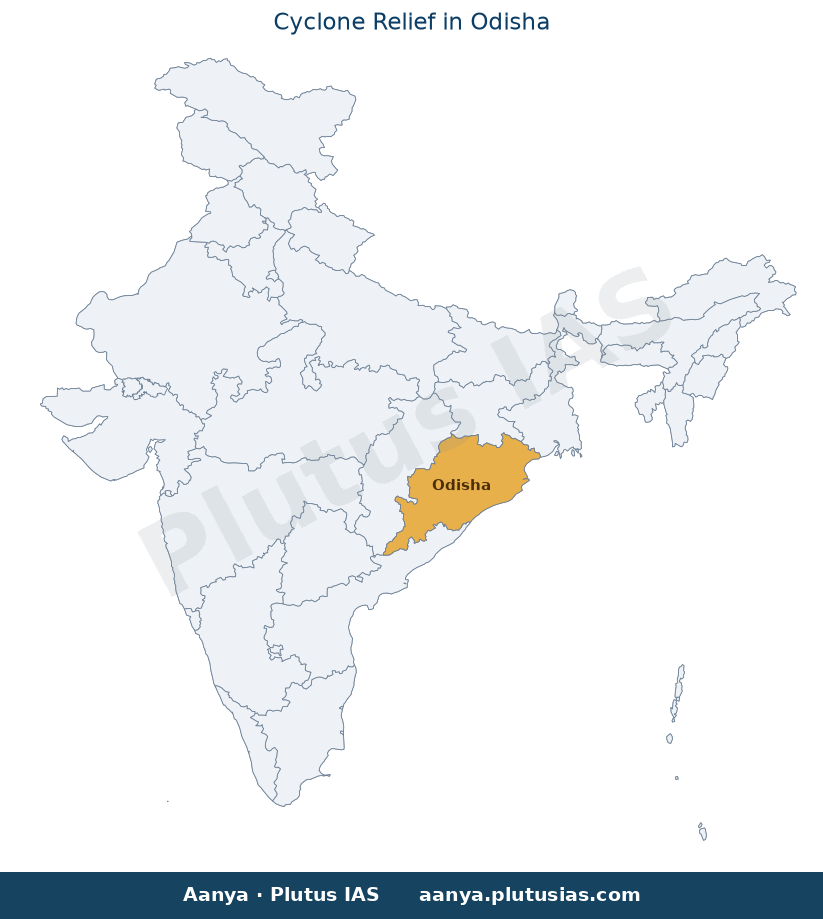
The state of Odisha recently experienced Cyclone Arnab, followed by severe flooding in districts such as Ganjam, Gajapati, and Kandhamal. In response, the state government announced a relief package for affected families, comprising 50 kg of rice and a cash assistance of ₹2,500. This initiative highlights the government’s immediate response mechanism to natural calamities and the operational aspects of disaster relief distribution.
Background
- Odisha is highly susceptible to natural disasters, particularly cyclones and floods, owing to its extensive coastline along the Bay of Bengal and numerous river systems.
- The state has developed a robust disaster management framework over the years, including early warning systems and evacuation protocols, which have significantly reduced casualties in recent events.
- Post-disaster relief operations typically involve the provision of essential commodities, financial aid, and rehabilitation measures to support affected populations.
- The Direct Benefit Transfer (DBT) mechanism is frequently employed for cash assistance to ensure transparency and direct delivery of funds to beneficiaries’ bank accounts.
- The Special Relief Commissioner (SRC) is a key state-level authority responsible for coordinating disaster management activities, including relief and rehabilitation.
- The National Disaster Management Authority (NDMA) provides guidelines and support for state-level disaster management plans and operations.
What is Disaster Management?
- Disaster Management encompasses the planning, organizing, coordinating, and implementing measures that are necessary for the prevention of, preparedness for, response to, and recovery from disasters.
- It is a continuous and integrated process of planning, organizing, coordinating, and implementing measures which are necessary or expedient for the prevention of danger or threat of any disaster.
- The Disaster Management Act, 2005, provides the legal framework for disaster management in India, establishing the National Disaster Management Authority (NDMA) at the national level and State Disaster Management Authorities (SDMAs) at the state level.
- The phases of disaster management include mitigation (reducing the impact of future disasters), preparedness (planning how to respond), response (actions during and immediately after a disaster), and recovery (restoring affected areas).
- Early warning systems, evacuation plans, and the establishment of relief camps are critical components of disaster preparedness and response.
- Financial assistance for disaster relief is often provided through mechanisms like the State Disaster Response Fund (SDRF) and the National Disaster Response Fund (NDRF), supplemented by state-specific packages.
- The Direct Benefit Transfer (DBT) scheme aims to streamline the delivery of subsidies and benefits directly to the bank accounts of beneficiaries, minimizing leakages and delays.
- Post-disaster assessments are crucial for evaluating the effectiveness of relief operations and informing future disaster management strategies.
Key Features
| Feature | Significance |
|---|---|
| Emergency Relief Assistance Extension | Broadens the scope of post-cyclone relief to all blocks in Ganjam, Gajapati, and Kandhamal districts, ensuring wider coverage for affected populations. |
| 50 kg Rice and ₹2,500 Cash | Provides immediate food security and financial aid to each affected family, addressing basic needs during the recovery phase. |
| Direct Benefit Transfer (DBT) | Ensures efficient, transparent, and accountable delivery of financial assistance directly to beneficiaries’ bank accounts, minimizing intermediaries and potential leakages. |
| Daily Progress Reporting | Mandates block-wise daily updates to the State Emergency Operations Centre (SEOC), enhancing oversight and enabling real-time monitoring of relief distribution. |
| Coordination with Supply Agencies | Involves district civil supply officers and the Odisha State Civil Supply Corporation to guarantee the timely availability and distribution of essential commodities like rice. |
| Alternative Payment Mechanisms | Addresses logistical challenges in areas with disrupted banking services by authorizing alternative payment methods, ensuring aid reaches all eligible recipients. |
Why it Matters
Disaster Management & Governance
- Demonstrates the state’s proactive approach to post-disaster relief and rehabilitation, aligning with the Sendai Framework for Disaster Risk Reduction.
- Highlights the importance of robust administrative mechanisms for identifying beneficiaries, coordinating logistics, and ensuring transparent aid distribution.
- Emphasizes the role of technology, such as Direct Benefit Transfer (DBT), in enhancing the efficiency and accountability of disaster relief operations.
Socio-Economic Impact
- Provides immediate succour to vulnerable populations, preventing further deterioration of their socio-economic status post-disaster.
- Aids in the restoration of livelihoods and basic living conditions, contributing to the resilience of affected communities.
- Mitigates the potential for food insecurity and financial distress among families impacted by natural calamities.
Public Policy & Administration
- Illustrates the implementation of a comprehensive relief package, encompassing both in-kind and financial assistance.
- Underscores the necessity of inter-departmental coordination (e.g., civil supplies, banking) for effective disaster response.
- Reflects the government’s commitment to accountability through daily reporting and monitoring of relief efforts.
Challenges
1. Accurate Beneficiary Identification
- Ensuring that only genuinely affected and eligible families receive aid, preventing exclusion errors for deserving individuals and inclusion errors for non-deserving ones.
- Developing robust verification mechanisms to prevent fraudulent claims and ensure equitable distribution.
UPSC Link: Governance; Social Justice
2. Logistical Hurdles in Aid Delivery
- Transporting bulk commodities like rice to remote or inaccessible areas, especially when infrastructure is damaged post-cyclone.
- Managing storage and distribution efficiently to prevent spoilage, theft, or delays.
UPSC Link: Disaster Management; Infrastructure
3. Banking Access and DBT Implementation
- Ensuring all eligible beneficiaries possess functional bank accounts, particularly in rural and tribal areas where financial inclusion might be lower.
- Addressing challenges in areas where banking services are disrupted due to the disaster, necessitating alternative payment arrangements.
UPSC Link: Financial Inclusion; Digital Governance
4. Transparency and Accountability
- Maintaining public trust amidst allegations of mismanagement or political interference in relief distribution.
- Ensuring that daily progress reports accurately reflect ground realities and that corrective actions are taken promptly based on monitoring.
UPSC Link: Ethics in Governance; Public Accountability
5. Flood and Dam Management
- Balancing flood control with irrigation and power generation needs, especially during periods of heavy rainfall.
- Implementing effective early warning systems and pre-emptive water release protocols to mitigate the impact of extreme weather events.
UPSC Link: Disaster Management; Water Resources
Challenges — UPSC Perspective
| Issue | Concern |
|---|---|
| Beneficiary Identification | Ensuring accurate and timely identification of all genuinely affected families, avoiding exclusion or inclusion errors. |
| Logistics of Rice Distribution | Challenges in transporting and distributing 50 kg rice bags to remote and flood-affected areas, especially with damaged infrastructure. |
| DBT in Disrupted Areas | Ensuring financial aid reaches beneficiaries in areas where banking services are non-functional due to the disaster, necessitating alternative, secure payment methods. |
| Transparency and Accountability | Preventing misuse or diversion of relief materials and funds, and ensuring public confidence in the distribution process through robust monitoring. |
| Dam Management during Floods | Effective coordination and timely decision-making regarding reservoir water release to prevent or mitigate severe downstream flooding, especially during unprecedented rainfall. |
| Political Allegations and Trust | Addressing accusations of human-made disaster and mismanagement, which can erode public trust in government’s disaster response capabilities. |
Way Forward
- Strengthen disaster preparedness and early warning systems, integrating meteorological data with hydrological forecasts for proactive response.
- Enhance the capacity of local administration for rapid damage assessment and accurate beneficiary identification post-disaster.
- Develop resilient infrastructure, including roads and communication networks, to ensure uninterrupted relief supply chains during emergencies.
- Promote financial inclusion and digital literacy to maximize the reach and efficiency of Direct Benefit Transfer (DBT) mechanisms, even in remote areas.
- Establish clear, transparent protocols for dam and reservoir management, involving inter-agency coordination and public communication during heavy rainfall events.
- Implement a robust grievance redressal mechanism for disaster-affected populations to address concerns regarding relief distribution promptly.
- Invest in community-based disaster risk reduction initiatives, empowering local populations to respond effectively to natural calamities.
UPSC Value Addition
Keywords for Mains Answer-Writing
Disaster Management Act 2005 · National Disaster Response Fund (NDRF) · State Disaster Response Fund (SDRF) · Direct Benefit Transfer (DBT) · Cyclone relief measures · Flood management strategies · Climate change adaptation · Early warning systems · Disaster resilient infrastructure · Inter-state water disputes
Constitutional & Policy Linkages
- {‘article’: ‘Article 21’, ‘note’: ‘Right to life and personal liberty’}
- {‘article’: ‘Article 243G’, ‘note’: ‘Powers, authority, responsibilities of Panchayats’}
- {‘article’: ‘Seventh Schedule, List II (State List)’, ‘note’: ‘Public health and sanitation’}
Concept Flow
Cyclonic Storm ‘Arnab’ causes heavy rainfall and floods. → Widespread damage and displacement of families in affected districts. → State government announces emergency relief package. → 50 kg rice and ₹2,500 cash aid to each affected family. → Beneficiary identification and verification initiated by collectors. → Relief distributed via DBT or alternative mechanisms, with daily monitoring. → Aims to provide immediate succour and facilitate recovery of affected populations.
Prelims Practice Questions
Q1. Consider the following statements regarding disaster relief in India:
1. The National Disaster Response Fund (NDRF) is primarily used for immediate relief and rehabilitation measures in the aftermath of a disaster.
2. The State Disaster Response Fund (SDRF) is the primary fund available with State Governments for responses to notified disasters.
3. The Ministry of Home Affairs is the nodal ministry for disaster management in India.
How many of the above statements are correct?
- Only one
- Only two
- All three
- None
Answer: All three — Statement 1 is incorrect. NDRF is for meeting the expenses for immediate relief operations, not primarily for rehabilitation. Statement 2 is correct, SDRF is indeed the primary fund for states. Statement 3 is correct, the Ministry of Home Affairs is the nodal ministry for disaster management.
Q2. Which of the following is NOT a component of the Direct Benefit Transfer (DBT) scheme in India?
- Aadhaar linkage
- Bank account seeding
- Cash transfers to beneficiaries
- Physical distribution of goods at fair price shops
Answer: Physical distribution of goods at fair price shops — Direct Benefit Transfer (DBT) aims to transfer subsidies directly to the beneficiaries’ bank accounts, often linked with Aadhaar, to reduce leakages and delays. Physical distribution of goods, while a form of welfare, is not a component of the DBT mechanism itself, which focuses on monetary transfers.
Mains Practice Question
✍ Examine the efficacy of current disaster relief mechanisms in India, particularly in the context of recurring hydro-meteorological hazards. Discuss the role of technology, such as Direct Benefit Transfer (DBT), in enhancing transparency and accountability in relief distribution. (15 Marks)
Approach: MODEL-ANSWER SKELETON: Introduction: Briefly define disaster relief mechanisms and the increasing frequency of hydro-meteorological hazards. Part 1: Efficacy of current disaster relief mechanisms – Discuss strengths (e.g., Disaster Management Act 2005, NDRF, SDRF, IMD’s early warning systems, NDMA guidelines, community participation) and weaknesses (e.g., challenges in last-mile delivery, coordination issues, inadequate infrastructure, climate change impacts, funding gaps, rehabilitation challenges). Provide examples of recurring hydro-meteorological hazards like floods and cyclones. Part 2: Role of technology in enhancing transparency and accountability – Focus on Direct Benefit Transfer (DBT): explain its mechanism (Aadhaar linkage, bank account seeding), benefits (reduced leakages, faster transfers, financial inclusion), and challenges (digital divide, banking access in remote areas, technical glitches). Mention other technologies like GIS mapping, satellite imagery, and mobile applications for damage assessment and monitoring. Conclusion: Summarize the need for a holistic, technology-driven, and community-centric approach to improve disaster resilience and relief operations.
Source: amarujala.com
Odisha PCS (OPSC (OAS)) — State PCS Practice
Prelims: Following recent cyclone-related relief measures announced by the Odisha government, which of the following statements is/are correct regarding the assistance provided to affected families?
1. Each affected family will receive 50 kg of rice.
2. The cash assistance component has been fixed at ₹1000 per family.
3. The relief package is specifically for families affected by floods, not cyclones.
- A. 1 only
- B. 2 only
- C. 1 and 2 only
- D. 1, 2 and 3
Answer: A. 1 only — The topic states 50 kg rice and cash for cyclone victims, but does not specify the cash amount, nor does it limit it to floods.
Mains: Discuss the challenges faced by the Odisha government in providing timely and adequate relief to cyclone-affected populations, considering the recent announcement of 50 kg rice and cash assistance, and the political discourse surrounding disaster management.
Generated by AanyaAi for educational purpose.
Related guides on our sites
- Current affairs for upsc 2026
- How to prepare for GS paper 1 for UPSC CSE mains exam
- Best UPSC coaching for IFOS exam
- Best geography optional coaching

- NAMASTE Scheme: Enhancing Sanitation Workers’ Livelihoods & Safety - November 14, 2026
- एमएसएमई का विशेष अभियान 6.0: स्वच्छता और लंबित मामलों का निपटारा - November 14, 2026
- Sea Vigil-26: Coastal Defence Drills Off Visakhapatnam - November 14, 2026

No Comments