


12 Nov Bengal’s Tax Surge: Panchayat Property & GST Revenue Up
✎ Improved property tax collection by local bodies and increased state GST revenue underscore effective fiscal decentralisation and robust economic activity, crucial for sub-national governance and development.
Subject Relevance — Where This Topic Fits
- GS Paper II — Governance, Decentralisation, Local Self-Government | GS Paper III — Indian Economy, Taxation, Fiscal Federalism
- Prelims: Panchayati Raj Institutions, Property Tax, Goods and Services Tax (GST), Local Self-Government Finance, Fiscal Decentralisation, Finance Commission
- Essay: The Role of Local Self-Government in India’s Development, Fiscal Federalism and the Strengthening of State Finances
Quick Revision: Improved property tax collection by local bodies and increased state GST revenue underscore effective fiscal decentralisation and robust economic activity, crucial for sub-national governance and development.
Why is this in the news?
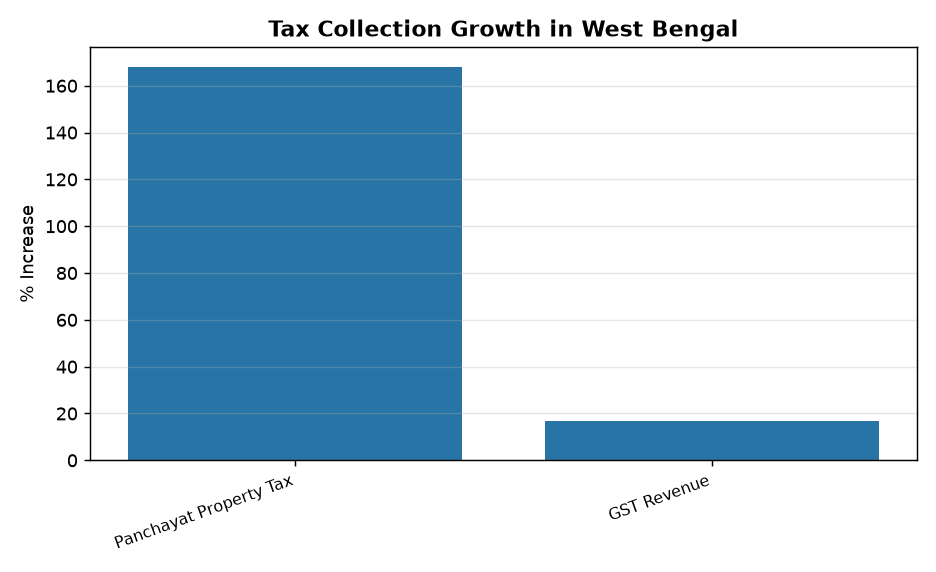
West Bengal has demonstrated a significant increase in property tax collection within its panchayat areas, recording a 168% rise during the initial seven months of the current financial year. Concurrently, the state’s Goods and Services Tax (GST) collection witnessed a 17% year-on-year increase in October. These figures highlight improved revenue mobilisation efforts at both local and state levels, attributed partly to the implementation of online tax collection systems and increased economic activity.
Background
- Local self-governments, including Panchayati Raj Institutions (PRIs) and Urban Local Bodies (ULBs), are constitutionally mandated to foster grassroots democracy and local development.
- Financial autonomy is crucial for the effective functioning of local bodies, enabling them to fund essential services and infrastructure projects.
- Property tax is a primary source of ‘own revenue’ for local bodies, providing a stable and predictable income stream directly linked to local economic activity.
- The Goods and Services Tax (GST) is a consumption-based indirect tax levied on the supply of goods and services, representing a significant component of state government revenues.
- The Finance Commission, a constitutional body, provides recommendations on the distribution of taxes between the Union and states, and among states, often linking performance grants to improvements in states’ own revenue generation.
- Digitalisation of tax collection processes is increasingly recognised as a key strategy for enhancing efficiency, transparency, and compliance in revenue administration.
Understanding Local Government Finance and GST
- Local government finance primarily comprises ‘own revenues’ (e.g., property tax, professional tax, user charges) and ‘assigned revenues’ (e.g., share of state taxes, grants from state and central governments).
- Property tax is a direct tax levied on real estate, typically assessed on the annual rental value or capital value of the property, and is a critical source of revenue for municipal corporations and panchayats.
- The 73rd and 74th Constitutional Amendment Acts (1992) institutionalised Panchayati Raj Institutions and Urban Local Bodies, respectively, granting them constitutional status and specifying their powers, functions, and financial resources.
- Fiscal decentralisation refers to the devolution of financial powers and responsibilities from higher levels of government to lower levels, aimed at improving resource allocation and public service delivery.
- GST is a multi-stage, destination-based tax levied on every value addition, subsuming various central and state indirect taxes, and is administered by the GST Council.
- Increased GST collection often indicates robust economic activity, particularly in consumption-driven sectors like hospitality and food services, which contribute significantly to state GST revenues.
- Online tax collection systems enhance taxpayer convenience, reduce administrative costs, minimise opportunities for corruption, and improve the accuracy and speed of revenue realisation.
Key Features
| Feature | Significance |
|---|---|
| 168% rise in panchayat property tax collection | Reflects enhanced local revenue generation capacity and improved administrative efficiency at the grassroots level. |
| Property tax collection of nearly Rs 118 crore (April-October) | Indicates a substantial increase in financial resources available to Panchayati Raj Institutions for local development initiatives. |
| Increase in property taxpayers from 11.69 lakh to 28.94 lakh | Suggests broader compliance and potentially a more comprehensive tax base, indicating improved outreach and enforcement. |
| Introduction of online property tax collection system in panchayat areas | Highlights the role of digital governance in streamlining tax administration, enhancing transparency, and facilitating taxpayer convenience. |
| 17% year-on-year rise in state GST collection (October) | Signifies robust economic activity and consumer spending, particularly during the festive season, contributing to state fiscal health. |
| GST collection from hospitality and food services up 35% during Durga Puja | Demonstrates the significant contribution of specific economic sectors to state revenue, influenced by seasonal demand. |
Why it Matters
Fiscal Decentralisation and Local Governance
- The substantial increase in property tax collection by panchayats underscores the growing financial autonomy of local self-governing bodies.
- Enhanced local revenue generation is crucial for Panchayati Raj Institutions (PRIs) to fund local development projects and provide essential services, reducing reliance on state grants.
- Improved tax collection mechanisms at the local level strengthen democratic decentralisation by empowering PRIs to manage their own finances more effectively.
Economic Growth and State Finances
- The 17% rise in GST collection indicates a healthy economic environment and robust consumer demand within the state, contributing positively to the state’s overall fiscal position.
- Increased GST revenue, particularly from sectors like hospitality and food services, reflects a resurgence in economic activity and consumer confidence.
- Strong state revenue collections provide the government with greater financial flexibility to invest in infrastructure, social welfare, and other developmental priorities.
Digital Governance and Administrative Efficiency
- The successful implementation of an online property tax collection system in panchayat areas exemplifies the transformative potential of digital initiatives in public administration.
- Digitalisation enhances transparency, reduces opportunities for corruption, and improves the efficiency of tax collection processes, benefiting both taxpayers and the administration.
- Extending online collection systems to urban local bodies, as planned, will further streamline municipal finance management and improve data compilation for better policy formulation.
Challenges
1. Ensuring Uniform Implementation of Digital Systems
- The uneven adoption of online tax collection across all urban local bodies presents a challenge in achieving comprehensive and centralised data compilation.
- Technical infrastructure disparities and varying levels of digital literacy among local administrative staff and citizens can impede full-scale digital integration.
UPSC Link: Governance: e-governance applications
2. Sustainability of Revenue Growth
- While festive season spending significantly boosted GST collections, sustaining this growth rate requires consistent economic policies and a favourable business environment.
- Reliance on seasonal spikes for revenue may lead to fluctuations, necessitating diversification of the tax base and stable economic drivers.
UPSC Link: Indian Economy: growth and development
3. Capacity Building for Local Bodies
- Despite increased collections, many local bodies may lack the institutional capacity for efficient utilisation and management of enhanced revenues.
- Training for local officials in financial management, project planning, and digital administration is crucial to translate increased revenue into tangible development outcomes.
UPSC Link: Panchayati Raj: functions and responsibilities
4. Addressing Tax Evasion and Non-Compliance
- While taxpayer numbers have risen, ensuring universal compliance and tackling remaining instances of tax evasion, particularly in informal sectors, remains an ongoing challenge.
- Continuous efforts are required to broaden the tax net and ensure equitable contribution from all eligible entities and individuals.
UPSC Link: Government Budgeting: taxation
Challenges — UPSC Perspective
| Issue | Concern |
|---|---|
| Incomplete online tax collection in urban local bodies | Hinders central compilation of municipal property tax data and uniform administrative efficiency. |
| Fluctuations in GST revenue | Dependence on seasonal spending, such as festive seasons, can lead to variability in state fiscal resources. |
| Optimal utilisation of increased local revenue | Ensuring that enhanced property tax collections are effectively deployed for local development and service delivery by PRIs. |
| Digital divide in rural and urban areas | Potential for disparities in access to and adoption of online tax payment systems among different demographic groups. |
| Maintaining a positive business environment | Sustaining GST revenue growth requires continuous policy support and stability to encourage economic activity. |
Way Forward
- Expedite the full implementation of online property tax collection systems across all urban local bodies to ensure uniformity and efficient data management.
- Invest in digital infrastructure and provide training to local administrative staff and citizens to bridge the digital divide and enhance digital literacy.
- Develop robust financial management frameworks and capacity-building programs for Panchayati Raj Institutions to ensure optimal utilisation of increased local revenues.
- Implement continuous monitoring and evaluation mechanisms for tax collection performance at both state and local levels to identify areas for improvement.
- Formulate policies that foster a stable and positive business environment to ensure sustained growth in GST collections and overall economic activity.
- Explore avenues for diversifying the tax base and reducing over-reliance on seasonal economic activities for revenue generation.
- Enhance public awareness campaigns regarding tax obligations and the benefits of digital payment systems to further improve compliance and broaden the taxpayer base.
UPSC Value Addition
Keywords for Mains Answer-Writing
Local Self-Government · Panchayati Raj Institutions · Own Source Revenue · Fiscal Decentralisation · Goods and Services Tax (GST) · State Finances · Digital Governance · Tax Collection Efficiency · 16th Finance Commission · Fiscal Federalism
Constitutional & Policy Linkages
- {‘Article 243G’: ‘Powers, authority, and responsibilities of Panchayats.’}
- {‘Article 243H’: ‘Powers to impose taxes by Panchayats.’}
- {‘Article 243X’: ‘Powers to impose taxes by Municipalities.’}
- {‘Article 243Y’: ‘Finance Commission for Municipalities.’}
- {‘Article 279A’: ‘Goods and Services Tax Council.’}
- {‘Seventh Schedule (List II)’: ‘State List, including local government and taxation.’}
Concept Flow
Introduction of online tax collection system by state. → Increased convenience and transparency for taxpayers. → Higher compliance and broader taxpayer base. → Significant rise in property tax collection by panchayats. → Enhanced financial resources for local bodies and state. → Improved local governance and state fiscal health.
Prelims Practice Questions
Q1. Consider the following statements regarding local government finances in India:
1. Property tax is a significant source of own-source revenue for Panchayati Raj Institutions.
2. The 16th Finance Commission considers improvements in a state’s own revenue as a criterion for performance grants.
3. Goods and Services Tax (GST) is collected by local bodies and forms part of their own-source revenue.
How many of the above statements are correct?
- Only one
- Only two
- Only three
- None
Answer: Only two — Statement 1 is correct: Property tax is indeed a crucial own-source revenue for PRIs, enabling them to fund local development and services. Statement 2 is correct: Finance Commissions, including the 16th, often link performance grants to states’ efforts in improving their own revenue generation. Statement 3 is incorrect: GST is a consumption tax levied by the Union and State governments, not directly by local bodies, although a portion of state GST collections may be devolved to local bodies as grants.
Q2. Which of the following is NOT a direct component of Goods and Services Tax (GST) revenue for a state?
- State Goods and Services Tax (SGST)
- Central Goods and Services Tax (CGST) apportionment
- Integrated Goods and Services Tax (IGST) apportionment
- Revenue from liquor sales
Answer: Revenue from liquor sales — Revenue from liquor sales for human consumption is currently outside the ambit of GST and continues to be taxed by states under their respective excise laws. SGST is directly collected by states. CGST and IGST are collected by the Union government, but a portion of their revenue is devolved to states based on recommendations of the Finance Commission and the GST Council.
Mains Practice Question
✍ Discuss the significance of enhancing own-source revenue for Panchayati Raj Institutions (PRIs) in strengthening fiscal decentralisation. Critically examine the role of digital initiatives in improving tax collection efficiency at the local level. (15 Marks)
Approach: Introduction: Define fiscal decentralisation and the importance of PRIs as local self-governments.
Significance of Own-Source Revenue (OSR) for PRIs:
1. Enhanced Autonomy: Reduces dependence on grants from higher levels of government.
2. Improved Service Delivery: Enables PRIs to fund local public goods and services tailored to community needs.
3. Accountability: Strengthens the link between local taxation and public expenditure, fostering greater accountability to citizens.
4. Local Development: Provides resources for infrastructure projects and welfare schemes at the grassroots level.
5. Fiscal Health: Contributes to the overall financial sustainability of local bodies.
Role of Digital Initiatives in Improving Tax Collection Efficiency:
1. Online Payment Systems: Facilitates convenient and transparent payment of property tax and other local levies.
2. Database Management: Enables better identification of taxpayers and properties, reducing evasion.
3. Reduced Leakages: Minimises human intervention, thereby curbing corruption and increasing collection accuracy.
4. Data Analytics: Provides insights for better tax policy formulation and administration.
5. Public Awareness: Digital platforms can be used to disseminate information about tax obligations and benefits.
Critical Examination:
1. Digital Divide: Challenges in implementation due to lack of digital literacy and internet access in rural areas.
2. Infrastructure Gaps: Requirement for robust digital infrastructure and technical support.
3. Capacity Building: Need for training local body staff in managing digital systems.
4. Security Concerns: Ensuring data privacy and cybersecurity for online transactions.
5. Integration Issues: Challenges in integrating various digital platforms and databases.
Conclusion: Summarise the dual importance of OSR and digital transformation for effective local governance, suggesting a balanced approach to address implementation challenges.
Source: The Indian Express
Generated by AanyaAi for educational purpose.
Related guides on our sites
- Best economics services coaching
- Best economics optional coaching
- Best economics optional coaching for upsc
- best teacher of economics optional

- NAMASTE Scheme: Enhancing Sanitation Workers’ Livelihoods & Safety - November 14, 2026
- एमएसएमई का विशेष अभियान 6.0: स्वच्छता और लंबित मामलों का निपटारा - November 14, 2026
- Sea Vigil-26: Coastal Defence Drills Off Visakhapatnam - November 14, 2026

No Comments