


12 Nov Odisha’s Cyclone Arnab & Flood Restoration: UPSC Geography
✎ The State Disaster Response Fund (SDRF) is the primary financial resource for state governments to undertake immediate relief and restoration efforts following notified disasters.
Subject Relevance — Where This Topic Fits
- GS Paper I — Geography (Cyclones, Floods, Disaster Management) | GS Paper III — Disaster Management (Funding, Response, Mitigation) | GS Paper II — Governance (State Administration, Public Services)
- Prelims: State Disaster Response Fund (SDRF), National Disaster Management Authority (NDMA), Cyclone Arnab, Disaster Management Act, 2005, Early Warning Systems, Climate Change Adaptation
- Essay: The imperative of robust disaster management for sustainable development in vulnerable regions., Climate change and its implications for disaster resilience and infrastructure planning.
Quick Revision: The State Disaster Response Fund (SDRF) is the primary financial resource for state governments to undertake immediate relief and restoration efforts following notified disasters.
Why is this in the news?
The Odisha Government has sanctioned a substantial amount of Rs. 482.42 crore from the State Disaster Response Fund (SDRF) for the repair, reconstruction, and restoration of public infrastructure severely damaged by Cyclone ‘Arnab’ and subsequent heavy rainfall and floods across six districts. This initiative aims to expedite restoration efforts and ensure the prompt resumption of essential public services in the affected areas, highlighting the state’s proactive approach to post-disaster recovery.
Background
- Odisha is highly susceptible to natural disasters, particularly cyclones originating in the Bay of Bengal, and associated flooding due to its extensive coastline and geographical features.
- The State Disaster Response Fund (SDRF) is the primary fund available with State Governments for responses to notified disasters, constituted under Section 48(1)(a) of the Disaster Management Act, 2005.
- The National Disaster Management Authority (NDMA) provides guidelines for the effective management of disasters, including preparedness, response, relief, and rehabilitation.
- Infrastructure damage from natural calamities often disrupts essential services such as drinking water supply, road connectivity, and access to healthcare and education, severely impacting daily life and economic activities.
- Effective disaster management involves a multi-pronged strategy encompassing early warning systems, evacuation protocols, immediate relief operations, and long-term rehabilitation and reconstruction.
- The allocation of funds from the SDRF underscores the critical role of financial mechanisms in enabling states to undertake timely and comprehensive disaster recovery operations.
Understanding Disaster Management and Response Mechanisms in India
- Disaster Management in India operates under the framework of the Disaster Management Act, 2005, which provides for the effective management of disasters and for matters connected therewith or incidental thereto.
- The National Disaster Management Authority (NDMA) is the apex body for disaster management in India, headed by the Prime Minister, responsible for laying down policies, plans, and guidelines.
- State Disaster Management Authorities (SDMAs), chaired by the Chief Ministers, are responsible for implementing disaster management plans at the state level.
- The State Disaster Response Fund (SDRF) is the primary resource for state governments to meet the expenses of immediate relief operations, with contributions from both the Central and State Governments.
- The National Disaster Response Fund (NDRF) supplements the SDRF in case of disasters of severe nature, where the SDRF is insufficient.
- Post-disaster recovery efforts typically involve damage assessment, provision of immediate relief (food, shelter, medical aid), and long-term rehabilitation including reconstruction of damaged infrastructure and restoration of livelihoods.
- Emphasis is placed on building back better (BBB) to enhance resilience against future disasters, incorporating disaster-resilient construction practices and infrastructure planning.
- Early warning systems, community-based disaster preparedness, and robust communication networks are crucial components of an effective disaster management strategy.
Key Features
| Feature | Significance |
|---|---|
| Sanction of Rs. 482.42 Crore | This substantial financial allocation from the State Disaster Response Fund (SDRF) is crucial for the immediate and comprehensive restoration of public infrastructure in six cyclone and flood-affected districts of Odisha. |
| Targeted Infrastructure Restoration | Funds are specifically earmarked for repairing and reconstructing essential public facilities, including school buildings, community halls, Gram Panchayat offices, Anganwadi centres, roads, bridges, culverts, health sub-centres, and drinking water projects. |
| Focus on Essential Services | Special emphasis on restoring drinking water supply and road connectivity underscores the priority given to basic amenities vital for daily life and livelihoods in disaster-affected regions. |
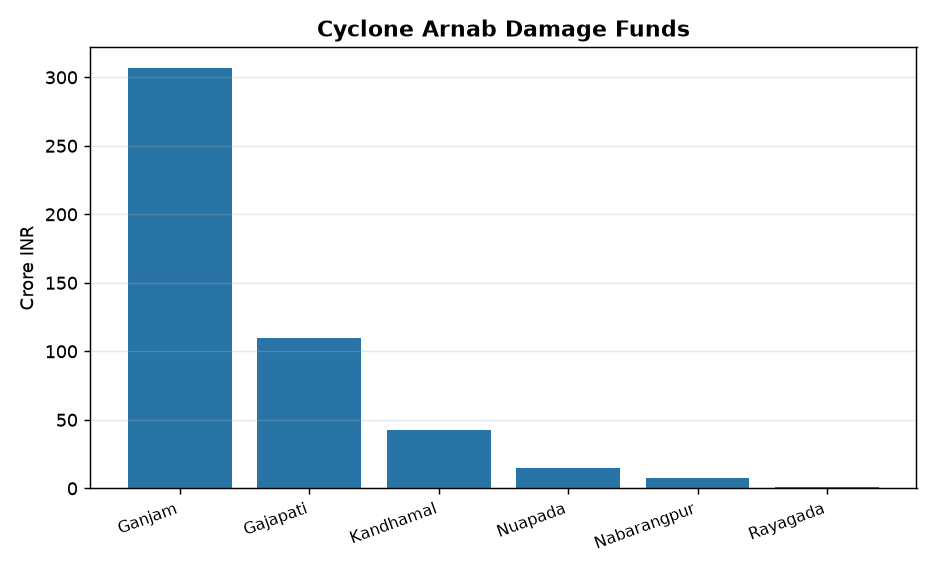
| District-wise Allocation | The differential allocation, with Ganjam receiving the highest share (Rs. 306.54 crore), reflects a needs-based approach, directing resources to areas with the most extensive damage. |
| Role of Panchayati Raj and Drinking Water Department | Entrusting this department with the funds ensures that restoration efforts are managed at a decentralized level, potentially leading to more efficient and responsive execution of projects. |
Why it Matters
Governance and Public Administration
- Demonstrates the state government’s proactive approach to disaster management and post-disaster recovery, ensuring the continuity of essential public services.
- Highlights the critical role of the State Disaster Response Fund (SDRF) as a primary financial mechanism for states to address immediate relief and rehabilitation needs.
- Emphasizes decentralized governance by channeling funds through the Panchayati Raj and Drinking Water Department, facilitating local-level execution and oversight of restoration work.
Socio-Economic Impact
- Expedited restoration of infrastructure, particularly drinking water and road connectivity, directly contributes to improving the quality of life and facilitating economic activities in affected communities.
- Reconstruction of school buildings and Anganwadi centres ensures the resumption of educational and child development services, mitigating long-term social disruption.
- Supports the livelihoods of affected populations by restoring access to markets, healthcare, and other vital services, thereby preventing prolonged economic distress.
Disaster Management
- Reinforces the importance of robust disaster preparedness and response mechanisms, including financial provisions, for effective mitigation of disaster impacts.
- Illustrates the multi-sectoral nature of disaster recovery, requiring coordinated efforts across various government departments to address diverse infrastructure damages.
- Provides a case study for understanding the practical application of disaster relief funds in rebuilding resilient infrastructure to withstand future climatic events.
Challenges
1. Efficient Fund Utilization and Oversight
- Ensuring that the sanctioned funds are utilized transparently and efficiently, without leakages or delays, is paramount for effective restoration.
- Robust monitoring mechanisms are required to track expenditure and project progress, particularly given the decentralized nature of implementation through local bodies.
UPSC Link: Governance; Disaster Management
2. Quality and Resilience of Reconstructed Infrastructure
- Rebuilding infrastructure to higher standards of resilience, capable of withstanding future extreme weather events, is crucial to break the cycle of repeated damage and reconstruction.
- Adherence to disaster-resilient building codes and engineering practices is essential to ensure the long-term sustainability of restored assets.
UPSC Link: Disaster Management; Infrastructure
3. Logistical Hurdles in Remote Areas
- Transporting materials and deploying skilled labour to remote and difficult-to-access areas, especially post-disaster, can pose significant logistical challenges.
- Ensuring timely delivery of resources to all affected villages, particularly those with extensive damage, requires meticulous planning and coordination.
UPSC Link: Disaster Management; Logistics
4. Community Participation and Needs Assessment
- Engaging local communities in the planning and execution of restoration projects can ensure that interventions are aligned with actual needs and priorities.
- Accurate and continuous assessment of community requirements is necessary to prioritize restoration efforts effectively and address evolving challenges.
UPSC Link: Social Justice; Governance
Challenges — UPSC Perspective
| Issue | Concern |
|---|---|
| Timely Execution | Delays in project implementation can prolong the suffering of affected communities and impede their return to normalcy. |
| Resource Allocation Equity | Ensuring that all severely affected areas, including those less accessible, receive adequate resources and attention for restoration. |
| Capacity Building | Strengthening the capacity of local government bodies and personnel in disaster-resilient construction and project management. |
| Climate Change Adaptation | Integrating climate change adaptation strategies into reconstruction efforts to build infrastructure that can withstand future extreme weather events. |
| Inter-departmental Coordination | Ensuring seamless coordination among various government departments involved in different aspects of infrastructure restoration. |
Government Initiatives — Must-Memorise for Prelims
- State Disaster Response Fund (SDRF)
Way Forward
- Implement a robust monitoring and evaluation framework to track the progress and quality of restoration work, ensuring accountability and efficient fund utilization.
- Adopt ‘Build Back Better’ principles in all reconstruction efforts, integrating disaster-resilient design and construction techniques to enhance infrastructure durability.
- Strengthen the capacity of Panchayati Raj Institutions and local engineering departments in disaster-resilient infrastructure planning, execution, and maintenance.
- Prioritize the restoration of critical lifeline infrastructure, such as drinking water systems and road networks, to ensure rapid resumption of essential services.
- Foster community participation in the identification of needs and oversight of restoration projects, ensuring that interventions are locally relevant and sustainable.
- Develop a comprehensive database of damaged infrastructure and restoration progress, utilizing technology for transparent reporting and informed decision-making.
- Enhance inter-departmental coordination and collaboration to streamline the procurement of materials, deployment of resources, and execution of multi-sectoral restoration projects.
UPSC Value Addition
Keywords for Mains Answer-Writing
State Disaster Response Fund · Disaster Management Act 2005 · National Disaster Management Authority · Cyclone preparedness · Flood management · Infrastructure resilience · Post-disaster rehabilitation · Climate change adaptation · Multi-hazard vulnerability · Community-based disaster management
Constitutional & Policy Linkages
- Article 243G: Powers, authority and responsibilities of Panchayats
Concept Flow
Cyclone Arnab and Floods Occur → Extensive Damage to Public Infrastructure → Odisha Government Sanctions Funds from SDRF → Panchayati Raj Dept. Receives Allocation → Repair and Reconstruction of Damaged Facilities → Restoration of Essential Public Services
Prelims Practice Questions
Q1. Consider the following statements regarding the State Disaster Response Fund (SDRF):
1. The SDRF is the primary fund available with State Governments for responses to notified disasters.
2. The Central Government contributes 75% of the SDRF allocation for general category states and 90% for special category states/union territories.
3. The SDRF can be used for immediate relief, but not for reconstruction of damaged infrastructure.
How many of the above statements are correct?
- Only one
- Only two
- Only three
- None
Answer: Only two — Statement 1 is correct: SDRF is indeed the primary fund for state-level disaster response. Statement 2 is correct: The Central Government’s contribution is 75% for general category states and 90% for special category states/UTs. Statement 3 is incorrect: SDRF can be used for immediate relief and also for restoration/reconstruction of damaged infrastructure, as evidenced by the news.
Q2. Which of the following bodies is responsible for laying down the policies, plans and guidelines for disaster management to ensure timely and effective response to disasters in India?
- National Executive Committee (NEC)
- National Disaster Management Authority (NDMA)
- State Disaster Management Authority (SDMA)
- District Disaster Management Authority (DDMA)
Answer: National Disaster Management Authority (NDMA) — The National Disaster Management Authority (NDMA), headed by the Prime Minister, is the apex body responsible for laying down policies, plans, and guidelines for disaster management in India.
Mains Practice Question
✍ Examine the institutional framework for disaster management in India, particularly focusing on the role of the State Disaster Response Fund (SDRF) in post-disaster rehabilitation. Discuss the challenges faced in ensuring effective and resilient infrastructure restoration in disaster-prone regions. (15 Marks)
Approach: MODEL-ANSWER SKELETON:
1. **Introduction:** Briefly introduce India’s vulnerability to various disasters and the necessity of a robust disaster management framework.
2. **Institutional Framework:**
* Mention the Disaster Management Act, 2005, as the legal basis.
* Outline the multi-tiered structure: NDMA (National), NEC (National Executive Committee), SDMA (State), DDMA (District).
* Briefly explain the roles of each body in preparedness, response, and mitigation.
3. **Role of SDRF in Post-Disaster Rehabilitation:**
* Define SDRF as the primary fund at the state level for immediate relief and restoration.
* Explain its funding mechanism (Central and State contributions).
* Elaborate on permissible uses, including repair and reconstruction of damaged infrastructure (e.g., roads, bridges, public buildings, drinking water projects, as highlighted in the news).
* Emphasise its importance in expediting recovery and restoring essential services.
4. **Challenges in Infrastructure Restoration:**
* **Funding Limitations:** Inadequate funds for extensive damage, delays in release, and procedural bottlenecks.
* **Capacity Gaps:** Shortage of skilled personnel, equipment, and technical expertise for resilient construction.
* **Lack of Disaster-Resilient Standards:** Inadequate implementation or enforcement of building codes and standards in vulnerable areas.
* **Logistical Hurdles:** Difficulties in accessing remote areas, especially post-disaster, affecting timely material and personnel movement.
* **Coordination Issues:** Challenges in inter-departmental and inter-agency coordination during restoration efforts.
* **Climate Change Impact:** Increasing frequency and intensity of extreme weather events, making restoration a continuous challenge.
* **Sustainability Concerns:** Ensuring that reconstructed infrastructure is more resilient to future hazards (‘Build Back Better’ principle).
5. **Conclusion:** Summarise the critical role of SDRF and the need for continuous strengthening of the disaster management framework, focusing on proactive measures, resilient infrastructure development, and efficient fund utilisation to minimise future losses.
Source: orissapost.com
Odisha PCS (OPSC (OAS)) — State PCS Practice
Prelims: The Government of Odisha recently sanctioned Rs 482.42 crore for the restoration of infrastructure damaged by Cyclone Arnab and floods. Which of the following is NOT among the six districts identified for this restoration work?
- Balasore
- Bhadrak
- Kendrapara
- Ganjam
Answer: Ganjam — The sanctioned amount is for six districts, and Ganjam is not explicitly mentioned as one of them in the provided topic.
Mains: Discuss the typical challenges faced by the Odisha government in post-cyclone and flood infrastructure restoration, with specific reference to the recent sanction for Cyclone Arnab affected areas.
Generated by AanyaAi for educational purpose.
Related guides on our sites
- Current affairs for upsc 2026
- How to prepare for GS paper 1 for UPSC CSE mains exam
- Best UPSC coaching for IFOS exam
- Best geography optional coaching

- Odisha’s Cyclone Arnab & Flood Restoration: UPSC Geography - November 12, 2026
- उपभोक्ता मूल्य सूचकांक (CPI) 2024 आधार वर्ष: अक्टूबर 2026 के आंकड़े - November 12, 2026
- INSA Endorses G20 Science Academies’ Joint Statement - November 12, 2026

No Comments