


12 Nov India-Italy Strategic Partnership: Dr. Jitendra Singh’s Visit
✎ The India-Italy Special Strategic Partnership, established in May 2026, is being advanced through a high-level visit focusing on enhanced bilateral cooperation in science, technology, and innovation.
Subject Relevance — Where This Topic Fits
- GS Paper II — International Relations | GS Paper III — Science and Technology
- Prelims: India-Italy Special Strategic Partnership, Science and Innovation Dialogue, Department of Science and Technology (DST), Electra Synchrotron Facility, ICTP (International Centre for Theoretical Physics), ICGEB (International Centre for Genetic Engineering and Biotechnology)
- Essay: The Role of Science Diplomacy in International Relations, Fostering Innovation Ecosystems through Global Partnerships
Quick Revision: The India-Italy Special Strategic Partnership, established in May 2026, is being advanced through a high-level visit focusing on enhanced bilateral cooperation in science, technology, and innovation.
Why is this in the news?
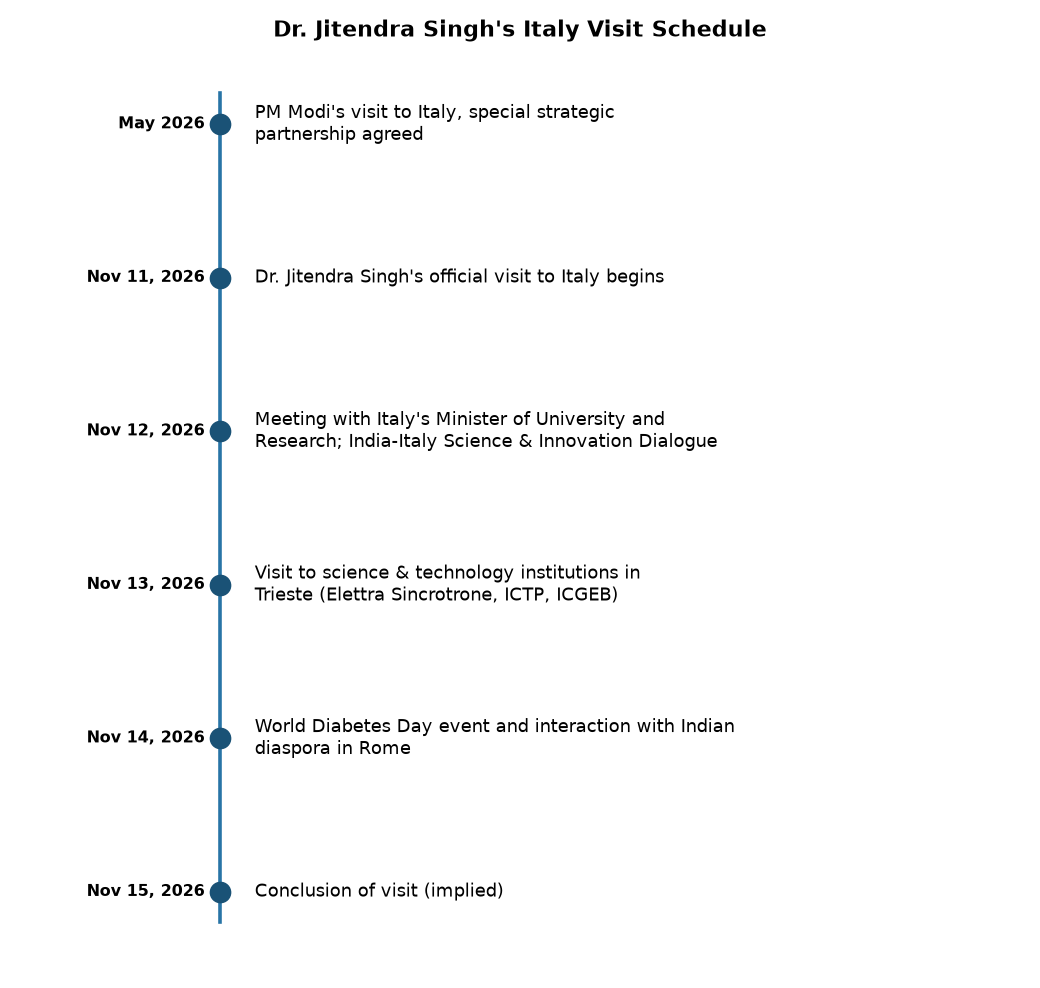
A high-level Indian delegation, led by the Union Minister of State (Independent Charge) for Science & Technology, Dr. Jitendra Singh, commenced an official visit to Italy from November 11 to 15, 2026. The primary objective of this visit is to further the ‘Special Strategic Partnership’ established during Prime Minister Narendra Modi’s visit to Italy in May 2026, with a particular focus on strengthening bilateral cooperation in the domains of science, technology, and innovation.
Background
- India and Italy have traditionally maintained cordial diplomatic relations, which have evolved into a ‘Special Strategic Partnership’ following high-level engagements.
- The ‘Special Strategic Partnership’ was formally agreed upon during the Indian Prime Minister’s visit to Italy in May 2026, signaling a deepened commitment to collaboration across various sectors.
- Science, technology, and innovation have been identified as pivotal pillars for enhancing bilateral ties, recognizing their potential to drive economic growth and societal development in both nations.
- Previous dialogues and institutional interactions have laid the groundwork for structured scientific and technological cooperation between India and Italy.
- The current visit aims to translate the strategic partnership into concrete collaborative projects and institutional linkages, particularly in advanced research and development.
- The Indian delegation comprises senior government officials, representatives from leading research institutions, academic centers, and technology incubators, highlighting a comprehensive approach to fostering scientific engagement.
What is the India-Italy Special Strategic Partnership?
- The India-Italy Special Strategic Partnership signifies an elevated level of bilateral engagement, moving beyond traditional diplomatic ties to a more comprehensive and forward-looking collaboration.
- It encompasses cooperation across multiple sectors, including defence, trade, investment, culture, and crucially, science, technology, and innovation.
- The partnership aims to leverage the strengths of both nations to address global challenges and foster mutual growth and development.
- In the realm of science and technology, it seeks to promote joint research projects, facilitate technology transfer, and encourage institutional partnerships between academic and research bodies.
- Key areas of focus within the scientific collaboration often include advanced materials, biotechnology, information technology, space technology, and sustainable energy solutions.
- The partnership is underpinned by regular high-level visits, ministerial dialogues, and joint working group meetings to ensure sustained progress and implementation of agreed initiatives.
- It also emphasizes people-to-people exchanges, including student and researcher mobility, to build a strong foundation for long-term collaboration.
- The ‘Science and Innovation Dialogue’ serves as a critical mechanism for identifying priority areas, reviewing ongoing projects, and charting future directions for scientific cooperation under this partnership.
Key Features
| Feature | Significance |
|---|---|
| High-Level Delegation | Comprises senior government officials, scientists, and representatives from premier research institutions and technology incubators, indicating a comprehensive approach to bilateral cooperation. |
| Focus on Science, Technology, and Innovation | Central to the strategic partnership, aiming to leverage mutual strengths in research, development, and technological advancement. |
| Bilateral Meetings and Institutional Dialogues | Includes discussions with Italian ministers and participation in the Science and Innovation Dialogue, fostering direct engagement and policy alignment. |
| Visits to Key Scientific Facilities | Delegation’s visits to institutions like Elettra Sincrotrone Facility, ICTP, and ICGEB in Trieste facilitate understanding of Italian scientific infrastructure and potential for collaborative research. |
| Engagement with Indian Diaspora | Participation in World Diabetes Day event and interaction with the Indian community in Italy, reinforcing cultural and community ties alongside scientific objectives. |
Why it Matters
Strategic
- Advances the Special Strategic Partnership established in May 2026, deepening bilateral relations beyond traditional diplomatic ties.
- Positions India as a significant global partner in scientific and technological advancements, enhancing its international standing.
Economic
- Fosters collaboration in innovation and technology, potentially leading to joint ventures, technology transfer, and increased trade in high-tech sectors.
- Attracts foreign investment and expertise into India’s research and development ecosystem, stimulating economic growth.
Scientific and Technological
- Facilitates knowledge exchange and collaborative research projects in cutting-edge fields, accelerating scientific discoveries and technological innovations.
- Provides Indian scientists and researchers access to advanced facilities and expertise, enhancing their capabilities and global competitiveness.
Diplomatic
- Strengthens India’s ‘Science Diplomacy’ initiatives, using scientific cooperation as a tool for fostering international goodwill and strategic alliances.
- Enhances multilateral engagement through shared scientific objectives, contributing to global challenges such as health and sustainable development.
Challenges
1. Funding and Resource Allocation
- Securing adequate and sustained financial resources for joint research projects and institutional collaborations can be challenging.
- Ensuring equitable distribution of resources and benefits between partner institutions requires robust frameworks.
UPSC Link: Government Budgeting, International Relations
2. Intellectual Property Rights (IPR) Management
- Establishing clear guidelines for ownership, protection, and commercialization of intellectual property generated from collaborative research is crucial.
- Differences in IPR laws and enforcement mechanisms between countries can complicate joint ventures.
UPSC Link: Intellectual Property Rights, International Law
3. Bureaucratic Hurdles and Administrative Delays
- Navigating administrative procedures and obtaining necessary clearances for international collaborations can lead to delays.
- Streamlining processes and establishing single-window clearances are essential for efficient execution of projects.
UPSC Link: Governance, Public Administration
4. Cultural and Language Barriers
- Differences in work culture, research methodologies, and communication styles can impede effective collaboration.
- Language differences can create misunderstandings and slow down project progress, necessitating translation and cultural sensitivity training.
UPSC Link: International Relations, Cross-Cultural Communication
5. Sustainability of Partnerships
- Ensuring long-term commitment and continuity of collaborative initiatives beyond initial agreements requires consistent political will and institutional support.
- Developing robust mechanisms for periodic review and adaptation of partnership objectives is vital for sustained relevance.
UPSC Link: International Cooperation, Policy Implementation
Challenges — UPSC Perspective
| Issue | Concern |
|---|---|
| Disparity in Research Infrastructure | Potential imbalances in technological capabilities and research facilities between partner institutions may affect the scope and scale of joint projects. |
| Data Sharing and Security | Establishing secure and mutually agreeable protocols for sharing sensitive research data, especially in areas like biotechnology and defense-related technologies. |
| Brain Drain | Risk of skilled Indian researchers migrating to countries with more advanced research opportunities if domestic infrastructure and incentives are not competitive. |
| Policy Consistency | Ensuring that scientific cooperation policies remain consistent across changes in government or political priorities in both nations. |
| Ethical Considerations | Aligning ethical guidelines and regulatory frameworks for research, particularly in emerging fields like AI and genetic engineering. |
Way Forward
- Establish a joint working group with clear mandates to identify priority areas for collaboration and monitor project implementation.
- Develop a robust framework for intellectual property rights management, ensuring fair benefit sharing and protection for both nations.
- Promote researcher mobility programs and exchange initiatives to foster deeper scientific understanding and collaboration.
- Allocate dedicated funding mechanisms and streamline administrative procedures to facilitate efficient execution of joint projects.
- Encourage private sector participation and Public-Private Partnerships (PPPs) to leverage industrial expertise and investment in scientific innovation.
- Regularly review and update the strategic partnership to adapt to evolving scientific landscapes and geopolitical dynamics.
- Initiate joint capacity-building programs and workshops to enhance skills and knowledge transfer between scientific communities.
UPSC Value Addition
Keywords for Mains Answer-Writing
India-Italy Strategic Partnership · Science and Technology Diplomacy · Bilateral Scientific Cooperation · Innovation Ecosystem Collaboration · Research and Development Partnerships · International Advanced Research · Technology Transfer Mechanisms · Global Scientific Engagement · Diplomatic Initiatives · Knowledge Exchange
Concept Flow
High-level visit by Indian Minister to Italy. → Focus on advancing existing Special Strategic Partnership. → Emphasis on science, technology, and innovation cooperation. → Bilateral meetings and institutional dialogues held. → Visits to key scientific research facilities undertaken. → Strengthening of scientific and technological collaboration between India and Italy.
Prelims Practice Questions
Q1. Consider the following statements regarding India’s international scientific collaborations:
1. The Department of Science & Technology (DST) is the nodal agency for promoting international cooperation in science and technology.
2. India’s scientific collaborations often involve institutional partnerships with leading research facilities and academic centres abroad.
3. Bilateral science and innovation dialogues are a key mechanism for advancing strategic partnerships in the field of S&T.
How many of the above statements are correct?
- Only one
- Only two
- All three
- None
Answer: All three — Statement 1: The Department of Science & Technology (DST) is indeed a primary nodal agency for fostering international S&T cooperation, aligning with its mandate to promote scientific and technological research. Statement 2: India actively pursues institutional partnerships with global research facilities and academic centres to enhance its scientific capabilities and facilitate knowledge exchange. Statement 3: Bilateral science and innovation dialogues are crucial platforms for high-level discussions and decision-making, driving strategic partnerships in science and technology.
Q2. Which of the following Indian institutions were mentioned as part of the delegation for enhancing scientific collaboration with Italy?
- International Advanced Research Centre for Powder Metallurgy and New Materials (ARCI), Hyderabad
- Indian Institute of Chemical Biology (IICB), Kolkata
- National Physical Laboratory (NPL), New Delhi
- All of the above
Answer: All of the above — The news report explicitly mentions Dr. R. Vijay, Director, International Advanced Research Centre for Powder Metallurgy and New Materials, Hyderabad; Prof. Venu Gopal Achanta, Director, National Physical Laboratory, New Delhi; and Prof. Vibha Tandon, Director, Indian Institute of Chemical Biology, Kolkata, as part of the Indian delegation, indicating their involvement in the scientific collaboration efforts.
Mains Practice Question
✍ Examine the significance of science and technology diplomacy in strengthening India’s bilateral relations and advancing its strategic interests. Illustrate with examples from recent international engagements. (15 Marks)
Approach: MODEL-ANSWER SKELETON:
1. **Introduction:** Define Science and Technology Diplomacy – use of scientific collaboration and technological exchange as tools for foreign policy objectives and strengthening bilateral ties.
2. **Significance of S&T Diplomacy:**
* **Strategic Partnerships:** Deepens trust and cooperation beyond traditional political/economic spheres.
* **Economic Growth:** Facilitates technology transfer, joint R&D, and innovation, leading to economic benefits.
* **Addressing Global Challenges:** Collaborative efforts on climate change, health (e.g., vaccine development), food security, etc.
* **Soft Power Projection:** Enhances India’s image as a responsible and capable scientific nation.
* **Capacity Building:** Access to advanced research facilities and expertise, fostering domestic scientific talent.
* **National Security:** Cooperation in critical and emerging technologies (e.g., space, defence).
3. **Examples from Recent International Engagements (specifically referencing the provided news and general knowledge):**
* **India-Italy Strategic Partnership:** Focus on science, technology, and innovation as a pillar of bilateral relations, as highlighted by the ministerial visit and the Science & Innovation Dialogue.
* **Specific Areas of Cooperation:** Mention potential areas like advanced materials (ARCI), medical sciences (SCTIMST), physical standards (NPL), chemical biology (IICB), and innovation ecosystems (IIT Kanpur, IKP Knowledge Park).
* **Other Engagements (General Knowledge):** Briefly mention collaborations with other countries/blocs (e.g., Quad, BRICS, EU) in areas like space, AI, quantum computing, clean energy, and healthcare.
4. **Challenges and Way Forward:** Briefly touch upon challenges like funding, intellectual property rights, and bureaucratic hurdles. Suggest measures for more effective S&T diplomacy.
5. **Conclusion:** Reiterate the pivotal role of S&T diplomacy in India’s foreign policy for achieving both scientific advancement and strategic objectives.
Source: PIB (Press Information Bureau)
Generated by AanyaAi for educational purpose.
Related guides on our sites
- Best PSIR optional coaching for upsc
- Best PSIR optional teacher for upsc
- Best teacher of PSIR optional for upsc
- Best PSIR optional coaching in delhi for UPSC

- NAMASTE Scheme: Enhancing Sanitation Workers’ Livelihoods & Safety - November 14, 2026
- एमएसएमई का विशेष अभियान 6.0: स्वच्छता और लंबित मामलों का निपटारा - November 14, 2026
- Sea Vigil-26: Coastal Defence Drills Off Visakhapatnam - November 14, 2026

No Comments