


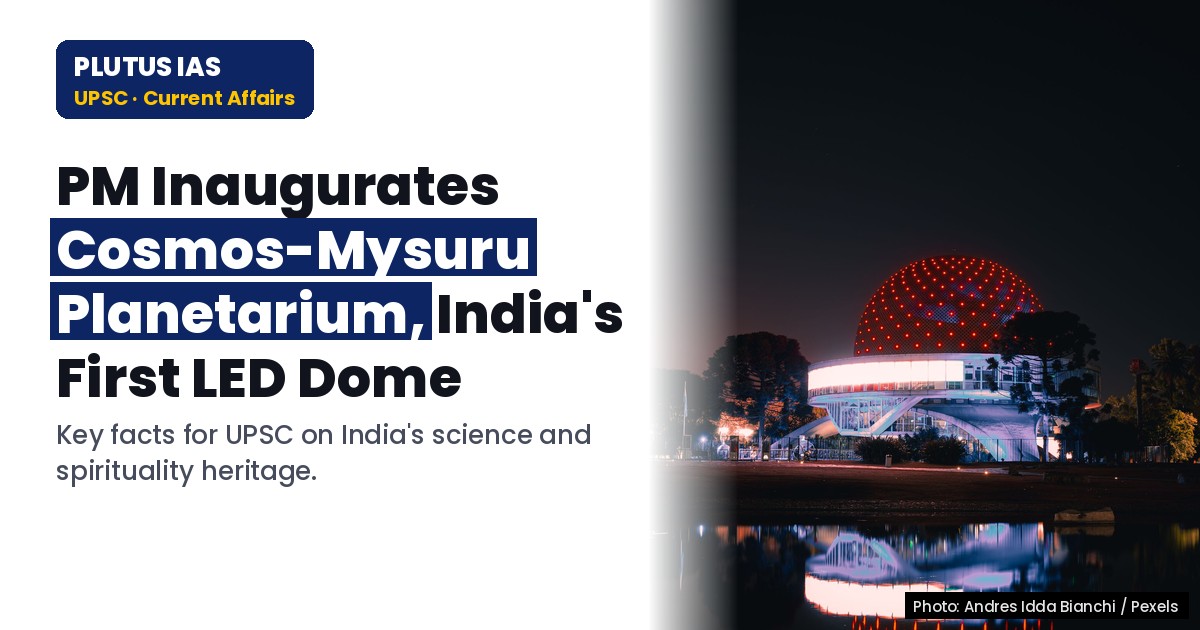
14 Nov PM Inaugurates Cosmos-Mysuru Planetarium: Science & Spirituality
✎ The COSMOS-Mysuru Planetarium, India's first LED Dome Planetarium, signifies a national commitment to fostering scientific temper and astronomical research, building upon India's rich scientific heritage and inspiring future…
Subject Relevance — Where This Topic Fits
- GS Paper III — Science and Technology — Developments and their Applications and Effects in Everyday Life; Achievements of Indians in Science & Technology; Indigenization of Technology and Developing New Technology. | GS Paper IV — Ethics, Integrity, and Aptitude — Public Service Values and Ethics in Public Administration — Scientific Temper
- Prelims: COSMOS-Mysuru Planetarium, LED Dome Planetarium, Indian Institute of Astrophysics, International Olympiad on Astronomy and Astrophysics, Scientific temper, Space sector initiatives
- Essay: The symbiotic relationship between ancient wisdom and modern scientific advancements for national progress., Cultivating scientific temper and innovation among youth as a cornerstone of a developed nation.
Quick Revision: The COSMOS-Mysuru Planetarium, India’s first LED Dome Planetarium, signifies a national commitment to fostering scientific temper and astronomical research, building upon India’s rich scientific heritage and inspiring future generations.
Why is this in the news?
The Prime Minister recently inaugurated the ‘COSMOS-Mysuru Planetarium’ in Mysuru, Karnataka, dedicating it to the nation. During the inaugural address, the Prime Minister highlighted India’s historical contributions to astronomy, the significance of institutions like the Mysuru University and the Indian Institute of Science in fostering knowledge, and the government’s vision for promoting science, technology, and research among the youth, encapsulated by the ‘Jai Vigyan, Jai Anusandhan’ slogan.
Background
- India possesses a rich heritage in astronomy, with ancient scholars like Aryabhata, Varahamihira, Bhaskara II, and Nilakantha Somayaji making significant contributions to understanding celestial mechanics, calendar systems, and eclipse predictions.
- The establishment of institutions like Mysuru University and the Indian Institute of Science (IISc) in Bengaluru, with historical support from the Wadiyar family, underscores a long-standing tradition of promoting scientific inquiry and education in the region.
- The ‘Jai Jawan, Jai Kisan’ slogan, originally coined by Lal Bahadur Shastri, was expanded by Atal Bihari Vajpayee to ‘Jai Vigyan’ to emphasize scientific progress, and further by the current Prime Minister to ‘Jai Anusandhan’ to underscore the importance of research and innovation.
- India has been actively participating in and hosting international science olympiads, demonstrating the capabilities of its young students in subjects like astronomy, astrophysics, mathematics, physics, chemistry, and biology.
- The government has been consistently promoting the space sector and astronomical research, recognizing its potential for technological advancement, economic growth, and inspiring scientific curiosity among the populace.
What is the COSMOS-Mysuru Planetarium?
- The COSMOS-Mysuru Planetarium is a newly inaugurated, state-of-the-art facility located in Mysuru, Karnataka.
- It is distinguished as India’s first LED Dome Planetarium, representing a significant technological advancement in astronomical education and public engagement.
- The planetarium aims to inspire scientific curiosity, particularly among youth, by providing an immersive experience of the cosmos and its mysteries.
- Its development involved collaboration between various entities, including the Indian Institute of Astrophysics, Mysuru University, and government departments.
- The facility is designed to serve as a resource for students, researchers, and the general public to learn about astronomy, astrophysics, and space science.
- It aligns with the national vision of fostering scientific temper and promoting research and innovation across various scientific disciplines.
Key Features
| Feature | Significance |
|---|---|
| COSMOS-Mysuru Planetarium | India’s inaugural LED Dome Planetarium, offering an immersive astronomical experience. |
| Location in Mysuru | Continues Mysuru’s historical legacy of fostering knowledge institutions, initiated by figures like Maharaja Nalwadi Krishnaraja Wadiyar. |
| Advanced Technology | Utilises state-of-the-art technology to present complex astronomical concepts, enhancing public engagement with science. |
| Educational Resource | Serves as a vital educational tool for students and researchers, complementing formal science education. |
| Inspiration for Youth | Aims to inspire young individuals towards careers and studies in astronomy, astrophysics, and space sciences. |
Why it Matters
Scientific Advancement
- Reinforces India’s commitment to scientific exploration and technological innovation, particularly in space and astronomy.
- Provides a modern platform for public engagement with scientific concepts, fostering a scientific temper among citizens.
- Contributes to the nation’s scientific infrastructure, supporting research and educational initiatives in astrophysics.
Educational Impact
- Offers an experiential learning environment that can significantly enhance understanding of celestial mechanics and cosmology.
- Motivates students to pursue STEM fields, aligning with national goals of skill development and innovation.
- Showcases India’s historical contributions to astronomy, connecting contemporary scientific efforts with ancient knowledge.
Cultural and Historical Context
- Symbolises the harmonious coexistence of spiritual and scientific traditions in India, as highlighted by the Prime Minister.
- Extends the legacy of institutions like Mysuru University and the Indian Institute of Science, promoting intellectual inquiry.
- Celebrates the achievements of ancient Indian astronomers such as Aryabhata and Varahamihira, contextualising modern advancements.
Challenges
1. Ensuring Accessibility and Outreach
- Making advanced scientific facilities like planetariums accessible to diverse populations, including those in rural and remote areas.
- Developing outreach programmes to ensure maximum utilisation by schools and colleges, transcending geographical barriers.
UPSC Link: Science & Technology, Education
2. Maintaining Technological Relevance
- Regularly updating the planetarium’s content and technology to keep pace with rapid advancements in astronomy and display technologies.
- Securing sustained funding and expertise for maintenance and upgrades to prevent obsolescence.
UPSC Link: Science & Technology, Infrastructure
3. Integrating with Formal Education
- Developing curricula and educational modules that effectively integrate planetarium visits into school and university syllabi.
- Training educators to leverage such facilities for enhanced pedagogical outcomes.
UPSC Link: Education, Human Resource Development
4. Fostering Research Linkages
- Establishing collaborations between the planetarium and research institutions to facilitate scientific discourse and projects.
- Utilising the facility not just for public viewing but also for academic discussions and workshops.
UPSC Link: Science & Technology, Research & Development
Challenges — UPSC Perspective
| Issue | Concern |
|---|---|
| Digital Divide | Unequal access to advanced scientific facilities and digital learning resources across different socio-economic strata. |
| Curriculum Integration | Lack of seamless integration of experiential learning opportunities, such as planetarium visits, into mainstream educational frameworks. |
| Funding Sustainability | Ensuring long-term financial viability for maintenance, content updates, and operational costs of high-tech facilities. |
| Skilled Manpower | Availability of trained personnel for operating, maintaining, and developing content for advanced planetariums. |
| Public Engagement | Sustaining public interest and participation in scientific activities beyond initial novelty. |
Way Forward
- Develop a national strategy for science communication, integrating planetariums and science centres into a cohesive network.
- Formulate educational programmes that align planetarium content with school and university curricula, enhancing learning outcomes.
- Establish public-private partnerships for funding, maintenance, and technological upgrades of scientific infrastructure.
- Invest in training programmes for educators and science communicators to effectively utilise advanced facilities.
- Promote regional and international collaborations in astronomy and astrophysics to share knowledge and resources.
- Leverage digital platforms to extend the reach of planetarium experiences to remote areas, bridging the digital divide.
- Encourage citizen science initiatives, allowing public participation in astronomical observations and data collection.
UPSC Value Addition
Keywords for Mains Answer-Writing
Scientific temper · Space exploration · Astronomy and astrophysics · Technological advancements · Innovation ecosystem · Research and development · Science education · Public-private partnership · National education policy · Skill development
Constitutional & Policy Linkages
- {‘article’: ‘Article 51A(h)’, ‘note’: ‘Duty to develop scientific temper’}
Concept Flow
Inauguration of COSMOS-Mysuru Planetarium → Enhanced public engagement with astronomy and space science → Inspiration for youth to pursue STEM fields → Development of scientific temper and innovation → Contribution to India’s scientific and technological progress
Prelims Practice Questions
Q1. Consider the following statements regarding the ‘Cosmos-Mysuru Planetarium’:
1. It is India’s first LED Dome Planetarium.
2. It was inaugurated by the Prime Minister in Mysuru, Karnataka.
3. The project involved collaboration between the Indian Institute of Astrophysics and Mysuru University.
How many of the above statements are correct?
- Only one
- Only two
- All three
- None
Answer: All three — Statement 1 is correct as the text mentions it is ‘भारत का पहला LED Dome प्लैनेटेरियम’. Statement 2 is correct as the headline and text confirm the Prime Minister’s inauguration in Mysuru. Statement 3 is correct as the text acknowledges the involvement of the Indian Institute of Astrophysics and Mysuru University in its construction.
Q2. Match the following Indian astronomers with their contributions:
Astronomer Contribution
1. Aryabhata A. Siddhanta Shiromani
2. Varahamihira B. Surya Siddhanta
3. Bhaskara II C. Brihat Samhita
Select the correct matching pair(s) using the codes given below:
(a) 1-B, 2-C, 3-A
(b) 1-A, 2-B, 3-C
(c) 1-C, 2-A, 3-B
(d) 1-B, 2-A, 3-C
- (a)
- (b)
- (c)
- (d)
Answer: (a) — Aryabhata is known for ‘Aryabhatiya’ which includes principles from ‘Surya Siddhanta’. Varahamihira is known for ‘Brihat Samhita’. Bhaskara II (Bhaskaracharya) is known for ‘Siddhanta Shiromani’. Therefore, the correct matching is 1-B, 2-C, 3-A.
Mains Practice Question
✍ The inauguration of the ‘Cosmos-Mysuru Planetarium’ highlights India’s commitment to fostering scientific temper and innovation. Discuss the significance of such initiatives in promoting science education and research, and outline the challenges that persist in achieving a robust scientific ecosystem in India. (15 Marks)
Approach: The answer should begin by discussing the significance of planetariums and similar scientific outreach initiatives in cultivating scientific temper, especially among youth. It should cover aspects like inspiring curiosity, promoting STEM education, and bridging the gap between scientific advancements and public understanding. Reference to the ‘Jai Vigyan, Jai Anusandhan’ slogan can be made. The second part of the answer must outline the challenges in building a robust scientific ecosystem, including issues like inadequate funding for R&D, brain drain, lack of industry-academia collaboration, quality of science education at foundational levels, and limited public engagement with science. Concrete examples or government initiatives aimed at addressing these challenges could be mentioned.
Source: PIB (Press Information Bureau)
Karnataka PCS (KPSC) — State PCS Practice
Prelims: Which city in Karnataka recently saw the inauguration of the ‘Cosmos-Mysuru Planetarium’, as mentioned in the Prime Minister’s address?
- Bengaluru
- Mysuru
- Hubballi
- Mangaluru
Answer: Mysuru — The Prime Minister’s address specifically referred to the inauguration of the ‘Cosmos-Mysuru Planetarium’ in Mysuru.
Mains: Analyze the potential impact of the ‘Cosmos-Mysuru Planetarium’ on science education and tourism in Karnataka, considering the state’s existing infrastructure and educational initiatives.
Generated by AanyaAi for educational purpose.
Related guides on our sites
- Current affairs for upsc 2026
- How to prepare for GS paper 1 for UPSC CSE mains exam
- Best UPSC coaching for IFOS exam
- Best mentorship programme for upsc

- NAMASTE Scheme: Enhancing Sanitation Workers’ Livelihoods & Safety - November 14, 2026
- एमएसएमई का विशेष अभियान 6.0: स्वच्छता और लंबित मामलों का निपटारा - November 14, 2026
- Sea Vigil-26: Coastal Defence Drills Off Visakhapatnam - November 14, 2026

No Comments