


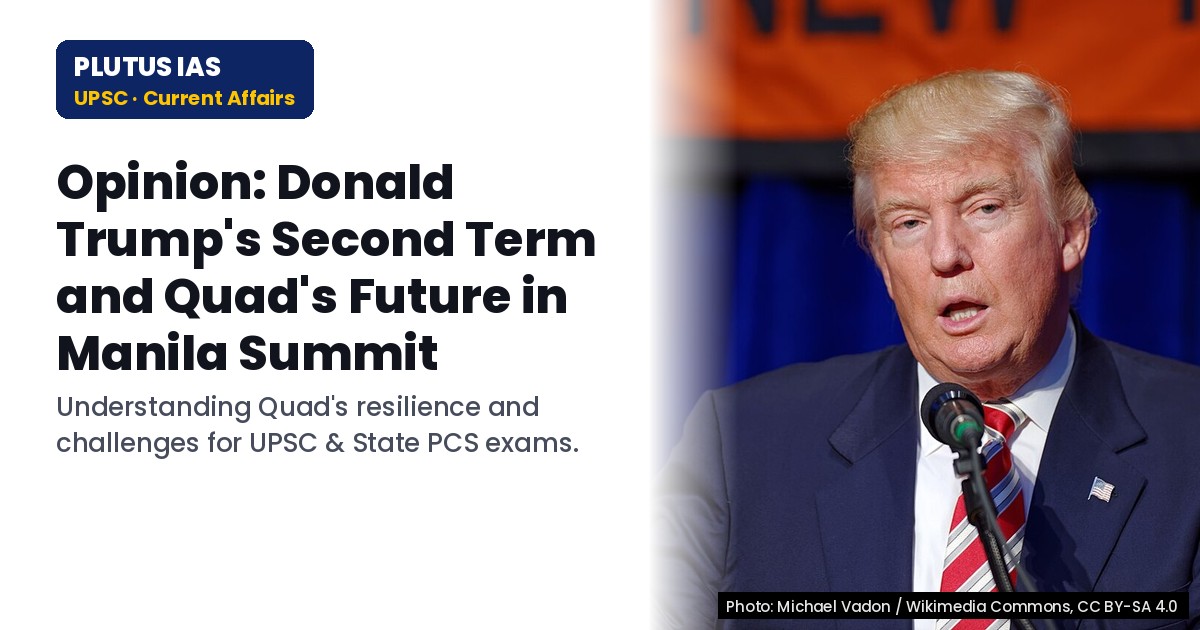
14 Nov Quad Summit in Manila: Challenges and Significance for India
✎ The Quad is an informal strategic forum of four democracies – India, the U.S., Japan, and Australia – committed to a free, open, and inclusive Indo-Pacific, engaging in diverse cooperation from maritime security to emerging…
Subject Relevance — Where This Topic Fits
- GS Paper II — International Relations: Bilateral, regional and global groupings and agreements involving India and/or affecting India’s interests; Effect of policies and politics of developed and developing countries on India’s interests, Indian diaspora.
- Prelims: Quad, Indo-Pacific, ASEAN Summit, Maritime Domain Awareness, Quadrilateral Security Dialogue, India-US relations, India-Australia relations, India-Japan relations
- Essay: The evolving geopolitical landscape and the imperative of multilateral cooperation., India’s strategic autonomy in a multipolar world.
Quick Revision: The Quad is an informal strategic forum of four democracies – India, the U.S., Japan, and Australia – committed to a free, open, and inclusive Indo-Pacific, engaging in diverse cooperation from maritime security to emerging technologies.
Why is this in the news?
The Quad leaders are anticipated to convene in Manila in November, on the sidelines of the ASEAN Summit. This prospective meeting holds significance as it would mark the first summit-level interaction of Quad leaders since the commencement of Donald Trump’s second term as U.S. President and the first attendance by Japanese Prime Minister Sanae Takaichi. The announcement follows a period of strategic turbulence within the grouping in 2025, attributed to shifting geopolitical priorities of the United States and evolving bilateral dynamics with member states, particularly India, underscoring the ongoing challenges in maintaining cohesion.
Background
- The Quad, formally known as the Quadrilateral Security Dialogue, is an informal strategic forum comprising four countries: India, the United States, Japan, and Australia.
- The concept of the Quad was initially mooted in 2004 following the Indian Ocean tsunami, with a focus on humanitarian assistance and disaster relief efforts.
- The grouping was formally established in 2007 but subsequently became inactive, only to be revived in 2017 amid growing concerns over China’s assertive actions in the Indo-Pacific region.
- Since its revival, the Quad has progressively elevated its engagement, transitioning from official-level meetings to ministerial and ultimately leaders’ summits, signifying its increasing strategic importance.
- The last Quad Leaders’ Summit was held in Wilmington in 2024, under the leadership of then U.S. President Joe Biden and Japan’s Prime Minister Fumio Kishida.
- Despite periods of strategic turbulence, the Quad has maintained operational synergies, exemplified by initiatives such as the elevation of the Indo-Pacific Maritime Domain Awareness initiative to the Indo-Pacific Maritime Surveillance Collaboration framework in May 2026.
What is the Quadrilateral Security Dialogue (Quad)?
- The Quad is an informal strategic dialogue between India, the United States, Japan, and Australia, primarily focused on promoting a free, open, prosperous, and inclusive Indo-Pacific region.
- Its objectives encompass a broad spectrum of cooperation, including maritime security, counter-terrorism, disaster relief, infrastructure development, critical and emerging technologies, climate change, and public health.
- The grouping operates on a non-binding basis, allowing for flexible cooperation and adaptation to evolving regional challenges and member states’ interests.
- A key focus of the Quad is enhancing maritime domain awareness and surveillance capabilities across the Indo-Pacific, crucial for ensuring freedom of navigation and adherence to international law.
- The Quad is not a military alliance, but rather a diplomatic and strategic forum that facilitates consultations and joint initiatives among its members.
- The dialogue aims to provide an alternative framework for regional cooperation, distinct from existing multilateral structures, by bringing together like-minded democracies.
- The Quad’s initiatives often involve practical cooperation, such as joint naval exercises (e.g., Malabar exercise), vaccine diplomacy during the COVID-19 pandemic, and infrastructure projects.
Key Features
| Feature | Significance |
|---|---|
| Informal Strategic Dialogue | Facilitates discussions on shared interests without the rigidity of a formal alliance, allowing for flexibility in addressing evolving geopolitical dynamics. |
| Shared Democratic Values | Underpins cooperation among member states, promoting a rules-based international order and adherence to democratic principles in the Indo-Pacific region. |
| Focus on Indo-Pacific Region | Addresses regional challenges and opportunities, including maritime security, infrastructure development, and humanitarian assistance, contributing to regional stability and prosperity. |
| Multi-faceted Cooperation | Extends beyond military exercises to include collaboration on critical and emerging technologies, supply chain resilience, climate change, and global health, demonstrating a comprehensive approach to regional challenges. |
Why it Matters
Geopolitical Significance
- The Quad serves as a crucial mechanism for coordinating approaches to regional security and stability, particularly in the Indo-Pacific, amidst shifting power balances.
- It provides a platform for like-minded democracies to articulate and reinforce a shared vision for a free, open, and inclusive Indo-Pacific, counterbalancing assertive actions by other regional actors.
Strategic Significance
- The grouping’s initiatives, such as the Indo-Pacific Maritime Surveillance Collaboration framework, enhance maritime domain awareness and information sharing, contributing to regional maritime security.
- It facilitates strategic alignment among key regional powers on issues of common concern, including counter-terrorism, disaster relief, and infrastructure development, thereby strengthening collective security.
Diplomatic Significance
- Regular high-level engagements, including leader-level summits and ministerial meetings, underscore the commitment of member states to multilateralism and diplomatic solutions to regional challenges.
- The Quad’s engagement with other regional groupings, such as ASEAN, demonstrates a commitment to inclusive regional architecture and respect for ASEAN centrality in the Indo-Pacific.
Economic Significance
- Cooperation on critical and emerging technologies, supply chain resilience, and infrastructure development aims to foster economic growth and connectivity within the Indo-Pacific, reducing vulnerabilities.
- The emphasis on a rules-based economic order promotes fair trade practices and investment, contributing to long-term economic stability and prosperity in the region.
Challenges
1. Maintaining Cohesion Amidst Divergent National Interests
- Each Quad member possesses unique national interests and foreign policy priorities, which can sometimes lead to differing approaches to regional issues.
- Balancing these individual interests with the collective goals of the Quad requires continuous diplomatic effort and a shared understanding of strategic imperatives.
UPSC Link: International Relations – Bilateral, Regional, Global Groupings
2. Navigating Evolving Geopolitical Landscapes
- The Indo-Pacific region is characterized by dynamic geopolitical shifts, including the rise of new powers and changing alliances, which necessitate constant adaptation of the Quad’s strategic focus.
- External pressures and the actions of non-member states can influence the internal dynamics and strategic direction of the Quad, requiring careful diplomatic management.
UPSC Link: International Relations – Effect of Policies & Politics of Developed & Developing Countries
3. Ensuring Inclusivity and Avoiding Perceptions of Bloc Formation
- The Quad must strive to maintain an inclusive approach, engaging with other regional partners and avoiding the perception of forming an exclusive security bloc.
- Addressing concerns from non-member states about the Quad’s intentions and ensuring its actions contribute to broader regional stability are crucial for its long-term effectiveness.
UPSC Link: International Relations – Important International Institutions, Agencies & Fora
4. Sustaining Political Will and Leadership Continuity
- Changes in leadership and political priorities within member states can impact the continuity and momentum of Quad initiatives.
- Ensuring consistent high-level political commitment across administrations is vital for the sustained efficacy and strategic coherence of the grouping.
UPSC Link: International Relations – India and its Neighbourhood-Relations
Challenges — UPSC Perspective
| Issue | Concern |
|---|---|
| Political Transitions in Member States | Changes in government or leadership within Quad nations can lead to shifts in foreign policy priorities, potentially impacting the group’s cohesion and strategic direction. |
| Divergent Approaches to Regional Challenges | While sharing common goals, member states may have different tactical approaches or sensitivities regarding specific regional issues, requiring careful coordination. |
| Perception as an Exclusive Bloc | The Quad’s informal nature and focus on certain strategic areas can lead to perceptions of it being an exclusive grouping, potentially alienating other regional stakeholders. |
| Balancing Bilateral Relations with Quad Commitments | Member states must navigate their individual bilateral relationships, which may sometimes present complexities or competing interests with their collective Quad commitments. |
| Resource Allocation and Implementation | Ensuring adequate resources and effective implementation for joint initiatives, such as maritime domain awareness, can be challenging given varied national capacities and bureaucratic processes. |
Government Initiatives — Must-Memorise for Prelims
- Indo-Pacific Maritime Surveillance Collaboration framework
Way Forward
- Strengthen institutional mechanisms for regular consultations and coordination among member states at all levels, from leaders to working groups.
- Expand cooperation into new and emerging domains, such as cybersecurity, space, and critical minerals, to address evolving global challenges.
- Enhance outreach and engagement with non-Quad countries and regional organizations, particularly ASEAN, to foster broader regional inclusivity and cooperation.
- Develop clear, actionable initiatives with measurable outcomes to demonstrate the Quad’s tangible contributions to regional peace and prosperity.
- Invest in public diplomacy to articulate the Quad’s positive vision for the Indo-Pacific, countering misperceptions and building broader support.
- Prioritize resilience-building efforts in supply chains, infrastructure, and climate adaptation to enhance regional stability and economic security.
- Foster greater interoperability and information sharing among member states’ defense and security agencies to enhance collective response capabilities.
- Promote joint research and development in critical and emerging technologies to maintain a competitive edge and address future challenges.
UPSC Value Addition
Keywords for Mains Answer-Writing
Quad grouping · Indo-Pacific strategy · Maritime Domain Awareness · Geopolitical dynamics · Multilateral cooperation · Regional security architecture · Strategic autonomy · US foreign policy · ASEAN centrality · India-US relations · Balance of power · Diplomatic engagement
Concept Flow
Formation of Quad as an informal strategic dialogue → Shared democratic values and commitment to a free and open Indo-Pacific → Development of joint initiatives (e.g., maritime surveillance) → Challenges arising from divergent national interests and geopolitical shifts → Sustaining cohesion through diplomatic engagement and shared strategic vision → Contribution to regional stability and a rules-based international order
Prelims Practice Questions
Q1. Consider the following statements regarding the Quad grouping:
1. The Quad is a strategic dialogue between India, Australia, Japan, and the United States.
2. The Indo-Pacific Maritime Domain Awareness initiative was launched following a Quad Foreign Ministers’ Meeting.
3. The Quad Leaders’ Summit has been held annually without any interruptions since its inception.
How many of the above statements are correct?
- Only one
- Only two
- Only three
- None
Answer: Only two — Statement 1 is correct: The Quad (Quadrilateral Security Dialogue) is indeed a strategic forum comprising India, Australia, Japan, and the United States, aimed at promoting a free, open, and inclusive Indo-Pacific. Statement 2 is correct: The Indo-Pacific Maritime Domain Awareness initiative was elevated to the Indo-Pacific Maritime Surveillance Collaboration framework in New Delhi in May 2026, following a Quad Foreign Ministers’ Meeting. Statement 3 is incorrect: The news mentions ‘a period of intense strategic turbulence in 2025’ for the grouping, indicating interruptions or challenges to regular summit-level meetings.
Q2. Which of the following countries are members of the Quadrilateral Security Dialogue (Quad)?
1. India
2. Japan
3. South Korea
4. Australia
5. United States
Select the correct answer using the code given below:
- 1, 2, and 4 only
- 1, 2, 4, and 5 only
- 1, 2, 3, 4, and 5
- 2, 3, and 5 only
Answer: 1, 2, 4, and 5 only — The Quad comprises India, Japan, Australia, and the United States. South Korea is not a member of the Quad.
Mains Practice Question
✍ Critically examine the significance of the Quadrilateral Security Dialogue (Quad) in shaping the geopolitical landscape of the Indo-Pacific region. Discuss the challenges to its cohesion and the strategies employed to maintain its operational synergies. (15 Marks)
Approach: Introduction: Define Quad as a strategic dialogue involving India, Australia, Japan, and the US, aimed at a free, open, and inclusive Indo-Pacific.
Significance of Quad:
1. Counterbalancing influence: Role in addressing growing geopolitical shifts and power dynamics in the Indo-Pacific.
2. Maritime Security: Initiatives like Indo-Pacific Maritime Surveillance Collaboration framework, enhancing maritime domain awareness and cooperation.
3. Regional Stability: Contribution to a rules-based international order and upholding international law, particularly in maritime commons.
4. Non-traditional security: Cooperation on areas like disaster relief, climate change, critical technologies, and vaccine diplomacy.
5. Economic engagement: Potential for economic cooperation and supply chain resilience.
Challenges to Cohesion:
1. Divergent national interests: Differences in strategic priorities and foreign policy approaches among member states.
2. Leadership changes: Impact of political transitions in member countries (e.g., US presidential changes) on commitment and policy direction.
3. Bilateral relations: Influence of evolving bilateral dynamics between Quad members on the grouping’s overall cohesion.
4. Perception of ‘anti-China’ bloc: Efforts to balance cooperation with avoiding direct confrontation, especially for countries with significant economic ties to China.
5. ASEAN centrality: Ensuring Quad initiatives complement rather than undermine ASEAN’s central role in regional architecture.
Strategies for Maintaining Operational Synergies:
1. Regular high-level engagements: Summits and ministerial meetings to foster dialogue and consensus.
2. Focus on practical cooperation: Emphasizing tangible outcomes in areas like maritime security, infrastructure, and technology.
3. Institutionalization: Developing frameworks and initiatives (e.g., I-PMDAC) that provide continuity irrespective of political changes.
4. Inclusivity: Communicating Quad’s positive agenda and avoiding perceptions of exclusivity or aggression.
Conclusion: Summarize Quad’s evolving role and the ongoing efforts to navigate challenges while strengthening its strategic relevance in the Indo-Pacific.
Source: The Hindu
Generated by AanyaAi for educational purpose.
Related guides on our sites
- Best PSIR optional coaching for upsc
- Best PSIR optional teacher for upsc
- Best teacher of PSIR optional for upsc
- Best PSIR optional coaching in delhi for UPSC

- NAMASTE Scheme: Enhancing Sanitation Workers’ Livelihoods & Safety - November 14, 2026
- एमएसएमई का विशेष अभियान 6.0: स्वच्छता और लंबित मामलों का निपटारा - November 14, 2026
- Sea Vigil-26: Coastal Defence Drills Off Visakhapatnam - November 14, 2026

No Comments