


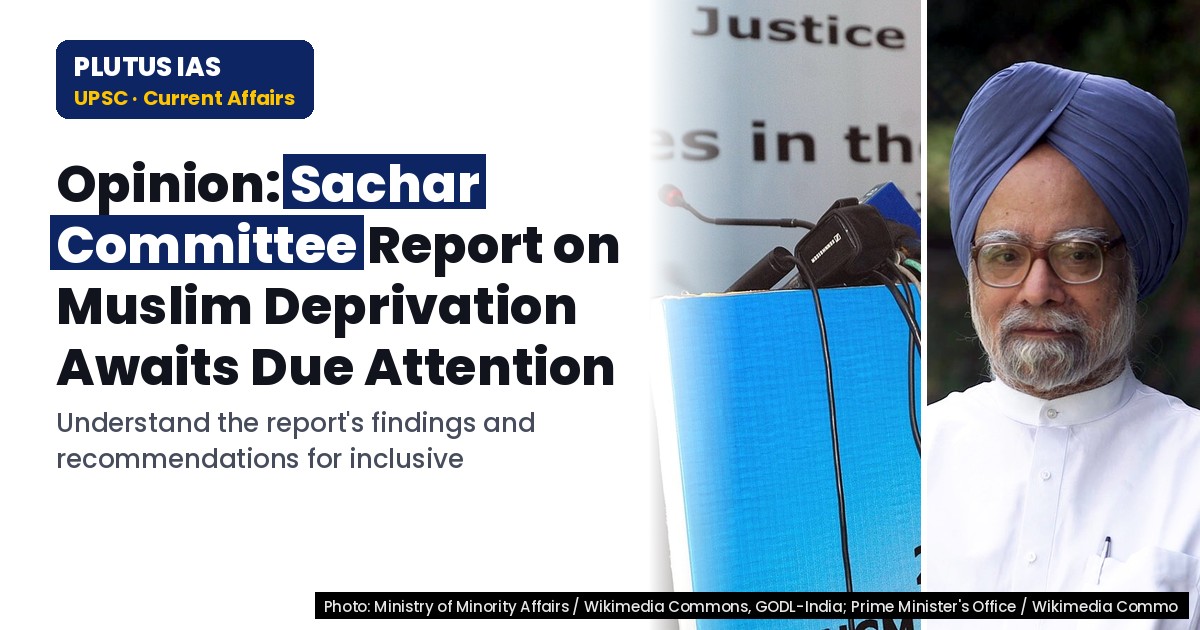
24 Nov Sachar Committee Report: Inclusive Development & Deprivation
✎ The Sachar Committee Report, submitted in 2006, is a comprehensive study detailing the socio-economic and educational status of the Muslim community in India, recommending policies for inclusive development and mainstreaming.
Subject Relevance — Where This Topic Fits
- GS Paper I — Indian Society; Social Empowerment | GS Paper II — Governance; Welfare Schemes for Vulnerable Sections; Mechanisms, Laws, Institutions and Bodies constituted for the Protection and Betterment of these Vulnerable Sections | GS Paper III — Inclusive Growth and Issues Arising From It
- Prelims: Sachar Committee, Minority Affairs Ministry, Inclusive Development, Mainstreaming, Social Exclusion, Socio-economic Indicators, Rajinder Sachar
- Essay: Social Justice and Inclusive Growth: Addressing Disparities in India, The Role of State in Mitigating Socio-Economic Inequalities
Quick Revision: The Sachar Committee Report, submitted in 2006, is a comprehensive study detailing the socio-economic and educational status of the Muslim community in India, recommending policies for inclusive development and mainstreaming.
Why is this in the news?
The Sachar Committee Report (SCR), submitted on November 17, 2006, is currently in news due to discussions regarding its impact and the extent to which its recommendations have been implemented. There is a renewed call for the government to revisit the report, present it in Parliament, and engage in a comprehensive discussion on its findings and proposed policies aimed at addressing the socio-economic status of the Muslim community in India.
Background
- The Sachar Committee was constituted by the Prime Minister’s Office in 2005 to prepare a report on the social, economic, and educational status of the Muslim community in India.
- Chaired by Justice (Retd.) Rajinder Sachar, the High-Level Committee was mandated to collect and analyse data across various developmental dimensions.
- The Committee submitted its comprehensive report to the then Prime Minister, Dr. Manmohan Singh, on November 17, 2006.
- The government subsequently made the report public by tabling it in Parliament on November 30, 2006.
- The report is widely regarded as a seminal and authentic document providing detailed insights into the conditions of Indian Muslims.
- It highlighted significant deficits and deprivations experienced by the community across nearly all indicators of development.
Key Aspects of the Sachar Committee Report (SCR)
- The Sachar Committee Report (SCR) provided an extensive analysis of the socio-economic and educational status of the Muslim community in India.
- It examined various parameters including population demographics, educational attainment, economic participation, employment in government services, access to banking facilities, and basic infrastructure.
- The report underscored that the Muslim community exhibited lower indicators of development compared to other socio-religious groups in India.
- Key findings included lower literacy rates, reduced access to higher education, underrepresentation in government employment, and limited access to credit and basic amenities.
- The SCR recommended a range of policy interventions focused on ‘inclusive development’ and ‘mainstreaming’ the Muslim community.
- Recommendations encompassed measures to enhance educational opportunities, improve access to credit, ensure equitable participation in employment, and address issues of identity and security.
- The report emphasised the necessity of targeted policies to bridge the developmental gaps and foster greater social inclusion for the community.
- It advocated for a data-driven approach to policy formulation to ensure effective resource allocation and programme implementation.
Key Features
| Feature | Significance |
|---|---|
| High-Level Committee | Constituted by the Prime Minister to examine the socio-economic, educational status of the Muslim community in India. |
| Justice (Retd.) Rajinder Sachar | Chaired the Committee, lending judicial authority and impartiality to its findings. |
| Comprehensive Data Analysis | Studied various indicators including population, education, economic status, employment, banking access, and basic infrastructure. |
| Focus on Deprivation | Identified deficits and deprivation across multiple dimensions of development within the Muslim community. |
| Recommendations for Inclusive Development | Proposed policies aimed at ‘inclusive development’ and ‘mainstreaming’ the community. |
Why it Matters
Social Justice and Equity
- The report highlights disparities, serving as a foundational document for policy interventions aimed at reducing inequalities and promoting social justice.
- It underscores the constitutional imperative of ensuring equitable opportunities and outcomes for all sections of society, including minority communities.
Governance and Policy Formulation
- Provides a data-driven basis for government to formulate targeted policies and schemes addressing specific developmental deficits identified within the Muslim community.
- Facilitates evidence-based policymaking, moving beyond anecdotal observations to address systemic issues of deprivation.
Inclusive Growth
- Emphasises the importance of inclusive growth, where no significant section of the population is left behind in the development process.
- Contributes to the broader national goal of achieving sustainable and equitable development by integrating marginalised groups into the economic and social mainstream.
Challenges
1. Implementation Deficit
- Despite the report’s submission, the extent and effectiveness of its recommendations’ implementation remain a subject of debate.
- Translating policy recommendations into tangible outcomes requires sustained political will and administrative efficiency.
UPSC Link: Governance: policies & interventions
2. Data Gaps and Monitoring
- Continuous monitoring and updated data collection are crucial to assess the impact of interventions and identify emerging challenges.
- Lack of regular, disaggregated data can hinder effective evaluation and course correction of welfare programmes.
UPSC Link: Social Justice: vulnerable sections
3. Perceptional Barriers
- Overcoming societal perceptions and biases is essential for the successful integration and upliftment of any community.
- Addressing the ‘perceptions in society’ noted by the committee requires comprehensive social awareness and inclusive narratives.
UPSC Link: Indian Society: diversity & challenges
4. Resource Allocation
- Adequate allocation of financial and human resources is critical for the effective implementation of welfare schemes.
- Ensuring that resources reach the intended beneficiaries without leakages or inefficiencies remains a persistent challenge.
UPSC Link: Governance: transparency & accountability
Challenges — UPSC Perspective
| Issue | Concern |
|---|---|
| Low Educational Attainment | Impacts human capital development and access to skilled employment opportunities. |
| Economic Disparity | Leads to lower income levels, reduced access to credit, and limited entrepreneurial growth. |
| Underrepresentation in Government Jobs | Reflects systemic barriers and affects equitable participation in public service. |
| Access to Basic Infrastructure | Deficiencies in banking facilities and other basic amenities hinder overall development and quality of life. |
| Poverty Levels | Higher incidence of poverty indicates persistent socio-economic vulnerability within the community. |
Way Forward
- Establish a dedicated mechanism for periodic review and public reporting on the implementation status of the Sachar Committee’s recommendations.
- Strengthen data collection and analysis systems to monitor socio-economic indicators of minority communities more effectively and regularly.
- Formulate and implement targeted welfare schemes based on the identified deficits, ensuring equitable access to education, employment, and basic services.
- Promote public awareness campaigns to foster social inclusion and address prevailing societal perceptions and biases.
- Enhance financial inclusion initiatives to ensure better access to credit and banking facilities for economically disadvantaged sections.
- Encourage skill development and entrepreneurship programmes tailored to the specific needs of the community to improve economic participation.
- Ensure transparency and accountability in the allocation and utilisation of funds for minority welfare programmes.
UPSC Value Addition
Keywords for Mains Answer-Writing
Sachar Committee Report · Inclusive development · Mainstreaming · Socio-economic indicators · Minority welfare · Government policies · Deprivation · Affirmative action · Social justice · Data-driven policy making
Constitutional & Policy Linkages
- {‘Article 14’: ‘Equality before law’, ‘Article 15’: ‘Prohibition of discrimination’, ‘Article 16’: ‘Equality of opportunity in public employment’, ‘Article 29’: ‘Protection of minority interests’, ‘Article 38’: ‘State to secure social order’}
Concept Flow
Prime Minister’s High-Level Committee constituted → Committee analyses socio-economic data → Report highlights community’s deprivation → Recommendations for inclusive development → Government considers policy interventions → Implementation aims for equitable outcomes
Prelims Practice Questions
Q1. Consider the following statements regarding the Sachar Committee Report:
1. The Committee was chaired by Justice (Retd.) Rajinder Sachar.
2. It submitted its report in 2006.
3. The report primarily focused on the socio-economic and educational status of the Muslim community in India.
How many of the above statements are correct?
- Only one
- Only two
- Only three
- None
Answer: Only three — Statement 1 is correct: The Committee was indeed chaired by Justice (Retd.) Rajinder Sachar. Statement 2 is correct: The report was submitted on November 17, 2006. Statement 3 is correct: The Sachar Committee Report is widely recognized for its detailed analysis of the socio-economic and educational status of the Muslim community in India.
Q2. Which of the following government initiatives were launched subsequent to the recommendations or findings similar to those highlighted by the Sachar Committee Report, aiming at minority welfare and inclusive development?
1. Pradhan Mantri Jan Dhan Yojana
2. Multi-sectoral Development Programme (MSDP)
3. Skill India Mission
4. Nai Manzil Scheme
Select the correct answer using the code given below:
- 1 and 2 only
- 2 and 4 only
- 1, 3 and 4 only
- 1, 2, 3 and 4
Answer: 2 and 4 only — The Multi-sectoral Development Programme (MSDP), later restructured as Pradhan Mantri Jan Vikas Karyakram (PMJVK), was specifically designed to address the development deficits in identified minority concentration areas, directly aligning with the Sachar Committee’s findings. The Nai Manzil Scheme is an educational and livelihood initiative for minority youth. While Pradhan Mantri Jan Dhan Yojana and Skill India Mission are broader schemes, MSDP and Nai Manzil are more directly linked to minority welfare as identified by such reports.
Mains Practice Question
✍ The Sachar Committee Report highlighted significant deficits and deprivation within a specific community, advocating for policies of ‘inclusive development’ and ‘mainstreaming’. Critically examine the extent to which subsequent government policies and programmes have addressed these recommendations. (15 Marks)
Approach: MODEL-ANSWER SKELETON:
1. **Introduction (20 words):** Briefly introduce the Sachar Committee Report (SCR) (2006) and its primary objective of assessing the socio-economic, educational, and health status of the Muslim community.
2. **Key Findings of SCR (40 words):** Outline major observations such as lower educational attainment, limited access to credit, underrepresentation in government jobs, and poor access to basic amenities.
3. **Recommendations of SCR (40 words):** Mention key recommendations like creating an Equal Opportunity Commission, improving access to education and finance, enhancing skill development, and ensuring equitable share in government schemes.
4. **Government Initiatives (Post-2006) (80 words):** Discuss specific schemes and policies launched or strengthened to address minority welfare, such as:
* **Multi-sectoral Development Programme (MSDP) / Pradhan Mantri Jan Vikas Karyakram (PMJVK):** Focus on infrastructure development in minority concentration areas.
* **Schemes of Ministry of Minority Affairs:** Nai Manzil (education and skill development), Hamari Dharohar (preserving minority culture), Seekho aur Kamao (skill development), Pradhan Mantri Kaushal Vikas Yojana (PMKVY) with minority focus.
* **Educational Initiatives:** Scholarship schemes (Pre-Matric, Post-Matric, Merit-cum-Means), Maulana Azad National Fellowship.
* **Financial Inclusion:** Priority Sector Lending guidelines for minorities, schemes like Mudra Yojana.
5. **Critical Examination/Challenges (50 words):** Analyze the effectiveness and limitations of these initiatives. Discuss issues like:
* **Implementation gaps:** Slow pace of execution, inadequate funding, lack of awareness.
* **Data availability and monitoring:** Need for robust disaggregated data to track progress.
* **Impact assessment:** Limited comprehensive studies on the actual impact on the ground.
* **Persistence of disparities:** Acknowledge that despite efforts, significant disparities may still exist.
6. **Conclusion (20 words):** Summarize by stating that while efforts have been made, sustained and targeted interventions, along with regular monitoring and evaluation, are crucial for achieving the goals of inclusive development and mainstreaming envisioned by the Sachar Committee.
Source: The Hindu
Generated by AanyaAi for educational purpose.
Related guides on our sites
- Best economics services coaching
- Anthropology VS PSIR
- Best PSIR optional coaching
- Best PSIR optional coaching online

- Sachar Committee Report: Inclusive Development & Deprivation - November 24, 2026
- Quad’s Evolving Role: Indo-Pacific Strategy & India’s Autonomy - November 24, 2026
- अंतर्राष्ट्रीय न्यायालय का रोहिंग्या नरसंहार पर निर्णय: चुनौतियाँ और निहितार्थ - November 24, 2026

No Comments