


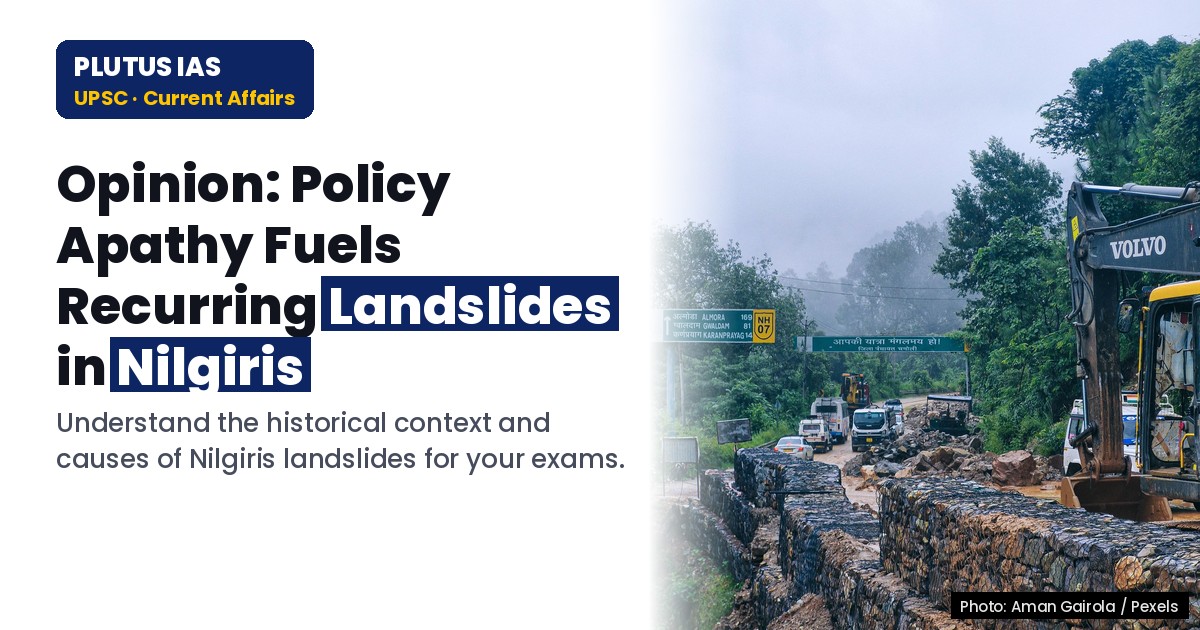
24 Nov Nilgiris Landslides: Policy Apathy & Disaster Management
✎ Effective landslide management in the Nilgiris necessitates a paradigm shift from reactive post-disaster response to proactive, scientifically-grounded prevention and mitigation, integrating robust conservation policies with…
Subject Relevance — Where This Topic Fits
- GS Paper I — Geography of India (Physical Geography, Important Geophysical Phenomena) | GS Paper III — Disaster Management (Disaster and Disaster Management) | GS Paper III — Environment (Conservation, Environmental Pollution and Degradation, Environmental Impact Assessment)
- Prelims: Landslides, Nilgiris, Geological Survey of India (GSI), National Disaster Management Authority (NDMA), Precambrian rocks, Northeast Monsoon, Anthropogenic influence, Disaster risk reduction
- Essay: Environmental degradation and sustainable development, The role of governance in disaster preparedness, Climate change and its impact on vulnerable ecosystems
Quick Revision: Effective landslide management in the Nilgiris necessitates a paradigm shift from reactive post-disaster response to proactive, scientifically-grounded prevention and mitigation, integrating robust conservation policies with inter-agency collaboration and community participation.
Why is this in the news?
Recent landslides in the Nilgiris, particularly during the northeast monsoon, have highlighted persistent issues of policy apathy, inadequate preventative measures, and a reactive approach to disaster management. Despite a long history of such incidents, dating back to 1824, the region continues to experience significant devastation, raising concerns about the efficacy of current conservation policies and inter-agency coordination.
Background
- The Nilgiris, a high-altitude landmass in Tamil Nadu, has a documented history of landslides, with significant events recorded in 1881, 1993, and 2009.
- The geological formation of the Nilgiris, comprising Precambrian metamorphic rocks with foliated structures, joints, and fractures, renders its slopes inherently susceptible to instability, particularly during prolonged rainfall.
- Anthropogenic activities, coupled with weak enforcement of conservation policies, have exacerbated the natural vulnerability of the Nilgiris, leading to increased frequency and intensity of landslides.
- Existing disaster management efforts in the region have been criticised for being predominantly post-hoc, focusing on rescue, rehabilitation, and indemnity, rather than proactive prevention and mitigation.
- Discrepancies in landslide susceptibility mapping, such as the recent Nationwide Landslide Susceptibility Mapping – 2025 by the Geological Survey of India (GSI), have created ambiguity and concern among local residents regarding the accurate identification of vulnerable locations.
- Deficiencies in inter-departmental collaboration and information sharing have been identified as significant impediments to effective and coordinated disaster response and prevention strategies in the Nilgiris.
Understanding Landslides and Disaster Management
- A landslide is a form of mass wasting that involves the movement of a mass of rock, debris, or earth down a slope, primarily driven by gravity.
- Factors contributing to landslides include geological conditions (e.g., weak rock structures, faults), hydrological conditions (e.g., heavy rainfall, water saturation), seismic activity, and anthropogenic interventions (e.g., deforestation, improper construction, mining).
- The Nilgiris’ susceptibility is heightened by its ancient Precambrian geological structure, which, despite its age, possesses inherent weaknesses that can be exploited by intense monsoon rainfall.
- Disaster management encompasses a comprehensive framework involving preparedness, mitigation, response, and recovery, aiming to reduce the impact of hazards on communities and infrastructure.
- Preventative measures for landslide-prone areas include slope stabilisation techniques (e.g., terracing, retaining walls), afforestation, controlled drainage, land-use planning, and strict enforcement of environmental regulations.
- The Geological Survey of India (GSI) is the primary national agency responsible for geological mapping and assessment, including landslide susceptibility mapping, which provides crucial data for disaster risk reduction.
- Effective disaster management necessitates robust inter-agency coordination, timely information dissemination, community engagement, and a shift from reactive crisis management to proactive risk reduction strategies.
- The National Disaster Management Authority (NDMA) in India formulates policies, plans, and guidelines for disaster management to ensure a holistic and coordinated approach across all levels of governance.
Key Features
| Feature | Significance |
|---|---|
| Nilgiris Geological Formation | Dates back to the Precambrian era, comprising high-grade metamorphic rocks with foliated structures, joints, and fractures that predispose slopes to instability during heavy rainfall. |
| Rainfall Threshold | While no universal minimum exists, Nilgiris’ weakened geology makes slopes susceptible to landslides when rainfall approaches 150mm. |
| Historical Landslide Incidents | Recorded since 1824, with significant events in 1881, 1890 (740mm rainfall), 1993 (Marapallam), and 2009 (Ralliah, part of 1,150 simultaneous landslides), indicating a long-standing vulnerability. |
| Anthropogenic Influence | Rapacious human activities, including ‘development’ outgrowing ‘conservation’, contribute significantly to slope destabilisation and increased landslide frequency. |
| Disputed Susceptibility Mapping | The Geological Survey of India’s (GSI) Nationwide Landslide Susceptibility Mapping – 2025 reduced vulnerable locations in Nilgiris from 283 to 156, a figure contested by environmental observers and causing ambiguity among residents. |
| Policy and Governance Gaps | Intergovernmental non-compliance, weak enforcement of conservation policies, and apathy towards safeguarding fragile mountains exacerbate the problem, shifting focus to post-hoc crisis management over prevention. |
Why it Matters
Environmental Significance
- The Nilgiris, part of the Western Ghats, are a UNESCO World Heritage Site and a biodiversity hotspot, making their ecological degradation due to landslides a critical environmental concern.
- Increased frequency and intensity of landslides disrupt delicate mountain ecosystems, leading to habitat loss, soil erosion, and altered hydrological regimes.
Socio-Economic Significance
- Landslides cause loss of human lives, displacement of communities, and destruction of infrastructure, including roads, homes, and agricultural land, impacting local livelihoods and regional connectivity.
- The recurring nature of these disasters necessitates significant public expenditure on rescue, relief, and rehabilitation, diverting resources from developmental initiatives.
Governance and Policy Significance
- The issue highlights critical deficiencies in disaster risk reduction strategies, including inadequate early warning systems, insufficient land-use planning, and weak enforcement of environmental regulations.
- Discrepancies in landslide susceptibility mapping and inter-agency coordination failures underscore the need for robust, scientifically informed, and collaborative governance frameworks for disaster management.
Challenges
1. Anthropogenic Pressure and Unsustainable Development
- Rapid and often unregulated ‘development’ activities, including construction, deforestation, and infrastructure projects, destabilise fragile slopes.
- Increased human footprint in ecologically sensitive zones exacerbates natural vulnerabilities, leading to more frequent and severe landslide events.
UPSC Link: Environmental Degradation; Disaster Management
2. Climate Change Impacts
- Intensifying climate crisis leads to altered rainfall patterns, including more extreme precipitation events, which are primary triggers for landslides in susceptible regions.
- The increased frequency of heavy rainfall spells overwhelms the natural stability of slopes, especially in geologically weakened areas like the Nilgiris.
UPSC Link: Climate Change; Disaster Management
3. Inadequate Disaster Prevention and Mitigation
- Focus remains predominantly on post-hoc crisis management (rescue, rehabilitation, indemnity) rather than proactive prevention and mitigation measures.
- Lack of obligatory scientific interventions and sporadic implementation of conservation policies leave the hills vulnerable to recurring disasters.
UPSC Link: Disaster Management; Environmental Policy
4. Inter-Agency Coordination and Data Discrepancies
- Deficient collaboration among line departments and intergovernmental non-compliance hinder effective and coordinated action in disaster management.
- Disputed landslide susceptibility mapping (e.g., GSI vs. state assessment) creates ambiguity and undermines trust among local residents, complicating targeted interventions.
UPSC Link: Governance; Disaster Management
5. Weak Enforcement of Conservation Policies
- Existing conservation policies are often weakly enforced, allowing for activities that compromise the ecological integrity and stability of mountain slopes.
- Apathy towards safeguarding fragile mountain ecosystems perpetuates a cycle of environmental degradation and increased disaster risk.
UPSC Link: Environmental Law; Governance
Challenges — UPSC Perspective
| Issue | Concern |
|---|---|
| Policy Apathy and Weak Enforcement | Lack of stringent implementation of conservation policies and a reactive approach to disaster management rather than proactive prevention. |
| Anthropogenic Influence | Unregulated ‘development’ activities and human encroachment in ecologically sensitive areas destabilise fragile mountain slopes. |
| Climate Change Intensification | Increased frequency and intensity of extreme rainfall events, exacerbating the natural vulnerability of the Nilgiris’ geology. |
| Intergovernmental Non-Compliance | Deficient coordination and collaboration among various government agencies, hindering integrated disaster risk reduction efforts. |
| Disputed Scientific Assessments | Contradictory findings in landslide susceptibility mapping (e.g., GSI vs. state assessments) create confusion and undermine effective planning. |
| Limited Accountability | Accountability in disaster management often remains arbitrarily restricted to rescue, rehabilitation, and indemnity, neglecting prevention. |
Way Forward
- Implement comprehensive land-use planning and zoning regulations, strictly restricting construction and development in identified high-risk landslide zones.
- Strengthen the enforcement of existing environmental protection laws and conservation policies, ensuring accountability for violations that contribute to slope instability.
- Invest in advanced scientific interventions, including high-resolution landslide susceptibility mapping, real-time monitoring systems, and early warning mechanisms, with community participation.
- Foster inter-agency coordination and collaboration among all relevant government departments (e.g., GSI, disaster management authorities, local administration) for integrated risk assessment and response.
- Promote sustainable tourism practices and regulate visitor access to vulnerable areas, minimising anthropogenic pressure on fragile ecosystems.
- Undertake extensive public awareness campaigns and community capacity building programmes to educate residents on landslide risks, safe practices, and emergency protocols.
- Prioritise nature-based solutions for slope stabilisation, such as afforestation with native species, bioengineering techniques, and restoration of natural drainage patterns.
- Establish a clear framework for accountability in disaster management that extends beyond post-disaster response to encompass prevention, mitigation, and preparedness.
UPSC Value Addition
Keywords for Mains Answer-Writing
Landslide susceptibility · Disaster risk reduction · Anthropogenic influence · Climate change adaptation · Environmental conservation · Geological Survey of India · National Disaster Management Authority · Inter-agency coordination · Sustainable development · Early warning systems · Post-disaster rehabilitation · Vulnerability assessment
Constitutional & Policy Linkages
- {‘article’: ‘Article 21’, ‘note’: ‘Right to life and personal liberty’}
- {‘article’: ‘Article 48A’, ‘note’: ‘Protection and improvement of environment’}
- {‘article’: ‘Article 243W’, ‘note’: ‘Powers of Municipalities’}
- {‘article’: ‘Article 243G’, ‘note’: ‘Powers of Panchayats’}
Concept Flow
Geological vulnerability of Nilgiris (Precambrian rocks, fractures) → Intensifying climate crisis (extreme rainfall events) → Anthropogenic pressures (‘development’ outgrowing ‘conservation’) → Weak enforcement & inter-agency non-compliance → Increased frequency and intensity of landslides → Socio-economic and environmental devastation → Focus on post-hoc crisis management over prevention
Prelims Practice Questions
Q1. Consider the following statements regarding landslides in the Nilgiris region:
1. The geological formation of the Nilgiris consists primarily of sedimentary rocks, making them susceptible to erosion.
2. Anthropogenic activities, such as unregulated development, have exacerbated landslide vulnerability in the region.
3. The Geological Survey of India (GSI) is responsible for landslide susceptibility mapping in India.
How many of the above statements are correct?
- Only one
- Only two
- Only three
- None
Answer: Only two — Statement 1 is incorrect: The Nilgiris consist of high-grade metamorphic rocks from the Precambrian era, not sedimentary rocks. Statement 2 is correct: Anthropogenic influence, including ‘development’ outgrowing ‘conservation’, is cited as a major factor. Statement 3 is correct: The GSI is explicitly mentioned as releasing the Nationwide Landslide Susceptibility Mapping.
Q2. Which of the following bodies is primarily responsible for formulating policies and guidelines for disaster management in India, including aspects of prevention, mitigation, and response?
- Geological Survey of India (GSI)
- National Disaster Management Authority (NDMA)
- Ministry of Earth Sciences (MoES)
- Indian Meteorological Department (IMD)
Answer: National Disaster Management Authority (NDMA) — The National Disaster Management Authority (NDMA) is the apex body for disaster management in India, responsible for laying down policies, plans, and guidelines for disaster management.
Mains Practice Question
✍ Critically examine the factors contributing to the increasing frequency and intensity of landslides in ecologically sensitive regions like the Nilgiris. Discuss the challenges in implementing effective disaster risk reduction strategies and suggest measures for enhancing resilience. (15 Marks)
Approach: INTRODUCTION: Define landslides and briefly introduce the Nilgiris as a vulnerable region. BODY PART 1 (Factors contributing to landslides): Discuss natural factors (geological fragility, heavy rainfall patterns, climate change impacts) and anthropogenic factors (unplanned development, deforestation, weak enforcement of conservation policies, intergovernmental non-compliance). Cite specific examples from the Nilgiris (e.g., Precambrian metamorphic rocks, historical landslide events, ‘development’ vs. ‘conservation’). BODY PART 2 (Challenges in disaster risk reduction): Address issues such as inadequate scientific interventions, contested vulnerability assessments (e.g., GSI vs. state assessment), deficient inter-agency coordination, focus on post-hoc crisis management over prevention, and policy apathy. BODY PART 3 (Measures for enhancing resilience): Propose solutions including strengthening early warning systems, comprehensive landslide susceptibility mapping, strict enforcement of environmental regulations, promoting sustainable land use practices, community-based disaster preparedness, capacity building for rescue and rehabilitation, and fostering inter-departmental collaboration. CONCLUSION: Summarize the need for a holistic, multi-stakeholder approach to disaster management in vulnerable ecosystems.
Source: newindianexpress.com
Generated by AanyaAi for educational purpose.
Related guides on our sites
- Anthropology VS PSIR
- Best PSIR optional coaching
- Best PSIR optional coaching online
- Best geography optional coaching

- Nilgiris Landslides: Policy Apathy & Disaster Management - November 24, 2026
- कर्नाटक में अनुसूचित जनजाति कल्याण हेतु समर्पित ऐप का विकास - November 24, 2026
- Andhra Pradesh NCD Survey Expands: UPSC Governance Focus - November 24, 2026

No Comments