


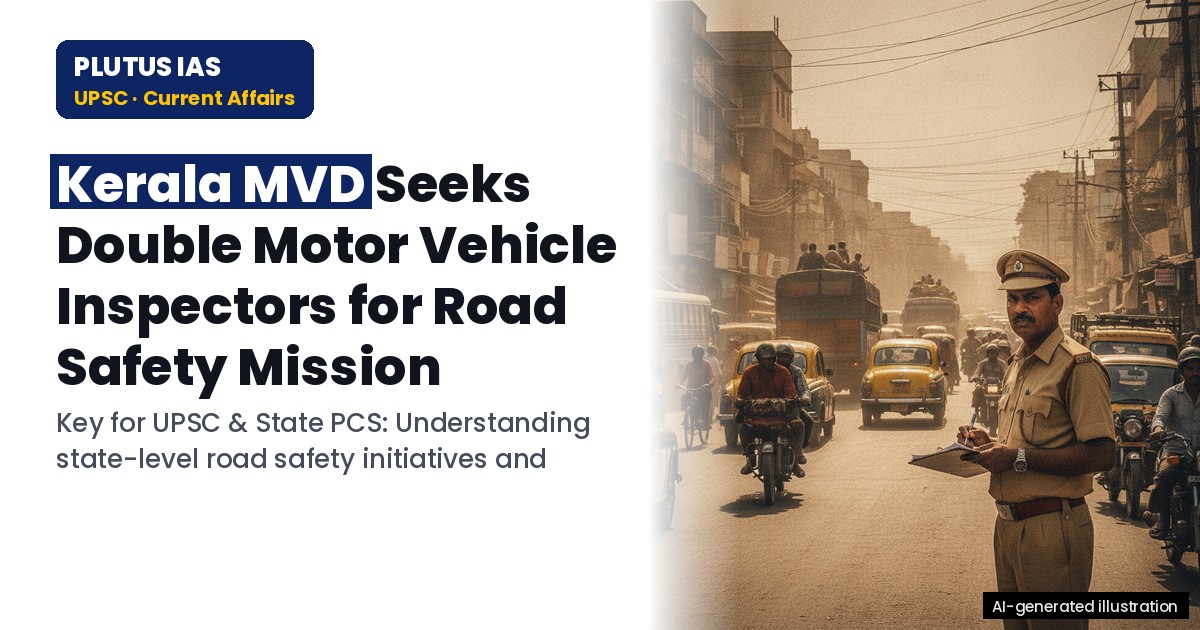
25 Nov Kerala Road Safety Mission: MVD Seeks More Personnel
✎ The Kerala Road Safety Mission (KRSM) seeks to enhance road safety through increased enforcement personnel, 24×7 field operations, and a robust supervisory structure, addressing the growing challenges of vehicle population and…
Subject Relevance — Where This Topic Fits
- GS Paper II — Governance; Government Policies and Interventions | GS Paper III — Internal Security; Infrastructure
- Prelims: Kerala Road Safety Mission (KRSM), Motor Vehicles Department (MVD), Road safety enforcement, AI-enabled cameras, e-challan systems, Kerala Road Safety Authority (KRSA)
- Essay: The imperative of robust governance in ensuring public safety and welfare., Leveraging technology and human resources for effective policy implementation.
Quick Revision: The Kerala Road Safety Mission (KRSM) seeks to enhance road safety through increased enforcement personnel, 24×7 field operations, and a robust supervisory structure, addressing the growing challenges of vehicle population and accident rates.
Why is this in the news?
The Kerala Motor Vehicles Department (MVD) has formally requested the state government to significantly increase its enforcement personnel, specifically Motor Vehicle Inspectors (MVIs) and Assistant MVIs. This initiative is aimed at bolstering the effective implementation of the recently launched Kerala Road Safety Mission (KRSM), addressing the challenges posed by an escalating vehicle population and the increasing complexity of traffic management, particularly during night hours when fatal accidents are more prevalent.
Background
- Kerala records approximately 50,000 road accidents annually, resulting in around 4,000 fatalities and over 56,000 injuries, highlighting a critical public safety concern.
- The state’s vehicle population is projected to reach two crore, necessitating a commensurate increase in enforcement capabilities to manage traffic and ensure compliance.
- Existing MVD personnel numbers (297 MVIs and AMVIs) are deemed inadequate to enforce traffic regulations 24×7, especially given the expansion of National Highway corridors and increased inter-state traffic.
- The ‘Safe Kerala Project’, launched approximately a decade ago, currently operates with only about 85 enforcement squads, indicating a long-standing need for enhanced field presence.
- Technological interventions like AI-enabled cameras and e-challan systems have improved compliance monitoring, but serious offences such as drunk driving and permit violations still require intensive field-level enforcement.
- The proposed recruitment of 510 additional AMVIs and 198 MVIs aims to facilitate a three-shift deployment system for enforcement squads, mirroring the operational model of the Police Department.
The Kerala Road Safety Mission (KRSM) and its Enforcement Framework
- The Kerala Road Safety Mission (KRSM) is a state-level initiative formally launched to establish an effective road safety management system and achieve the road safety objectives outlined in the 2026 Revised Budget.
- It aims to reduce road accidents, fatalities, and injuries through comprehensive enforcement, awareness campaigns, and infrastructural improvements.
- The Motor Vehicles Department (MVD) is the primary agency responsible for the implementation and enforcement of the KRSM, including traffic rule enforcement and penalising violators.
- The mission proposes a 24×7 deployment of enforcement squads, operating on a three-shift system, to ensure continuous monitoring and intervention, particularly during peak accident hours.
- Key enforcement areas include serious offences such as drunk driving, dangerous driving, permit and fitness violations, overloading, and tax evasion, which require direct field intervention.
- The proposed supervisory structure includes a Senior Deputy Transport Commissioner (Enforcement) for daily monitoring and an Assistant Transport Commissioner (Enforcement) as the state-level nodal officer for post-accident probes and district-specific enforcement strategies.
- Coordination with other agencies such as the Kerala Road Safety Authority (KRSA), National Highways Authority of India (NHAI), Public Works Department (PWD), and the Police is integral to the comprehensive approach of the KRSM.
Key Features
| Feature | Significance |
|---|---|
| Kerala Road Safety Mission (KRSM) | Formal launch aimed at establishing an effective road safety management system. |
| Increased Enforcement Personnel Requirement | Proposal to recruit 765 Motor Vehicle Inspectors (MVI) and Assistant MVIs, more than double the current 297, to address the rising vehicle population and enforcement challenges. |
| 24×7 Enforcement Deployment | Proposed implementation of a three-shift system for enforcement squads, similar to the Police department, to ensure continuous monitoring and rule enforcement. |
| Technological Interventions | Utilisation of AI-enabled cameras and e-challan systems to strengthen compliance monitoring and enhance enforcement efficiency. |
| Supervisory Structure Enhancement | Proposal for a Senior Deputy Transport Commissioner (Enforcement) for daily monitoring and an Assistant Transport Commissioner (Enforcement) as a State-level nodal officer for post-accident probes and inter-agency coordination. |
Why it Matters
Governance and Public Administration
- Demonstrates the proactive approach of the Motor Vehicles Department (MVD) in addressing critical public safety issues through administrative reforms and resource augmentation.
- Highlights the necessity for continuous capacity building within government departments to keep pace with evolving societal needs and infrastructural growth.
- Illustrates the importance of inter-agency coordination (MVD, KRSA, NHAI, PWD, Police) for comprehensive policy implementation and effective governance.
Economic Implications
- Potential to generate significant additional revenue (₹360.40 crore annually) through fines and penalties, substantially outweighing the increased expenditure on personnel salaries (₹42.60 crore annually).
- Reduction in road accidents and fatalities can lead to substantial economic savings by decreasing healthcare costs, property damage, and productivity losses.
- Improved road safety infrastructure and enforcement can positively impact logistics operations, especially with the commencement of activities at Vizhinjam International Port, fostering economic growth.
Social Welfare and Public Safety
- Directly contributes to enhancing public safety by reducing the incidence of road accidents, injuries, and fatalities, thereby improving the quality of life for citizens.
- Addresses critical issues like drunk driving, dangerous driving, and overloading, which are major contributors to severe accidents, particularly during night hours.
- The emphasis on 24×7 enforcement aims to create a safer road environment, fostering a culture of compliance among road users.
Technological Integration
- Showcases the strategic integration of advanced technologies like AI-enabled cameras and e-challan systems in modern governance for efficient traffic management and enforcement.
- Emphasises that while technology aids compliance, human intervention and field-level enforcement remain crucial for addressing complex violations and ensuring comprehensive road safety.
Challenges
1. Inadequate Enforcement Personnel
- Existing personnel strength (297 MVIs and AMVIs) is insufficient to effectively enforce traffic rules 24×7 across the state.
- Difficulty in penalising rule violators, especially during peak accident hours at night, due to staff shortages.
UPSC Link: Public Administration: Personnel Management
2. Rising Vehicle Population and Infrastructure Growth
- Unprecedented growth in vehicle numbers, expansion of National Highway corridors, and increasing inter-State traffic necessitate a larger enforcement presence.
- Commencement of logistics operations through Vizhinjam International Port further increases the demand for stringent road safety regulation.
UPSC Link: Economy: Infrastructure; Environment: Transport
3. Complex Violations Requiring Field Enforcement
- Serious offences such as drunk driving, dangerous driving, permit and fitness violations, overloading, and tax evasion cannot be fully addressed by technological interventions alone.
- These violations require intensive field-level enforcement and physical presence of personnel.
UPSC Link: Internal Security: Law and Order; Governance: Public Safety
4. Ensuring Continuous Enforcement
- The current operational model struggles to enforce traffic rules round-the-clock, particularly during night hours when fatal accidents are prevalent.
- Implementing a three-shift system requires substantial human resources and robust logistical support.
UPSC Link: Public Administration: Organisational Behaviour; Governance: Service Delivery
Challenges — UPSC Perspective
| Issue | Concern |
|---|---|
| Personnel Shortage | Existing staff cannot adequately manage the increasing vehicle population and enforce rules 24×7, leading to enforcement gaps. |
| Enforcement of Serious Offences | Technological tools are insufficient for violations like drunk driving, overloading, and dangerous driving, necessitating more field personnel. |
| Night-Time Accident Peak | Inadequate night-time enforcement contributes to a higher incidence of fatal accidents during these hours. |
| Revenue Realisation | Suboptimal collection of fines and penalties due to insufficient enforcement capacity, impacting potential government revenue. |
| Inter-Agency Coordination | Need for robust coordination mechanisms between MVD, KRSA, NHAI, PWD, and Police for holistic road safety management. |
Government Initiatives — Must-Memorise for Prelims
- Kerala Road Safety Mission (KRSM)
- Safe Kerala Project
Way Forward
- Expeditious recruitment and training of the proposed additional Motor Vehicle Inspectors and Assistant MVIs to bridge the existing personnel gap.
- Implement the proposed three-shift system for enforcement squads to ensure 24×7 vigilance and rule enforcement, particularly during critical night hours.
- Strengthen the supervisory structure with dedicated Senior Deputy Transport Commissioner (Enforcement) and Assistant Transport Commissioner (Enforcement) roles for effective monitoring and coordination.
- Enhance inter-agency coordination mechanisms involving the Kerala Road Safety Authority (KRSA), NHAI, PWD, and Police for a unified approach to road safety.
- Leverage technological interventions like AI-enabled cameras and e-challan systems in conjunction with increased field enforcement for comprehensive compliance monitoring.
- Conduct regular public awareness campaigns on road safety regulations and the consequences of violations to foster a culture of responsible driving.
- Utilise accident data and profiles to strategically deploy enforcement resources and target high-risk areas and specific types of violations.
- Invest in continuous training and capacity building for enforcement personnel to keep them updated with new technologies, regulations, and best practices in road safety management.
UPSC Value Addition
Keywords for Mains Answer-Writing
Road Safety Mission · Motor Vehicles Act 1988 · Road Safety Authority · Enforcement personnel · Traffic rule enforcement · Accident reduction strategies · Technological interventions in road safety · Safe Kerala Project · Inter-agency coordination · Revenue generation from penalties · Human resource augmentation · Road safety management system
Concept Flow
Increasing Vehicle Population and Infrastructure Growth → Inadequate Enforcement Personnel and Resources → Challenges in 24×7 Traffic Rule Enforcement → Increased Road Accidents, Injuries, and Fatalities → Proposal for Enhanced Personnel and Supervisory Structure → Improved Road Safety, Revenue Generation, and Public Welfare
Prelims Practice Questions
Q1. Consider the following statements regarding road safety in India:
1. The Motor Vehicles Act, 1988, is the primary legislation governing road transport and safety in India.
2. The National Road Safety Policy aims to reduce road accidents and fatalities by 50% by 2030.
3. State Road Safety Councils are statutory bodies established under the Motor Vehicles (Amendment) Act, 2019.
- Only one
- Only two
- Only three
- None
Answer: Only two — Statement 1 is correct. The Motor Vehicles Act, 1988, is indeed the principal legislation. Statement 2 is correct. India aims to reduce road accidents and fatalities by 50% by 2030, aligning with the global target set by the Second Global High-Level Conference on Road Safety. Statement 3 is incorrect. State Road Safety Councils are typically established under state-specific rules or executive orders, not directly as statutory bodies under the Motor Vehicles (Amendment) Act, 2019, although the Act strengthens provisions for road safety governance.
Q2. Which of the following measures are considered effective in enhancing road safety enforcement?
1. Deployment of AI-enabled cameras for automated challans.
2. Increased field-level enforcement personnel for serious offences.
3. Implementation of a multi-shift system for enforcement squads.
4. Inter-agency coordination among MVD, Police, and NHAI.
- 1 and 2 only
- 2, 3 and 4 only
- 1, 3 and 4 only
- 1, 2, 3 and 4
Answer: 1, 2, 3 and 4 — All four measures listed are effective in enhancing road safety enforcement. AI-enabled cameras and e-challan systems improve compliance monitoring. Increased field personnel are crucial for serious offences like drunk driving and overloading. A multi-shift system ensures 24×7 enforcement, especially during peak accident hours. Inter-agency coordination is vital for holistic road safety management and accident investigation.
Mains Practice Question
✍ Critically examine the challenges in effective implementation of road safety missions in India, with particular reference to human resource constraints and technological integration. Suggest measures to overcome these obstacles. (15 Marks)
Approach: INTRODUCTION: Briefly define road safety missions and their significance in India. CHALLENGES IN IMPLEMENTATION: Discuss human resource constraints (e.g., inadequate personnel, training gaps, workload), technological integration issues (e.g., infrastructure, data management, interoperability), and other systemic challenges (e.g., funding, public awareness, inter-agency coordination, political will). MEASURES TO OVERCOME OBSTACLES: Propose solutions such as increasing enforcement personnel, enhancing training, leveraging technology (AI, IoT, big data analytics), improving inter-agency collaboration, strengthening legal frameworks, and promoting public education. CONCLUSION: Summarise the importance of a multi-pronged, integrated approach for achieving sustainable road safety outcomes.
Source: The Hindu
Kerala PCS (Kerala PSC (KAS)) — State PCS Practice
Prelims: Which of the following bodies is seeking more enforcement personnel to effectively implement the Kerala Road Safety Mission?
- A. Kerala State Disaster Management Authority (KSDMA)
- B. Motor Vehicles Department (MVD)
- C. Kerala Police Department
- D. Public Works Department (PWD)
Answer: B. Motor Vehicles Department (MVD) — The Motor Vehicles Department (MVD) is the specific body mentioned as seeking more personnel for road safety enforcement.
Mains: Discuss the significance of increasing enforcement personnel for the effective implementation of the Kerala Road Safety Mission, as highlighted by the Motor Vehicles Department (MVD).
Generated by AanyaAi for educational purpose.
Related guides on our sites
- Anthropology VS PSIR
- Best PSIR optional coaching
- Best PSIR optional coaching online
- Best PSIR optional teacher

- Kerala Road Safety Mission: MVD Seeks More Personnel - November 25, 2026
- बिलकिस बानो मामला: सर्वोच्च न्यायालय का आदेश और न्याय की अवधारणा - November 25, 2026
- SC Collegium Recommends Chief Justices for HCs - November 25, 2026

No Comments