


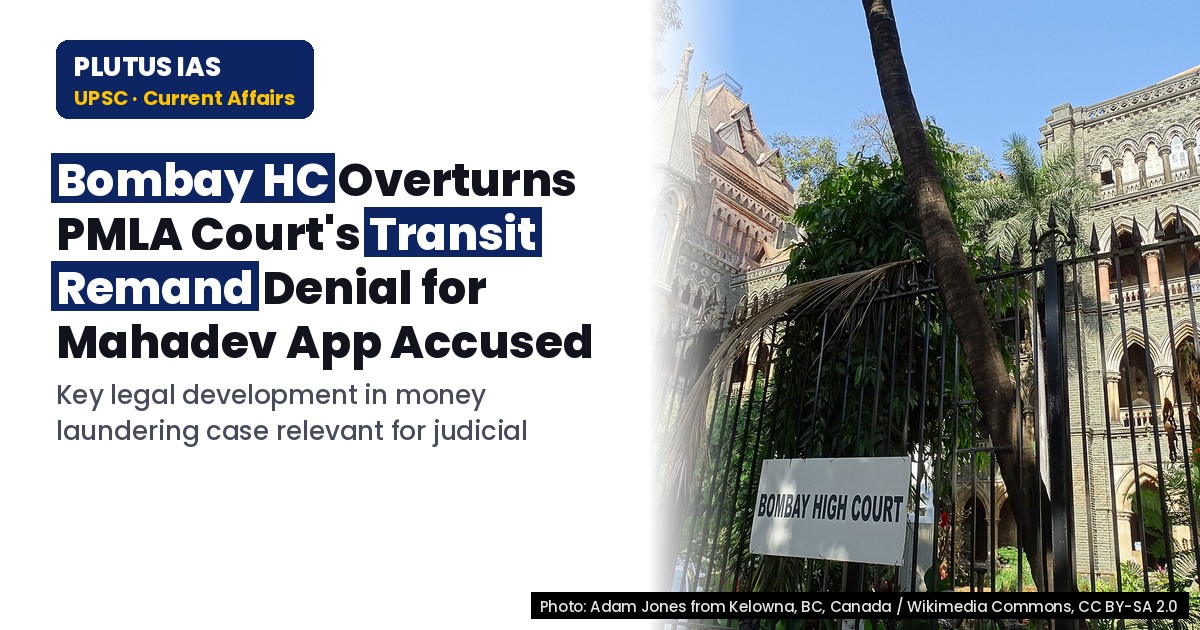
25 Nov Bombay HC Overturns PMLA Court’s Transit Remand Denial
✎ The Bombay High Court's ruling on transit remand reaffirms the importance of judicial discretion and adherence to procedural safeguards, particularly the 24-hour production rule, in cases investigated by agencies like the…
Subject Relevance — Where This Topic Fits
- GS Paper II — Polity and Governance | GS Paper II — Structure, Organisation and Functioning of the Executive and the Judiciary | GS Paper III — Money Laundering and its Prevention
- Prelims: Prevention of Money Laundering Act (PMLA), Enforcement Directorate (ED), Transit Remand, Judicial Remand, Lookout Circular (LOC), Article 22(2) of the Constitution, Code of Criminal Procedure (CrPC)
- Essay: The delicate balance between individual liberty and state power in criminal justice administration., Challenges in combating financial crimes: The role of inter-agency cooperation and judicial oversight.
Quick Revision: The Bombay High Court’s ruling on transit remand reaffirms the importance of judicial discretion and adherence to procedural safeguards, particularly the 24-hour production rule, in cases investigated by agencies like the Enforcement Directorate under the PMLA.
Why is this in the news?
The Bombay High Court recently set aside an order by a special Prevention of Money Laundering Act (PMLA) court that had denied transit remand for an accused in the Mahadev betting app case. The High Court permitted the Enforcement Directorate (ED) to re-arrest the individual, highlighting the procedural nuances and legal principles governing transit remand, particularly concerning the 24-hour production rule under Article 22(2) of the Constitution and Section 57 of the CrPC.
Background
- The case involves a money laundering investigation initiated by the Enforcement Directorate (ED) under the Prevention of Money Laundering Act, 2002, concerning the alleged proceeds of crime from the Mahadev Online Book betting application.
- An accused was detained at Mumbai airport under a Lookout Circular (LOC) while attempting to depart for Dubai, subsequently leading to his arrest by the ED’s Raipur office.
- The PMLA court in Mumbai had denied transit remand, citing that the 24-hour period for producing an arrested person before a magistrate, as mandated by law, was calculated from the time of detention, not formal arrest by the ED.
- The ED contended that the formal arrest and subsequent production before the court were within the stipulated 24-hour timeframe, and the PMLA court’s reasoning for denying transit remand was ‘perverse’ and based on ‘flimsy grounds’.
- Transit remand is a judicial authorisation granted by a magistrate in one jurisdiction to allow an investigating agency to transport an arrested person to another jurisdiction where the primary case is registered and further investigation is required.
- The legal framework mandates that an arrested person must be produced before the nearest magistrate within 24 hours of arrest, excluding the time necessary for the journey from the place of arrest to the magistrate’s court, as per Article 22(2) of the Constitution and Section 57 of the Code of Criminal Procedure, 1973.
Key Legal Concepts and Institutions Involved
- The Prevention of Money Laundering Act (PMLA), 2002, is a comprehensive legislation enacted to prevent money laundering and to provide for confiscation of property derived from, or involved in, money laundering.
- The Enforcement Directorate (ED) is a multi-disciplinary organisation mandated to investigate offences of money laundering and violations of foreign exchange laws. It functions under the Department of Revenue, Ministry of Finance.
- Transit Remand is a judicial order permitting the police or an investigating agency to move an arrested person from the place of arrest to the court having jurisdiction over the case for further proceedings, ensuring compliance with the 24-hour production rule.
- Judicial Remand refers to the custody of an accused person ordered by a court, typically after their initial production, allowing for continued detention during the investigation or trial period.
- A Lookout Circular (LOC) is a circular issued by government agencies to restrict the movement of individuals, often used to prevent absconding accused persons from leaving the country or to apprehend them upon arrival.
- Article 22(2) of the Indian Constitution guarantees that every person arrested and detained in custody shall be produced before the nearest magistrate within a period of twenty-four hours of such arrest, excluding the time necessary for the journey from the place of arrest to the court of the magistrate, and no such person shall be detained in custody beyond the said period without the authority of a magistrate.
Key Features
| Feature | Significance |
|---|---|
| Transit Remand | A judicial authorisation for the temporary custody of an accused person, enabling their transfer from the jurisdiction of arrest to the jurisdiction where the alleged offence occurred or where the investigation is being conducted. |
| Prevention of Money Laundering Act (PMLA), 2002 | A comprehensive legislation enacted to combat money laundering, confiscate property derived from or involved in money laundering, and address related matters, empowering the Enforcement Directorate (ED) with significant investigative powers. |
| Lookout Circular (LOC) | An administrative instruction issued by various law enforcement agencies to immigration authorities at ports of entry/exit, preventing an individual from leaving the country or facilitating their detention/arrest upon arrival. |
| 24-hour Production Rule | A fundamental safeguard enshrined in criminal jurisprudence, mandating that an arrested person must be produced before a Magistrate within 24 hours of arrest, excluding the time necessary for the journey from the place of arrest to the court. |
| Judicial Scrutiny of Lower Court Orders | The power of higher courts (e.g., High Courts) to review and set aside orders of lower courts if they are found to be legally unsound, perverse, or in contravention of established legal principles. |
Why it Matters
Legal and Jurisprudential Significance
- The Bombay High Court’s ruling reinforces the established legal principles governing transit remand, clarifying that such authorisation should generally be granted when there are no substantive grounds for refusal, particularly in cases involving inter-state investigations.
- The High Court’s observation on the ‘perverse’ finding by the PMLA court underscores the importance of judicial discretion being exercised within the bounds of legal provisions and established precedents, rather than based on individual notions.
- The case highlights the procedural intricacies involved in inter-jurisdictional arrests and the necessity for judicial cooperation to facilitate effective law enforcement and investigation across state boundaries.
Enforcement and Investigative Efficacy
- The decision strengthens the operational capacity of central investigative agencies like the Enforcement Directorate (ED) in pursuing complex financial crimes that often involve multiple jurisdictions and require the transfer of accused persons.
- It reaffirms the validity of using instruments like Lookout Circulars (LOCs) as crucial tools for preventing economic offenders from absconding and ensuring their availability for investigation and prosecution.
- The ruling provides clarity on the interpretation of the 24-hour production rule in the context of transit remand, ensuring that procedural technicalities do not unduly impede legitimate investigative processes.
Combating Financial Crime
- The case pertains to the ‘Mahadev betting app’ investigation, which involves alleged proceeds of crime running into several thousand crores of rupees, thereby underscoring the scale and complexity of modern money laundering operations.
- Effective application of PMLA provisions, supported by appropriate judicial interpretations, is crucial for tracing, attaching, and confiscating assets derived from illegal activities, thereby deterring financial crime.
- The ability of agencies to secure transit remand expeditiously is vital for consolidating investigations in a single jurisdiction, which is often necessary for prosecuting large-scale financial frauds and organised crime syndicates.
Challenges
1. Inter-Jurisdictional Coordination
- Investigating complex financial crimes often involves multiple state jurisdictions, necessitating seamless coordination between different law enforcement agencies and judicial authorities.
- Discrepancies in interpretation of procedural laws by courts in different states can create hurdles for central agencies like the ED, impacting the efficiency of investigations.
UPSC Link: Criminal Justice System; Federalism
2. Procedural Delays and Obstacles
- Technical interpretations of procedural requirements, such as the 24-hour production rule or the grounds for transit remand, can lead to delays or even the release of accused persons, potentially jeopardising investigations.
- The need for special holiday benches or urgent hearings highlights the challenges in ensuring timely judicial intervention for critical investigative steps, especially in high-stakes cases.
UPSC Link: Criminal Procedure; Judicial Administration
3. Effectiveness of Anti-Money Laundering Framework
- The success of the PMLA in combating money laundering hinges on robust investigative powers, effective inter-agency cooperation, and consistent judicial support for procedural requirements like transit remand.
- Challenges in securing custody or transferring accused persons can undermine the ability to follow the money trail and bring perpetrators of large-scale financial frauds to justice.
UPSC Link: Money Laundering; Economic Offences
4. Balancing Rights of Accused and Investigative Imperatives
- Courts must carefully balance the fundamental rights of the accused, including the right to be produced before a magistrate within 24 hours, with the legitimate requirements of law enforcement agencies to conduct thorough investigations.
- Ensuring that transit remand is not refused on ‘flimsy grounds’ is crucial for maintaining this balance and preventing undue obstruction of justice.
UPSC Link: Fundamental Rights; Criminal Justice
Challenges — UPSC Perspective
| Issue | Concern |
|---|---|
| Denial of Transit Remand | Obstructs inter-state investigations, particularly in complex financial crimes, by preventing the transfer of accused persons to the primary jurisdiction of the offence. |
| Interpretation of 24-hour Rule | Varied judicial interpretations regarding the commencement and calculation of the 24-hour period for production can create legal ambiguities and procedural challenges for law enforcement agencies. |
| Judicial Discretion | Exercise of judicial discretion based on ‘notions’ rather than established legal principles can lead to ‘perverse’ orders, necessitating intervention by higher courts and causing delays. |
| Absconding Accused | Refusal of transit remand or release of an accused, especially those with a history of frequent international travel, increases the risk of them absconding and evading justice. |
| Resource Utilisation | Appeals to higher courts for procedural matters like transit remand consume significant judicial and investigative resources, diverting attention from substantive aspects of the case. |
Way Forward
- Promote judicial training and sensitisation programs for lower court judges on the nuances of procedural laws, especially those pertaining to inter-jurisdictional arrests and special legislations like PMLA.
- Develop standardised guidelines for the grant of transit remand, ensuring consistency across different jurisdictions and minimising arbitrary denials based on non-substantive grounds.
- Strengthen inter-agency coordination mechanisms between central investigative agencies and state police forces to streamline the process of arrests, transfers, and evidence collection in multi-state cases.
- Leverage technology for efficient communication and information sharing between courts and law enforcement agencies, potentially facilitating faster processing of remand applications.
- Consider legislative clarifications, if necessary, to address ambiguities in procedural provisions, such as the precise interpretation of the 24-hour production rule in transit remand scenarios.
- Enhance the capacity of special courts, including PMLA courts, to handle complex financial crime cases expeditiously, ensuring timely and legally sound decisions.
- Implement robust systems for monitoring individuals under lookout circulars to prevent their escape, complementing the legal framework with effective enforcement measures.
UPSC Value Addition
Keywords for Mains Answer-Writing
Prevention of Money Laundering Act (PMLA) · Enforcement Directorate (ED) · Transit Remand · Judicial Scrutiny · Constitutional Rights of Accused · Criminal Procedure Code (CrPC) · Lookout Circular (LOC) · Money Laundering Investigation · Jurisdiction of Courts · Rule of Law · Judicial Review · Fair Trial
Constitutional & Policy Linkages
- Article 22(2): Right to be produced before a Magistrate within 24 hours of arrest.
- Article 226: Power of High Courts to issue writs, including for setting aside lower court orders.
- Article 21: Protection of life and personal liberty, encompassing fair procedure in arrest and detention.
- Article 136: Special Leave Petition power of the Supreme Court to hear appeals from any court.
Concept Flow
Accused detained under Lookout Circular (LOC) at airport. → Enforcement Directorate (ED) seeks transit remand from PMLA court. → PMLA court denies transit remand, citing procedural grounds. → ED challenges the denial in Bombay High Court. → High Court sets aside PMLA court order, permits fresh arrest. → Accused to be produced before appropriate court for remand.
Prelims Practice Questions
Q1. Consider the following statements regarding the Prevention of Money Laundering Act (PMLA), 2002:
1. The Enforcement Directorate (ED) is the primary agency responsible for investigating offences under PMLA.
2. PMLA offences are cognizable and non-bailable.
3. The Act defines ‘proceeds of crime’ as any property derived or obtained, directly or indirectly, by any person as a result of criminal activity relating to a scheduled offence.
How many of the above statements are correct?
- Only one
- Only two
- All three
- None
Answer: All three — Statement 1 is correct: The ED is indeed the primary agency for PMLA investigations. Statement 2 is correct: Offences under PMLA are cognizable and non-bailable, making arrest without a warrant permissible and bail difficult to obtain. Statement 3 is correct: This accurately reflects the definition of ‘proceeds of crime’ as per Section 2(1)(u) of the PMLA.
Q2. Which of the following legal provisions mandates the production of an arrested person before a Magistrate within 24 hours of arrest, excluding the time necessary for the journey from the place of arrest to the Magistrate’s court?
- Article 20 of the Constitution of India
- Article 21 of the Constitution of India
- Article 22(2) of the Constitution of India
- Section 167 of the Code of Criminal Procedure, 1973
Answer: Article 22(2) of the Constitution of India — Article 22(2) of the Constitution of India explicitly states that every person who is arrested and detained in custody shall be produced before the nearest Magistrate within a period of twenty-four hours of such arrest, excluding the time necessary for the journey from the place of arrest to the court of the Magistrate, and no such person shall be detained in custody beyond the said period without the authority of a Magistrate. Section 57 of the CrPC also reiterates this provision.
Mains Practice Question
✍ Examine the concept of ‘transit remand’ in the Indian criminal justice system. Discuss its significance in inter-state investigations and the judicial principles governing its grant or refusal, with reference to recent judicial pronouncements. (15 Marks)
Approach: MODEL-ANSWER SKELETON:
1. **Introduction:** Define ‘transit remand’ – temporary custody granted by a Magistrate in one jurisdiction to enable an investigating agency to transport an arrested person to the court having jurisdiction over the case in another state.
2. **Legal Basis:** Mention Section 167 of the Code of Criminal Procedure (CrPC), 1973, which implicitly provides for transit remand by mandating production before a Magistrate within 24 hours of arrest. Also, refer to Article 22(2) of the Constitution.
3. **Significance in Inter-State Investigations:**
* Facilitates seamless transfer of accused across jurisdictions.
* Ensures adherence to the 24-hour production rule.
* Prevents accused from evading justice by crossing state borders.
* Maintains the chain of custody and legal propriety.
4. **Judicial Principles Governing Grant/Refusal:**
* **Purpose:** Primarily to enable production before the jurisdictional court, not for detailed interrogation at the transit location.
* **Prima Facie Case:** The Magistrate must be satisfied that a prima facie case exists against the accused and that the arresting agency has lawful authority.
* **Compliance with 24-hour Rule:** Strict adherence to Article 22(2) and Section 57 CrPC.
* **Opportunity for Accused:** The accused must be produced before the Magistrate and given an opportunity to be heard, including representation by counsel.
* **No Flimsy Grounds for Refusal:** Transit remand should not be refused on hyper-technical or ‘perverse’ grounds if the legal requirements are met, as highlighted by the Bombay High Court in the instant case.
* **Consideration of Travel Time:** The time taken for travel to the jurisdictional court is a legitimate consideration.
* **Judicial Discretion:** While discretion exists, it must be exercised judiciously and not arbitrarily.
5. **Recent Judicial Pronouncements/Observations (connect to the news):**
* Refer to the Bombay High Court’s observation that transit remand should generally be granted when there are no other grounds for refusal, especially when the accused is produced within 24 hours.
* Emphasize the High Court’s stance against a trial court imposing its ‘own notions’ regarding the timing of production within the 24-hour window.
* Mention the importance of considering the ‘transit’ nature of the remand, implying a less rigorous scrutiny than regular remand.
6. **Conclusion:** Reiterate the balance between facilitating effective investigation and safeguarding the fundamental rights of the accused, with courts playing a crucial role in upholding procedural fairness and the rule of law.
Source: Times of India
Maharashtra PCS (MPSC) — State PCS Practice
Prelims: Which of the following statements is INCORRECT regarding the recent Bombay High Court decision concerning transit remand in the Mahadev betting app case?
- The Bombay High Court set aside an order by a PMLA court.
- The accused was arrested in Mumbai and sought transit remand to another state.
- The PMLA court had initially granted the transit remand, which was challenged.
- The case involves an accused linked to the Mahadev online betting application.
Answer: The PMLA court had initially granted the transit remand, which was challenged. — The PMLA court had initially DENIED the transit remand, which the Bombay High Court subsequently set aside.
Mains: Analyze the implications of the Bombay High Court’s decision to set aside the PMLA court’s denial of transit remand in the Mahadev betting app case, particularly in the context of inter-state investigations and the jurisdiction of special courts in Maharashtra.
Generated by AanyaAi for educational purpose.
Related guides on our sites
- Anthropology VS PSIR
- Best PSIR optional coaching
- Best PSIR optional coaching online
- Best PSIR optional teacher

- Bombay HC Overturns PMLA Court’s Transit Remand Denial - November 25, 2026
- गंगा जल संधि: भारत-बांग्लादेश संबंध और नवीनीकरण की चुनौतियाँ - November 25, 2026
- उमर खालिद और शरजील इमाम की जमानत याचिका पर सुप्रीम कोर्ट में सुनवाई - November 25, 2026

No Comments