


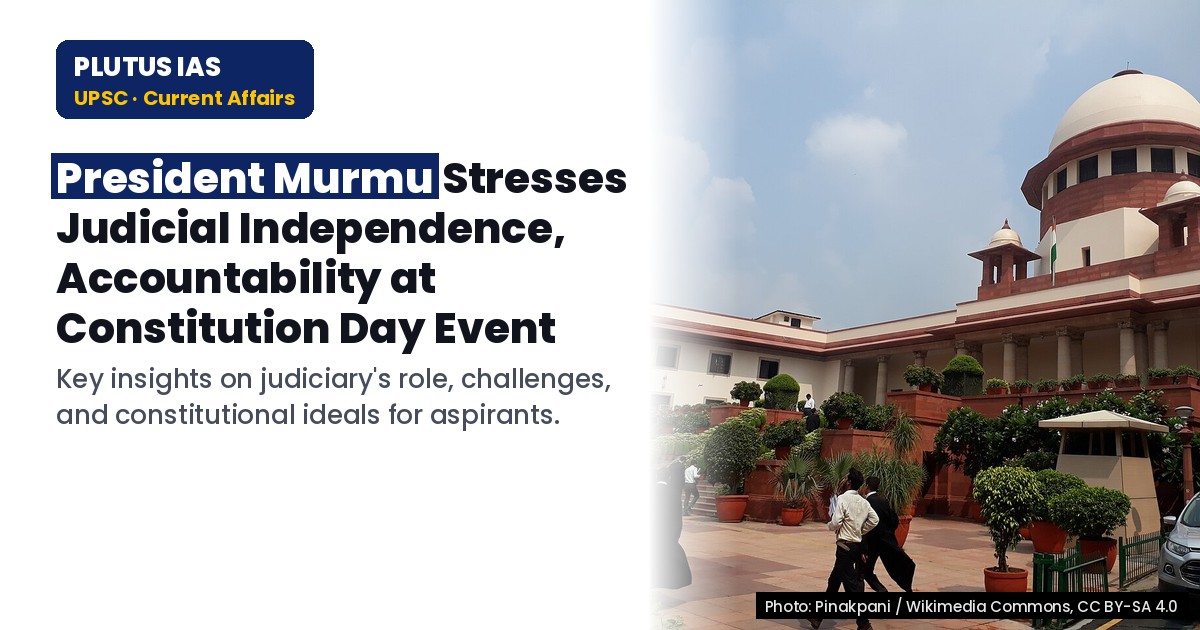
27 Nov President Murmu on Judicial Independence & Accountability
✎ Constitution Day commemorates the adoption of the Indian Constitution on November 26, 1949, highlighting the judiciary's role in upholding constitutional values, ensuring timely justice, and promoting equitable access to legal…
Subject Relevance — Where This Topic Fits
- GS Paper II — Indian Constitution: historical underpinnings, evolution, features, amendments, significant provisions and basic structure. | GS Paper II — Separation of powers between various organs dispute redressal mechanisms and institutions. | GS Paper II — Structure, organization and functioning of the Executive and the Judiciary Ministries and Departments of the Government; pressure groups and formal/informal associations and their role in the Polity. | GS Paper II — Government policies and interventions for development in various sectors and issues arising out of their design and implementation. | GS Paper II — Welfare schemes for vulnerable sections of the population by the Centre and States and the performance of these schemes; mechanisms, laws, institutions and Bodies constituted for the protection and betterment of these vulnerable sections.
- Prelims: Constitution Day, Dr. B.R. Ambedkar, Judicial independence, Judicial accountability, Access to justice, Legal aid, National Legal Services Authority (NALSA), Article 39A
- Essay: The Indian Judiciary: Upholding Constitutional Values and Ensuring Social Justice., Balancing Judicial Independence and Accountability for a Robust Democracy.
Quick Revision: Constitution Day commemorates the adoption of the Indian Constitution on November 26, 1949, highlighting the judiciary’s role in upholding constitutional values, ensuring timely justice, and promoting equitable access to legal services.
Why is this in the news?
The President of India recently participated in the Constitution Day celebrations organised by the Supreme Court of India. During her address, the President underscored the foundational importance of the Constitution, acknowledged the judiciary’s invaluable contributions, and highlighted critical areas for strengthening the justice delivery system, including judicial independence, accountability, timely justice, and enhanced access to legal services for all citizens.
Background
- Constitution Day, also known as ‘Samvidhan Divas’, is celebrated annually on November 26th to commemorate the adoption of the Constitution of India.
- On November 26, 1949, the Constituent Assembly of India adopted the Constitution, which came into effect on January 26, 1950.
- The Government of India declared November 26th as Constitution Day in 2015, to mark the 125th birth anniversary of Dr. B.R. Ambedkar, who is widely regarded as the chief architect of the Indian Constitution.
- The day serves to promote constitutional values among citizens and to pay tribute to the framers of the Constitution.
- The Indian judiciary, comprising the Supreme Court, High Courts, and subordinate courts, plays a crucial role as the guardian and interpreter of the Constitution, upholding its ideals and ensuring justice.
- The principles of judicial independence and accountability are cornerstones of a robust and democratic justice system, ensuring impartiality and public trust.
Key Aspects of Judicial Functioning and Constitutional Principles
- Judicial Independence: This principle ensures that judges are free to make decisions based on law and fact, without improper influence from the executive, legislature, or private interests. It is a fundamental aspect of the rule of law and a fair justice system.
- Judicial Accountability: While independent, the judiciary is also accountable for its actions and decisions. This involves mechanisms to ensure transparency, ethical conduct, and adherence to constitutional principles, without compromising judicial independence.
- Access to Justice: Enshrined in the Preamble and various Articles of the Constitution (e.g., Article 39A), this principle mandates that justice should be accessible to all, irrespective of economic or social status. It includes provisions for free legal aid and simplifying judicial processes.
- Timely Justice: A critical component of the concept of justice, timely resolution of cases is essential to prevent undue hardship and maintain public faith in the judicial system. Delays in justice can undermine its effectiveness and fairness.
- Role of Legal Services Authorities: District, State, and National Legal Services Authorities (e.g., NALSA) are established under the Legal Services Authorities Act, 1987, to provide free and competent legal services to the weaker sections of society, ensuring equal opportunities for justice.
- Inclusivity in Judiciary: Promoting greater representation of women and diverse backgrounds within the judiciary, both as judges and advocates, is crucial for fostering a more equitable, just, and inclusive society, bringing varied perspectives to judicial decision-making.
- Constitutional Morality: This refers to the adherence to the core principles and values embedded in the Constitution, even when faced with popular opinion or political pressure. It guides the judiciary in upholding the spirit of the Constitution.
- Technology in Judiciary: Utilisation of technology, such as e-courts and digital case management systems, is being increasingly adopted to streamline judicial processes, enhance efficiency, and improve access to information and services.
Key Features
| Feature | Significance |
|---|---|
| Judicial Independence and Accountability | Essential for strengthening the judiciary’s role and upholding constitutional ideals. |
| Timely Justice | A fundamental component of the concept of justice, requiring streamlined processes and technological integration. |
| Access to Justice | Ensuring equitable opportunities for all citizens, particularly the economically disadvantaged, through free legal aid. |
| Inclusivity and Merit | Promoting diverse representation, especially of women, within the judiciary to foster a more equitable and balanced justice system. |
| Legal Education Reform | Emphasising empathy and ethics alongside legal knowledge to cultivate compassionate and competent legal professionals. |
Why it Matters
Governance and Rule of Law
- Reinforces the foundational principles of the Indian Constitution, particularly the role of the judiciary as its guardian.
- Highlights the ongoing commitment to judicial reforms aimed at enhancing efficiency and accessibility of justice.
- Underscores the importance of a robust and independent judiciary for a functioning democracy and the protection of fundamental rights.
Social Justice
- Emphasises the constitutional directive for free legal aid, ensuring that economic or other disadvantages do not impede access to justice.
- Promotes inclusivity within the legal profession and judiciary, advocating for greater representation of women to enrich judicial decision-making.
- Addresses disparities in access to quality legal representation for vulnerable and marginalised sections of society.
Institutional Development
- Acknowledges the invaluable contributions of the Supreme Court, High Courts, and subordinate courts to the republic’s journey.
- Calls for adaptation of judicial processes to contemporary challenges, including leveraging technology and establishing specialised courts.
- Stresses the need for continuous efforts by legal services authorities to extend justice to the weaker sections.
Challenges
1. Pendency of Cases
- The substantial volume of pending cases across all levels of the judiciary remains a significant impediment to timely justice.
- This backlog can lead to prolonged incarceration, increased legal costs, and erosion of public trust in the justice system.
UPSC Link: Judiciary; Structure, Organisation and Functioning
2. Access to High Courts and Supreme Court
- Many citizens lack the financial resources to access higher courts, creating an imbalance in legal representation.
- The constitutional mandate for equal opportunity in accessing justice is often challenged by socio-economic barriers.
UPSC Link: Social Justice; Mechanisms, Laws, Institutions and Bodies
3. Quality of Legal Aid
- Ensuring consistent quality and reliability of legal advocacy for the poor and disadvantaged remains a critical challenge.
- The effectiveness of legal aid schemes depends heavily on the competence and dedication of empanelled lawyers.
UPSC Link: Social Justice; Welfare Schemes for Vulnerable Sections
4. Inclusivity in Judiciary
- The underrepresentation of women in judicial roles and as advocates limits the diversity of perspectives in legal processes.
- Promoting greater inclusivity requires systemic changes in recruitment, promotion, and professional development within the legal fraternity.
UPSC Link: Role of Women and Women’s Organisation
Challenges — UPSC Perspective
| Issue | Concern |
|---|---|
| Judicial Backlog | Delay in justice delivery, impacting fundamental rights and public confidence. |
| Resource Disparity | Unequal access to higher courts for economically weaker sections, undermining the principle of equality before law. |
| Legal Aid Efficacy | Variations in the quality and reliability of free legal services for vulnerable populations. |
| Gender Imbalance | Limited representation of women in judicial and advocacy roles, affecting diversity in legal perspectives. |
| Ethical Standards | Need for greater emphasis on empathy and ethics in legal education and practice. |
Way Forward
- Expedite judicial reforms focusing on process simplification, technological integration, and establishment of specialised courts to address case pendency.
- Strengthen the capacity and outreach of District, State, and National Legal Services Authorities to ensure effective and quality legal aid for all citizens.
- Promote greater inclusivity and merit-based appointments within the judiciary, with a specific focus on increasing the representation of women.
- Revamp legal education curricula to integrate empathy, ethics, and practical skills alongside theoretical knowledge, fostering a holistic approach to justice.
- Encourage senior legal professionals to mentor young advocates, instilling values of excellence, empathy, and compassion in the legal profession.
- Explore alternative dispute resolution mechanisms more extensively to reduce the burden on traditional courts and provide quicker remedies.
- Regularly review and update judicial infrastructure and human resources to match the evolving demands of a growing population and complex legal landscape.
UPSC Value Addition
Keywords for Mains Answer-Writing
Constitution Day · Judicial Independence · Judicial Accountability · Access to Justice · Legal Aid · Judicial Reforms · Gender Parity in Judiciary · Constitutional Morality
Constitutional & Policy Linkages
- {‘article’: ‘Article 14’, ‘note’: ‘Equality before law’}
- {‘article’: ‘Article 21’, ‘note’: ‘Protection of life and personal liberty’}
- {‘article’: ‘Article 39A’, ‘note’: ‘Equal justice and free legal aid’}
- {‘article’: ‘Article 50’, ‘note’: ‘Separation of judiciary from executive’}
- {‘article’: ‘Article 124’, ‘note’: ‘Establishment of Supreme Court’}
- {‘article’: ‘Article 214’, ‘note’: ‘High Courts for States’}
Concept Flow
Constitution adopted on November 26, 1949 → Decision in 2015 to celebrate November 26 as Constitution Day → President attends Constitution Day celebrations → Emphasises judicial independence, accountability, and timely justice → Highlights challenges like case pendency and access to justice → Advocates for inclusivity, legal aid, and ethical legal education → Strengthening judiciary for a just and equitable society
Prelims Practice Questions
Q1. Consider the following statements regarding Constitution Day in India:
1. Constitution Day is celebrated on November 26th each year to commemorate the adoption of the Constitution of India.
2. The decision to observe November 26th as Constitution Day was taken in 2015 to mark the 125th birth anniversary of Dr. B.R. Ambedkar.
3. Prior to 2015, November 26th was observed as National Law Day.
- Only one
- Only two
- Only three
- None
Answer: Only three — Statement 1 is correct as November 26th marks the date when the Constituent Assembly adopted the Constitution in 1949. Statement 2 is correct as the decision to celebrate Constitution Day on November 26th annually was indeed taken in 2015, coinciding with Dr. B.R. Ambedkar’s 125th birth anniversary. Statement 3 is also correct; before 2015, November 26th was traditionally observed as National Law Day.
Q2. Which of the following Articles of the Indian Constitution mandates the provision of free legal aid to ensure justice on the basis of equal opportunity?
- Article 14
- Article 21
- Article 39A
- Article 32
Answer: Article 39A — Article 39A of the Constitution of India, a Directive Principle of State Policy, directs the State to secure that the operation of the legal system promotes justice on a basis of equal opportunity, and shall, in particular, provide free legal aid, by suitable legislation or schemes or in any other way, to ensure that opportunities for securing justice are not denied to any citizen by reason of economic or other disabilities.
Mains Practice Question
✍ Judicial independence and judicial accountability are two foundational pillars for a robust and effective justice delivery system. Critically examine their interplay in strengthening the judiciary’s role in India, with reference to contemporary challenges such as pendency of cases and access to justice. (15 Marks)
Approach: MODEL-ANSWER SKELETON:
1. Introduction: Define Judicial Independence (e.g., freedom from executive/legislative interference, security of tenure, financial autonomy) and Judicial Accountability (e.g., transparency, ethical conduct, timely disposal of cases, internal mechanisms).
2. Interplay and Synergy: Explain how these two principles, while seemingly in tension, are complementary. Independence allows fearless adjudication, while accountability ensures public trust and prevents arbitrary exercise of power.
3. Constitutional Provisions for Independence: Articles 50 (separation of judiciary from executive), 124 (appointment, tenure, removal of SC judges), 217 (appointment, tenure, removal of HC judges), 125 (salaries), 146 (administrative expenses).
4. Mechanisms for Accountability: Mention internal mechanisms like in-house procedure for removal of judges, contempt of court powers, judicial review of administrative actions, and the role of the National Judicial Data Grid (NJDG) for transparency in case pendency.
5. Contemporary Challenges and their Impact:
a. Pendency of Cases: Discuss the impact of massive backlog on timely justice, eroding public faith, and the need for procedural reforms, technology adoption, and increased judicial strength.
b. Access to Justice: Highlight barriers such as economic constraints, geographical remoteness, and lack of legal awareness. Emphasize the role of Legal Services Authorities (NALSA, SALSA, DLSA) under Article 39A.
c. Quality of Legal Education and Ethics: Discuss the need for empathy and ethics in legal education and practice.
d. Diversity and Inclusivity: Address the call for greater representation of women and marginalized sections in the judiciary to enrich judicial decision-making.
6. Conclusion: Reiterate that a balanced approach, integrating both independence and accountability, is crucial for upholding constitutional ideals and ensuring an equitable and efficient justice system.
Source: PIB (Press Information Bureau)
Generated by AanyaAi for educational purpose.
Related guides on our sites
- Best PSIR optional coaching for upsc
- Best Law optional coaching for upsc
- Best PSIR optional teacher for upsc
- Best teacher of PSIR optional for upsc

- President Murmu on Judicial Independence & Accountability - November 27, 2026
- पुरातत्व सर्वेक्षण द्वारा लौटाई गईं प्राचीन वस्तुएँ: सांस्कृतिक विरासत की वापसी - November 27, 2026
- Ganga Water Treaty: India-Bangladesh Ties & Renewal Challenges - November 27, 2026

No Comments