


27 Nov Ganga Water Treaty: India-Bangladesh Ties & Renewal Challenges
✎ The Ganga Water Treaty of 1996, a 30-year agreement between India and Bangladesh, governs the equitable sharing of the Ganga River's waters at Farakka during the lean season.
Subject Relevance — Where This Topic Fits
- GS Paper II — International Relations | GS Paper II — Government Policies and Interventions | GS Paper I — Geography (Resources)
- Prelims: Ganga Water Treaty 1996, India-Bangladesh relations, Transboundary rivers, Farakka Barrage, Joint Rivers Commission, Water sharing agreements
- Essay: Water as a Catalyst for Regional Cooperation and Conflict, The Evolving Dynamics of India’s Neighbourhood Policy
Quick Revision: The Ganga Water Treaty of 1996, a 30-year agreement between India and Bangladesh, governs the equitable sharing of the Ganga River’s waters at Farakka during the lean season.
Why is this in the news?
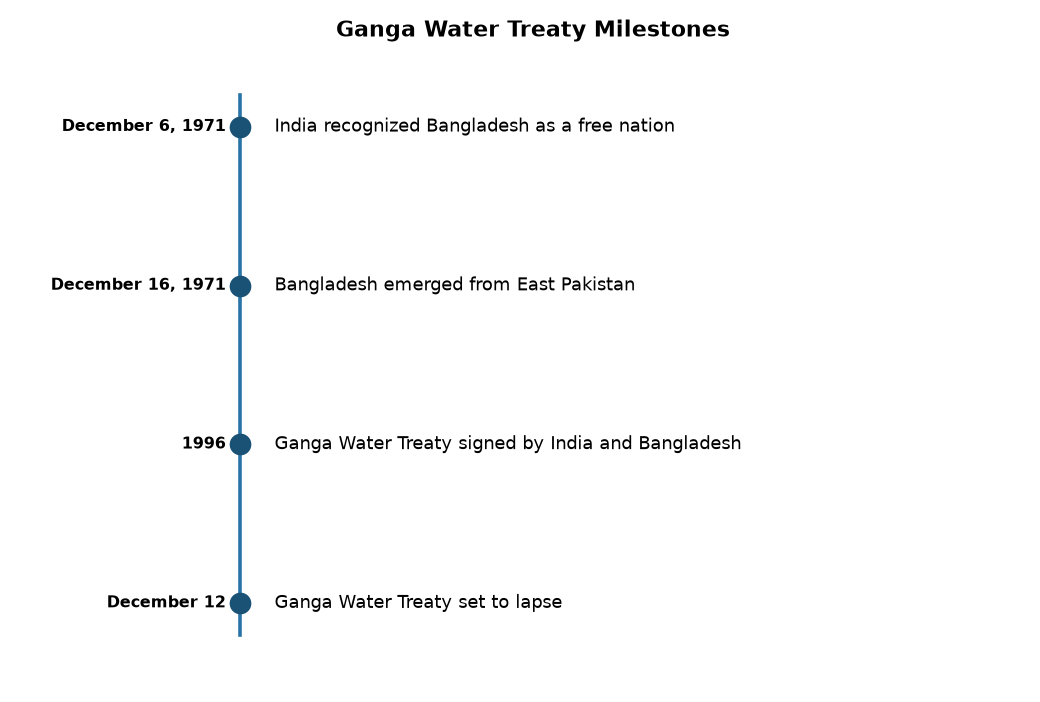
The Ganga Water Treaty, signed between India and Bangladesh in 1996, is approaching its expiration date on December 12, 2026. The current diplomatic environment between the two nations, characterised by a perceived lack of high-level engagement, has led to uncertainty regarding the treaty’s renewal or renegotiation, raising concerns about the future of transboundary water management in the region.
Background
- The Ganga River, a transboundary watercourse, is vital for both India and Bangladesh, supporting agriculture, livelihoods, and ecosystems.
- Historical disputes over water sharing, particularly concerning the lean season flow, necessitated a formal agreement.
- The Farakka Barrage, constructed by India in the 1970s, diverted Ganga waters to the Hooghly River, impacting downstream flows into Bangladesh and intensifying water sharing concerns.
- The 1996 Ganga Water Treaty was a landmark agreement, establishing a 30-year framework for equitable water sharing during the lean season (January 1 to May 31).
- December holds significant historical importance for India-Bangladesh relations, marking India’s recognition of Bangladesh in 1971 and Bangladesh’s independence later that month.
What is the Ganga Water Treaty of 1996?
- The Ganga Water Treaty is a bilateral agreement between India and Bangladesh concerning the sharing of the Ganga River’s waters at Farakka.
- Signed on December 12, 1996, by then Prime Ministers H.D. Deve Gowda of India and Sheikh Hasina of Bangladesh, it has a duration of 30 years.
- The treaty stipulates a formula for sharing the Ganga waters during the lean season (January 1 to May 31), ensuring a minimum flow for Bangladesh.
- It mandates that if the availability of water at Farakka falls below 50,000 cusecs in any 10-day period, India and Bangladesh shall each receive 50% of the available flow.
- The agreement includes provisions for joint monitoring of water flows at Farakka and other specified points to ensure transparency and compliance.
- The treaty does not explicitly address other transboundary rivers shared by the two countries, focusing solely on the Ganga.
- It is considered a significant achievement in bilateral diplomacy, establishing a framework for cooperation on a historically contentious issue.
Key Features
| Feature | Significance |
|---|---|
| Ganga Water Treaty (1996) | A bilateral agreement between India and Bangladesh for the equitable sharing of Ganga waters at Farakka. |
| Duration of Treaty | A 30-year agreement, set to lapse on December 12, 2026, requiring renewal or renegotiation. |
| Farakka Barrage | The point of water diversion in India, upstream of the Bangladesh border, central to the treaty’s provisions. |
| Historical Context | Signed by then Prime Ministers H.D. Deve Gowda (India) and Sheikh Hasina (Bangladesh), reflecting a commitment to cooperative water management. |
| December 1971 | Symbolic month for India-Bangladesh relations, marking India’s recognition of Bangladesh and its independence. |
Why it Matters
Bilateral Relations
- The treaty’s status is a critical indicator of the overall health and stability of diplomatic ties between India and Bangladesh.
- Successful renewal would reinforce trust and cooperation, while failure could strain diplomatic engagements.
Water Security
- Ensures predictable water flows for Bangladesh, crucial for its agriculture, ecosystems, and livelihoods, particularly in the southwestern region.
- For India, it manages downstream flows and maintains regional stability regarding shared water resources.
Regional Stability
- The treaty’s continuity contributes to regional peace by preventing potential disputes over transboundary river waters.
- Its lapse could exacerbate existing political and social tensions within Bangladesh, potentially impacting regional security.
International Law and Diplomacy
- Serves as a precedent for managing shared river basins between riparian states, demonstrating principles of equitable utilization and no significant harm.
- The outcome of its renewal will be observed by other nations with shared transboundary rivers.
Challenges
1. Diplomatic Stasis
- Perceived disinclination from one side to engage in high-level discussions can impede progress on critical bilateral agreements.
- Lack of timely and constructive dialogue can lead to uncertainty and the lapse of important treaties.
UPSC Link: International Relations: Bilateral Groupings
2. Domestic Political Instability
- Internal political turmoil, widespread violence, and labour unrest in a partner country can divert governmental focus from external affairs.
- A volatile domestic environment can complicate decision-making processes regarding international commitments.
UPSC Link: International Relations: India and its Neighbourhood
3. Transboundary Water Management
- Managing shared river resources equitably and sustainably is inherently complex, involving diverse hydrological, ecological, and socio-economic considerations.
- Climate change impacts, such as altered rainfall patterns and glacier melt, add further complexity to water availability and sharing.
UPSC Link: Geography: Water Resources; Environment: Climate Change
4. Perception and Trust Deficit
- Any perceived lack of engagement or delay in treaty renewal can erode trust between nations.
- Public and political narratives can be influenced by the status of such agreements, impacting overall bilateral sentiment.
UPSC Link: International Relations: Diplomacy
Challenges — UPSC Perspective
| Issue | Concern |
|---|---|
| Treaty Expiry | The impending lapse of the Ganga Water Treaty on December 12, 2026, without a clear renewal plan. |
| Diplomatic Engagement | Reported lack of high-level engagement between India and Bangladesh, contributing to uncertainty. |
| Bangladesh’s Internal Situation | Widespread violence and labour unrest in Bangladesh potentially diverting governmental attention from bilateral issues. |
| Equitable Water Sharing | Ensuring fair and sustainable distribution of Ganga waters, which is vital for both nations’ agricultural and ecological needs. |
| Future of Bilateral Relations | The potential for the treaty’s limbo to negatively impact the broader strategic and economic partnership between India and Bangladesh. |
Way Forward
- Initiate high-level diplomatic dialogues to address concerns and facilitate the timely renewal or renegotiation of the Ganga Water Treaty.
- Establish a joint technical committee to review the treaty’s implementation, assess current hydrological data, and propose necessary adjustments.
- Explore comprehensive basin-level management approaches for shared rivers, moving beyond specific treaties to holistic cooperation.
- Enhance people-to-people contact and cultural exchanges to build mutual understanding and goodwill, fostering a conducive environment for diplomatic resolutions.
- Develop contingency plans for water sharing in the event of a temporary lapse of the treaty, ensuring continuity of cooperation.
- Utilize multilateral platforms and international best practices for transboundary water management to inform bilateral negotiations.
- Address domestic political sensitivities in both nations through transparent communication and public awareness campaigns regarding the benefits of cooperation.
UPSC Value Addition
Keywords for Mains Answer-Writing
Ganga Water Treaty 1996 · India-Bangladesh bilateral relations · Transboundary river water sharing · Riparian rights · International water law · Teesta River dispute · Hydropolitics · South Asian regional cooperation · Water diplomacy · Joint Rivers Commission
Concept Flow
Ganga Water Treaty (1996) signed for 30 years. → Treaty approaches expiry on December 12, 2026. → Reported ‘stasis’ in India-Bangladesh diplomatic ties. → Bangladesh faces internal political instability and unrest. → Uncertainty regarding treaty renewal or renegotiation. → Potential implications for bilateral relations and regional water security.
Prelims Practice Questions
Q1. Consider the following statements regarding the Ganga Water Treaty:
1. The Treaty was signed in 1996 between India and Bangladesh.
2. It addresses the sharing of waters of the Ganga River at Farakka.
3. The Treaty has a perpetual validity and does not require periodic renewal.
How many of the above statements are correct?
- Only one
- Only two
- Only three
- None
Answer: Only two — Statement 1 is correct: The Ganga Water Treaty was indeed signed in 1996. Statement 2 is correct: The Treaty specifically deals with the sharing of Ganga waters at the Farakka Barrage. Statement 3 is incorrect: The Treaty has a 30-year validity period, expiring in December 2026, and requires renewal.
Q2. Which of the following bodies is primarily responsible for addressing transboundary river water issues between India and Bangladesh?
- South Asian Association for Regional Cooperation (SAARC)
- Bay of Bengal Initiative for Multi-Sectoral Technical and Economic Cooperation (BIMSTEC)
- Joint Rivers Commission (JRC)
- Mekong Ganga Cooperation (MGC)
Answer: Joint Rivers Commission (JRC) — The Joint Rivers Commission (JRC) was established in 1972 by India and Bangladesh specifically to maintain liaison and ensure the most effective joint efforts in maximizing the benefits from common river systems.
Mains Practice Question
✍ Critically examine the significance of the Ganga Water Treaty of 1996 in fostering bilateral relations between India and Bangladesh. Discuss the challenges associated with its renewal and suggest measures for sustainable water diplomacy. (15 Marks)
Approach: MODEL-ANSWER SKELETON:
1. **Introduction:** Briefly introduce the Ganga Water Treaty (1996), its signatories (H.D. Deve Gowda, Sheikh Hasina), and its context (sharing of Ganga waters at Farakka).
2. **Significance of the Treaty:**
* **Conflict Resolution:** Highlight its role in resolving a long-standing dispute over Ganga water sharing.
* **Trust Building:** Emphasize its contribution to building mutual trust and cooperation.
* **Precedent for Water Diplomacy:** Discuss its establishment as a framework for managing transboundary rivers.
* **Economic and Social Stability:** Mention its impact on agricultural livelihoods and environmental stability in the lower riparian regions.
3. **Challenges in Renewal:**
* **Political Stasis:** Refer to the current political climate and perceived disinclination to engage.
* **Domestic Pressures:** Acknowledge internal political dynamics and public opinion in both countries.
* **Emerging Water Demands:** Discuss increased water demands due to population growth, industrialization, and climate change.
* **Inclusion of Other Rivers:** Mention the unresolved Teesta water-sharing issue and its impact on overall relations.
* **Technical Complexities:** Allude to hydrological data sharing, climate change impacts on river flows, and infrastructure development.
4. **Measures for Sustainable Water Diplomacy:**
* **Strengthening Joint Rivers Commission (JRC):** Propose enhancing its mandate and operational efficiency.
* **Comprehensive Basin-Wide Approach:** Advocate for a holistic management strategy for shared rivers, beyond just Ganga.
* **Data Sharing and Joint Research:** Emphasize transparency and collaborative studies on hydrological data and climate impacts.
* **Multi-Stakeholder Engagement:** Suggest involving technical experts, civil society, and local communities.
* **Political Will and High-Level Dialogue:** Stress the importance of sustained diplomatic engagement at the highest levels.
* **Benefit-Sharing Mechanisms:** Explore innovative approaches beyond just water quantity, such as power generation, navigation, and flood control.
5. **Conclusion:** Summarize the importance of renewing the Treaty for regional stability and bilateral ties, advocating for a forward-looking, cooperative approach to transboundary water management.
Source: The Hindu
Generated by AanyaAi for educational purpose.
Related guides on our sites
- Current affairs for upsc 2026
- Best PSIR optional coaching for upsc
- Best PSIR optional teacher for upsc
- Best teacher of PSIR optional for upsc

- Ganga Water Treaty: India-Bangladesh Ties & Renewal Challenges - November 27, 2026
- उत्तर कोरिया: सामरिक परमाणु हथियारों की तैनाती पर किम जोंग उन का जोर - November 26, 2026
- Karnataka Proposes National Portal for Substandard Drugs - November 26, 2026

No Comments