


27 Nov AI in Mathematics: Lean & Reinforcement Learning
✎ AI-driven theorem proving combines Large Language Models for proof generation, proof assistants for rigorous verification, and reinforcement learning for iterative refinement, significantly advancing the capability to solve…
Subject Relevance — Where This Topic Fits
- GS Paper III — Science and Technology; Developments in AI | GS Paper III — Internal Security; Challenges to AI ethics and governance
- Prelims: Artificial Intelligence (AI), Large Language Models (LLMs), Reinforcement Learning, Proof Assistants (e.g., Lean), Navier-Stokes Equations, Riemann Hypothesis, Millennium Prize Problems, Exponential Time Hypothesis
- Essay: The transformative potential and ethical considerations of Artificial Intelligence, The evolving relationship between human intellect and advanced computational systems
Quick Revision: AI-driven theorem proving combines Large Language Models for proof generation, proof assistants for rigorous verification, and reinforcement learning for iterative refinement, significantly advancing the capability to solve complex mathematical problems.
Why is this in the news?
Recent developments have highlighted the significant role of Artificial Intelligence (AI) in addressing complex mathematical problems, including long-standing Millennium Prize Problems such as the Navier-Stokes equations and the Riemann Hypothesis. AI models, particularly Large Language Models (LLMs) combined with proof assistants and reinforcement learning, have demonstrated the capability to generate and verify mathematical proofs, marking a notable advancement in the field of automated theorem proving.
Background
- The field of mathematics contains several ‘Millennium Prize Problems’, designated by the Clay Mathematics Institute, which carry a significant monetary prize for their solution, underscoring their profound difficulty and importance.
- The Navier-Stokes equations, formulated in the 19th century, describe the motion of viscous fluid substances and are fundamental in fluid dynamics. Their complete analytical understanding, particularly regarding the existence and smoothness of solutions, has remained elusive.
- The Riemann Hypothesis, proposed in 1859, is a conjecture about the distribution of prime numbers, considered one of the most important unsolved problems in pure mathematics.
- The Exponential Time Hypothesis (ETH) is a computational complexity theory conjecture that posits certain problems cannot be solved in sub-exponential time, impacting the theoretical limits of algorithms.
- Traditional mathematical proof generation relies heavily on human intuition, creativity, and rigorous logical deduction, often taking decades or centuries to resolve complex conjectures.
- Proof assistants are software tools designed to help mathematicians and computer scientists construct and verify formal proofs, ensuring every logical step is valid according to a predefined set of axioms and inference rules.
How AI Proves Theorems
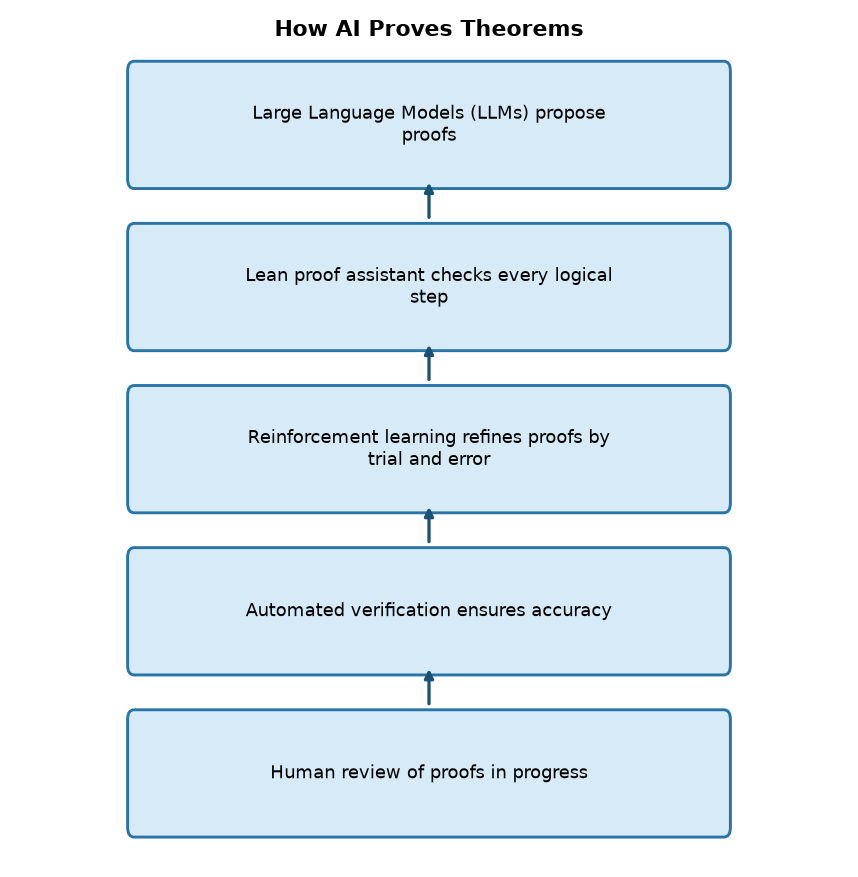
- Artificial Intelligence (AI) systems, specifically Large Language Models (LLMs), are being leveraged to generate potential mathematical proofs by learning from vast datasets of human-written text, including mathematical literature.
- LLMs are pre-trained on trillions of ‘tokens’ (words or word fragments) from the internet, books, code, and academic papers, enabling them to learn the vocabulary, grammar, and structural patterns of various languages, including mathematics.
- This pre-training allows LLMs to develop a ‘sense’ of mathematical reasoning, enabling them to predict subsequent logical steps in a proof, akin to how they predict the next word in a sentence.
- Proof assistants, such as ‘Lean’, play a crucial role in verifying the logical validity of the proofs proposed by AI models.
- Reinforcement learning is employed to refine the AI model’s proof-generating capabilities. The model generates a proof, which is then evaluated by the proof assistant; positive feedback (reward) is given for correct steps, and negative feedback for errors, allowing the AI to learn and improve through trial and error.
- The combination of LLMs for hypothesis generation, proof assistants for rigorous verification, and reinforcement learning for iterative improvement creates a robust framework for automated theorem proving.
- While AI proposes and refines proofs, human mathematicians remain essential for supplying initial statements, guiding the AI, and ultimately judging the significance and elegance of the generated solutions.
- The ability of AI to tackle problems like the Navier-Stokes equations and the Riemann Hypothesis signifies a paradigm shift, potentially accelerating mathematical discovery and providing new tools for scientific research.
Key Features
| Feature | Significance |
|---|---|
| Large Language Models (LLMs) | Form the foundational AI architecture, learning mathematical language, vocabulary, grammar, and structural patterns (definitions, lemmas, theorems, proofs) from vast textual datasets. |
| Proof Assistants (e.g., Lean) | Act as automated verification systems, rigorously checking every logical step of a proposed mathematical proof, ensuring correctness and eliminating errors. |
| Reinforcement Learning | Refines the AI model’s proof-generating capabilities through iterative trial-and-error, using feedback from the proof assistant to improve accuracy and efficiency. |
| Pre-training on Mathematical Texts | Enables LLMs to develop a ‘sense’ of mathematical reasoning and inference patterns by predicting subsequent tokens in mathematical passages, similar to how a student learns from worked examples. |
| Attention Mechanism | Allows LLMs to draw on all preceding information within a given text when making predictions, facilitating coherent and contextually relevant proof generation. |
Why it Matters
Scientific and Mathematical Advancement
- Potential to accelerate the resolution of long-standing, complex mathematical problems, including Millennium Prize Problems, which have eluded human mathematicians for decades.
- Offers a novel paradigm for mathematical discovery and verification, potentially leading to new theorems and insights across various scientific disciplines.
Technological Innovation
- Demonstrates the advanced capabilities of AI, particularly the synergy between LLMs, formal verification tools, and reinforcement learning, pushing the boundaries of artificial intelligence applications.
- Highlights the evolving role of AI as a tool for intellectual exploration and problem-solving, augmenting human cognitive abilities in highly abstract domains.
Educational Implications
- Provides new tools and methodologies that could potentially be integrated into advanced mathematical research and education, aiding in the understanding and verification of complex proofs.
- Challenges traditional notions of mathematical proof generation and verification, potentially influencing future pedagogical approaches in mathematics and computer science.
Challenges
1. Reliability and Hallucination
- AI models, particularly LLMs, are known to ‘hallucinate’ or generate factually incorrect but syntactically plausible information, requiring stringent verification mechanisms.
- Ensuring the absolute logical soundness of AI-generated proofs, especially in areas departing from familiar patterns, remains a critical challenge despite proof assistants.
UPSC Link: Science and Technology- developments and their applications
2. Interpretability and Transparency
- The ‘black box’ nature of complex AI models makes it difficult to fully understand the reasoning process behind a generated proof, potentially hindering human comprehension and trust.
- Establishing transparency in AI’s mathematical discovery process is crucial for academic acceptance and further human-led exploration of the generated proofs.
UPSC Link: Ethics, Integrity, and Aptitude- accountability and ethical governance
3. Computational Resources
- Training and operating advanced AI models for complex mathematical problem-solving require substantial computational power and data, posing resource allocation challenges.
- The energy consumption associated with large-scale AI operations raises concerns regarding environmental sustainability.
UPSC Link: Science and Technology- awareness in the fields of IT
4. Human Oversight and Validation
- Despite AI’s capabilities, human review and validation remain indispensable for accepting and integrating AI-generated proofs into the established body of mathematical knowledge.
- The process of human review for highly complex, AI-generated proofs can be time-consuming and demand specialized expertise.
UPSC Link: Science and Technology- indigenization of technology
Challenges — UPSC Perspective
| Issue | Concern |
|---|---|
| AI Hallucinations | The inherent tendency of LLMs to generate plausible but incorrect statements necessitates rigorous external verification for mathematical proofs. |
| Trust and Acceptance | Gaining widespread acceptance within the mathematical community for AI-generated proofs requires demonstrating consistent accuracy and interpretability. |
| Resource Intensity | The significant computational and energy demands of training and running advanced AI models for complex mathematical tasks present practical and environmental concerns. |
| Human-AI Collaboration | Optimizing the interface and workflow between human mathematicians and AI proof assistants to leverage the strengths of both effectively. |
| Bias in Training Data | Potential for biases present in the training data to influence the AI’s reasoning, leading to skewed or incomplete mathematical explorations. |
Way Forward
- Foster interdisciplinary research combining AI, mathematics, and computer science to enhance the robustness and reliability of AI-driven proof generation.
- Develop more transparent and interpretable AI models to facilitate human understanding and verification of complex mathematical reasoning processes.
- Invest in advanced computational infrastructure and energy-efficient AI algorithms to support the escalating demands of AI-powered mathematical research.
- Establish standardized protocols and benchmarks for validating AI-generated mathematical proofs to ensure their acceptance and integration into scientific literature.
- Promote educational initiatives to train future mathematicians and computer scientists in the effective use and critical evaluation of AI proof assistants.
- Explore hybrid human-AI collaboration models where AI assists in generating proof ideas and steps, while human experts provide critical oversight and intuition.
- Address ethical considerations related to intellectual property, authorship, and the potential impact of AI on the future of mathematical research and employment.
UPSC Value Addition
Keywords for Mains Answer-Writing
Artificial Intelligence (AI) · Machine Learning · Large Language Models (LLMs) · Reinforcement Learning · Proof Assistants · Navier-Stokes Equations · Riemann Hypothesis · Millennium Prize Problems · Mathematical Reasoning · Automated Theorem Proving · Computational Mathematics · AI Ethics
Concept Flow
LLMs pre-trained on vast text learn mathematical language and reasoning patterns. → LLMs propose potential proof steps or entire proofs based on learned patterns. → Proof assistants (e.g., Lean) formally verify each logical step of the proposed proof. → Reinforcement learning algorithm receives feedback on proof correctness from the assistant. → AI model parameters are adjusted to improve future proof generation based on feedback. → Iterative refinement leads to increasingly accurate and complex mathematical proofs.
Prelims Practice Questions
Q1. Consider the following statements regarding Artificial Intelligence (AI) in theorem proving:
1. Large Language Models (LLMs) are primarily trained to predict the next token, thereby learning linguistic patterns.
2. Proof assistants like Lean are used to automatically generate complex mathematical conjectures.
3. Reinforcement learning helps refine AI models by providing feedback on the correctness of generated proofs.
How many of the above statements are correct?
- Only one
- Only two
- Only three
- None
Answer: Only two — Statement 1 is correct: LLMs are trained on vast datasets to predict the next token, which enables them to learn language structures, including mathematical language. Statement 2 is incorrect: Proof assistants are primarily used for formal verification of mathematical proofs, not for generating conjectures. Statement 3 is correct: Reinforcement learning is employed to improve the AI’s ability to construct valid proofs through trial and error, using the proof assistant as a ‘checker’. Thus, only two statements are correct.
Q2. Which of the following mathematical problems, recently addressed by AI, is also a Millennium Prize Problem?
- Fermat’s Last Theorem
- Goldbach Conjecture
- Navier-Stokes Equations
- Twin Prime Conjecture
Answer: Navier-Stokes Equations — The Navier-Stokes Equations are one of the seven Millennium Prize Problems, for which a solution or proof of insolubility carries a significant monetary award. Fermat’s Last Theorem has been proven, and the Goldbach Conjecture and Twin Prime Conjecture are open problems but not Millennium Prize Problems.
Mains Practice Question
✍ Examine the synergistic role of Large Language Models (LLMs) and proof assistants in advancing automated theorem proving. Discuss the potential implications of these advancements for scientific research and mathematical discovery. (15 Marks)
Approach: MODEL-ANSWER SKELETON:
1. **Introduction**: Briefly define Automated Theorem Proving (ATP) and the recent breakthroughs by AI in solving complex mathematical problems (e.g., Navier-Stokes, Riemann Hypothesis).
2. **Synergistic Role of LLMs and Proof Assistants**:
* **Large Language Models (LLMs)**: Explain their function (pre-training on vast text data, learning mathematical language/patterns, generating coherent arguments/proof attempts). Mention their limitations (hallucination, lack of inherent logical truth).
* **Proof Assistants (e.g., Lean)**: Describe their role in formal verification, checking every logical step for correctness, and ensuring mathematical rigor. Highlight their function as a ‘judge’ or ‘checker’.
* **Synergy**: Elaborate on how LLMs propose proof steps or entire proofs, while proof assistants rigorously validate these proposals, creating a robust system for discovery and verification. Mention reinforcement learning as a mechanism for iterative improvement.
3. **Potential Implications for Scientific Research and Mathematical Discovery**:
* **Accelerated Discovery**: Potential to solve long-standing open problems, generate new conjectures, and explore vast mathematical spaces more efficiently.
* **Enhanced Rigor and Verification**: Ensuring the correctness of complex proofs, reducing human error, and building more reliable mathematical foundations.
* **Democratization of Mathematics**: Potentially making advanced mathematical research more accessible by automating tedious verification steps.
* **Interdisciplinary Applications**: Impact on fields relying heavily on mathematics (e.g., physics, computer science, engineering) by providing verified solutions to complex models.
* **Ethical and Epistemological Considerations**: Discuss the role of human intuition vs. AI-driven discovery, issues of trust, and the evolution of mathematical practice.
4. **Conclusion**: Summarize the transformative potential of AI in mathematics, emphasizing the human-AI collaboration model for future advancements, while acknowledging the ongoing need for human oversight and interpretation.
Source: The Indian Express
Generated by AanyaAi for educational purpose.
Related guides on our sites
- How to prepare for GS paper 1 for UPSC CSE mains exam
- Best UPSC coaching for IFOS exam
- Best mentorship programme for upsc
- UPSC+BA degree

- AI in Mathematics: Lean & Reinforcement Learning - November 27, 2026
- भारत के निजी अंतरिक्ष क्षेत्र में स्काईरूट एयरोस्पेस की भूमिका और भविष्य - November 27, 2026
- 8th Pay Commission: Pension Hike & OPS Restoration Demands - November 27, 2026

No Comments