


27 Nov 8th Pay Commission: Pension Hike & OPS Restoration Demands
✎ The ongoing debate on pension reforms centres on the restoration of the Old Pension Scheme (OPS) and the enhancement of pension calculation rates, reflecting concerns over social security and fiscal sustainability.
Subject Relevance — Where This Topic Fits
- GS Paper II — Governance, Welfare Schemes | GS Paper III — Indian Economy, Government Budgeting
- Prelims: Old Pension Scheme (OPS), National Pension System (NPS), 8th Central Pay Commission, Consolidated Fund of India, Superannuation Pension, Retiring Pension, Fitment Factor
- Essay: Pension Reforms and Fiscal Sustainability in India, Social Security and Employee Welfare in Public Administration
Quick Revision: The ongoing debate on pension reforms centres on the restoration of the Old Pension Scheme (OPS) and the enhancement of pension calculation rates, reflecting concerns over social security and fiscal sustainability.
Why is this in the news?
Various employee organisations, including the Bharatiya Pratirakhsa Mazdoor Sangh (BPMS) and the National Council of the Joint Consultative Machinery (NC-JCM), have submitted representations to the 8th Pay Commission. These representations advocate for the restoration of the Old Pension Scheme (OPS) for central government employees and propose an increase in the pension calculation rate to 67% of the last-drawn pay, moving beyond the current 50% norm. This development highlights ongoing discussions regarding the adequacy and structure of pensionary benefits for government personnel.
Background
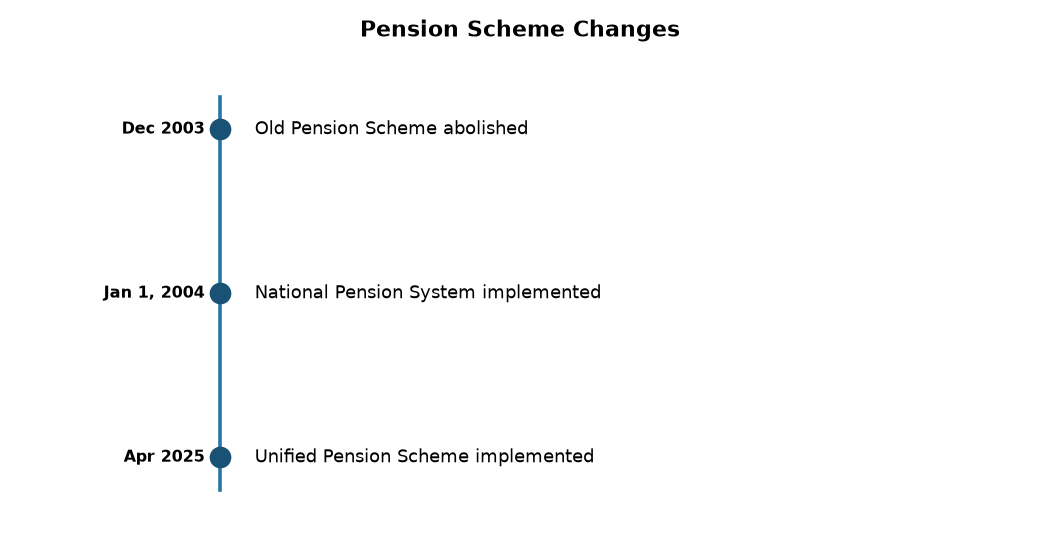
- The Old Pension Scheme (OPS) was abolished by the central government in December 2003.
- The National Pension System (NPS) was implemented for all central government employees joining service from January 1, 2004, replacing the OPS.
- The Unified Pension Scheme (UPS), an option under the NPS, was reportedly implemented in April 2025.
- Under current rules, pension is calculated as 50% of emoluments (last pay drawn) or 50% of the average emoluments (average of the last 10 months’ pay), whichever is more beneficial to the employee.
- Employee federations are advocating for a pension calculation based on 67% of the last-drawn pay, alongside other demands such as centralisation of pension budgets under the Consolidated Fund of India and ‘one rank one pension’ for civilian employees.
- A central government servant is entitled to receive a pension upon completing at least 10 years of qualifying service, payable up to the date of death, under rules such as Superannuation Pension (Rule 35) and Retiring Pension (Rules 36, 48, 48-A of CCS (Pension) Rules).
Key Aspects of Pension Systems in India
- The Old Pension Scheme (OPS) was a defined benefit scheme, guaranteeing a fixed pension amount, typically 50% of the last drawn salary, with inflation adjustments (Dearness Relief). It was non-contributory from the employee’s side.
- The National Pension System (NPS) is a market-linked, defined contribution scheme. Employees contribute a percentage of their salary, matched by the government, into a pension fund, with the final pension amount dependent on market returns and annuity purchase.
- Pay Commissions are constituted by the Government of India to review and recommend changes to the salary structure, allowances, and pensionary benefits for central government employees.
- A ‘fitment factor’ is a multiplier applied to the basic pay in the previous pay commission’s recommendations to determine the new basic pay in the subsequent pay commission, impacting both active salaries and pension calculations.
- Superannuation Pension is granted to a government servant on retirement from service on attaining the age of superannuation, provided they have completed the requisite qualifying service.
- Retiring Pension is granted to a government servant who voluntarily retires after completing a specified period of qualifying service, as per extant rules.
- The Consolidated Fund of India is the primary government account where all revenues received by the government, loans raised, and receipts from recoveries of loans granted by the government flow. All expenditure of the government is met from this fund.
Key Features
| Feature | Significance |
|---|---|
| Old Pension Scheme (OPS) | A defined benefit scheme where the pension amount is fixed, typically 50% of the last drawn salary, and is fully government-funded. It guarantees a predictable income post-retirement. |
| National Pension System (NPS) | A defined contribution scheme where employees contribute to their pension corpus, along with a government contribution. The final pension amount depends on market returns and the accumulated corpus. |
| 8th Pay Commission | A body constituted by the Central Government to review and recommend changes to the salary structure, allowances, and pension benefits for central government employees. Its recommendations significantly impact employee remuneration and government expenditure. |
| Fitment Factor | A multiplier applied to the basic pay to arrive at the revised basic pay in a new pay commission. It is crucial in determining the overall increase in salary and, consequently, pension benefits. |
| Qualifying Service | The minimum period of service required for an employee to be eligible for pension benefits. For superannuation pension, it is typically 10 years. |
| Superannuation Pension | Pension payable to a government employee on retirement after attaining the prescribed age of superannuation and completing the requisite qualifying service. |
Why it Matters
Fiscal Implications
- The potential restoration of the Old Pension Scheme (OPS) or an increase in the pension payout percentage under the 8th Pay Commission could lead to a substantial increase in the government’s pension liability, impacting fiscal deficit and budgetary allocations.
- A higher pension burden may necessitate re-prioritization of public expenditure, potentially affecting investments in infrastructure, social welfare, or other developmental projects.
- The shift from a defined contribution (NPS) to a defined benefit (OPS) model transfers market risks from employees back to the government, requiring robust actuarial assessments and long-term financial planning.
Social Security and Employee Welfare
- Enhanced pension benefits provide greater financial security and predictability for retired central government employees, addressing concerns about post-retirement income adequacy.
- The demand for OPS restoration reflects a broader sentiment among employees regarding the perceived security and benefits of the old system compared to market-linked pension schemes.
- Improved pension provisions can serve as a motivational factor for government employees, potentially enhancing morale and reducing attrition rates in public service.
Economic Impact
- Increased pension payouts can boost consumption demand in the economy, particularly among the retired population, contributing to economic activity.
- The long-term sustainability of pension systems is critical for macroeconomic stability, as unfunded or underfunded liabilities can pose significant fiscal risks.
- The design of pension schemes influences savings patterns and capital market development, with defined contribution schemes like NPS channeling funds into financial markets.
Governance and Policy Making
- The recommendations of the Pay Commission and subsequent government decisions on pension reforms reflect the state’s approach to employee welfare, fiscal prudence, and intergenerational equity.
- The ongoing debate between OPS and NPS highlights the complexities of balancing employee demands for guaranteed benefits with the government’s need for fiscal sustainability.
- Policy decisions regarding pension schemes have far-reaching implications for public administration, human resource management in government, and the overall social contract between the state and its employees.
Challenges
1. Fiscal Sustainability of Pension Liabilities
- The primary challenge lies in managing the escalating pension bill, particularly if the Old Pension Scheme (OPS) is reinstated or if pension payouts are significantly increased, potentially straining government finances.
- Forecasting long-term pension liabilities accurately is complex, requiring robust demographic and economic assumptions, which can be subject to considerable uncertainty.
UPSC Link: Government Budgeting; Fiscal Policy
2. Intergenerational Equity
- A significant portion of current government revenue is allocated to pension payments, potentially reducing resources available for development projects or welfare schemes benefiting the younger generation.
- The burden of an unfunded defined benefit scheme like OPS falls on future taxpayers, raising concerns about fairness across generations.
UPSC Link: Social Justice; Public Finance
3. Balancing Employee Expectations and Economic Realities
- Meeting employee demands for higher and guaranteed pension benefits while ensuring the long-term economic viability of the pension system presents a delicate balancing act for policymakers.
- The perceived security of OPS versus the market-linked returns of NPS creates a dichotomy in employee preferences that needs careful consideration.
UPSC Link: Government Policies and Interventions; Human Resource Management
4. Impact on Capital Markets and Savings
- A shift away from the National Pension System (NPS) could reduce the flow of long-term capital into financial markets, potentially affecting investment and economic growth.
- The design of pension schemes influences national savings rates and the availability of funds for infrastructure development.
UPSC Link: Indian Economy and Issues Relating to Planning; Investment Models
Challenges — UPSC Perspective
| Issue | Concern |
|---|---|
| Restoration of Old Pension Scheme (OPS) | Reinstating OPS would revert to a defined benefit system, increasing the government’s unfunded pension liability significantly and potentially jeopardizing fiscal stability. |
| Increased Pension Payouts (e.g., 67% of last pay drawn) | Elevating the pension calculation base from 50% to 67% of the last drawn salary would directly amplify the financial burden on the exchequer, requiring substantial additional budgetary allocations. |
| Impact of Fitment Factor | A higher fitment factor recommended by the 8th Pay Commission would lead to a substantial increase in basic pay, consequently raising both current salary expenditure and future pension liabilities. |
| Demands for ‘One Rank One Pension’ for Civilians | Extending the ‘One Rank One Pension’ principle to civilian employees would introduce complex actuarial challenges and potentially lead to an exponential increase in pension expenditure across various employee cadres. |
| Minimum Pension Demands (e.g., Rs 45,000) | Establishing a high minimum pension threshold could disproportionately benefit lower-level employees, but also significantly increase the overall pension outflow, especially for a large workforce. |
| Centralization of Pension under Consolidated Fund of India | Consolidating all pension payments under the Consolidated Fund of India, as opposed to departmental budgets, would centralize financial responsibility but also make the total pension burden more transparent and potentially more politically contentious. |
Government Initiatives — Must-Memorise for Prelims
- Old Pension Scheme (OPS)
- National Pension System (NPS)
- Unified Pension Scheme (UPS)
Way Forward
- Conduct a comprehensive actuarial study to assess the long-term fiscal implications of various pension reform proposals, including OPS restoration and increased payout percentages, ensuring data-driven policy decisions.
- Explore hybrid pension models that combine elements of both defined benefit and defined contribution schemes, aiming to provide a balance between employee security and fiscal sustainability.
- Strengthen the National Pension System (NPS) by enhancing its attractiveness through improved investment options, better returns, and clearer communication of benefits, to address employee concerns.
- Establish an independent expert committee to continually review and recommend adjustments to the pension system, ensuring its adaptability to changing economic and demographic realities.
- Implement robust mechanisms for pension fund management, including diversification of investments and transparent governance, to optimize returns and ensure the solvency of pension funds.
- Initiate a broad public discourse involving all stakeholders, including employee unions, financial experts, and policymakers, to build consensus on sustainable pension reforms.
- Consider phased implementation of any significant pension reforms to allow for gradual adjustment of fiscal policies and to mitigate immediate financial shocks.
UPSC Value Addition
Keywords for Mains Answer-Writing
8th Pay Commission · Old Pension Scheme (OPS) · National Pension System (NPS) · Central Government employees · Pension reforms · Retirement benefits · Fiscal implications of pension schemes · Social security for government employees · Fitment factor · Defined benefit vs. Defined contribution
Concept Flow
Employee organizations submit demands to 8th Pay Commission. → Demands include OPS restoration, higher pension percentages, and fitment factor adjustments. → 8th Pay Commission evaluates demands, considering fiscal and social aspects. → Recommendations are formulated, impacting government expenditure and employee benefits. → Government reviews recommendations, making policy decisions on pension reforms. → Implementation of new pension rules affects central government employees’ financial security and national fiscal health.
Prelims Practice Questions
Q1. Consider the following statements regarding pension schemes for Central Government employees in India:
1. The Old Pension Scheme (OPS) was abolished for all central government employees from January 1, 2004.
2. Under the current rules, the pension amount is typically 50% of the last pay drawn or 50% of the average emoluments of the last 10 months, whichever is more beneficial.
3. The National Pension System (NPS) is a defined contribution pension scheme.
How many of the above statements are correct?
- Only one
- Only two
- All three
- None
Answer: All three — Statement 1 is correct: The OPS was indeed abolished for central government employees from January 1, 2004, with the introduction of the NPS. Statement 2 is correct: This accurately describes the general calculation method for pension under the existing rules. Statement 3 is correct: NPS is fundamentally a defined contribution scheme, where the final pension amount depends on the contributions made and the investment returns.
Q2. Which of the following is a key characteristic of the Old Pension Scheme (OPS) as compared to the National Pension System (NPS)?
- It is a market-linked pension scheme.
- It offers a defined benefit, typically a percentage of the last drawn salary.
- It requires individual contributions from employees throughout their service.
- It is managed by the Pension Fund Regulatory and Development Authority (PFRDA).
Answer: It offers a defined benefit, typically a percentage of the last drawn salary. — The Old Pension Scheme (OPS) is a defined benefit scheme, guaranteeing a fixed percentage of the last drawn salary as pension, irrespective of market performance. NPS, in contrast, is market-linked and requires employee contributions, and is regulated by PFRDA.
Mains Practice Question
✍ Examine the key differences between the Old Pension Scheme (OPS) and the National Pension System (NPS) in India. Discuss the fiscal and social implications of a potential reversion to the OPS for Central Government employees. (15 Marks)
Approach: MODEL-ANSWER SKELETON:
1. **Introduction:** Briefly define OPS and NPS as the two primary pension frameworks for government employees in India.
2. **Key Differences (OPS vs. NPS):**
* **Nature of Benefit:** OPS (Defined Benefit – fixed percentage of last drawn salary, e.g., 50%); NPS (Defined Contribution – market-linked, based on contributions and investment returns).
* **Contribution:** OPS (Non-contributory by employees); NPS (Contributory by both employee and employer).
* **Inflation Indexation:** OPS (Dearness Relief linked to inflation); NPS (Market-driven returns, no direct inflation indexation for the final annuity).
* **Fund Management:** OPS (Managed by the government, unfunded); NPS (Managed by PFRDA-regulated pension funds, funded).
* **Applicability:** OPS (For employees appointed before Jan 1, 2004); NPS (For employees appointed on or after Jan 1, 2004).
3. **Fiscal Implications of Reversion to OPS:**
* **Increased Budgetary Burden:** OPS is an unfunded liability, leading to significant and growing pension expenditure from the Consolidated Fund of India.
* **Inter-generational Equity:** Current taxpayers bear the burden of pensions for past generations, potentially reducing funds for development.
* **Crowding Out Effect:** Higher pension outlays could reduce fiscal space for capital expenditure, infrastructure development, and social welfare schemes.
* **Impact on State Finances:** Many states have also adopted NPS; reversion would similarly strain state budgets.
4. **Social Implications of Reversion to OPS:**
* **Enhanced Retirement Security (for beneficiaries):** Guaranteed income stream provides greater certainty and reduces old-age poverty risk for pensioners.
* **Employee Morale:** Potential for improved morale and attraction of talent to government service due to perceived better retirement benefits.
* **Equity Concerns:** Creates a disparity between government employees under OPS and those under NPS, as well as with private sector employees.
* **Sustainability Concerns:** Long-term sustainability of the pension system in the face of increasing life expectancy and an aging population.
5. **Conclusion:** Summarise the trade-offs between fiscal prudence and social security, emphasising the need for a balanced and sustainable pension reform strategy.
Source: m.economictimes.com
Generated by AanyaAi for educational purpose.
Related guides on our sites
- Best economics optional coaching for upsc
- Best economics optional teacher for upsc
- How to prepare for GS paper 1 for UPSC CSE mains exam
- Best UPSC coaching for IFOS exam

- 8th Pay Commission: Pension Hike & OPS Restoration Demands - November 27, 2026
- संविधान: लोकतंत्र, एकता और प्रगति का आधार – लोकसभा अध्यक्ष - November 27, 2026
- Karnataka’s Constitution Day Model: A National Replication? - November 27, 2026

No Comments