


27 Nov Women’s Dominance in Rajasthan Zila Parishads: A Social Shift
✎ The 73rd Constitutional Amendment Act mandates women's reservation in Panchayati Raj Institutions, fostering grassroots democracy and female political participation.
Subject Relevance — Where This Topic Fits
- GS Paper II — Polity and Governance | GS Paper I — Society
- Prelims: Panchayati Raj Institutions, 73rd Constitutional Amendment Act, Women’s Reservation, Zila Parishad, District Collector, State Election Commission
- Essay: Empowering Women through Grassroots Democracy, The Role of Local Self-Governance in India’s Development
Quick Revision: The 73rd Constitutional Amendment Act mandates women’s reservation in Panchayati Raj Institutions, fostering grassroots democracy and female political participation.
Why is this in the news?
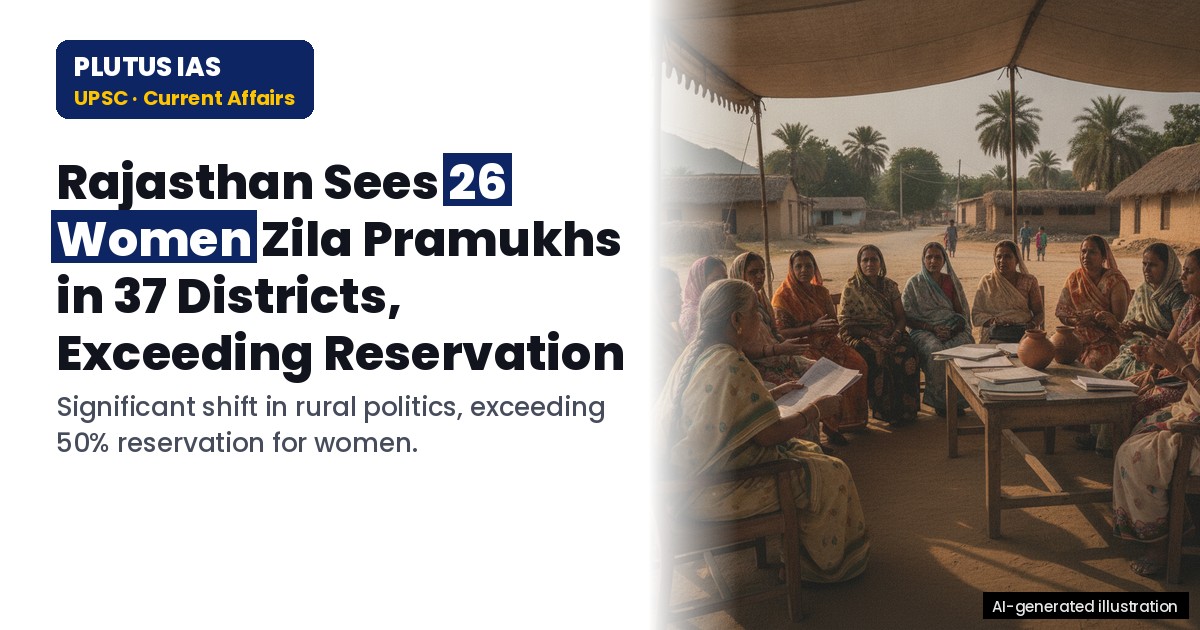
Recent Zila Parishad elections in Rajasthan have highlighted a significant increase in women’s representation, with 26 out of 37 Zila Pramukhs being women. This outcome surpasses the mandated 50% reservation for women, indicating a growing trend of female leadership in local self-governance. Additionally, the average age of elected women Zila Pramukhs is notably lower than their male counterparts, suggesting an infusion of younger leadership into these institutions.
Background
- The 73rd Constitutional Amendment Act, 1992, institutionalized Panchayati Raj in India, providing for a three-tier system of local self-governance at the village, intermediate, and district levels.
- Article 243D of the Constitution mandates reservation of seats for women in Panchayati Raj Institutions (PRIs), with not less than one-third of the total seats, including those reserved for Scheduled Castes and Scheduled Tribes, to be reserved for women.
- Several states, including Rajasthan, have enhanced this reservation to 50% through state legislation, aiming to further empower women in local decision-making processes.
- The Zila Parishad constitutes the district-level body of the Panchayati Raj system, responsible for planning and implementing development programs at the district level.
- The Zila Pramukh is the elected head of the Zila Parishad, playing a crucial role in its functioning and in coordinating with various government departments.
- The State Election Commission is responsible for conducting elections to Panchayati Raj Institutions, ensuring free and fair electoral processes.
Panchayati Raj Institutions and Women’s Representation
- Panchayati Raj Institutions (PRIs) are self-governing bodies at the local level, established to foster grassroots democracy and decentralize administration.
- The 73rd Constitutional Amendment Act, 1992, granted constitutional status to PRIs, making their establishment and functioning mandatory across states.
- The three-tier structure comprises Gram Panchayats at the village level, Panchayat Samitis at the intermediate (block) level, and Zila Parishads at the district level.
- Reservation for women in PRIs aims to address historical gender inequalities and ensure their participation in political decision-making at the local level.
- The provision of reservation has significantly increased the number of women elected representatives, leading to greater visibility and potential influence in local governance.
- Despite increased numerical representation, challenges such as proxy representation, lack of training, and societal barriers sometimes impede the full empowerment of women in PRIs.
- The Zila Parishad, as the apex body in the district, oversees rural development, welfare schemes, and local planning, with the Zila Pramukh as its executive head.
- The trend of younger women assuming leadership roles in PRIs indicates a positive shift towards more dynamic and potentially progressive local governance.
Key Features
| Feature | Significance |
|---|---|
| Women’s Representation in Zila Parishads | 26 out of 37 Zila Pramukhs in Rajasthan are women, exceeding the 50% reservation. |
| Exceeding Reservation Quota | Women secured 7-8 additional Zila Pramukh positions beyond the 50% reservation, indicating broader political acceptance and electoral viability. |
| Youthful Leadership | Several women Zila Pramukhs are notably young, with some as young as 21 and 22 years, contributing to a lower average age for women leaders compared to men. |
| Average Age Disparity | The average age of women Zila Pramukhs is 37 years, which is 12 years younger than their male counterparts, whose average age is 49 years. |
| Political Party Support | Both major political parties, the Congress and BJP, fielded women candidates, demonstrating a recognition of their electoral potential. |
Why it Matters
Social Empowerment
- The increased representation of women, particularly young women, in local governance bodies signifies a progressive shift in societal attitudes towards women’s leadership and participation in public life.
- This trend can inspire greater participation of women from diverse backgrounds in political processes, fostering a more inclusive and representative democracy at the grassroots level.
- The election of younger women leaders indicates a potential for fresh perspectives and innovative approaches to local governance, addressing contemporary issues with renewed vigour.
Democratic Decentralisation
- Enhanced women’s leadership in Zila Parishads strengthens the principles of democratic decentralisation by ensuring that decision-making bodies at the district level are more reflective of the population’s demographic composition.
- The active involvement of women in local self-governance can lead to more gender-sensitive policies and programmes, addressing specific needs and concerns of women and children in rural areas.
- This development reinforces the foundational objectives of the Panchayati Raj system, which aims to empower local communities and ensure their effective participation in development initiatives.
Political Inclusion
- Women securing positions beyond reserved quotas demonstrates their growing political agency and ability to win elections on merit, challenging traditional gender barriers in politics.
- The willingness of political parties to nominate and support women candidates, irrespective of reservation, indicates a strategic recognition of women as a significant electoral force and capable leaders.
- This trend contributes to the normalisation of women in leadership roles, potentially leading to a more equitable distribution of power and influence within political structures over time.
Challenges
1. Effective Functioning and Autonomy
- Ensuring that elected women representatives, especially those new to politics, are able to function effectively and independently, free from undue influence or proxy control.
- Providing adequate training and capacity building to equip women Zila Pramukhs with the necessary administrative, financial, and leadership skills for their roles.
UPSC Link: Panchayati Raj; Women’s Empowerment
2. Resource Allocation and Implementation
- Guaranteeing that women Zila Pramukhs have genuine authority over resource allocation and programme implementation to bring about tangible development outcomes.
- Addressing potential bureaucratic hurdles or resistance that might impede their ability to enact policy decisions and drive local development initiatives.
UPSC Link: Local Governance; Public Administration
3. Sustaining Political Participation
- Developing mechanisms to sustain and further increase women’s political participation beyond the current electoral cycle, ensuring long-term engagement.
- Tackling socio-cultural barriers and gender stereotypes that may still discourage women from entering or remaining in political life.
UPSC Link: Social Justice; Political Participation
Challenges — UPSC Perspective
| Issue | Concern |
|---|---|
| Proxy Representation | Risk of elected women representatives being influenced or controlled by male family members or political patrons, undermining their autonomy. |
| Capacity Building | Need for comprehensive training in governance, finance, and policy for newly elected women, particularly younger leaders. |
| Gender-Sensitive Policy Implementation | Ensuring that the presence of women leaders translates into the effective formulation and implementation of policies addressing women’s specific needs. |
| Political Support and Mentorship | Requirement for sustained support and mentorship from political parties and senior leaders to foster the growth of women in politics. |
| Public Perception and Acceptance | Overcoming traditional biases and ensuring full public acceptance and cooperation for women in leadership roles. |
Way Forward
- Implement robust capacity-building programmes for elected women representatives, focusing on administrative, financial management, and leadership skills.
- Promote mentorship initiatives where experienced women leaders guide and support newly elected women Zila Pramukhs.
- Strengthen institutional mechanisms to ensure the autonomy and independent functioning of women in local governance, preventing proxy representation.
- Encourage political parties to continue fielding women candidates on merit, beyond reservation quotas, fostering a culture of genuine political inclusion.
- Conduct regular gender audits of local governance policies and programmes to ensure they are responsive to the needs of women and marginalised communities.
- Launch public awareness campaigns to challenge gender stereotypes and promote greater societal acceptance and support for women in leadership roles.
- Facilitate networking platforms for women Zila Pramukhs to share experiences, best practices, and collectively address common challenges.
UPSC Value Addition
Keywords for Mains Answer-Writing
Women’s political representation · Panchayati Raj Institutions · 73rd Constitutional Amendment Act · Gender mainstreaming in governance · Local self-governance · Political empowerment of women · Decentralisation · Grassroots democracy · Reservations for women · Leadership development
Constitutional & Policy Linkages
- Article 243D: Reservation of seats for women in Panchayats.
Concept Flow
Constitutional Provision for Women’s Reservation in Panchayats → Increased Political Participation and Candidature of Women → Women Winning Elections Beyond Reserved Quotas → Enhanced Representation of Women in Local Governance (Zila Parishads) → Potential for Gender-Sensitive Policies and Inclusive Development
Prelims Practice Questions
Q1. Consider the following statements regarding women’s representation in Panchayati Raj Institutions (PRIs) in India:
1. The 73rd Constitutional Amendment Act mandates at least one-third reservation for women in PRIs.
2. Several states have legislated to provide 50% reservation for women in PRIs.
3. The reservation for women in PRIs applies only to the position of members, not to the chairperson posts.
How many of the above statements are correct?
- Only one
- Only two
- Only three
- None
Answer: Only two — Statement 1 is correct: The 73rd Constitutional Amendment Act, 1992, mandates not less than one-third (including the number of seats reserved for women belonging to the Scheduled Castes and the Scheduled Tribes) of the total number of seats to be reserved for women in every Panchayat. Statement 2 is correct: Several states, including Rajasthan, Bihar, Madhya Pradesh, and Uttarakhand, have increased this reservation to 50% through their respective state legislations. Statement 3 is incorrect: The reservation for women also extends to the offices of Chairpersons at all levels of Panchayats, as per Article 243D(4) of the Constitution.
Q2. Which of the following Articles of the Indian Constitution is related to the reservation of seats for women in Panchayats?
- Article 243A
- Article 243C
- Article 243D
- Article 243E
Answer: Article 243D — Article 243D of the Indian Constitution deals with the reservation of seats in Panchayats. Specifically, Article 243D(3) mandates the reservation of not less than one-third of the total number of seats for women, and Article 243D(4) mandates the reservation of not less than one-third of the total number of offices of Chairpersons in the Panchayats at each level for women.
Mains Practice Question
✍ The enhanced representation of women in Panchayati Raj Institutions, often exceeding statutory reservations, signifies a crucial step towards substantive gender equality in local governance. Critically examine the factors contributing to this trend and discuss the challenges that persist in ensuring their effective participation and leadership. (15 Marks)
Approach: MODEL-ANSWER SKELETON:
1. **Introduction:** Briefly acknowledge the increasing trend of women’s representation in PRIs, particularly exceeding the mandated 33% or 50% reservation, as highlighted by recent election results.
2. **Factors Contributing to Enhanced Representation:**
* **Statutory Provisions:** Role of the 73rd Constitutional Amendment Act (Article 243D) and subsequent state legislations increasing reservations to 50%.
* **Political Will:** Growing willingness of political parties to field women candidates, even in unreserved seats, viewing them as winnable.
* **Grassroots Mobilisation:** Increased awareness and participation of women due to self-help groups (SHGs), NGOs, and government schemes.
* **Social Change:** Gradual shift in societal attitudes towards women’s leadership and public roles.
* **Performance and Credibility:** Instances where women leaders have demonstrated effective governance, leading to greater acceptance.
* **Demographic Dividend:** Younger women entering politics, as indicated by lower average age.
3. **Challenges to Effective Participation and Leadership:**
* **’Sarpanch Pati’ Syndrome:** Influence of male relatives (husbands, fathers) in decision-making, undermining women’s autonomy.
* **Lack of Training and Capacity Building:** Insufficient training on administrative procedures, financial management, and legal frameworks.
* **Socio-Cultural Barriers:** Deep-rooted patriarchal norms, mobility restrictions, and household responsibilities limiting active engagement.
* **Resource Constraints:** Limited access to financial resources, information, and support networks.
* **Political Marginalisation:** Women often relegated to less influential committees or roles.
* **Violence and Harassment:** Vulnerability to political intimidation, harassment, and discrimination.
* **Dual Burden:** Balancing public duties with domestic responsibilities.
4. **Conclusion:** Summarise the dual nature of progress and persistent challenges. Emphasise the need for comprehensive strategies including continued capacity building, strict enforcement against proxy rule, fostering an enabling environment, and promoting genuine political empowerment to realise the full potential of women’s leadership in PRIs.
Source: amarujala.com
Rajasthan PCS (RPSC / RAS) — State PCS Practice
Prelims: Which of the following statements is/are correct regarding the recent trends in District Council elections in Rajasthan?
I. Women hold a majority in 26 out of 37 District Councils.
II. The average age of women elected to District Councils is 12 years less than their male counterparts.
III. This trend indicates a decreasing participation of women in local self-governance.
Choose the correct option:
- A. Only I
- B. Only II
- C. I and II
- D. I, II and III
Answer: C. I and II — Statements I and II are directly supported by the provided topic, indicating a strong presence of women with a younger average age. Statement III is incorrect as the topic suggests increased female dominance, not decreasing participation.
Mains: राजस्थान में जिला परिषदों में महिलाओं के बढ़ते प्रतिनिधित्व और उनकी औसत आयु में कमी के सामाजिक-राजनीतिक निहितार्थों का विश्लेषण कीजिए। (Analyze the socio-political implications of the increasing representation of women and their reduced average age in District Councils in Rajasthan.)
Generated by AanyaAi for educational purpose.
Related guides on our sites
- Best PSIR optional coaching for upsc
- Best sociology optional coaching for upsc
- Which is best sociology optional coaching for upsc
- Best PSIR optional teacher for upsc

- Women’s Dominance in Rajasthan Zila Parishads: A Social Shift - November 27, 2026
- केंद्र ने राज्यों/केंद्रशासित प्रदेशों को UAPA के तहत IRF पर कार्रवाई का अधिकार दिया - November 27, 2026
- Delhi Human Trafficking & Cyber Fraud Racket Exposed - November 27, 2026

No Comments