


27 Nov Delhi Human Trafficking & Cyber Fraud Racket Exposed
✎ Human trafficking and cyber fraud represent a growing nexus of transnational organised crime, exploiting vulnerable individuals for illicit financial gain through deceptive employment offers and coercive control.
Subject Relevance — Where This Topic Fits
- GS Paper II — International Relations | GS Paper II — Governance, Social Justice | GS Paper III — Internal Security, Cyber Security
- Prelims: Human Trafficking, Cyber Fraud, Transnational Organised Crime, Immigration Laws, Victim Protection, Interpol
- Essay: The evolving landscape of transnational crime and its challenges to global governance, Technology as a double-edged sword: Facilitating development and enabling illicit activities
Quick Revision: Human trafficking and cyber fraud represent a growing nexus of transnational organised crime, exploiting vulnerable individuals for illicit financial gain through deceptive employment offers and coercive control.
Why is this in the news?
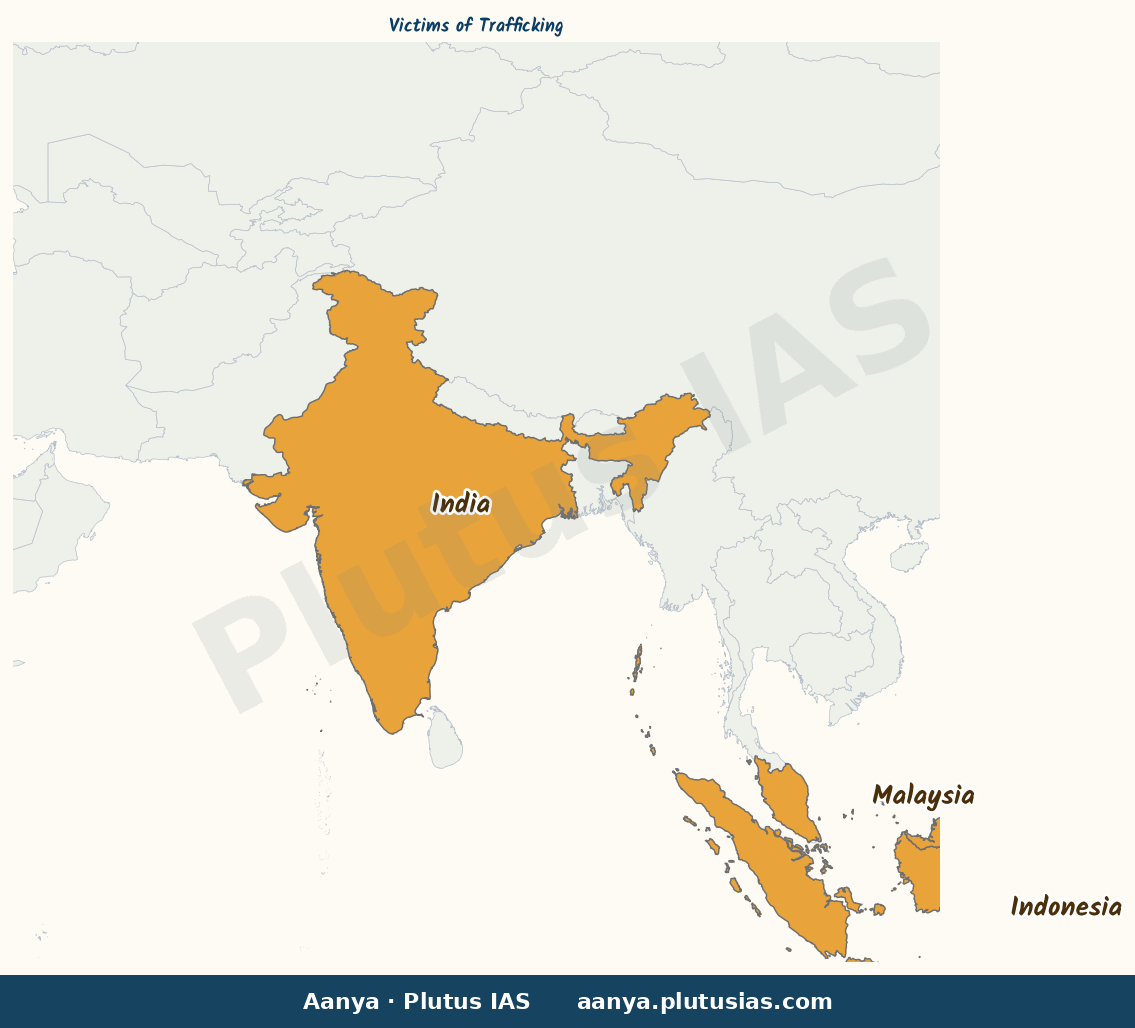
Delhi Police recently uncovered an international human trafficking and cyber fraud operation, rescuing 164 foreign nationals, predominantly from Indonesia and Malaysia. These individuals were allegedly lured to India with false promises of employment, subsequently had their passports confiscated, and were coerced into participating in cyber fraud schemes targeting their compatriots. The operation highlights the intricate linkages between human trafficking, cybercrime, and transnational organised criminal networks.
Background
- Human trafficking is a grave violation of human rights, involving the exploitation of individuals through force, fraud, or coercion for various purposes, including forced labour, sexual exploitation, or other forms of servitude.
- India is a source, transit, and destination country for victims of human trafficking, both internal and international. The country’s vast population and porous borders contribute to the complexity of the issue.
- Cyber fraud encompasses a range of illicit activities conducted through digital means, including phishing, investment scams, and identity theft, often leveraging advanced technology to deceive victims.
- The convergence of human trafficking and cyber fraud represents an emerging threat, where victims are not only exploited for their labour but also instrumentalised as perpetrators in criminal enterprises.
- International cooperation is crucial in combating transnational crimes like human trafficking and cyber fraud, requiring coordinated efforts among law enforcement agencies, intelligence services, and international organisations.
Understanding Human Trafficking and Cyber Fraud
- Human trafficking, as defined by the United Nations Palermo Protocol, involves the recruitment, transportation, transfer, harbouring, or receipt of persons, by means of threat or use of force or other forms of coercion, of abduction, of fraud, of deception, of the abuse of power or of a position of vulnerability or of the giving or receiving of payments or benefits to achieve the consent of a person having control over another person, for the purpose of exploitation.
- Exploitation includes, at a minimum, the exploitation of the prostitution of others or other forms of sexual exploitation, forced labour or services, slavery or practices similar to slavery, servitude or the removal of organs.
- Cyber fraud refers to any fraudulent activity carried out using computers or the internet, often involving deceptive practices to trick individuals into divulging sensitive information or transferring funds.
- Common forms of cyber fraud include phishing scams, where perpetrators impersonate legitimate entities to obtain personal data; investment scams, promising high returns on fictitious investments; and romance scams, where fraudsters build emotional relationships to solicit money.
- The intersection of human trafficking and cyber fraud involves traffickers luring individuals under false pretences, often with promises of lucrative jobs, only to exploit them by forcing them to engage in cybercrime activities.
- Victims are typically subjected to coercive control, including confiscation of passports, restriction of movement, and threats of violence, making escape extremely difficult.
- Combating these crimes requires a multi-faceted approach, including robust law enforcement, victim identification and protection, international collaboration, and public awareness campaigns to prevent individuals from falling prey to such schemes.
Key Features
| Feature | Significance |
|---|---|
| International Scope | Highlights the transnational nature of organised crime, necessitating cross-border cooperation and intelligence sharing among law enforcement agencies. |
| Human Trafficking Modus Operandi | Illustrates the use of deceptive employment offers to lure victims, followed by passport seizure and forced labour, which are hallmarks of trafficking. |
| Cyber Fraud Integration | Demonstrates the convergence of human trafficking with cybercrime, where victims are exploited to perpetrate financial fraud against others. |
| Vulnerability of Migrant Workers | Underscores the susceptibility of individuals seeking overseas employment to exploitation due to lack of information, economic pressures, and inadequate legal protections. |
| Organised Crime Syndicate | Indicates the presence of a sophisticated criminal network with structured operations, including logistics (transport, accommodation) and coercive measures. |
Why it Matters
National Security
- The operation of international criminal syndicates within national borders poses a threat to internal security, potentially involving money laundering and other illicit activities.
- The use of foreign nationals in cyber fraud operations can strain diplomatic relations and raise concerns about the efficacy of immigration and border control mechanisms.
Socio-Economic Impact
- Victims of human trafficking suffer severe psychological trauma, physical abuse, and financial exploitation, leading to long-term social and economic disenfranchisement.
- The proliferation of cyber fraud erodes public trust in digital platforms and financial systems, causing significant economic losses to individuals and institutions.
Governance and Law Enforcement
- The incident highlights the imperative for robust law enforcement capabilities, including specialised units for cybercrime and human trafficking, and enhanced inter-agency coordination.
- It underscores the need for effective regulatory frameworks and international agreements to combat transnational organised crime and protect vulnerable populations.
Challenges
1. Identifying and Rescuing Victims
- Victims are often isolated, deprived of communication, and under constant surveillance, making their identification and rescue challenging.
- Language barriers and fear of reprisal further complicate the process of extracting information and providing assistance to victims.
UPSC Link: Internal Security; Social Justice
2. Prosecuting Transnational Organised Crime
- Gathering evidence across multiple jurisdictions and securing extradition of perpetrators involved in international rackets is complex.
- Variations in legal frameworks and investigative procedures across countries can impede effective prosecution and conviction.
UPSC Link: Internal Security; International Relations
3. Preventing Deceptive Recruitment
- The increasing sophistication of fraudulent job offers, often disseminated through digital platforms, makes it difficult for potential victims to discern legitimacy.
- Lack of awareness among aspiring migrant workers regarding safe migration channels and the risks of illegal recruitment contributes to their vulnerability.
UPSC Link: Social Justice; Governance
4. Combating Cyber Fraud
- The rapid evolution of cyber fraud techniques and the anonymity offered by digital platforms present significant challenges for law enforcement.
- Attribution of cybercrimes and tracing illicit financial flows across international borders requires advanced technical capabilities and collaborative efforts.
UPSC Link: Internal Security; Science and Technology
Challenges — UPSC Perspective
| Issue | Concern |
|---|---|
| Victim Identification and Support | Difficulty in identifying trafficked persons due to coercion and isolation, compounded by inadequate support systems for their rehabilitation and repatriation. |
| Cross-Border Law Enforcement | Challenges in coordinating investigations, sharing intelligence, and executing arrests across national boundaries, hindering effective dismantling of international syndicates. |
| Digital Forensics and Attribution | Complexity in tracing digital footprints, identifying perpetrators, and gathering admissible evidence in cyber fraud cases, especially when servers and actors are geographically dispersed. |
| Public Awareness and Education | Insufficient public awareness campaigns regarding the dangers of human trafficking and cyber fraud, leaving individuals vulnerable to exploitation. |
| Legislative and Policy Gaps | Potential gaps in national laws or international agreements that may not adequately address the evolving nature of human trafficking and cybercrime. |
Way Forward
- Strengthen international cooperation through bilateral and multilateral agreements to facilitate intelligence sharing, joint operations, and mutual legal assistance in combating human trafficking and cyber fraud.
- Enhance the capacity of law enforcement agencies with specialised training in digital forensics, cybercrime investigation, and human trafficking protocols, including language proficiency for international cases.
- Implement comprehensive public awareness campaigns, utilising various media platforms, to educate potential migrant workers about safe migration practices, legitimate recruitment channels, and the risks of fraudulent job offers.
- Develop robust victim support mechanisms, including safe shelters, psychological counselling, legal aid, and facilitated repatriation processes, ensuring the dignity and rehabilitation of trafficked persons.
- Fortify border control measures and immigration checks to detect and prevent the entry and exit of individuals involved in human trafficking, while also scrutinising suspicious travel documents and visas.
- Promote responsible use of digital platforms and collaborate with technology companies to identify and remove fraudulent job advertisements and social media profiles used by traffickers and cybercriminals.
- Review and update national legislation to align with international conventions on human trafficking and cybercrime, ensuring comprehensive legal frameworks for prosecution and victim protection.
UPSC Value Addition
Keywords for Mains Answer-Writing
Human Trafficking · Cyber Fraud · Transnational Organised Crime · Immigration Laws · Victim Protection · International Cooperation · Anti-Trafficking Legislation · Digital Forensics · Labour Exploitation · Passport Seizure
Constitutional & Policy Linkages
- {‘article’: ‘Article 23’, ‘note’: ‘Prohibition of human trafficking and forced labour’}
- {‘article’: ‘Article 21’, ‘note’: ‘Protection of life and personal liberty’}
Concept Flow
Fraudulent job offers disseminated internationally. → Victims lured to India under false pretences. → Passports seized, movement restricted upon arrival. → Forced labour in cyber fraud call centres. → Victims compelled to defraud others in their home countries. → Exploitation and abuse of trafficked individuals.
Prelims Practice Questions
Q1. Consider the following statements regarding human trafficking:
1. Human trafficking involves the use of force, fraud, or coercion to exploit individuals.
2. The Immoral Traffic (Prevention) Act, 1956, is the primary legislation in India addressing human trafficking.
3. International cooperation is crucial in combating transnational human trafficking networks.
How many of the above statements are correct?
- Only one
- Only two
- All three
- None
Answer: All three — Statement 1 is correct: The UN Palermo Protocol defines human trafficking as the recruitment, transportation, transfer, harbouring or receipt of persons, by means of the threat or use of force or other forms of coercion, of abduction, of fraud, of deception, of the abuse of power or of a position of vulnerability or of the giving or receiving of payments or benefits to achieve the consent of a person having control over another person, for the purpose of exploitation. Statement 2 is correct: The Immoral Traffic (Prevention) Act, 1956 (ITPA) is indeed the primary legislation in India for the prevention of trafficking for commercial sexual exploitation. Statement 3 is correct: Given the transnational nature of many trafficking operations, international cooperation through intelligence sharing and joint operations is essential for effective combat.
Q2. Which of the following international instruments is specifically aimed at preventing, suppressing, and punishing trafficking in persons, especially women and children?
- Universal Declaration of Human Rights
- International Covenant on Civil and Political Rights
- Protocol to Prevent, Suppress and Punish Trafficking in Persons, Especially Women and Children, supplementing the United Nations Convention against Transnational Organized Crime (Palermo Protocol)
- Convention on the Elimination of All Forms of Discrimination against Women
Answer: Protocol to Prevent, Suppress and Punish Trafficking in Persons, Especially Women and Children, supplementing the United Nations Convention against Transnational Organized Crime (Palermo Protocol) — The Protocol to Prevent, Suppress and Punish Trafficking in Persons, Especially Women and Children, supplementing the United Nations Convention against Transnational Organized Crime, commonly known as the Palermo Protocol, is the specific international instrument dedicated to combating human trafficking. The other options are broader human rights instruments.
Mains Practice Question
✍ Transnational human trafficking and cyber fraud networks pose significant challenges to national security and individual rights. Examine the multifaceted nature of these crimes and discuss the institutional and legal frameworks in India for combating them. (15 Marks)
Approach: MODEL-ANSWER SKELETON:
1. **Introduction**: Briefly define human trafficking (Palermo Protocol definition) and cyber fraud, highlighting their transnational nature and convergence.
2. **Multifaceted Nature of Crimes**:
* **Human Trafficking**: Recruitment (false promises of employment), transportation, harbouring, exploitation (forced labour, sexual exploitation, cyber fraud operations), coercion (passport seizure, physical assault, restriction of movement).
* **Cyber Fraud**: Use of digital platforms, social engineering (fictitious identities, scripts), financial exploitation (fraudulent investment schemes), targeting specific demographics/countries.
* **Convergence**: How trafficking facilitates cyber fraud by providing forced labour, and how cyber fraud generates illicit funds for trafficking.
* **Impact**: Violation of human rights, economic losses, national security implications, psychological trauma to victims.
3. **Institutional Frameworks in India**:
* **Law Enforcement**: Delhi Police Crime Branch, National Investigation Agency (NIA) for transnational crimes, Central Bureau of Investigation (CBI).
* **Nodal Agencies**: Ministry of Home Affairs (MHA) for overall policy and coordination.
* **Anti-Human Trafficking Units (AHTUs)**: Established at district levels.
* **Immigration Authorities**: Bureau of Immigration for border control and vigilance.
* **Cyber Crime Coordination Centre (I4C)**: For combating cybercrime.
4. **Legal Frameworks in India**:
* **The Immoral Traffic (Prevention) Act, 1956 (ITPA)**: Primary legislation against trafficking for sexual exploitation.
* **Indian Penal Code (IPC), 1860**: Sections 370 (Trafficking of persons), 370A (Exploitation of a trafficked person), 420 (Cheating), 468 (Forgery for purpose of cheating), 471 (Using as genuine a forged document), 120B (Criminal conspiracy), 342 (Wrongful confinement), 323 (Voluntarily causing hurt).
* **Information Technology Act, 2000**: Addresses cybercrimes, including those related to fraud and data misuse.
* **Passport Act, 1967**: Addresses passport-related offences, including seizure.
* **Foreigners Act, 1946**: Regulates entry, stay, and exit of foreigners.
* **Proposed Anti-Trafficking Bill**: Discuss the need for comprehensive legislation addressing all forms of trafficking and victim protection.
5. **Challenges and Way Forward**: Cross-border cooperation, digital forensics capabilities, victim identification and rehabilitation, public awareness, capacity building of law enforcement.
6. **Conclusion**: Reiterate the complexity and the need for a multi-pronged, coordinated national and international approach to effectively counter these evolving threats.
Source: orissapost.com
Generated by AanyaAi for educational purpose.
Related guides on our sites
- Current affairs for upsc 2026
- Best sociology optional coaching for upsc
- Which is best sociology optional coaching for upsc
- Best teacher of sociology optional for upsc

- केंद्र ने राज्यों/केंद्रशासित प्रदेशों को UAPA के तहत IRF पर कार्रवाई का अधिकार दिया - November 27, 2026
- Delhi Human Trafficking & Cyber Fraud Racket Exposed - November 27, 2026
- एआई द्वारा गणित की जटिल समस्याओं का समाधान: यूपीएससी हेतु विश्लेषण - November 27, 2026

No Comments