


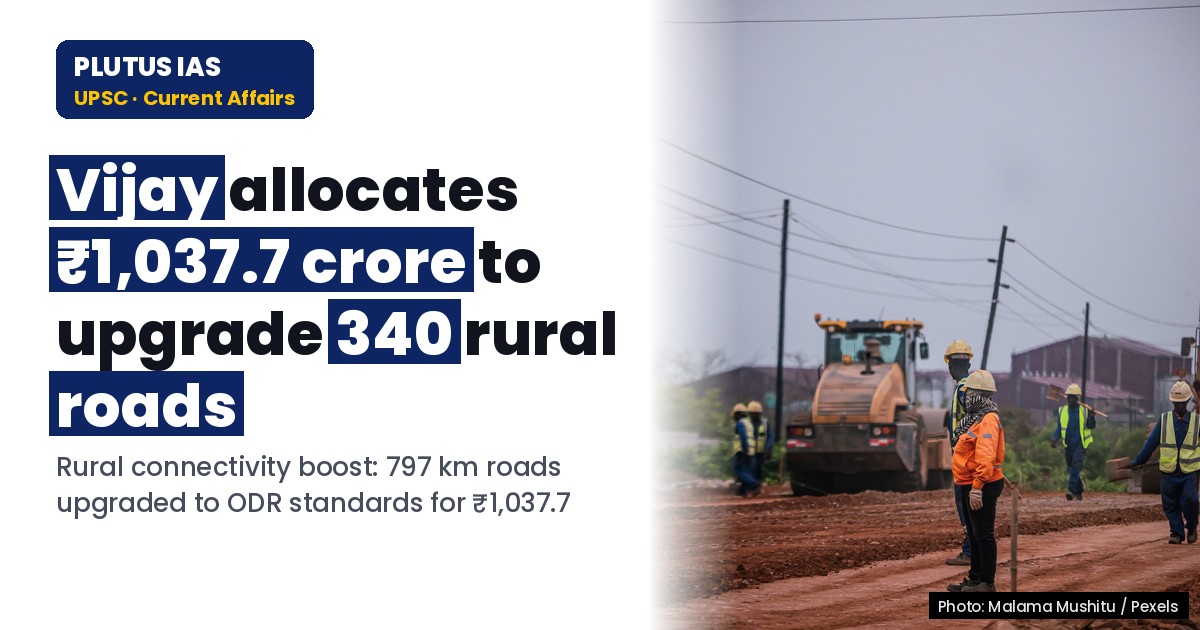
28 Nov Tamil Nadu allocates ₹1,037.7 crore to upgrade 340 rural roads under ODR standards
✎ Other District Roads (ODRs) are rural connectors designed for all-weather accessibility, bridging the gap between village roads and district highways, and are critical for rural socio-economic integration.
Subject Relevance — Where This Topic Fits
- GS Paper II — Governance, Constitution and Polity (Local Self-Government) | GS Paper III — Infrastructure (Rural Roads, Rural Development)
- Prelims: Panchayati Raj System, Other District Roads (ODRs), Mahatma Gandhi National Rural Employment Guarantee Scheme (MGNREGS), Pradhan Mantri Gram Sadak Yojana (PMGSY), Local Area Development Funds, Convergence of Schemes, Rural Connectivity, Devolution of Funds
- Essay: Rural Infrastructure as a Catalyst for Inclusive Growth, The Role of Local Governance in National Development
Quick Revision: Other District Roads (ODRs) are rural connectors designed for all-weather accessibility, bridging the gap between village roads and district highways, and are critical for rural socio-economic integration.
Why is this in the news?
The Tamil Nadu government has sanctioned a financial outlay of ₹1,037.70 crore for the upgradation of 340 village and panchayat union roads to the standards of Other District Roads (ODRs), covering a total distance of 797.13 km. This initiative, announced on 28 November 2026, underscores the state’s commitment to enhancing rural connectivity, facilitating socio-economic development, and aligning with national frameworks for rural infrastructure development.
Background
- The Panchayati Raj System in India, as enshrined in the 73rd Constitutional Amendment Act, 1992, empowers local self-governments to plan and execute rural development schemes, including infrastructure projects.
- Rural roads are critical for improving market access, healthcare delivery, and educational opportunities in agrarian and remote communities.
- The National Rural Road Development Agency (NRRDA) under the Ministry of Rural Development oversees the implementation of the Pradhan Mantri Gram Sadak Yojana (PMGSY), which aims to provide all-weather road connectivity to unconnected habitations.
- Tamil Nadu’s rural road network faces challenges such as inadequate maintenance, poor surfacing, and limited all-weather connectivity, particularly in hilly and coastal regions.
- The upgradation of village roads to ODR standards is a key strategy to integrate rural areas with district and state road networks, enhancing logistical efficiency.
What are Other District Roads (ODRs) and their significance?
- Other District Roads (ODRs) are a category of rural roads defined under the Rural Roads Manual of the Ministry of Rural Development, India, serving as connectors between villages, panchayats, and district roads.
- ODRs are designed to provide all-weather connectivity, ensuring accessibility during monsoons and facilitating uninterrupted movement of goods and services.
- They are distinct from village roads, which are typically shorter and serve intra-village connectivity, and from national or state highways, which form the primary arterial network.
- The upgradation of village roads to ODR standards involves measures such as metalling, drainage provision, culvert construction, and geometric improvements to enhance safety and durability.
- ODRs play a pivotal role in enabling rural entrepreneurship, reducing transportation costs, and improving access to essential services like healthcare and education.
- The upgradation aligns with the Sustainable Development Goals (SDG 9: Industry, Innovation and Infrastructure) by promoting resilient and sustainable infrastructure in rural areas.
- Tamil Nadu’s initiative is part of a broader trend of state-led rural infrastructure augmentation, complementing centrally sponsored schemes like PMGSY and MGNREGS.
- The financial allocation reflects a convergence of state resources with national priorities, ensuring equitable development across regions.
Key Features
| Feature | Significance |
|---|---|
| Allocation of ₹1,037.7 crore | Substantial financial commitment for rural road infrastructure, indicating prioritisation of grassroots connectivity. |
| Upgrade to ODR standards | Ensures all-weather accessibility and durability, aligning with national rural road development benchmarks. |
| Coverage of 797.13 km across 340 roads | Significant spatial expansion of rural road network, enhancing intra- and inter-village connectivity. |
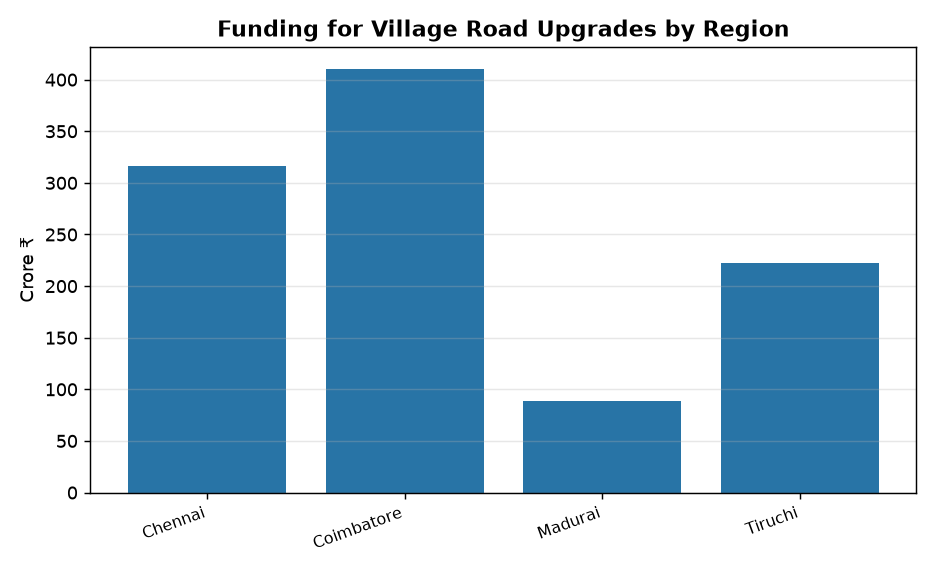
| Regional distribution (Chennai, Coimbatore, Madurai, Tiruchi) | Demonstrates equitable geographical allocation, addressing regional disparities in rural infrastructure. |
| Panchayat Union roads included | Directly strengthens local self-governance institutions by improving roads under their jurisdiction. |
Why it Matters
Economic
- Enhances rural mobility, reducing transportation costs for agricultural produce and local trade, thereby stimulating rural economies.
- Increases employment opportunities in road construction and maintenance sectors, particularly in rural areas.
- Improves access to markets, healthcare, and education, fostering economic integration of rural communities with urban centres.
Social
- Facilitates better access to essential services such as schools, hospitals, and administrative offices, improving quality of life.
- Strengthens social cohesion by improving connectivity between villages and panchayats, enabling community interactions.
- Reduces isolation of rural populations, particularly in remote or hilly regions, by providing reliable road networks.
Administrative
- Demonstrates the state government’s commitment to decentralised development through panchayati raj institutions.
- Aligns with the 73rd Constitutional Amendment Act, 1992, by empowering local bodies in infrastructure planning and execution.
- Serves as a model for other states in utilising centrally sponsored schemes for rural road development.
Strategic
- Improves logistical efficiency for disaster response and emergency services in rural areas.
- Supports national integration by enhancing connectivity in strategically important regions.
- Contributes to the broader goal of reducing rural-urban divide, a key objective of national development policies.
Challenges
1. Land Acquisition and Right-of-Way Issues
- Potential delays due to disputes over land ownership or compensation claims.
- Need for transparent and efficient land acquisition processes under the Right to Fair Compensation and Transparency in Land Acquisition, Rehabilitation and Resettlement Act, 2013.
- Coordination between multiple stakeholders, including landowners, local bodies, and state agencies.
UPSC Link: Land Acquisition Act, 2013
2. Environmental and Ecological Concerns
- Risk of environmental degradation in ecologically sensitive areas, necessitating adherence to environmental impact assessment norms.
- Need for sustainable construction practices to mitigate soil erosion, deforestation, and water body disturbances.
- Compliance with the Forest (Conservation) Act, 1980, and other environmental laws in case of road alignment through protected areas.
UPSC Link: Environmental Impact Assessment
3. Quality Assurance and Maintenance
- Ensuring adherence to technical standards (e.g., ODR specifications) during construction to avoid premature deterioration.
- Long-term maintenance challenges due to limited resources or inadequate planning for post-construction upkeep.
- Need for robust monitoring mechanisms to prevent substandard work or corruption in execution.
UPSC Link: Road Safety and Maintenance
4. Financial Sustainability
- Dependency on state budget allocations, which may fluctuate due to economic conditions or competing priorities.
- Risk of cost overruns due to inflation, material shortages, or unforeseen geotechnical challenges.
- Need for innovative financing models, such as public-private partnerships (PPPs), to supplement state funds.
UPSC Link: Infrastructure Financing
5. Technical and Manpower Constraints
- Shortage of skilled labour and technical expertise in rural areas for road construction and maintenance.
- Need for capacity-building initiatives to train local workers in modern construction techniques.
- Reliance on external contractors, which may lead to delays or quality issues if not properly supervised.
UPSC Link: Skill Development and Employment
Challenges — UPSC Perspective
| Issue | Concern |
|---|---|
| Land Acquisition Delays | Potential legal disputes and compensation claims may stall project timelines. |
| Environmental Clearances | Strict compliance with environmental laws may lead to prolonged approval processes. |
| Quality Control | Ensuring adherence to ODR standards requires stringent supervision and testing protocols. |
| Maintenance Post-Construction | Inadequate planning for upkeep may result in rapid deterioration of roads. |
| Financial Constraints | Dependence on state funds may limit scalability or lead to cost-cutting measures. |
| Skilled Labour Shortage | Local availability of trained workers may be insufficient for large-scale projects. |
Way Forward
- Establish a multi-stakeholder monitoring committee comprising state officials, panchayat representatives, and technical experts to oversee project execution.
- Adopt transparent land acquisition processes under the LARR Act, 2013, with grievance redressal mechanisms for affected landowners.
- Integrate environmental impact assessments into the planning phase to ensure compliance with the Environment Protection Act, 1986.
- Implement a phased maintenance plan post-construction, allocating dedicated funds and training local bodies for upkeep.
- Explore public-private partnerships (PPPs) to supplement state funding and leverage private sector efficiency in road construction.
- Conduct periodic audits and third-party quality checks to ensure adherence to ODR standards and prevent substandard work.
- Invest in skill development programmes for local workers in road construction and maintenance to address manpower constraints.
- Develop a digital dashboard for real-time tracking of project progress, fund utilisation, and grievance redressal to enhance accountability.
UPSC Value Addition
Keywords for Mains Answer-Writing
Panchayati Raj Institutions · Rural Infrastructure Development · Village Roads · Other District Roads (ODRs) · Local Governance · State Finance Commission · Convergence of Schemes · Rural Connectivity · Gram Panchayat · Devolution of Funds · 15th Finance Commission · Mahatma Gandhi National Rural Employment Guarantee Scheme (MGNREGS) · Pradhan Mantri Gram Sadak Yojana (PMGSY) · Fiscal Federalism · Decentralised Planning
Constitutional & Policy Linkages
- 73rd Constitutional Amendment Act, 1992 (Panchayati Raj Institutions)
Concept Flow
State government identifies rural road connectivity gaps as a development priority. → Allocation of ₹1,037.7 crore for upgrading 340 roads to ODR standards. → Project planning involves regional distribution, technical specifications, and financial allocation. → Implementation phase requires land acquisition, environmental clearances, and contractor engagement. → Construction phase focuses on quality control, labour training, and adherence to ODR standards. → Post-construction maintenance and monitoring ensure long-term sustainability and impact assessment. → Feedback loops and audits inform future rural infrastructure policies and allocations.
Prelims Practice Questions
Q1. Consider the following statements regarding the classification of roads in India:
1. National Highways are maintained by the National Highways Authority of India (NHAI).
2. State Highways are the responsibility of State Public Works Departments (PWD).
3. Other District Roads (ODRs) are maintained by Panchayati Raj Institutions.
4. Rural Roads are classified under the Pradhan Mantri Gram Sadak Yojana (PMGSY).
How many of the above statements are correct?
- Only one
- Only two
- Only three
- All
Answer: All — Statements 1, 2, and 4 are correct. Statement 3 is incorrect because ODRs are typically maintained by State PWD or Rural Development Departments, not directly by Panchayati Raj Institutions, though devolution may vary by state.
Q2. Assertion (A): The 15th Finance Commission recommended greater devolution of funds to local governments.
Reason (R): Local governments in India are constitutionally mandated to maintain rural roads under the 73rd Amendment Act, 1992.
Options:
A. Both A and R are true, and R is the correct explanation of A.
B. Both A and R are true, but R is not the correct explanation of A.
C. A is true, but R is false.
D. A is false, but R is true.
Answer: ? — Assertion (A) is true as the 15th Finance Commission did recommend enhanced devolution to local governments. Reason (R) is also true but is not the correct explanation of A, as the mandate for maintaining rural roads is derived from the 73rd Amendment and state-specific laws, not solely from the Finance Commission’s recommendations.
Q3. Match the following schemes with their primary objectives:
Column I (Scheme) | Column II (Objective)
—————–|——————-
A. PMGSY | 1. Provision of all-weather roads to unconnected habitations
B. MGNREGS | 2. Guaranteed wage employment in rural areas
C. ODR Upgradation | 3. Enhancing rural connectivity and accessibility
D. Finance Commission Devolution | 4. Fiscal transfers to strengthen local governance
Options:
A. A-1, B-2, C-3, D-4
B. A-3, B-2, C-1, D-4
C. A-2, B-1, C-4, D-3
D. A-4, B-3, C-2, D-1
Answer: ? — A-1 (PMGSY aims to provide all-weather roads to unconnected habitations), B-2 (MGNREGS guarantees 100 days of wage employment), C-3 (ODR upgradation enhances rural connectivity), D-4 (Finance Commission devolution strengthens local governance through fiscal transfers).
Mains Practice Question
✍ The upgradation of 340 village and panchayat union roads to Other District Road (ODR) standards in Tamil Nadu, sanctioned with ₹1,037.7 crore, exemplifies the convergence of rural infrastructure development and decentralised governance. Critically examine the significance of such initiatives for rural development and local governance in India. Also, analyse the challenges in ensuring effective devolution of funds and implementation of such schemes at the grassroots level. (15 Marks)
Approach: MODEL-ANSWER SKELETON:
1. **Introduction (2 marks)**: Define ODRs and their role in rural connectivity; cite the 73rd Constitutional Amendment Act, 1992, and the 15th Finance Commission’s recommendations on devolution to local bodies.
2. **Significance of the Initiative (5 marks)**:
– Enhances rural connectivity, reducing isolation and improving access to markets, healthcare, and education (cite PMGSY as a reference).
– Strengthens local governance by empowering Panchayati Raj Institutions (PRIs) in planning and maintenance (reference to Article 243G and State Finance Commissions).
– Economic multiplier effects: job creation, agricultural productivity, and rural entrepreneurship.
– Alignment with Sustainable Development Goals (SDG 9: Industry, Innovation, and Infrastructure; SDG 11: Sustainable Cities and Communities).
3. **Challenges in Implementation (5 marks)**:
– **Fiscal Constraints**: Over-reliance on state budgets or central schemes; need for robust State Finance Commission recommendations.
– **Capacity Gaps**: Limited technical and administrative capacity in PRIs for planning, execution, and maintenance (reference to the 2nd ARC report on local governance).
– **Convergence Issues**: Fragmentation of schemes (PMGSY, MGNREGS, ODR upgradation) leading to duplication or gaps; need for integrated planning.
– **Monitoring and Accountability**: Weak grievance redressal and social audit mechanisms (reference to MGNREGS audit provisions).
– **Geographical Disparities**: Hilly, tribal, or remote areas may face logistical and cost challenges.
4. **Way Forward (3 marks)**:
– Strengthening devolution of funds and functions to PRIs under the 73rd Amendment.
– Leveraging technology (GIS mapping, e-governance) for transparent planning and monitoring.
– Capacity-building programs for PRIs (reference to NITI Aayog’s Aspirational Districts Programme).
– Ensuring convergence with national schemes (PMGSY, MGNREGS) for holistic rural development.
Source: The Hindu
Generated by AanyaAi for educational purpose.
Related guides on our sites
- Anthropology VS PSIR
- Best PSIR optional coaching
- Best PSIR optional coaching online
- Best PSIR optional teacher

- Rajasthan HC Directs Filling of Women Commission Vacancies in 2 Months - November 28, 2026
- लोकसभा सीटों में 50% वृद्धि: केंद्र सरकार का बड़ा फैसला, जानें क्या होगा असर - November 28, 2026
- RBI to Auction ₹23,000 Crore Treasury Bills: Key Details for UPSC & State PCS - November 28, 2026

No Comments