


29 Oct A New Chapter in India’s Electronics Manufacturing: ECMS Approvals Worth ₹5,532 Crore
This article covers “Daily Current Affairs” and A New Chapter in India’s Electronics Manufacturing: ECMS Approvals Worth ₹5,532 Crore
GS- 3–Science & Technology – A New Chapter in India’s Electronics Manufacturing: ECMS Approvals Worth ₹5,532 Crore”
FOR PRELIMS
What is the Electronics Component Manufacturing Scheme (ECMS)?
FOR MAINS
What are the main objectives of the Electronics Component Manufacturing Scheme (ECMS)?
Why in the News?
A new phase in India’s electronics manufacturing journey has begun as the government approved projects worth ₹5,532 crore under the Electronics Component Manufacturing Scheme (ECMS). These are the first seven projects sanctioned under the scheme, expected to generate production worth ₹44,406 crore and create over 5,000 jobs.
The announcement by Union Minister Ashwini Vaishnaw underscores India’s commitment to strengthening its domestic electronics value chain and reducing import dependence. This move aligns with India’s broader vision of becoming a global hub for advanced electronics manufacturing, building on the sector’s rapid growth — now the third-largest and fastest-growing export category in 2024–25.
Scheme Overview
The Electronics Component Manufacturing Scheme (ECMS), notified on 8 April 2025 with an outlay of ₹22,919 crore (USD 2.7 billion), aims to build a strong, self-reliant ecosystem for electronics component manufacturing in India. With a six-year tenure and an optional one-year gestation period, the scheme focuses on attracting domestic and global investments, enhancing value addition, and integrating India’s electronics industry with global value chains through the production of key components, sub-assemblies, and raw materials.
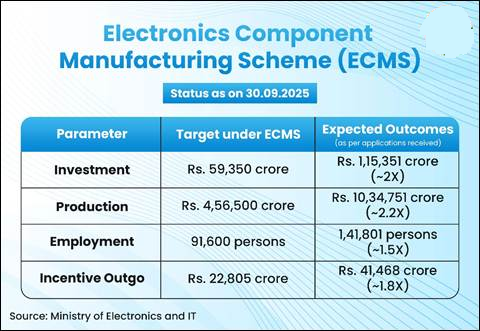
As of 30 September 2025, investment commitments have reached ₹1,15,351 crore, nearly double the target, with expected production worth ₹10,34,751 crore — 2.2 times the initial projection. The incentive outgo is projected at ₹41,468 crore, while the scheme is estimated to create 1.4 lakh direct jobs, exceeding its original goal.
Products Covered under the First Set of ECMS Approvals
The first seven projects approved under the Electronics Component Manufacturing Scheme (ECMS) encompass a wide range of high-value electronic components and materials essential to modern technology. These include components used in smartphones, automobiles, medical devices, telecommunications, and industrial systems.
Camera Module Sub-Assembly
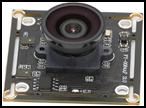
Camera module sub-assemblies are used in smartphones, drones, medical devices, and robots. They capture high-quality images and videos in electronic devices and serve as the imaging component in smartphones, tablets, laptops, security cameras, automotive systems, and IoT devices.
Multi-Layer PCB
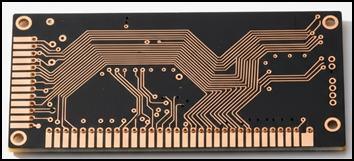
Multi-layer Printed Circuit Boards (PCBs) are used in automotive, consumer electronics, ICT, medical devices, telecommunication, aerospace and defence, and industrial manufacturing. They have multiple copper and dielectric layers that are interconnected with through-hole vias and are widely used in consumer electronics, industrial controls, and automotive systems.
HDI PCB
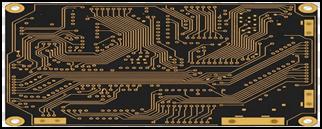
High-density interconnect PCBs are used in consumer electronics and wearable technology, automotive electronics, medical devices, telecommunication, aerospace and defence. These are advanced versions of PCBs with microvias, blind and buried vias, via-in-pad structures, finer tracks, and tighter spacing. They enable compact, high-performance designs for smartphones, tablets, wearables, aerospace, and medical devices.
Laminate (Copper Clad Laminate)
 Copper clad laminates are used in automotive, consumer electronics, medical devices, ICT, telecommunication, aerospace and defence, and industrial manufacturing. They serve as the base component for the manufacture of multi-layer PCBs.
Polypropylene Film
 Polypropylene film is used in capacitors for consumer electronics, automotive, ICT, industrial and manufacturing, telecommunications, and computing. It is the key material used in the production of capacitors.
Overview of Approved Applications under ECMS
| Applicant Name | Product | Project Location | Investment (₹ crore) | Expected Production (₹ crore) | Employment (Persons) |
|---|---|---|---|---|---|
| Kaynes Circuits India Pvt. Ltd. | Multi-Layer Printed Circuit Board (PCB) | Tamil Nadu | 104 | 4,300 | 220 |
| Kaynes Circuits India Pvt. Ltd. | Camera Module Sub-Assembly | Tamil Nadu | 325 | 12,630 | 480 |
| Kaynes Circuits India Pvt. Ltd. | HDI PCB | Tamil Nadu | 1,684 | 4,510 | 1,480 |
| Kaynes Circuits India Pvt. Ltd. | Laminate | Tamil Nadu | 1,167 | 6,875 | 300 |
| SRF Limited | Polypropylene Film | Madhya Pradesh | 496 | 1,311 | 225 |
| Syrma Strategic Electronics Pvt. Ltd. | Multi-Layer Printed Circuit Board (PCB) | Andhra Pradesh | 765 | 6,933 | 955 |
| Ascent Circuits Pvt. Ltd. | Multi-Layer Printed Circuit Board (PCB) | Tamil Nadu | 991 | 7,847 | 1,535 |
| Total | — | — | 5,532 | 44,406 | 5,195 |
Electronics as India’s Leading Export Category
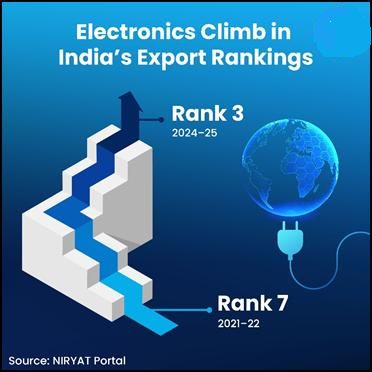
Electronics have emerged as India’s third largest and fastest growing export category in 2024–25, rising from the seventh position in 2021–22. In the first half of FY 2025–26, electronics exports stood at USD 22.2 billion[1], maintaining strong growth momentum and placing the sector on course to become the country’s second largest exported item.
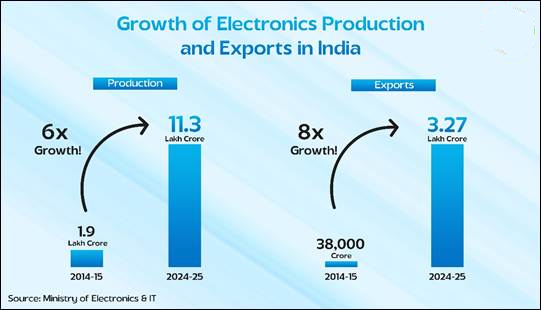
The country’s electronics production has grown from ₹1.9 lakh crore in 2014–15 to ₹11.3 lakh crore in 2024–25, marking a six-fold increase. Exports rose from ₹38,000 crore to ₹3.27 lakh crore in the same period, reflecting an eight-fold jump. Over the past decade, electronics manufacturing has created around 25 lakh jobs across the country.
Mobile manufacturing has played a major role in this transformation. Production in this segment has increased from ₹18,000 crore in 2014–15 to ₹5.45 lakh crore in 2024–25, a 28-fold rise. India is now the world’s second largest mobile phone manufacturer, with more than 300 units operating compared to just two in 2014.
Exports of mobile phones have shown remarkable progress, rising 127 times from ₹1,500 crore in 2014–15 to ₹2 lakh crore in 2024–25. In 2024, Apple alone exported iPhones worth ₹1,10,989 crore, crossing the ₹1 lakh crore mark with 42 per cent year-on-year growth. In the first five months of 2025–26, smartphone exports touched ₹1 lakh crore, a 55 per cent rise over the same period last year.
India has now achieved near self-reliance in mobile production, moving from importing most of its requirements a decade ago to manufacturing almost all devices domestically. This transformation highlights the strength of India’s policy ecosystem and its emergence as a trusted hub for global electronics manufacturing and exports.
Conclusion
India’s electronics manufacturing sector stands at a defining moment. The approval of projects under the Electronics Component Manufacturing Scheme marks not just an industrial milestone but a strategic step towards deepening self-reliance and strengthening the nation’s global position in technology production. With strong investment commitments, record production targets, and steady job creation, the scheme is set to reinforce the foundation of India’s electronics value chain.
From components to complete devices, India is moving up the manufacturing ladder with confidence. The growth in exports, the rise of domestic production, and the rapid expansion of mobile manufacturing together show a clear direction. India is not only producing for its own needs but also powering global supply chains. As these efforts continue, the country’s vision of becoming a global electronics hub is fast turning into a tangible reality.
Prelims question:
Q. Consider the following statements about the Electronics Component Manufacturing Scheme (ECMS):
1. The scheme was notified in April 2025 with a total outlay of ₹22,919 crore.
2. It aims to promote domestic manufacturing of key electronic components, sub-assemblies, and raw materials.
3. Tamil Nadu, Andhra Pradesh, and Madhya Pradesh are among the states where the first ECMS projects have been approved.
Which of the statements given above is/are correct?
(a) 1 and 2 only
(b) 2 and 3 only
(c) 1 and 3 only
(d) 1, 2 and 3
Answer: D
Mains Question:
Q. Discuss the significance of the Electronics Component Manufacturing Scheme (ECMS) in strengthening India’s electronics value chain and achieving self-reliance in the sector.
(250 words)

- Before New Taxes, Make Every Rupee Count: Fiscal Discipline and Outcome-Based Governance in Tamil Nadu - August 20, 2026
- A Palestinian State as the Foundation for Regional Peace - August 20, 2026
- A Vision for an Inclusive Bangladesh: Democracy, Minority Rights and India’s Neighbourhood - August 19, 2026

No Comments