


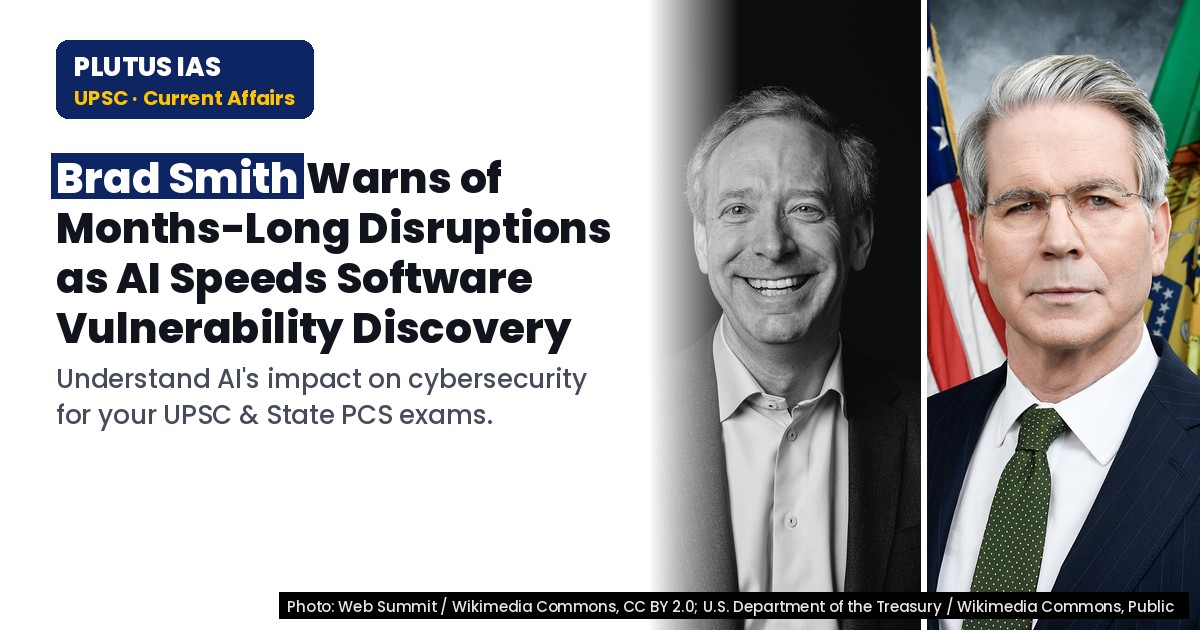
25 Nov AI Accelerates Software Vulnerabilities: Microsoft Warns
✎ The accelerated discovery of software vulnerabilities by Artificial Intelligence necessitates a rapid but meticulously managed approach to security patching to prevent widespread digital disruptions and cyber exploitation.
Subject Relevance — Where This Topic Fits
- GS Paper III — Science and Technology | GS Paper III — Internal Security | GS Paper III — Economy
- Prelims: Artificial Intelligence (AI), Cybersecurity, Software Vulnerabilities, Digital Infrastructure, Cyberattacks, Information Technology (IT) Governance
- Essay: The Dual Nature of Technology: Progress and Peril, Ensuring Digital Resilience in an Interconnected World
Quick Revision: The accelerated discovery of software vulnerabilities by Artificial Intelligence necessitates a rapid but meticulously managed approach to security patching to prevent widespread digital disruptions and cyber exploitation.
Why is this in the news?
Recent statements by Microsoft president Brad Smith highlight the escalating challenge of cybersecurity in an era of advanced Artificial Intelligence (AI). Smith warned that AI’s capacity to rapidly identify software vulnerabilities necessitates an accelerated pace of security patching, which, if not managed carefully, could lead to increased system disruptions and outages. This situation underscores the critical need for enhanced testing, improved coordination, and modernization of ageing digital infrastructure to mitigate risks posed by both malicious actors and the rapid deployment of security updates.
Background
- The digital transformation across sectors has led to an exponential increase in software-dependent systems, making cybersecurity a paramount concern for national security, economic stability, and public services.
- Artificial Intelligence (AI) technologies are increasingly being leveraged by both cybersecurity professionals for defence and by malicious actors for identifying and exploiting system vulnerabilities.
- Software vulnerabilities, often latent within complex codebases, represent weaknesses that can be exploited to compromise system integrity, confidentiality, or availability.
- The rapid development and deployment of software updates, while essential for security, introduce inherent risks of introducing new bugs or compatibility issues, particularly in legacy systems.
- Governments and critical infrastructure operators globally face the challenge of securing vast and often interconnected digital ecosystems against sophisticated and evolving cyber threats.
- Recent incidents, such as banking disruptions attributed to security updates, underscore the fragility of digital systems and the potential for widespread impact from technical glitches.
Understanding Cybersecurity in the AI Era
- Cybersecurity encompasses the protection of internet-connected systems, including hardware, software, and data, from cyber threats.
- Artificial Intelligence (AI) significantly enhances the speed and scale at which software vulnerabilities can be discovered, both by security researchers and by malicious actors.
- Software vulnerabilities are flaws or weaknesses in a computer program or operating system that can be exploited by an attacker to gain unauthorized access or cause system disruption.
- Patch management involves applying software updates to fix bugs, improve performance, or, critically, to address security vulnerabilities.
- Digital infrastructure refers to the foundational components and systems that support digital operations, including networks, servers, data centres, and software applications.
- Cyberattacks are malicious attempts to breach the information system of an individual or organization, often with the intent to steal, alter, or destroy data, or to disrupt services.
- The ‘race to patch’ describes the urgent effort by technology companies and organizations to identify and fix security flaws before they can be exploited by cybercriminals.
- Effective cybersecurity strategies in the AI era require robust testing protocols for software updates, enhanced inter-organizational coordination, and continuous modernization of legacy IT systems.
Key Features
| Feature | Significance |
|---|---|
| AI-Accelerated Vulnerability Discovery | Artificial Intelligence significantly reduces the time required to identify weaknesses in computer code, enhancing both defensive patching efforts and offensive exploitation by malicious actors. |
| Increased Pace of Software Updates | The rapid identification of vulnerabilities necessitates an accelerated deployment of security patches, creating a dynamic and potentially unstable software environment. |
| Risk of Outages from Patches | Rushed or inadequately tested security updates, particularly on legacy systems, can introduce new software bugs and lead to service disruptions. |
| Global Race Against Exploitation | A worldwide competition exists between technology companies patching security flaws and cybercriminals attempting to exploit them before fixes are implemented. |
| Importance of Robust Testing | Thorough testing of software updates is crucial to prevent the introduction of new vulnerabilities or operational issues during the patching process. |
| Inter-sectoral Cooperation | Enhanced collaboration between governments and technology companies is vital for effective information sharing regarding emerging cyber threats and coordinated defence strategies. |
Why it Matters
Technological Significance
- AI’s dual role in both identifying and potentially exploiting software vulnerabilities underscores its transformative impact on cybersecurity paradigms.
- The accelerated discovery of flaws necessitates a paradigm shift in software development lifecycles, emphasizing continuous integration of security measures and rapid deployment capabilities.
- Investment in advanced testing methodologies and infrastructure becomes paramount to ensure the stability and reliability of updated systems.
Economic Significance
- Potential service disruptions due to rushed security updates can result in substantial economic losses for businesses and impact critical infrastructure.
- The need for robust cybersecurity measures and resilient IT infrastructure drives increased expenditure on technology upgrades, skilled personnel, and advanced security solutions.
- Maintaining public trust in digital services, including banking, requires a proactive and transparent approach to managing security incidents and system stability.
Governance Significance
- Governments must collaborate with the private sector to develop comprehensive cybersecurity frameworks, share threat intelligence, and coordinate responses to large-scale cyber incidents.
- Regulatory bodies may need to establish standards for software update processes, testing protocols, and incident reporting to mitigate risks to critical national infrastructure.
- Ensuring the resilience of essential services, such as financial systems, against technological disruptions is a key aspect of national security and economic stability.
Social Significance
- Frequent service outages can erode public confidence in digital platforms and services, impacting daily life and economic activities.
- The imperative for individuals to regularly install security updates on personal devices highlights the shared responsibility in maintaining a secure digital ecosystem.
- Awareness campaigns on cybersecurity best practices and the importance of timely updates are crucial for empowering citizens to protect their digital assets.
Challenges
1. Accelerated Vulnerability Exploitation
- AI significantly reduces the time required for malicious actors to identify and exploit software vulnerabilities, shortening the window for defensive action.
- The sophistication of AI-driven attack vectors is increasing, posing a greater challenge to traditional security measures.
UPSC Link: Cybersecurity challenges; internal security
2. Risk of Patch-Induced Outages
- Rapid deployment of security patches, especially on complex or legacy systems, without adequate testing, can introduce new bugs and cause service disruptions.
- The trade-off between speed of patching and thoroughness of testing presents a critical operational dilemma for organizations.
UPSC Link: Infrastructure; IT systems management
3. Legacy System Vulnerabilities
- Older technology infrastructure is often more susceptible to vulnerabilities and less compatible with rapid, frequent updates, increasing the risk of instability.
- The cost and complexity of upgrading or replacing extensive legacy systems can be prohibitive for many organizations.
UPSC Link: Digital infrastructure; technology adoption
4. Coordination and Information Sharing Gaps
- Lack of effective coordination between IT teams within organizations and insufficient information sharing between governments and technology companies hinder collective defence efforts.
- Siloed approaches to cybersecurity can leave critical vulnerabilities unaddressed across interconnected systems.
UPSC Link: Cybersecurity governance; inter-agency coordination
5. Skill Shortage in Cybersecurity
- The rapid evolution of cyber threats and defence mechanisms creates a persistent demand for highly skilled cybersecurity professionals, which current supply struggles to meet.
- Organizations face challenges in recruiting, training, and retaining talent capable of managing complex security environments.
UPSC Link: Skill development; human resource management
Challenges — UPSC Perspective
| Issue | Concern |
|---|---|
| AI-Driven Threat Evolution | Artificial Intelligence accelerates the discovery and exploitation of software vulnerabilities by malicious actors, increasing the speed and sophistication of cyberattacks. |
| Patch-Induced Instability | Rushed deployment of security updates, particularly on older or complex systems without rigorous testing, risks introducing new software bugs and causing system outages. |
| Legacy Infrastructure Vulnerability | Ageing technology systems are often more prone to security flaws and less resilient to frequent updates, posing significant operational and security risks. |
| Testing and Quality Assurance Deficiencies | The imperative for rapid patching can lead to insufficient testing of updates, potentially compromising system stability and introducing new vulnerabilities. |
| Inter-Organizational Coordination | Lack of seamless information sharing and coordinated action between technology companies and government entities can impede a unified response to emerging cyber threats. |
| Resource Allocation for Cybersecurity | Organizations face challenges in dedicating adequate financial and human resources to maintain robust cybersecurity postures and upgrade outdated infrastructure. |
Way Forward
- Implement AI-powered security tools for proactive threat detection and automated vulnerability management, augmenting human analysis capabilities.
- Mandate rigorous testing protocols and staged deployment strategies for all software updates, especially for critical infrastructure, to minimize the risk of patch-induced outages.
- Invest significantly in upgrading and modernizing legacy IT infrastructure across sectors to enhance resilience against cyber threats and facilitate seamless security updates.
- Foster greater public-private partnerships for real-time threat intelligence sharing, collaborative research on cybersecurity, and joint incident response exercises.
- Develop comprehensive national cybersecurity policies that include guidelines for software supply chain security, incident reporting, and accountability frameworks.
- Launch national skill development programs focused on cybersecurity to address the talent gap, ensuring a robust workforce capable of defending against evolving threats.
- Promote public awareness campaigns on the importance of regular software updates and cybersecurity hygiene for individual users and small businesses.
- Establish international cooperation mechanisms for combating cross-border cybercrime and sharing best practices in digital security governance.
UPSC Value Addition
Keywords for Mains Answer-Writing
Artificial Intelligence (AI) · Cybersecurity · Software vulnerabilities · Digital infrastructure · Cyber threats · Information security · Critical infrastructure protection · Public-private cooperation · Digital governance · Risk management · Technological disruption · Cyber resilience
Concept Flow
AI accelerates vulnerability discovery → Increased pressure for rapid patching → Risk of rushed, inadequately tested updates → Potential for new software bugs/outages → Disruption to services and operations → Need for enhanced testing and coordination → Improved cybersecurity posture and resilience
Prelims Practice Questions
Q1. Consider the following statements regarding cybersecurity and Artificial Intelligence (AI) in the contemporary digital landscape:
1. AI significantly reduces the time required to identify software vulnerabilities, aiding both defensive and offensive cyber operations.
2. Rapid deployment of security patches, especially on legacy systems, can introduce new system instabilities and outages.
3. International cooperation between governments and technology companies is crucial for sharing intelligence on emerging cyber threats.
How many of the above statements are correct?
- Only one
- Only two
- All three
- None
Answer: All three — Statement 1 is correct: AI’s analytical capabilities accelerate the discovery of software weaknesses, benefiting both cybersecurity professionals and malicious actors. Statement 2 is correct: Rushed updates, particularly on older or complex systems, can lead to unforeseen compatibility issues and service disruptions. Statement 3 is correct: Collaborative efforts are essential for a comprehensive approach to global cyber threat intelligence and mitigation.
Q2. Which of the following measures are recommended to mitigate the risks associated with accelerated software updates and AI-driven vulnerability discovery?
1. Implementing more rigorous testing protocols for software updates.
2. Enhancing coordination among Information Technology (IT) teams within organisations.
3. Prioritising the replacement of ageing technology infrastructure.
4. Fostering closer collaboration between governmental agencies and technology firms for threat information sharing.
Select the correct answer using the code given below:
- 1 and 2 only
- 3 and 4 only
- 1, 2 and 3 only
- 1, 2, 3 and 4
Answer: 1, 2, 3 and 4 — All four measures are recommended. Rigorous testing (1) prevents new issues from being introduced. Enhanced coordination (2) ensures smooth integration and deployment. Replacing ageing infrastructure (3) reduces susceptibility to vulnerabilities. Closer collaboration (4) facilitates a proactive defence against evolving cyber threats.
Mains Practice Question
✍ Artificial Intelligence (AI) is transforming the landscape of cybersecurity by both enhancing defensive capabilities and creating new avenues for exploitation. Discuss the dual impact of AI on cybersecurity and critically examine the challenges associated with maintaining digital infrastructure resilience in this evolving environment. (15 Marks)
Approach: Introduction: Define AI’s role in cybersecurity. Dual Impact of AI: Positive aspects (e.g., automated threat detection, vulnerability scanning, anomaly identification, faster incident response) and Negative aspects (e.g., AI-powered attacks, accelerated vulnerability discovery by malicious actors, sophisticated phishing, autonomous malware). Challenges to Digital Infrastructure Resilience: Discuss issues like the race to patch vulnerabilities, risks of rushed updates (especially on legacy systems), need for robust testing, coordination gaps, ageing infrastructure, skill shortages, and the imperative for public-private cooperation. Measures/Way Forward: Propose solutions such as enhanced testing protocols, infrastructure modernisation, inter-agency and international collaboration, R&D in secure AI, and continuous skill development. Conclusion: Summarise the need for a holistic and adaptive approach to cybersecurity in the AI era.
Source: nationalheraldindia.com
Generated by AanyaAi for educational purpose.

- AI Accelerates Software Vulnerabilities: Microsoft Warns - November 25, 2026
- State Visit of Prime Minister of Nepal (November 22–23, 2026) - November 24, 2026
- Magnet School Scheme & ADB Agreement Protest Analysis - November 24, 2026

No Comments