


01 Sep AI-Generated Artwork: Copyright Office Rules No AI Authorship Possible
✎ Under the Copyright Act, 1957, authorship is exclusively attributed to human beings; AI systems cannot be recognised as authors, though AI-generated works may still qualify for copyright if they meet the originality threshold…
Subject Relevance — Where This Topic Fits
- GS Paper II — Governance, Constitution and Polity (Intellectual Property Rights) | GS Paper III — Science and Technology (IPR and Emerging Technologies)
- Prelims: Copyright Act, 1957, Intellectual Property Rights, Artificial Intelligence, Authorship, Originality in Copyright, Ministry of Commerce and Industry, Registrar of Copyrights, Delhi High Court
- Essay: The intersection of artificial intelligence and intellectual property rights: Challenges and ethical considerations, Balancing innovation and legal frameworks in the digital age
Quick Revision: Under the Copyright Act, 1957, authorship is exclusively attributed to human beings; AI systems cannot be recognised as authors, though AI-generated works may still qualify for copyright if they meet the originality threshold through human involvement.
Why is this in the news?
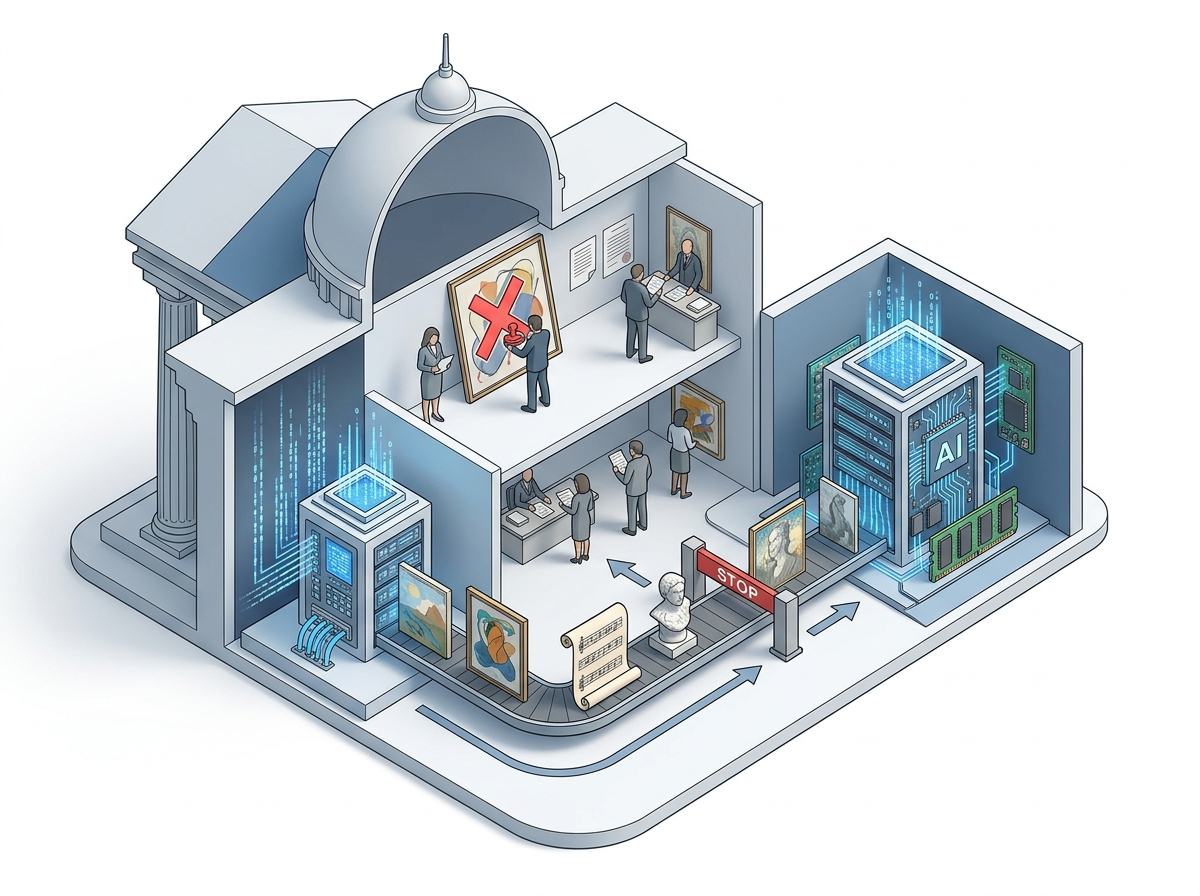
The Copyright Office, under the Ministry of Commerce and Industry, has issued a significant ruling affirming that artificial intelligence (AI) systems cannot be recognised as authors of creative works under the Copyright Act, 1957. This decision, arising from a case involving researcher Stephen Thaler’s AI-generated artwork ‘A Recent Entrance to Paradise’, clarifies the legal status of AI-generated content in India, aligning with global jurisprudence while addressing domestic implications for creators, developers, and legal practitioners.
Background
- The case originated from an application by US researcher Stephen Thaler to register copyright for an artwork autonomously generated by his AI system, DABUS (Device for the Autonomous Bootstrapping of Unified Sentience), attributing authorship solely to the AI.
- The Delhi High Court, in April 2026, directed the Copyright Office to adjudicate on whether an AI system could claim sole authorship over a work it generated.
- Globally, jurisdictions such as the United States and the European Union have similarly rejected AI authorship claims, emphasising the necessity of human involvement in the creative process.
- The ruling underscores the distinction between the technological process of creation and the legal recognition of authorship, a critical issue as AI systems increasingly produce original works.
- The decision aligns with India’s broader intellectual property framework, which prioritises human creativity and innovation while accommodating technological advancements.
What is the legal framework governing authorship and artificial intelligence under the Copyright Act, 1957?
- Section 2(d) of the Act defines ‘author’ in relation to literary, dramatic, musical, and artistic works, explicitly referring to individuals responsible for the work’s creation.
- The Act does not recognise legal personality for AI systems, meaning they cannot hold rights, obligations, or authorship under the law.
- Originality, a key criterion for copyright protection, is assessed based on the independent creation of the work by the author, which the Copyright Office ruled must involve human conception.
- The ruling distinguishes between the ‘technological mechanism’ of AI-generated output and the ‘legally recognised person’ responsible for the work, reinforcing human-centric authorship.
- AI-generated works may still be protected under copyright if they meet the threshold of originality, provided a human is involved in the creative process, such as conception, selection, or arrangement.
- The decision reflects a global consensus, as seen in jurisdictions like the US and EU, where courts have consistently denied AI authorship claims while acknowledging the potential for copyright in AI-assisted works.
- The ruling has implications for developers, artists, and legal practitioners, particularly in clarifying ownership and licensing frameworks for AI-generated content.
UPSC Value Addition
Keywords for Mains Answer-Writing
Copyright Act, 1957 · Authorship under Copyright Law · Artificial Intelligence and Intellectual Property · Originality in Copyright · Human authorship doctrine · Legal personality of AI systems · Registrar of Copyrights · Delhi High Court directions · AI-generated works · Intellectual Property Rights framework · Ministry of Commerce and Industry · DABUS case · Stephen Thaler · Constitutional and statutory interpretation
Prelims Practice Questions
Q1. Consider the following statements regarding authorship under the Copyright Act, 1957:
1. The Copyright Act, 1957 defines an ‘author’ as a ‘person’ who causes the work to be created.
2. An AI system can be granted copyright over a work it autonomously generates.
3. The Delhi High Court in April 2026 directed the Copyright Office to decide on AI authorship claims.
How many of the above statements are correct?
- Only one
- Only two
- All three
- None
Answer: Only two — Statement 1 is correct as the Copyright Act, 1957 explicitly defines an ‘author’ as a ‘person’ under Section 2(d). Statement 2 is incorrect as the Copyright Office has held that AI systems cannot be authors. Statement 3 is incorrect as the Delhi High Court directed the Copyright Office in April 2025, not 2026.
Q2. Assertion (A): The Copyright Office, under the Ministry of Commerce and Industry, has ruled that an AI system cannot be the author of a work it generates.
Reason (R): The Copyright Act, 1957 requires human authorship for copyright protection, and autonomy in execution does not equate to conception of a work.
Code:
(A) Both A and R are true, and R is the correct explanation of A.
(B) Both A and R are true, but R is NOT the correct explanation of A.
(C) A is true, but R is false.
(D) A is false, but R is true.
- A
- B
- C
- D
Answer: A — Both Assertion (A) and Reason (R) are true. The Copyright Act, 1957 requires human authorship, and the Copyright Office’s ruling aligns with this statutory requirement. R correctly explains A.
Q3. Match the following columns regarding intellectual property rights and AI:
Column I | Column II
1. Copyright Act, 1957 | A. Defines ‘author’ as a ‘person’
2. DABUS | B. AI system developed by Stephen Thaler
3. Registrar of Copyrights | C. Decides on copyright claims under the Act
4. Originality threshold | D. Requires human authorship for protection
Select the correct match:
- 1-A, 2-B, 3-C, 4-D
- 1-D, 2-A, 3-C, 4-B
- 1-B, 2-D, 3-A, 4-C
- 1-C, 2-A, 3-D, 4-B
Answer: 1-A, 2-B, 3-C, 4-D — 1-A: Copyright Act, 1957 defines ‘author’ as a ‘person’. 2-B: DABUS is an AI system developed by Stephen Thaler. 3-C: The Registrar of Copyrights decides on copyright claims. 4-D: The Copyright Act requires human authorship for protection.
Mains Practice Question
✍ The Copyright Office has recently ruled that an Artificial Intelligence (AI) system cannot be the author of a work it generates, though the work itself may qualify for copyright protection. Critically examine this position in the context of the Copyright Act, 1957, and discuss the implications for the evolving landscape of AI-generated creative works. (15 Marks)
Approach: MODEL-ANSWER SKELETON:
1. **Statutory Framework**:
– Reference Section 2(d) of the Copyright Act, 1957, which defines an ‘author’ as a ‘person’.
– Highlight the distinction between ‘author’ and ‘owner’ under the Act.
– Cite the requirement of ‘originality’ under Section 13 for copyright protection.
2. **Judicial and Institutional Precedents**:
– Discuss the Copyright Office’s ruling in the DABUS case (2025) and its reasoning: autonomy in execution ≠ conception of a work.
– Mention the Delhi High Court’s direction to the Copyright Office (April 2025) to decide on AI authorship.
– Reference the US Copyright Office’s earlier rejection of AI authorship (March 2025).
3. **Policy and Theoretical Debates**:
– Present the balance between encouraging innovation and protecting creators’ rights.
– Discuss the ‘human authorship’ doctrine: whether it aligns with technological advancements or creates a legal void for AI-generated works.
– Reference scholars like Lawrence Lessig or Jessica Silbey on IP and technology.
4. **Implications for AI-Generated Works**:
– Explore the practical challenges: attribution, ownership, and enforcement.
– Discuss the role of the ‘person’ who configures/trains the AI (e.g., Stephen Thaler in the DABUS case).
– Consider the need for legislative or judicial evolution to address AI’s creative outputs.
5. **Conclusion**:
– Take a reasoned position: Should the law evolve to recognize AI as a ‘tool’ rather than an ‘author’, or should sui generis rights be considered?
– Emphasize the need for a balanced approach that fosters innovation while safeguarding IPR principles.
Source: The Indian Express
Generated by AanyaAi for educational purpose.
Related guides on our sites
- Best Law optional coaching for upsc
- Best law optional teacher for upsc
- How to prepare for GS paper 1 for UPSC CSE mains exam
- Best UPSC coaching for IFOS exam

- Kerala HC rules delay cannot quash Domestic Violence Act proceedings - September 20, 2026
- नासा-इसरो सहयोग: अंतरिक्ष अनुसंधान में नया मोड़, जानिए क्या है अगला कदम? - September 20, 2026
- NASA highlights ISRO partnership for future space missions in UPSC focus - September 20, 2026

No Comments