


11 Aug AI-Generated Defamatory Images: Cyber Crime in Chhattisgarh | UPSC Polity
✎ AI-generated objectionable imagery disseminated on social media constitutes a cybercrime under Sections 67, 67A of the IT Act, and may attract penal provisions under Sections 354C and 509 of the IPC, with victims advised to…
Subject Relevance — Where This Topic Fits
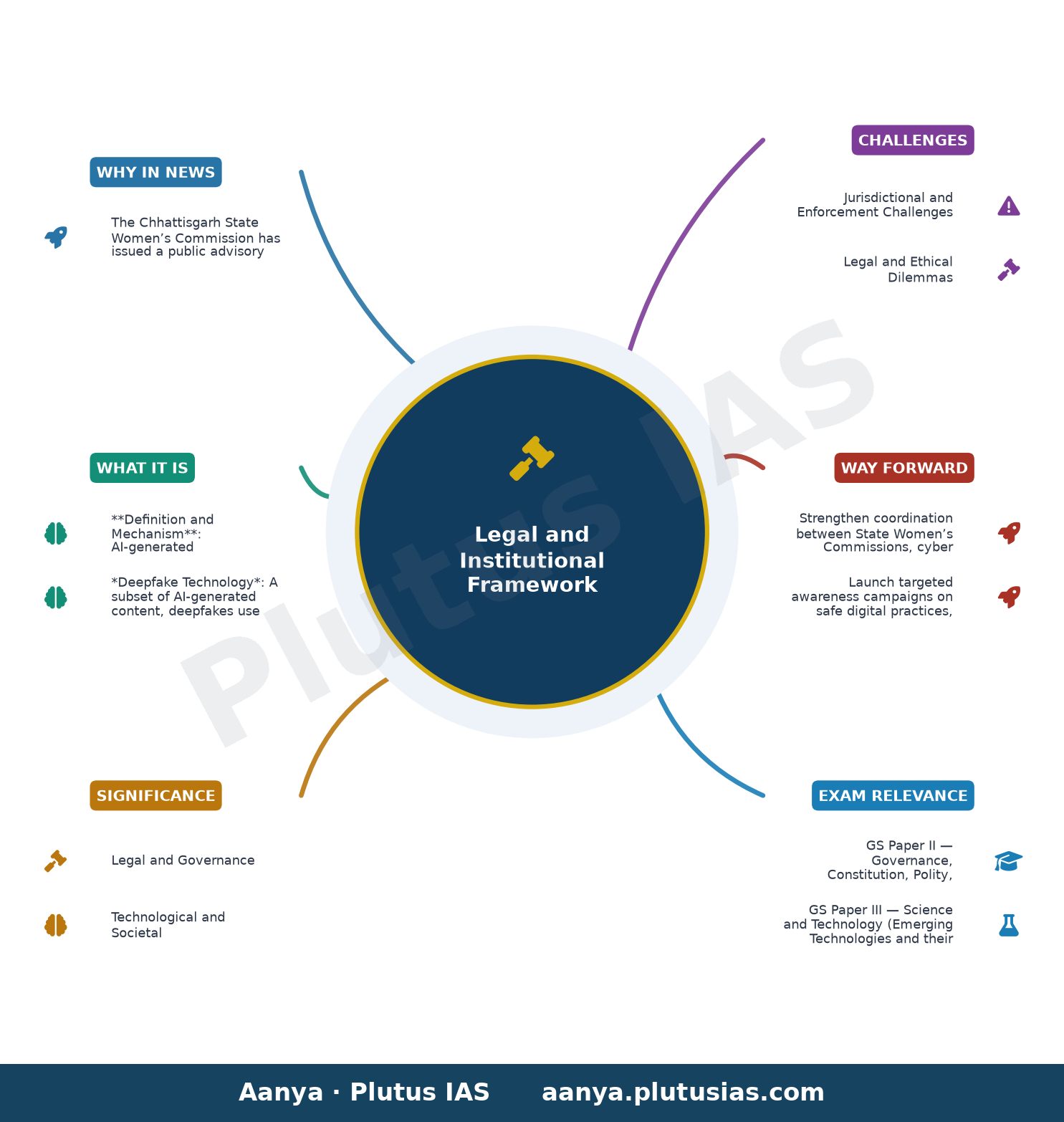
- GS Paper II — Governance, Constitution, Polity, Social Justice and International Relations (Cyber Laws and Digital Governance) | GS Paper III — Science and Technology (Emerging Technologies and their Societal Implications)
- Prelims: Information Technology Act, 2000 (Section 67, 67A, 67B), Cybercrimes against women, AI-generated deepfakes, Digital Personal Data Protection Act, 2023, National Cyber Crime Reporting Portal (NCRP), Section 354C of the Indian Penal Code (Voyeurism), Section 509 of the Indian Penal Code (Word, gesture or act intended to insult the modesty of a woman)
- Essay: The Ethical Dilemma of AI: Balancing Innovation with Human Dignity, Digital Empowerment and the Paradox of Surveillance: Safeguarding Privacy in a Hyperconnected World
Quick Revision: AI-generated objectionable imagery disseminated on social media constitutes a cybercrime under Sections 67, 67A of the IT Act, and may attract penal provisions under Sections 354C and 509 of the IPC, with victims advised to report such offences immediately to the National Cyber Crime Reporting Portal for redressal.
Why is this in the news?
The Chhattisgarh State Women’s Commission has issued a public advisory highlighting the criminal liability under cyber laws for the creation and dissemination of AI-generated objectionable imagery involving women on social media platforms. This follows a complaint during a public hearing where a woman alleged that her morphed AI-generated images were being circulated online with malicious intent. The incident underscores the evolving challenges posed by artificial intelligence to personal dignity, privacy, and the efficacy of existing legal safeguards in the digital domain.
Background
- The proliferation of artificial intelligence (AI) and deepfake technologies has significantly lowered the barriers to creating hyper-realistic synthetic media, including images, videos, and audio.
- Social media platforms, while enabling free expression, have also become vectors for the rapid and widespread dissemination of harmful, non-consensual, and defamatory content.
- India has witnessed a surge in cybercrimes targeting women, particularly in the form of morphing, revenge porn, and AI-generated deepfakes, necessitating robust legal and institutional responses.
- The Information Technology Act, 2000 (IT Act) and the Indian Penal Code (IPC) provide the primary legal framework to address such offences, though their interpretation and enforcement remain complex in the context of rapidly evolving technologies.
- The Digital Personal Data Protection Act, 2023, introduces additional obligations on data fiduciaries and platforms to safeguard personal data, including biometric and facial data, which may be exploited through AI tools.
- The National Cyber Crime Reporting Portal (NCRP) serves as a centralized platform for reporting cybercrimes, including those against women, facilitating timely intervention by law enforcement agencies.
AI-Generated Objectionable Imagery on Social Media: Legal, Institutional, and Technological Dimensions
- **Definition and Mechanism**: AI-generated objectionable imagery refers to synthetic media created using artificial intelligence techniques such as deep learning, generative adversarial networks (GANs), and diffusion models, which can produce realistic images, videos, or audio of individuals without their consent.
- *Deepfake Technology*: A subset of AI-generated content, deepfakes use neural networks to swap faces, alter voices, or fabricate events, often with malicious intent to defame, harass, or blackmail individuals, particularly women.
- *Legal Provisions*: Under Section 67 of the IT Act, publishing or transmitting obscene material in electronic form is punishable with imprisonment up to 5 years and a fine up to ₹10 lakh. Section 67A criminalizes the publication or transmission of material containing sexually explicit acts, with penalties including imprisonment up to 7 years and a fine.
- *Voyeurism and Modesty Offences*: Section 354C of the IPC defines voyeurism and prescribes punishment for capturing or disseminating images of a woman engaged in a private act without her consent. Section 509 of the IPC addresses acts intended to insult the modesty of a woman, including gestures, words, or digital communications.
- *Digital Personal Data Protection Act, 2023*: This Act mandates the protection of personal data, including biometric and facial data, and imposes obligations on data fiduciaries to prevent unauthorized processing or disclosure, with penalties for non-compliance.
- *Institutional Safeguards*: The National Cyber Crime Reporting Portal (NCRP) enables victims to report cybercrimes, including those involving AI-generated content, to law enforcement agencies. State-level women’s commissions play a critical role in sensitizing stakeholders, conducting public hearings, and advocating for victim-centric policies.
- *Role of Social Media Platforms*: Intermediaries are required under the IT Act to observe due diligence and remove unlawful content expeditiously upon receiving a complaint. The IT Rules, 2021, further specify obligations for grievance redressal and transparency in content moderation.
- *Technological Countermeasures*: Advances in AI-driven detection tools, such as deepfake detection algorithms, watermarking, and blockchain-based verification, are being developed to identify and mitigate the spread of synthetic media, though their efficacy remains a subject of ongoing research.
Key Features
| Feature | Significance |
|---|---|
| AI-generated objectionable imagery | Demonstrates the misuse of generative AI technologies to create and disseminate non-consensual, harmful visual content, escalating risks of digital harassment and reputational damage. |
| Social media dissemination | Highlights the rapid, borderless propagation of harmful content on digital platforms, complicating immediate mitigation and legal recourse. |
| State Women’s Commission advisory | Reflects institutional recognition of cyber-crimes against women and the need for proactive legal guidance and victim support mechanisms. |
| Cyber-crime categorisation | Clarifies that AI-generated defamatory or obscene content falls under existing cyber laws, enabling structured legal action. |
| Victim-centric legal recourse | Emphasises the right of victims to file immediate FIRs and seek redressal under cyber laws, reinforcing institutional accountability. |
Why it Matters
Legal and Governance
- Reinforces the application of the Information Technology Act, 2000 (especially Section 67 and Section 67A) to AI-generated content, ensuring legal coverage for emerging digital threats.
- Demonstrates the role of quasi-judicial bodies like State Women’s Commissions in sensitising stakeholders and guiding victims toward formal legal recourse.
- Highlights the need for synchronised enforcement between cyber cells, women’s commissions, and digital platforms to address AI-enabled cyber-crimes efficiently.
Technological and Societal
- Exposes the dual-use nature of AI technologies, where generative models designed for benign applications can be weaponised for harassment and defamation.
- Underscores the urgency of digital literacy programmes to educate users, especially women and youth, about safe online practices and recognition of cyber threats.
- Signals the growing intersection of technology and gender-based violence, necessitating interdisciplinary approaches in policy and prevention.
Institutional and Policy
- Illustrates the proactive stance of state-level institutions in addressing cyber-crimes against women, complementing central initiatives like the Cyber Crime Prevention against Women and Children (CCPWC) scheme.
- Emphasises the importance of victim support systems, including legal aid, counselling, and platform-level interventions, to mitigate harm and restore agency.
Challenges
1. Jurisdictional and Enforcement Challenges
- Cross-border nature of AI-generated content dissemination complicates legal jurisdiction and slows down investigation and prosecution.
- Platform accountability remains uneven, with delays in content moderation and response to takedown requests.
- Underreporting due to stigma, lack of awareness, or fear of further harassment delays justice delivery.
- Technical complexity of tracing AI-generated content to its source hinders attribution and legal recourse.
UPSC Link: GS3: Cyber Security
2. Legal and Ethical Dilemmas
- Balancing free expression with protection from defamation and harassment in the context of AI-generated content raises constitutional questions under Article 19(1)(a).
- Determining intent and consent in cases involving AI-generated imagery requires nuanced legal interpretation.
- Existing laws may not fully address the unique harms posed by synthetic media, necessitating amendments or new legislation.
UPSC Link: GS2: Fundamental Rights
3. Digital Divide and Awareness Gaps
- Limited digital literacy among vulnerable groups, particularly rural women, delays recognition of cyber threats and utilisation of legal remedies.
- Socio-cultural barriers may discourage victims from reporting or seeking institutional support.
- Asymmetry in access to technology and legal knowledge exacerbates vulnerability to cyber exploitation.
UPSC Link: GS1: Social Empowerment
Challenges — UPSC Perspective
| Issue | Concern |
|---|---|
| Cross-border content dissemination | Complicates jurisdiction and delays legal recourse due to differing national laws and enforcement mechanisms. |
| Underreporting of incidents | Stigma and lack of awareness prevent victims from filing complaints, leading to unaddressed harm. |
| Platform accountability gaps | Inconsistent content moderation and slow response times hinder effective mitigation of harmful AI-generated content. |
| Technical attribution challenges | Difficulty in tracing AI-generated content to its origin delays investigation and prosecution. |
| Legal ambiguity in intent | Determining malicious intent in AI-generated content cases requires refined legal frameworks. |
Way Forward
- Strengthen coordination between State Women’s Commissions, cyber cells, and digital platforms to streamline reporting and redressal mechanisms.
- Launch targeted awareness campaigns on safe digital practices, focusing on AI-generated content risks and legal recourse for women and youth.
- Enhance technical capabilities of law enforcement agencies to detect, trace, and attribute AI-generated cyber-crimes efficiently.
- Amend existing cyber laws to explicitly address AI-generated defamatory or obscene content, ensuring robust legal coverage.
- Promote voluntary adoption of AI ethics guidelines by tech companies to preempt misuse of generative models.
- Establish victim support centres with multidisciplinary teams to provide legal aid, counselling, and platform-level interventions.
- Integrate digital literacy modules into school and college curricula to build early awareness of cyber threats and safe online behaviour.
UPSC Value Addition
Keywords for Mains Answer-Writing
Cyber Crime Prevention Act, 2000 · Information Technology Act, 2000 · Section 67C of IT Act · Deepfake technology · Digital Personal Data Protection Act, 2023 · Cybercrimes against women · Pornographic content regulation · Artificial Intelligence ethics · National Commission for Women (NCW) · Social media intermediaries · Intermediary Guidelines Rules, 2021 · Cyber forensic investigation
Constitutional & Policy Linkages
- [‘Article 19(1)(a): Freedom of Speech’, ‘Balancing expression with protection from defamation in digital spaces.’]
- [‘Article 21: Right to Privacy’, ‘Protection from unauthorised use of personal imagery, including AI-generated content.’]
- [‘Article 15(3): Positive Discrimination’, ‘State obligation to protect women from cyber-based harassment and discrimination.’]
Concept Flow
Rise of generative AI technologies → Increased misuse for creating non-consensual imagery → Rapid dissemination on social media → Victimisation and reputational harm → Recognition of cyber-crime by Women’s Commission → Legal categorisation under IT Act → Victim’s recourse via FIR filing → Institutional support and awareness campaigns → Policy and technological reforms.
Prelims Practice Questions
Q1. Consider the following statements regarding cybercrimes under the Information Technology Act, 2000:
1. Section 67C mandates intermediaries to preserve and retain specified information for a period of 90 days.
2. Posting morphed or deepfake images of women with malicious intent is punishable under Section 67 of the IT Act.
3. The IT Act applies only to offences committed within the territorial boundaries of India.
How many of the above statements are correct?
- Only one
- Only two
- All three
- None
Answer: Only two — Statement 1 is correct (Rule 3 of the Intermediary Guidelines Rules, 2021, read with Section 67C). Statement 2 is correct (Section 67 of the IT Act penalises publishing obscene material in electronic form). Statement 3 is incorrect (extraterritorial jurisdiction exists under Section 75 of the IT Act).
Q2. Assertion (A): The Digital Personal Data Protection Act, 2023, empowers the Data Protection Board of India to impose penalties for non-compliance with data processing obligations.
Reason (R): The Act classifies deepfake-generated content as ‘sensitive personal data’ requiring explicit consent for processing.
Options:
A. Both A and R are true, and R is the correct explanation of A.
B. Both A and R are true, but R is not the correct explanation of A.
C. A is true, but R is false.
D. A is false, but R is true.
- A
- B
- C
- D
Answer: C — Assertion (A) is true: the Act empowers the Board to impose penalties (Section 25). Reason (R) is false: the Act does not classify deepfake content as ‘sensitive personal data’; it regulates all digital personal data processing.
Mains Practice Question
✍ The proliferation of deepfake and AI-generated objectionable content targeting women on social media platforms poses a grave challenge to cybersecurity and gender justice in India. Critically examine the adequacy of existing legal and institutional mechanisms to address this menace. (15 Marks)
Approach: MODEL-ANSWER SKELETON:
1. **Legal Framework Analysis** (6 points)
– Information Technology Act, 2000: Sections 66C (identity theft), 66E (privacy violation), 67 (obscenity), 67A (publishing sexually explicit material), and 67C (intermediary obligations).
– Digital Personal Data Protection Act, 2023: Data fiduciary obligations and penalties for non-compliance (Sections 8–10, 25).
– POCSO Act, 2012: Applicability to minors in AI-generated content (Section 14).
– Limitations: Ambiguity in defining ‘objectionable’ content; lack of specific provisions for deepfakes.
2. **Institutional Mechanisms** (5 points)
– Role of National Commission for Women (NCW) and State Women Commissions: Advisory, sensitisation, and facilitation of complaints (as in the Chhattisgarh case).
– Intermediary Guidelines Rules, 2021: Due diligence requirements for social media platforms (Rule 3(1)(b), Rule 4(4)).
– Cyber Crime Cells and Cyber Forensic Labs: Jurisdictional challenges and resource constraints.
– Judicial Precedents: Landmark cases like *Puttaswamy v. Union of India* (2017) on privacy and *K.S. Puttaswamy v. Union of India* (2019) on Aadhaar linkage.
3. **Challenges and Gaps** (4 points)
– Technological Limitations: Rapid evolution of AI tools outpaces regulatory updates.
– Enforcement Bottlenecks: Cross-jurisdictional nature of cybercrimes; lack of standardised forensic tools.
– Ethical and Societal Dimensions: Normalisation of misogynistic content; need for digital literacy campaigns.
4. **Way Forward** (5 points)
– Legislative Reforms: Specific provisions for deepfakes (e.g., criminalising AI-generated non-consensual intimate imagery).
– Institutional Strengthening: Capacity-building for cyber forensic units and dedicated cybercrime courts.
– Multi-Stakeholder Collaboration: Partnerships with tech platforms for proactive content moderation (e.g., Microsoft’s Video Authenticator).
– Awareness and Empowerment: Community-level training programs for women and girls.
– Global Cooperation: Alignment with international frameworks like the Budapest Convention on Cybercrime.
Source: amarujala.com
Generated by AanyaAi for educational purpose.

- India’s IIP June 2026: Net Claims Rise by $16.5 Billion - September 30, 2026
- बिहार कैबिनेट ने 30 प्रस्तावों पर लगाई मुहर, जानिए प्रमुख फैसले - September 30, 2026
- NCERT Links Supreme Court Motto to Mahabharata in Class 9 Book - September 30, 2026

No Comments