


11 Aug AI-Generated Objectionable Images: Cyber Crime & Legal Recourse in Chhattisgarh
✎ AI-generated deepfakes involving women constitute cyber crimes under Sections 66C, 67, and 67A of the IT Act, 2000, and victims must report such offences immediately to the National Cyber Crime Reporting Portal or local…
Subject Relevance — Where This Topic Fits
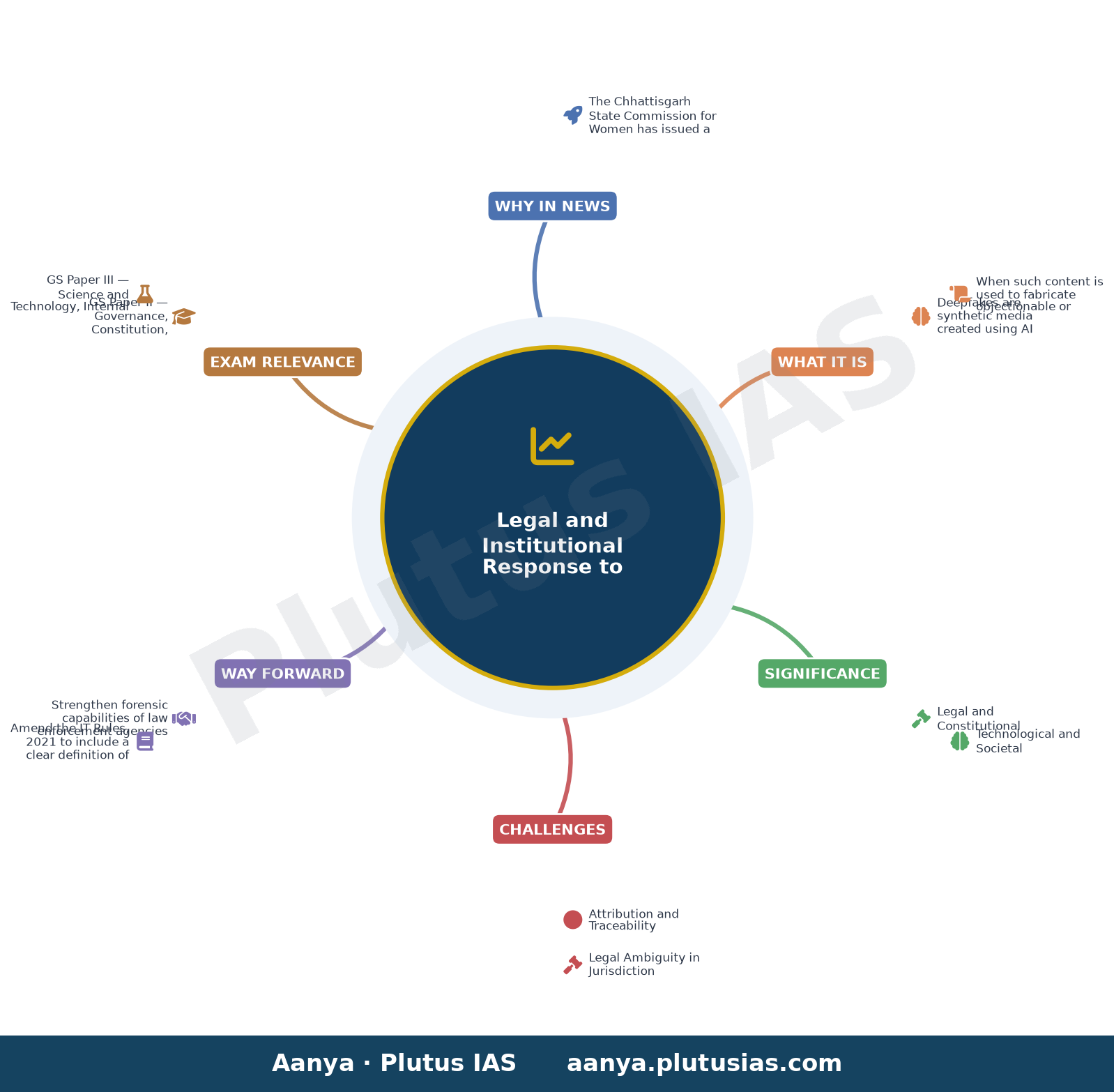
- GS Paper II — Governance, Constitution, Polity, Social Justice and International Relations (Cyber Governance, Digital Rights, and Women’s Rights) | GS Paper III — Science and Technology, Internal Security (Cyber Security, AI Ethics, and Legal Framework)
- Prelims: Deepfake, Section 66C of the Information Technology Act, 2000, Cybercrimes against women, National Cyber Crime Reporting Portal, Digital Personal Data Protection Act, 2023, Chhattisgarh State Commission for Women
- Essay: The Ethical Dilemma of Artificial Intelligence: Balancing Innovation with Human Dignity, Digital Empowerment vs. Digital Exploitation: Safeguarding Citizens in the Age of AI
Quick Revision: AI-generated deepfakes involving women constitute cyber crimes under Sections 66C, 67, and 67A of the IT Act, 2000, and victims must report such offences immediately to the National Cyber Crime Reporting Portal or local authorities.
Why is this in the news?
The Chhattisgarh State Commission for Women has issued a public advisory warning that the creation and dissemination of AI-generated objectionable images of women on social media constitutes a cyber crime under existing legal provisions. This development highlights the rising incidence of deepfake-based gender-based violence and the institutional response required to address it within India’s cyber governance framework.
Background
- The proliferation of artificial intelligence (AI) technologies, particularly generative AI, has enabled the rapid creation of hyper-realistic synthetic media, including images, videos, and audio, commonly referred to as ‘deepfakes’.
- Deepfakes are frequently weaponised to spread misogynistic content, including morphed or fabricated images of women, leading to reputational harm, psychological distress, and social ostracisation.
- India’s legal framework, including the Information Technology Act, 2000 (amended in 2008), criminalises cyber offences such as identity theft, impersonation, and the publication of obscene or defamatory material online.
- Section 66C of the IT Act penalises identity theft and cheating by personation using computer resources, while Section 67 and 67A criminalise the publication or transmission of obscene or sexually explicit material in electronic form.
- The National Cyber Crime Reporting Portal (NCRP), launched by the Ministry of Home Affairs, provides a platform for reporting cyber crimes, including those targeting women.
- The Digital Personal Data Protection Act, 2023, introduces obligations on data fiduciaries to prevent misuse of personal data, including images, and grants individuals the right to seek redressal for data breaches.
What are AI-Generated Deepfakes and How Do They Relate to Cyber Crimes Against Women?
- Deepfakes are synthetic media created using AI algorithms, such as Generative Adversarial Networks (GANs) or diffusion models, which can generate realistic images, videos, or audio of individuals without their consent.
- When such content is used to fabricate objectionable or defamatory material involving women, it constitutes a violation of their right to privacy, dignity, and reputation under Article 21 of the Constitution of India.
- The creation and dissemination of deepfakes fall under the ambit of cyber crimes as defined in the Information Technology Act, 2000, particularly Sections 66C, 67, and 67A, which address identity theft, obscenity, and defamation in digital form.
- Institutional bodies such as the National Commission for Women (NCW) and State Women’s Commissions play a critical role in addressing complaints, conducting inquiries, and recommending legal action in cases of gender-based cyber violence.
- The Chhattisgarh State Commission for Women’s advisory underscores the need for proactive measures, including public awareness, legal literacy, and timely reporting of such offences to law enforcement agencies.
- Victims of deepfake-based cyber crimes can file complaints with local police stations, the National Cyber Crime Reporting Portal, or directly approach the Women’s Commission for redressal and support.
- Preventive measures include the use of digital watermarking, AI-based detection tools, and stricter platform accountability under the IT Rules, 2021, to curb the spread of non-consensual synthetic media.
- The intersection of AI ethics, gender justice, and cyber governance necessitates a multi-stakeholder approach involving government, civil society, and technology platforms to mitigate risks and ensure accountability.
Key Features
| Feature | Significance |
|---|---|
| AI-generated deepfake imagery | Enables hyper-realistic fabrication of individuals’ images without consent, escalating risks of reputational harm and psychological distress. |
| Social media dissemination | Amplifies the reach and impact of fabricated content, making redressal and mitigation time-sensitive and technically challenging. |
| Cybercrime classification | Provides legal recourse under the Information Technology Act, 2000, and the Indian Penal Code, enabling penal action against perpetrators. |
| State Women’s Commission intervention | Institutionalizes grievance redressal, raises public awareness, and bridges gaps between victims and law enforcement. |
| Legal recourse for victims | Empowers individuals to file FIRs and seek injunctions, reinforcing the right to privacy and dignity under Article 21. |
Why it Matters
Legal and Constitutional
- Reinforces the constitutional guarantee of dignity (Article 21) by addressing digital violations of personal autonomy.
- Clarifies the applicability of existing cyber laws (IT Act, 2000; IPC Sections 354A, 354C, 509) to AI-generated content, ensuring no legal vacuum.
- Highlights the role of quasi-judicial bodies (State Commissions) in supplementing judicial mechanisms for gender-based digital crimes.
Technological and Societal
- Exposes the dual-use nature of AI, where generative models can be weaponised for harassment despite their benign applications.
- Underscores the need for digital literacy among women to identify and report AI-generated misinformation or defamation.
- Raises questions about platform accountability (e.g., social media intermediaries) in detecting and removing deepfake content.
Institutional and Governance
- Demonstrates the proactive role of State Commissions in addressing emerging forms of gender-based violence within their mandate.
- Illustrates the intersection of governance and technology, requiring coordinated responses from law enforcement, judiciary, and civil society.
- Emphasises the importance of victim-centric approaches in cybercrime investigations to minimise secondary trauma.
Challenges
1. Attribution and Traceability
- Perpetrators often operate through anonymised accounts or cross-border servers, complicating identification and prosecution.
- AI-generated content lacks inherent metadata, making forensic analysis resource-intensive and technically complex.
UPSC Link: GS3: Cyber Security Challenges
2. Legal Ambiguity in Jurisdiction
- Conflict between state laws and central IT Act provisions may delay justice delivery in cross-platform or inter-state cases.
- Lack of uniform guidelines for handling AI-generated deepfakes across states hinders consistent enforcement.
UPSC Link: GS2: Federalism and Centre-State Relations
3. Platform Responsibility and Liability
- Social media intermediaries often delay takedowns due to unclear definitions of ‘objectionable content’ under the IT Rules, 2021.
- Inadequate AI-based detection tools for regional languages and dialects exacerbate the problem in multilingual contexts.
UPSC Link: GS3: Role of Social Media Platforms
4. Victim Support and Rehabilitation
- Psychological trauma from deepfake harassment is often underreported due to stigma and lack of awareness about support mechanisms.
- Limited access to legal aid and counselling services in rural and semi-urban areas delays recovery and justice.
UPSC Link: GS2: Social Justice and Welfare
5. Technological Arms Race
- Rapid advancements in generative AI outpace regulatory frameworks, creating a persistent lag in policy adaptation.
- Adversarial AI techniques (e.g., adversarial attacks on detection systems) further complicate mitigation efforts.
UPSC Link: GS3: Emerging Technologies and Governance
Challenges — UPSC Perspective
| Issue | Concern |
|---|---|
| Cross-border cybercrime | Difficulty in extradition and coordination with foreign law enforcement agencies. |
| Deepfake detection limitations | Current tools struggle with high-fidelity AI-generated content, leading to false negatives. |
| Underreporting of cases | Social stigma and lack of awareness deter victims from filing complaints. |
| Resource constraints in law enforcement | Inadequate training and infrastructure to investigate AI-driven cybercrimes. |
| Platform compliance gaps | Non-adherence to IT Rules, 2021 by intermediaries due to vague definitions of ‘deepfake’. |
| Judicial delays | Backlog of cybercrime cases and lack of specialised courts prolong justice delivery. |
Way Forward
- Strengthen forensic capabilities of law enforcement agencies through AI-based detection tools and training programmes.
- Amend the IT Rules, 2021 to include a clear definition of ‘AI-generated deepfakes’ and mandate 24-hour takedown protocols for intermediaries.
- Establish dedicated cybercrime units in State Women’s Commissions to handle AI-driven gender-based violence cases.
- Launch nationwide awareness campaigns on digital rights, focusing on identifying and reporting deepfakes.
- Develop victim support frameworks, including helplines, legal aid, and psychological counselling, with a focus on rural areas.
- Encourage research collaborations between academia, tech industry, and government to develop robust deepfake detection algorithms.
- Enhance inter-state and international cooperation through bilateral agreements and mutual legal assistance treaties.
- Integrate cyber hygiene education into school curricula to foster early awareness of digital risks.
UPSC Value Addition
Keywords for Mains Answer-Writing
Cyber Crimes against Women · Artificial Intelligence and Digital Harms · Information Technology Act, 2000 · Cyber Security Framework for Women · Digital Privacy and Consent · Deepfakes and AI-generated Content · Protection of Women from Cyber Crimes · Legal Recourse for Cyber Harassment · Digital Empowerment of Women · Constitutional Safeguards for Digital Rights
Constitutional & Policy Linkages
- Article 21: Right to Privacy and Dignity (Protection from digital harassment).
- Article 19(1)(a): Freedom of Speech vs. Regulation of harmful content.
- Article 15(3): Special provisions for women and children in cybercrime prevention.
Concept Flow
AI-generated deepfake imagery → Social media dissemination → Victim identification and psychological harm → Legal classification as cybercrime → Filing of FIR and institutional intervention → Challenges in attribution and platform liability → Need for forensic and regulatory reforms → Long-term victim support and awareness.
Prelims Practice Questions
Q1. Consider the following statements regarding cyber crimes against women in India:
1. Posting AI-generated objectionable pictures of women on social media is punishable under the Information Technology Act, 2000.
2. The National Commission for Women (NCW) has the power to directly register FIRs in cases of cyber harassment.
3. Section 67C of the IT Act mandates intermediaries to preserve and retain information for a minimum period of 90 days.
How many of the above statements are correct?
- Only one
- Only two
- All three
- None
Answer: Only two — Statement 1 is correct as Section 67 and 67A of the IT Act cover punishment for publishing obscene or sexually explicit material. Statement 2 is incorrect as the NCW does not have direct FIR registration powers but can recommend actions. Statement 3 is correct as Section 67C mandates intermediaries to preserve data for 90 days.
Q2. Assertion (A): Deepfake technology can be used to create non-consensual explicit imagery of individuals.
Reason (R): The Information Technology (Intermediary Guidelines and Digital Media Ethics Code) Rules, 2021, require social media platforms to remove such content within 24 hours of being reported.
Codes:
A. Both A and R are true, and R is the correct explanation of A.
B. Both A and R are true, but R is not the correct explanation of A.
C. A is true, but R is false.
D. A is false, but R is true.
- A
- B
- C
- D
Answer: C — Assertion (A) is true as deepfakes can indeed be used to create non-consensual explicit imagery. Reason (R) is also true as the 2021 IT Rules mandate removal of such content within 24 hours. However, R does not directly explain A, as the Rules address removal mechanisms rather than the creation of deepfakes.
Q3. Match the following legal provisions with their respective purposes:
Column I (Provision) | Column II (Purpose)
1. Section 67A IT Act | A. Punishment for publishing sexually explicit material
2. Section 67B IT Act | B. Punishment for publishing material depicting children in sexually explicit acts
3. Section 67C IT Act | C. Preservation and retention of information by intermediaries
4. Section 354D IPC | D. Punishment for stalking or cyberstalking
Options:
A. 1-A, 2-B, 3-C, 4-D
B. 1-B, 2-A, 3-D, 4-C
C. 1-C, 2-D, 3-A, 4-B
D. 1-D, 2-C, 3-B, 4-A
- A
- B
- C
- D
Answer: A — Section 67A IT Act covers punishment for publishing sexually explicit material. Section 67B IT Act covers punishment for publishing material depicting children in sexually explicit acts. Section 67C IT Act mandates preservation and retention of information by intermediaries. Section 354D IPC covers punishment for stalking or cyberstalking.
Mains Practice Question
✍ The proliferation of AI-generated deepfakes and non-consensual imagery poses a grave threat to women’s dignity and privacy in the digital sphere. Critically examine the adequacy of existing legal and institutional frameworks in India to address this menace. Also, suggest measures to strengthen the cyber security ecosystem for women. (15 Marks)
Approach: MODEL-ANSWER SKELETON:
1. **Introduction (2 Marks)**: Define deepfakes and AI-generated non-consensual imagery; highlight the rise of such crimes and their impact on women’s dignity and privacy.
2. **Legal Framework Analysis (5 Marks)**:
– **Information Technology Act, 2000**: Sections 67, 67A, 67B, and 67C; their limitations in addressing AI-generated content.
– **Indian Penal Code (IPC)**: Sections 354C (voyeurism), 354D (stalking), 509 (word/gesture intended to insult modesty), and 292 (sale of obscene material).
– **Protection of Children from Sexual Offences (POCSO) Act, 2012**: Applicability to minors in AI-generated content.
– **Information Technology (Intermediary Guidelines and Digital Media Ethics Code) Rules, 2021**: Obligations on intermediaries to remove content within 24 hours.
3. **Institutional Gaps (3 Marks)**:
– Role of the National Commission for Women (NCW) and State Women Commissions: Powers, limitations, and effectiveness.
– Police and judicial delays in registering and adjudicating cybercrime cases.
– Lack of awareness and digital literacy among women and law enforcement agencies.
4. **Judicial Precedents (2 Marks)**:
– Supreme Court’s observations in *Puttaswamy v. Union of India* (2017) on privacy as a fundamental right.
– High Court judgments on cyber harassment and deepfakes (e.g., *Ashish Bhalla v. Suresh Chawdhury* on defamation via social media).
5. **Suggested Measures (3 Marks)**:
– **Legal Reforms**: Amend IT Act to specifically criminalize AI-generated non-consensual imagery; introduce strict liability for intermediaries.
– **Institutional Strengthening**: Establish dedicated cybercrime units for women; enhance training for law enforcement.
– **Technological Solutions**: Develop AI-based detection tools for deepfakes; mandate watermarking of AI-generated content.
– **Awareness Campaigns**: Digital literacy programs for women; public awareness drives on reporting mechanisms.
6. **Conclusion (2 Marks)**: Emphasize the need for a multi-stakeholder approach involving government, judiciary, civil society, and technology platforms to address the menace effectively.
Source: amarujala.com
Generated by AanyaAi for educational purpose.


No Comments