


10 Aug AI Listening to India’s Forests: UPSC’s New Ecoacoustics Breakthrough
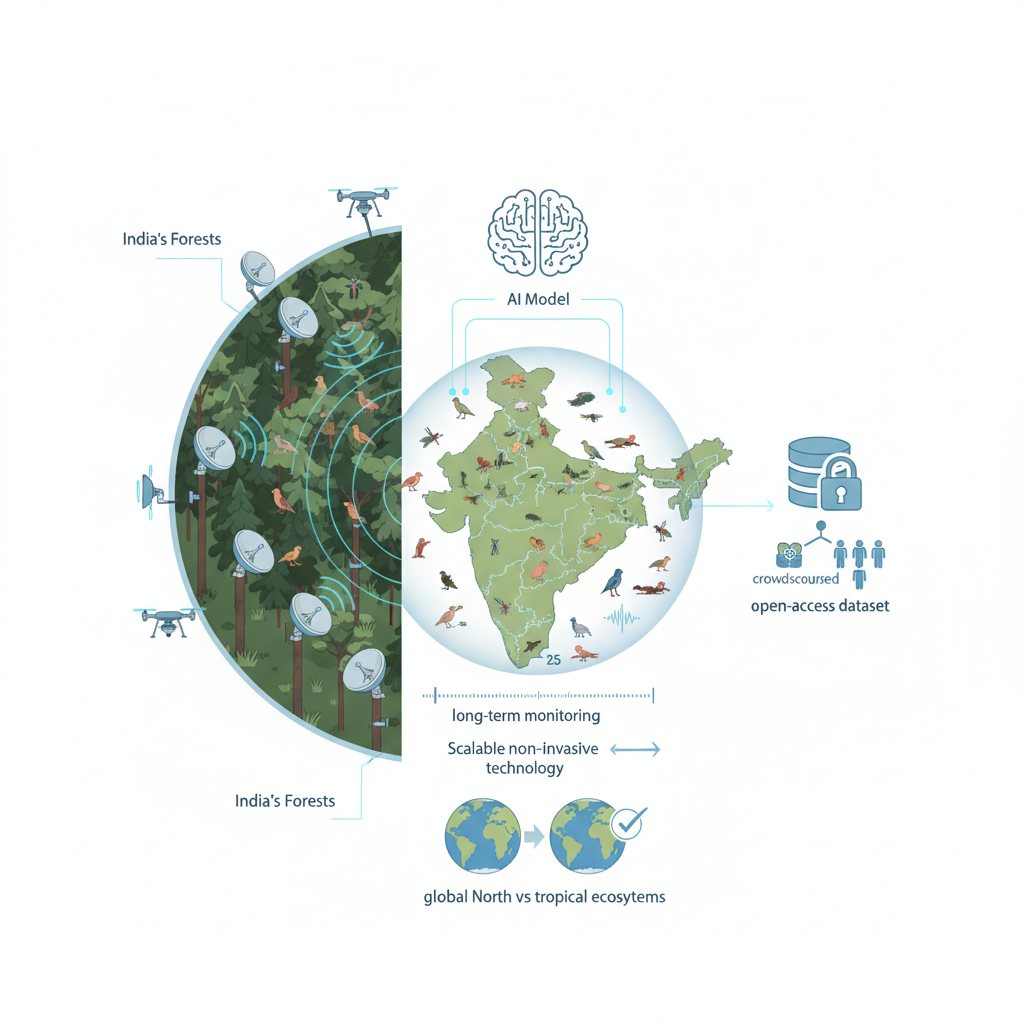
Ecoacoustic datasetAI modelBiodiversity monitoringForest recordingsSpecies documentation✎ Ecoacoustics, powered by AI and citizen science, provides a scalable, non-invasive method for biodiversity monitoring in India’s dense forests, addressing the critical gap in global bioacoustic datasets dominated by…
Subject Relevance — Where This Topic Fits
- GS Paper III — Environment, Biodiversity, and Climate Change
- Prelims: Ecoacoustics, Bioacoustics, Deep Learning, Biodiversity Monitoring, Spectrogram, Western Ghats, Deccan Plateau, Global South, AI in Ecology, Citizen Science, Open-Access Data, Nature Research Scientific Data
- Essay: The Role of Technology in Conservation: Balancing Innovation and Ecological Stewardship, Citizen Science as a Catalyst for Environmental Governance
Quick Revision: Ecoacoustics, powered by AI and citizen science, provides a scalable, non-invasive method for biodiversity monitoring in India’s dense forests, addressing the critical gap in global bioacoustic datasets dominated by temperate-region species.
Why is this in the news?
The publication of India’s first open-access, crowdsourced ecoacoustic dataset—comprising 5,815 minutes of recordings across 25 states and union territories, documenting 518 species—marks a seminal development in leveraging artificial intelligence (AI) for biodiversity monitoring. This initiative addresses a critical gap in global biodiversity data, where AI models trained predominantly on Global North datasets perform poorly in tropical ecosystems. The dataset, published on bioRxiv and under review by *Scientific Data* (Nature Research), enables non-invasive, scalable, and long-term monitoring of India’s ecosystems, particularly in dense forests where visual surveys are inadequate.
Background
- Ecoacoustics, the study of environmental sounds to infer ecological patterns, has gained traction globally but remains nascent in India due to fragmented data and limited localised training datasets for AI models.
- The Indian Ecoacoustics Network (IEN), a collective of ecologists, data scientists, and citizen volunteers, was formed to address this gap through crowdsourced field recordings and open-access data sharing.
- Prior to this dataset, India’s ecoacoustic recordings were scattered across institutions, with no unified, machine-readable resource for AI training or long-term ecological analysis.
What is Ecoacoustics and How is AI Enhancing It?
- **Definition**: Ecoacoustics is the interdisciplinary study of environmental sounds (bioacoustics, geophony, and anthropophony) to assess biodiversity, ecosystem health, and ecological processes. It serves as a non-invasive tool for monitoring species richness, behaviour, and habitat changes over time.
- AI Integration**: Deep learning models (e.g., BirdNET, Perch) are trained on spectrograms—visual representations of sound frequencies—to automatically identify species from recordings. These models reduce manual labour and enable real-time or batch processing of large datasets.
- Advantages Over Traditional Methods**: Ecoacoustics captures species beyond visual detection (e.g., bats, frogs, insects) and operates across frequencies (infrasound to ultrasound) inaccessible to human hearing. It supports long-term, periodic monitoring without disturbing wildlife.
- Challenges in Tropical Ecosystems**: Tropical soundscapes are dense and diverse, with overlapping calls and high background noise, making AI model training difficult without region-specific datasets. Global North-trained models often misclassify species due to acoustic dissimilarities.
- India’s Dataset**: The crowdsourced library includes 518 species (birds, insects, amphibians, reptiles, bats, and marine animals) across 25 states, with recordings from ecosystems like the Western Ghats. Metadata includes species presence, call frequency, and spectrogram annotations.
- Applications**: The dataset enables tracking of habitat degradation, invasive species, and climate change impacts (e.g., shifts in bird migration patterns). It also aids in identifying species with unique vocalisations, such as tigers’ chuffing calls, for individual recognition.
- Citizen Science Role**: Volunteers and local communities contribute recordings, democratising data collection and fostering public engagement in conservation. Open-access licensing ensures global utility for researchers and policymakers.
Key Features
| Feature | Significance |
|---|---|
| Open-access crowdsourced dataset | Provides India’s first comprehensive, free-to-use ecoacoustic library for biodiversity monitoring and AI training |
| 518 species coverage across 25 states/UTs | Enables pan-India acoustic biodiversity assessment, bridging gaps in Global North-centric AI models |
| Spectrogram-based annotation | Facilitates precise species identification through visual sound mapping, enhancing data reliability |
| Non-invasive recording methodology | Uses tree-mounted recorders to capture wildlife sounds without disturbing ecosystems, ensuring ethical data collection |
| Integration with deep learning models | Enables automated species detection (e.g., BirdNET, Perch) for scalable and efficient biodiversity monitoring |
Why it Matters
Scientific Advancement
- Addresses the critical gap in ecoacoustic datasets dominated by Global North recordings, ensuring AI models are trained on India-specific soundscapes
- Enhances biodiversity monitoring through automated species detection, reducing reliance on manual field surveys
- Provides a time-series tool for tracking ecosystem health and anthropogenic impacts via long-term acoustic data
Conservation Policy
- Supports India’s commitment to the Kunming-Montreal Global Biodiversity Framework (Target 3: 30×30 protection) by improving habitat monitoring capabilities
- Strengthens enforcement of the Wildlife (Protection) Act, 1972, through non-invasive data collection methods
- Facilitates evidence-based policy interventions for endangered species conservation (e.g., Manipur Fulvetta)
Technological Innovation
- Pioneers the application of AI in Indian forest ecosystems, fostering indigenous technological solutions for conservation
- Encourages interdisciplinary collaboration between ecologists, data scientists, and AI researchers
- Demonstrates the potential of citizen science in large-scale ecological data collection
Academic Research
- Serves as a foundational resource for Indian universities and research institutions studying bioacoustics and ecosystem dynamics
- Enables comparative studies between Indian and global soundscapes to understand ecological uniqueness
- Provides a model for other tropical countries to develop region-specific ecoacoustic datasets
Challenges
1. Data Bias in AI Training
- Existing deep learning models (e.g., BirdNET, Perch) are primarily trained on Global North datasets, leading to poor performance in Indian ecosystems
- Indian soundscapes exhibit higher species diversity, noise pollution, and unique acoustic signatures, requiring tailored AI solutions
UPSC Link: GS3: Science & Tech; GS3: Environment
2. Species Identification Accuracy
- Manual annotation of 5,815 minutes of recordings is labour-intensive and prone to human error, especially for cryptic or rare species
- Spectrogram-based identification requires expert knowledge, limiting scalability for large datasets
UPSC Link: GS3: Environment
3. Hardware and Infrastructure Gaps
- High-quality, weatherproof recording devices are expensive and may not be accessible to grassroots conservation groups
- Limited internet connectivity in remote forest areas hinders real-time data transmission and cloud storage
UPSC Link: GS3: Science & Tech
4. Ethical and Legal Concerns
- Unauthorised recording in protected areas could violate the Wildlife (Protection) Act, 1972, or local tribal rights
- Data privacy issues may arise if recordings inadvertently capture human activity or sensitive locations
UPSC Link: GS2: Governance
5. Standardisation and Metadata Management
- Lack of uniform protocols for recording, annotation, and metadata tagging may reduce interoperability with global datasets
- Inconsistent naming conventions for species (e.g., common vs. scientific names) can lead to data misinterpretation
UPSC Link: GS3: Environment
Challenges — UPSC Perspective
| Issue | Concern |
|---|---|
| AI Model Bias | Poor performance of global AI tools in Indian ecosystems due to lack of region-specific training data |
| Data Annotation Bottleneck | Labour-intensive manual process for spectrogram-based species identification |
| Hardware Accessibility | High costs and logistical challenges in deploying recording devices in remote areas |
| Regulatory Compliance | Potential conflicts with wildlife protection laws or indigenous rights during field recordings |
| Data Standardisation | Inconsistent metadata and annotation protocols limiting dataset usability |
Way Forward
- Strengthen collaboration between the Indian Ecoacoustics Network (IEN) and global AI research labs to develop India-specific deep learning models for ecoacoustics
- Establish a national-level protocol for ecoacoustic data collection, annotation, and metadata management to ensure interoperability
- Invest in low-cost, weatherproof recording devices and explore public-private partnerships for equitable distribution
- Integrate ecoacoustic datasets with India’s biodiversity portals (e.g., Biodiversity Atlas India) for real-time monitoring and policy support
- Promote citizen science initiatives to expand the dataset while ensuring ethical and legal compliance in data collection
- Develop AI-driven tools for automated spectrogram analysis to reduce manual annotation workload and improve accuracy
- Conduct pilot studies in collaboration with forest departments to validate the efficacy of ecoacoustics in conservation planning
- Advocate for the inclusion of ecoacoustics in India’s National Biodiversity Action Plan (NBAP) to institutionalise its use in conservation strategies
UPSC Value Addition
Keywords for Mains Answer-Writing
Ecoacoustics · Biodiversity monitoring · Artificial Intelligence in conservation · Citizen science · Deep learning models for species identification · Western Ghats biodiversity · Non-invasive ecological monitoring · Open-access biological datasets · Machine learning in ecology · India’s bioacoustic dataset · Conservation technology · Spectrogram analysis · Indian Ecoacoustics Network (IEN) · Global South ecological data · Wildlife vocalisation studies
Concept Flow
Scarcity of India-specific ecoacoustic data → Poor performance of global AI models in Indian ecosystems → Need for indigenous dataset → Crowdsourced recording and annotation → Publication of open-access dataset → Development of India-specific AI tools → Enhanced biodiversity monitoring → Evidence-based conservation policies → Strengthened enforcement of wildlife protection laws
Prelims Practice Questions
Q1. Consider the following statements regarding ecoacoustics and AI in biodiversity monitoring:
1. Ecoacoustics relies on visual observation of species in dense forests.
2. AI models like BirdNET and Perch are trained primarily on data from the Global North.
3. The Indian Ecoacoustics Network (IEN) has published India’s first open-access, crowdsourced ecoacoustic dataset.
4. Spectrograms are visual representations of sound frequencies used to identify species.
How many of the above statements are correct?
- Only one
- Only two
- Only three
- All
Answer: All — Statement 1 is incorrect: ecoacoustics uses sound recordings, not visual observation. Statements 2, 3, and 4 are correct as per the article and static syllabus knowledge.
Q2. Assertion (A): Deep learning models for species identification in ecoacoustics perform poorly in tropical ecosystems like India.
Reason (R): Most training datasets for such models originate from the Global North, which lacks representation of India’s unique soundscapes.
Options:
A. Both A and R are true, and R is the correct explanation of A.
B. Both A and R are true, but R is not the correct explanation of A.
C. A is true, but R is false.
D. A is false, but R is true.
- A
- B
- C
- D
Answer: A — Both assertion and reason are true, and the reason correctly explains the assertion based on the article and static knowledge of AI training biases.
Q3. Match the following columns related to ecoacoustics and AI in biodiversity monitoring:
Column I
1. BirdNET
2. Spectrogram
3. Indian Ecoacoustics Network (IEN)
4. Western Ghats
Column II
A. Visual map of sound frequencies
B. Open-access bioacoustic dataset from India
C. AI model for species identification
D. Biodiversity hotspot in India
Options:
1. 1-A, 2-B, 3-C, 4-D
2. 1-C, 2-A, 3-B, 4-D
3. 1-B, 2-A, 3-C, 4-D
4. 1-C, 2-D, 3-A, 4-B
- 1
- 2
- 3
- 4
Answer: 2 — Correct matches: BirdNET (C), Spectrogram (A), IEN (B), Western Ghats (D).
Mains Practice Question
✍ Ecoacoustic monitoring, leveraging AI and citizen science, is emerging as a transformative tool for biodiversity assessment in India. Critically examine the potential of this approach in addressing the challenges of conventional wildlife monitoring methods. Also, discuss the implications of relying on AI-driven ecoacoustic datasets for long-term conservation policy formulation. (15 Marks)
Approach: MODEL-ANSWER SKELETON:
1. **Introduction (2 marks)**: Define ecoacoustics and its relevance in biodiversity monitoring. Highlight the limitations of conventional methods (e.g., point counts, visual surveys) in dense forests or nocturnal ecosystems.
2. **Advantages of Ecoacoustics (4 marks)**:
– Non-invasive data collection (e.g., automated recorders in forests).
– Captures species beyond human hearing range (ultrasonic/infrasonic sounds).
– Long-term, periodic monitoring for temporal trends (e.g., seasonal variations, habitat degradation).
– AI models (e.g., BirdNET, Perch) enable automated species identification and reduce manual labor.
– Citizen science contributions (e.g., Indian Ecoacoustics Network’s crowdsourced dataset with 518 species, 5,815 minutes).
3. **Challenges and Limitations (4 marks)**:
– Data bias: AI models trained predominantly on Global North datasets perform poorly in tropical ecosystems.
– Species-specific limitations: Some taxa (e.g., reptiles, insects) lack sufficient training data for AI identification.
– Technical constraints: High computational costs, need for spectrogram analysis expertise, and infrastructure for large datasets.
– Ethical concerns: Potential misuse of bioacoustic data (e.g., poaching, habitat disturbance).
4. **Implications for Conservation Policy (3 marks)**:
– Policy integration: Ecoacoustic datasets can inform Protected Area management, climate change adaptation, and Sustainable Development Goals (e.g., SDG 14, 15).
– Standardization: Need for national-level protocols for data collection, storage, and sharing (e.g., open-access platforms like bioRxiv).
– Capacity building: Training local communities and forest departments in AI-assisted monitoring.
– Legal framework: Addressing data ownership, privacy, and intellectual property rights in crowdsourced datasets.
5. **Conclusion (2 marks)**: Balanced view—ecoacoustics complements but does not replace traditional methods. Emphasize the need for hybrid approaches (e.g., combining AI with expert field validation) and indigenous knowledge systems in conservation.
Source: The Indian Express
Generated by AanyaAi for educational purpose.

- केरल उच्च न्यायालय ने 14 साल पुराने सैनिक लापता मामले में सीबीआई जांच का दिया आदेश - October 5, 2026
- ECI’s constitutional mandate under strain: UPSC & State PCS analysis - October 5, 2026
- तीन-भाषा नीति: छात्रों को तीसरी भाषा चुनने की आजादी क्यों जरूरी? - October 5, 2026

No Comments