


21 Oct AI vs Handwritten Notes: Indian Students’ Learning Preferences Explained
✎ AI in education enhances efficiency and accessibility but must complement, not replace, traditional methods like handwriting that foster deeper learning and cognitive retention.
Subject Relevance — Where This Topic Fits
- GS Paper II — Social Justice: Issues Relating to Education | GS Paper III — Science and Technology: Developments and their Applications and Effects in Everyday Life
- Prelims: AI in education, NEP 2020, National Education Policy, Digital India, Cognitive load theory, Metacognition, EdTech, Blended learning
- Essay: The paradox of technology in human development: Accelerating progress while preserving depth, Education in the age of artificial intelligence: Challenges and opportunities
Quick Revision: AI in education enhances efficiency and accessibility but must complement, not replace, traditional methods like handwriting that foster deeper learning and cognitive retention.
Why is this in the news?
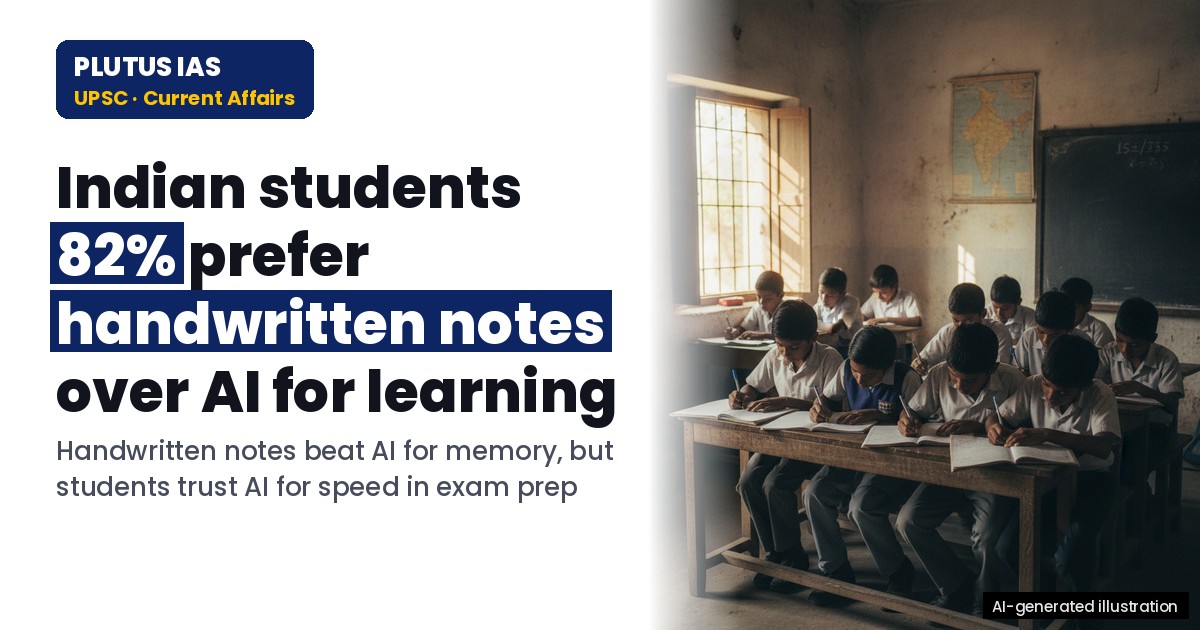
A recent global survey by HP, conducted in collaboration with the Global Learning Council and the Education Leaders Forum, reveals that while 82% of Indian students prefer handwritten or printed notes for deeper learning, a majority acknowledge AI’s utility in expediting task completion. The findings underscore a critical tension in contemporary education: the need to integrate AI tools for efficiency without compromising foundational cognitive processes essential for comprehension and retention. This survey, covering over 6,000 students globally (including 758 Indian respondents), highlights the evolving expectations of learners in an AI-driven educational landscape and the policy imperatives for curriculum design.
Background
- The integration of Artificial Intelligence (AI) in education has accelerated globally, driven by advancements in natural language processing, machine learning, and adaptive learning platforms.
- India’s National Education Policy (NEP) 2020 emphasizes the adoption of technology in education, including AI, to enhance learning outcomes and accessibility while promoting foundational literacy and numeracy.
- The COVID-19 pandemic accelerated the adoption of digital learning tools, including AI-powered platforms, making them a permanent fixture in the educational ecosystem.
- Cognitive science research highlights the role of handwriting in memory retention and deeper learning, as the motor and sensory processes involved in writing enhance neural encoding and retrieval.
- The Global Learning Council and Education Leaders Forum advocate for a balanced approach to AI in education, prioritizing durable skills such as critical thinking, creativity, and problem-solving alongside technological fluency.
- India’s demographic dividend necessitates an education system that equips students with both technical competencies and higher-order cognitive abilities to thrive in an AI-driven job market.
What is the role of Artificial Intelligence in modern education?
- Artificial Intelligence (AI) in education refers to the use of machine learning, natural language processing, and data analytics to personalize learning experiences, automate administrative tasks, and provide adaptive feedback to students.
- AI tools such as chatbots, virtual tutors, and intelligent tutoring systems (ITS) can supplement traditional teaching by offering instant clarifications, generating practice questions, and tailoring content to individual learning paces.
- The efficiency gains from AI—such as automated grading, content curation, and real-time analytics—address the scalability challenges of large classroom settings, particularly in India’s diverse educational landscape.
- However, AI’s role in deep learning remains debated. Studies in cognitive science suggest that handwriting engages multiple brain regions, including those responsible for memory and comprehension, thereby fostering deeper understanding.
- The survey’s findings indicate that while students recognize AI’s utility for speed, they intuitively prefer traditional methods (handwriting/printing) for tasks requiring retention and conceptual clarity.
- The integration of AI must align with pedagogical principles that prioritize active learning, metacognition, and the development of higher-order thinking skills, as outlined in frameworks like Bloom’s Taxonomy.
- AI’s potential to democratize education—through multilingual support, accessibility tools for students with disabilities, and low-cost learning platforms—aligns with India’s equity-focused educational goals.
- The Global Learning Council’s recommendations emphasize that AI should augment, not replace, human educators, ensuring that foundational skills and creative problem-solving remain central to curricula.
Key Features
| Feature | Significance |
|---|---|
| Preference for handwritten/printed notes (82% of Indian students) | Indicates reliance on traditional learning methods for retention and comprehension, aligning with cognitive science principles on active recall and kinesthetic learning. |
| AI for task acceleration (majority of students) | Reflects recognition of AI’s efficiency in processing information rapidly, though concerns persist about its impact on depth of understanding. |
| Confidence in education system (92% of Indian students) | Demonstrates trust in institutional frameworks, though this may not correlate with actual employability outcomes without critical evaluation. |
| Belief in AI-driven job creation (78% of students) | Highlights optimism about technological disruption creating new opportunities, though this requires alignment with evolving skill demands. |
| Emphasis on durable skills (creativity, critical thinking) | Underscores the need for foundational competencies beyond technical proficiency, as recommended by global education policy frameworks. |
Why it Matters
Cognitive and Pedagogical Implications
- The survey underscores the enduring role of active learning techniques (e.g., handwriting) in memory consolidation, supported by neuroscience research on the ‘generation effect’ and embodied cognition.
- AI’s utility in speeding up information processing highlights the importance of balancing efficiency with deep learning, particularly in domains requiring analytical rigor.
- The findings align with UNESCO’s ‘Learning to Be’ framework, which prioritises holistic development over rote memorisation in AI-integrated education systems.
Economic and Workforce Preparedness
- The survey’s emphasis on durable skills (creativity, critical thinking) reflects the World Economic Forum’s projections on the future of work, where 50% of all employees will need reskilling by 2025.
- The belief in AI-driven job creation (78%) resonates with McKinsey’s estimates that AI could contribute $15.7 trillion to the global economy by 2030, necessitating workforce adaptability.
- Confidence in education systems (92%) may indicate a gap between perceived and actual employability, warranting alignment with industry skill standards (e.g., NEP 2020’s vocational integration).
Policy and Institutional Responses
- The report’s call for integrating critical thinking into core curricula echoes the National Education Policy 2020’s emphasis on ’21st-century skills’ and multidisciplinary learning.
- The recommendation to prioritise foundational literacy and numeracy aligns with India’s National Achievement Survey (NAS) framework and global SDG 4 targets.
- The survey’s global scope (6,000+ students) suggests a need for cross-border collaboration in standardising AI literacy and ethical frameworks in education.
Challenges
1. Over-reliance on AI for Learning
- Risk of superficial understanding due to AI-generated summaries, which may bypass the cognitive processes required for deep learning.
- Potential erosion of traditional pedagogical methods that foster analytical and creative thinking, particularly in humanities and social sciences.
- Ethical concerns around AI tools replacing foundational learning activities, such as note-taking, without adequate safeguards.
UPSC Link: GS2: Education Policy
2. Skill Mismatch in AI-Driven Job Markets
- Gap between student confidence (92%) and actual employability metrics, as highlighted by periodic labour force surveys.
- Disparities in access to AI tools across socio-economic strata, exacerbating digital divides in education.
- Need for continuous upskilling in response to rapid technological change, as outlined in the Skill India Mission.
UPSC Link: GS3: Employment and Skill Development
3. Integration of Durable Skills in Curricula
- Challenge of embedding creativity and critical thinking in rote-heavy examination systems, particularly in competitive exam cultures.
- Lack of standardised assessment mechanisms for durable skills, complicating their inclusion in mainstream evaluation frameworks.
- Teacher training gaps in facilitating experiential and project-based learning, as per NEP 2020’s implementation challenges.
UPSC Link: GS2: Curriculum Reform
4. Ethical and Governance Concerns
- Regulatory vacuum around AI tools in education, including data privacy and algorithmic bias risks.
- Need for transparent guidelines on AI usage in classrooms, balancing innovation with safeguards for students.
- Potential commercialisation of AI tools in education, raising concerns about equitable access and vendor lock-ins.
UPSC Link: GS4: Ethics in Governance
Challenges — UPSC Perspective
| Issue | Concern |
|---|---|
| AI for efficiency vs. depth of learning | Risk of prioritising speed over comprehension, undermining foundational knowledge. |
| Student confidence in education systems | Possible disconnect between perceived and actual employability outcomes. |
| Integration of durable skills in curricula | Challenges in assessment and teacher capacity for experiential learning. |
| Digital divide in AI tool access | Exacerbation of socio-economic disparities in educational outcomes. |
| Ethical governance of AI in education | Lack of regulatory frameworks for data privacy and algorithmic fairness. |
Way Forward
- Integrate active learning techniques (e.g., handwriting, mind maps) into AI-assisted curricula to balance efficiency and depth.
- Develop national standards for AI literacy in schools, aligned with NEP 2020’s multidisciplinary approach.
- Establish teacher training programmes to facilitate experiential and project-based learning, with a focus on durable skills.
- Create a regulatory framework for AI tools in education, addressing data privacy, bias, and equitable access.
- Align school curricula with industry skill demands through partnerships with employers and vocational training providers.
- Promote research on the cognitive impacts of AI tools in learning, informing evidence-based policy decisions.
- Strengthen foundational literacy and numeracy programmes, with periodic assessments to track progress.
- Encourage cross-sector collaboration between education, technology, and policy stakeholders to address systemic challenges.
UPSC Value Addition
Keywords for Mains Answer-Writing
Artificial Intelligence in education · Handwritten notes vs AI tools · Deep learning techniques · Durable skills in education · Critical thinking and creativity · Foundational learning · AI-driven workplace · HP Futures 2026 global survey · Global Learning Council · Education policy for AI era · Pedagogical methods · Learning outcomes assessment
Constitutional & Policy Linkages
- [‘Article 51A(h): Duty to develop scientific temper’]
Concept Flow
Student reliance on handwritten notes → Recognition of active learning benefits → Cognitive science evidence on memory retention → Need for balanced AI integration → Policy emphasis on durable skills → Curriculum reform challenges → Teacher training gaps → Regulatory and ethical considerations → Future workforce preparedness.
Prelims Practice Questions
Q1. Consider the following statements about the HP Futures 2026 global survey on AI in education:
1. The survey covered more than 6,000 students globally, including 758 Indian students.
2. 82% of Indian students prefer conventional methods such as handwriting or printing notes for deeper learning.
3. 92% of Indian students believe that their education is preparing them for the job market.
How many of the above statements are correct?
- Only one
- Only two
- Only three
- None
Answer: Only three — Statements 1 and 3 are correct as per the survey findings. Statement 2 is also correct, as 82% of Indian students prefer conventional methods for deeper learning. Therefore, all three statements are correct.
Q2. Assertion (A): Artificial Intelligence (AI) tools are universally accepted by students as enhancing deep learning.
Reason (R): The HP Futures 2026 survey reveals that while students acknowledge AI for speed, a majority prefer handwritten notes for deeper understanding.
Options:
A. Both A and R are true, and R is the correct explanation of A.
B. Both A and R are true, but R is not the correct explanation of A.
C. A is true, but R is false.
D. A is false, but R is true.
- A
- B
- C
- D
Answer: D — Assertion (A) is false because the survey indicates that students do not universally accept AI for deep learning; they prefer conventional methods. Reason (R) is true as it accurately reflects the survey findings.
Q3. Match the following terms with their correct descriptions:
Column I
1. Durable skills
2. Foundational learning
3. AI-driven workplace
4. Global Learning Council
Column II
A. A body of education and policy experts discussing AI’s impact on education.
B. Skills like creativity and critical thinking that remain valuable despite technological changes.
C. A work environment where AI tools are integral to operations.
D. Basic literacy, numeracy, and cognitive abilities essential for further learning.
Options:
1. 1-B, 2-D, 3-C, 4-A
2. 1-A, 2-B, 3-D, 4-C
3. 1-C, 2-D, 3-B, 4-A
4. 1-D, 2-B, 3-A, 4-C
- 1
- 2
- 3
- 4
Answer: 1 — 1-B (Durable skills are creativity and critical thinking), 2-D (Foundational learning includes literacy and numeracy), 3-C (AI-driven workplace integrates AI tools), 4-A (Global Learning Council is an expert body).
Mains Practice Question
✍ Critically examine the role of Artificial Intelligence (AI) in modern education, particularly in the context of the trade-off between speed and deep learning. How far does the reliance on AI tools impact the development of durable skills such as critical thinking and creativity? (15 Marks)
Approach: MODEL-ANSWER SKELETON:
1. Introduction (2 marks):
– Define AI in education and its dual role (enhancer of speed vs. potential threat to deep learning).
– Reference the HP Futures 2026 survey findings on Indian students’ preferences.
2. AI for Speed and Efficiency (3 marks):
– Discuss how AI tools (e.g., generative AI, adaptive learning platforms) accelerate task completion and personalise learning.
– Cite examples like AI-driven tutoring systems (e.g., Khanmigo, Duolingo Max) and their impact on student productivity.
– Reference the survey’s finding that 78% of students believe AI will create more job opportunities.
3. AI and Deep Learning: The Trade-off (4 marks):
– Explain the cognitive science basis for handwritten notes in deep learning (e.g., dual coding theory by Paivio, active recall, and the generation effect).
– Critically analyse why 82% of Indian students prefer conventional methods for remembering content.
– Discuss potential risks of over-reliance on AI, such as reduced critical thinking, passive learning, and the ‘illusion of competence.’
4. Durable Skills in the AI Era (3 marks):
– Define durable skills (critical thinking, creativity, problem-solving) as per the survey and NEP 2020.
– Discuss the role of AI in complementing these skills (e.g., AI as a tool for analysis and creativity augmentation).
– Reference the report’s recommendation to integrate these skills into the core curriculum.
5. Policy and Pedagogical Responses (3 marks):
– Outline measures to balance AI adoption with foundational learning (e.g., blended learning models, teacher training in AI literacy).
– Discuss the role of institutions like the Global Learning Council in shaping AI-ready education policies.
– Highlight the need for evidence-based pedagogical methods that prioritise deep learning alongside AI tools.
6. Conclusion (2 marks):
– Summarise the need for a nuanced approach to AI in education—leveraging its speed while safeguarding deep learning and durable skills.
– Emphasise the role of policymakers, educators, and students in achieving this balance.
Source: The Indian Express
Generated by AanyaAi for educational purpose.
Related guides on our sites
- Current affairs for upsc 2026
- Best PSIR optional coaching for upsc
- Best economics optional coaching for upsc
- Best PSIR optional teacher for upsc

- India-Australia AUSTRAHIND 2026 Exercise: Key Highlights for UPSC & State PCS - October 22, 2026
- एससीओ बैठक में भारत का आतंकवाद विरोध: क्षेत्रीय सहयोग पर जोर - October 22, 2026
- SEC Directs Strict SC Order Compliance for Andhra ULB Polls - October 22, 2026

No Comments