


07 Aug Allahabad HC Rejects Zero-Mark BA LLB Student’s Plea, Flags Legal Education Crisis
✎ Judicial intervention in academic matters is permissible only in cases of arbitrariness, malice, or legal error, as reiterated by the Allahabad High Court in dismissing the zero-mark petition while stressing the need for systemic…
Subject Relevance — Where This Topic Fits
- GS Paper II — Judiciary and Constitutional Framework | GS Paper II — Governance, Transparency and Accountability | GS Paper III — Issues Relating to Education
- Prelims: Judicial Review, Bar Council of India, Legal Education Standards, RTI Act 2005, All India Bar Examination, Evaluation Process, Academic Malpractice, Single Judge Bench, Judicial Intervention in Academic Matters
- Essay: Judicial Activism and Academic Accountability: Balancing Educational Integrity and Judicial Intervention, Legal Education in India: Challenges and Reforms for a Competent Judiciary
Quick Revision: Judicial intervention in academic matters is permissible only in cases of arbitrariness, malice, or legal error, as reiterated by the Allahabad High Court in dismissing the zero-mark petition while stressing the need for systemic reforms in legal education standards.
Why is this in the news?
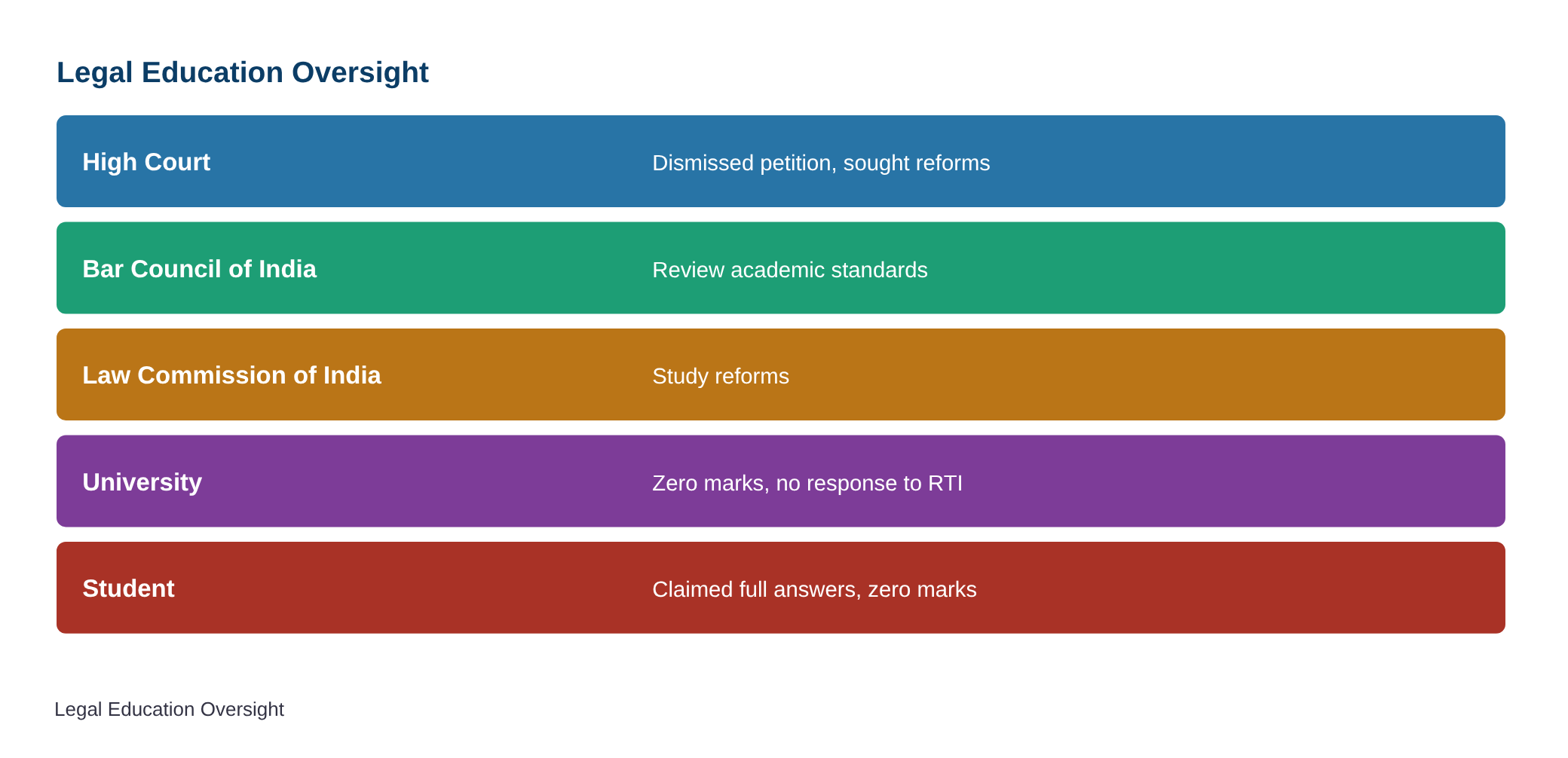
The Allahabad High Court recently dismissed a petition filed by a BA LLB student who had scored zero marks in the subject ‘Biodiversity Protection Law’ for the ninth semester, while simultaneously expressing grave concern over the deteriorating standards of legal education in India. The Court’s observations underscore systemic deficiencies in evaluation mechanisms, institutional accountability, and the broader framework governing legal education, prompting calls for review by the Bar Council of India and the Law Commission of India.
Background
- The case pertains to a BA LLB student from a university in Uttar Pradesh who received zero marks in the subject ‘Biodiversity Protection Law’ despite claiming to have answered all questions in the examination.
- [‘The student approached the High Court after exhausting internal remedies, including a Right to Information (RTI) application to obtain the evaluated answer sheet and a subsequent request for re-evaluation, which yielded no response from the university.’, ‘The Allahabad High Court, in a single-judge bench order by Justice Vinod Divakar, examined the original question paper and the answer sheet, concluding that the answers lacked legal comprehension, logical reasoning, or coherent analysis, thereby justifying the zero marks awarded.’, ‘The Court emphasized that judicial intervention in academic evaluation is permissible only in cases of arbitrariness, malice, or legal error, none of which were established in this instance.’, ‘The High Court directed the Bar Council of India (BCI) to review the academic and infrastructural standards of the concerned institution and the Law Commission of India to study and recommend reforms in legal education standards across the country.’, ‘This case reflects broader concerns about the quality of legal education, examination malpractices, and the adequacy of regulatory oversight in India’s legal education system.’]
- about”: {“heading”: “Legal Education in India: Regulatory Framework, Challenges, and Reform Imperatives”, “points”: [{
Key Features
| Feature | Significance |
|---|---|
| Judicial scrutiny of academic evaluation | Ensures fairness in examination processes and upholds the integrity of academic institutions. |
| High Court’s suo motu concern over legal education standards | Highlights systemic deficiencies in legal pedagogy and assessment mechanisms. |
| Right to Information (RTI) application for answer scripts | Empowers students to seek transparency in evaluation processes. |
| Bar Council of India’s review mandate | Institutionalizes accountability for legal education quality control. |
| Judicial reluctance to intervene in academic matters | Reinforces the principle of separation between judicial and academic domains. |
Why it Matters
Judicial-Legal
- The judgment underscores the judiciary’s role in safeguarding academic integrity while respecting institutional autonomy.
- It establishes a precedent for judicial restraint in academic disputes unless procedural irregularities or malafide intent are proven.
- The High Court’s directive to the Bar Council of India and Law Commission of India signals systemic introspection in legal education governance.
Institutional
- The case exposes deficiencies in the assessment infrastructure of law colleges, particularly in specialized subjects like Biodiversity Protection Law.
- It highlights the need for standardized evaluation frameworks to prevent arbitrary grading.
- The judgment may compel law schools to adopt robust internal grievance redressal mechanisms.
Student-Centric
- The ruling reinforces the student’s right to seek recourse through legal and administrative channels for perceived academic injustices.
- It emphasizes the importance of transparency in examination processes and answer script evaluations.
- The case serves as a cautionary tale for students relying solely on institutional remedies without escalating to judicial forums.
Challenges
1. Decline in Legal Education Standards
- Inadequate faculty expertise in specialized areas such as environmental law.
- Lack of standardized assessment tools leading to subjective grading.
- Insufficient infrastructure for practical training in legal education.
- Absence of a robust quality assurance mechanism within law colleges.
UPSC Link: GS2: Higher Education
2. Judicial-Academic Interface
- Balancing judicial intervention with institutional autonomy in academic matters.
- Preventing frivolous litigation while ensuring justice for genuine grievances.
- Addressing the dichotomy between legal principles and academic discretion.
UPSC Link: GS2: Judiciary
3. Student Grievance Redressal
- Lack of timely and effective institutional mechanisms for addressing student grievances.
- Over-reliance on judicial forums due to perceived institutional bias.
- Inadequate awareness among students regarding their rights and recourse options.
UPSC Link: GS2: Governance
4. Regulatory Oversight in Legal Education
- Fragmented regulatory framework governing legal education in India.
- Inadequate enforcement of Bar Council of India (BCI) norms by law colleges.
- Lack of periodic reviews and updates to legal education curricula.
UPSC Link: GS2: Regulatory Bodies
Challenges — UPSC Perspective
| Issue | Concern |
|---|---|
| Subjective evaluation in law colleges | Arbitrary grading leading to student dissatisfaction and litigation. |
| Lack of specialized faculty in niche legal domains | Compromises the quality of legal education in emerging fields. |
| Inadequate grievance redressal mechanisms | Forces students to seek judicial intervention for academic disputes. |
| Regulatory gaps in legal education governance | Allows substandard institutions to operate without accountability. |
| Judicial reluctance to intervene in academic matters | May leave genuine grievances unaddressed due to procedural constraints. |
Way Forward
- Bar Council of India must conduct a comprehensive review of law colleges’ assessment mechanisms and faculty qualifications.
- Law Commission of India should formulate standardized evaluation frameworks for specialized legal subjects.
- Law schools should establish internal grievance redressal committees with student representation for timely resolution of academic disputes.
- Judiciary should issue guidelines clarifying the scope of judicial intervention in academic matters to prevent frivolous litigation.
- Students must be educated about their rights under RTI and institutional grievance redressal mechanisms before resorting to judicial forums.
- Higher Education Regulatory Authority (HERA) should integrate legal education into its accreditation framework to ensure quality control.
- Continuous professional development programs for law faculty should be mandated to address gaps in specialized legal domains.
UPSC Value Addition
Keywords for Mains Answer-Writing
Legal Education in India · Judicial Review of Academic Evaluation · Bar Council of India · Law Commission of India · Judicial Standards in Higher Education · Academic Integrity in Legal Studies · Judicial Activism vs. Judicial Restraint · Evaluation System in Law Colleges · Right to Information in Education · Judicial Concerns over Legal Pedagogy
Concept Flow
Student receives zero marks in Biodiversity Protection Law examination → Student files RTI application to obtain answer script → University fails to address grievance through internal mechanisms → Student files writ petition in Allahabad High Court → High Court examines answer script and upholds examiner’s decision → High Court expresses concern over legal education standards and directs BCI and Law Commission to review the system → Judicial precedent reinforcing separation of judicial and academic domains
Prelims Practice Questions
Q1. Consider the following statements regarding the Bar Council of India (BCI) and the Law Commission of India:
1. The Bar Council of India is a statutory body established under the Advocates Act, 1961.
2. The Law Commission of India is a statutory body constituted by the Government of India to recommend reforms in the legal system.
3. Both BCI and the Law Commission of India are empowered to issue binding directives to law universities regarding curriculum and evaluation standards.
How many of the above statements are correct?
- Only one
- Only two
- All three
- None
Answer: All three — Statement 1 is correct as BCI is established under the Advocates Act, 1961. Statement 2 is correct as the Law Commission of India is a non-statutory body constituted by the Government of India. Statement 3 is incorrect as neither BCI nor the Law Commission of India has the power to issue binding directives to law universities.
Q2. Assertion (A): The High Court, while dismissing a petition seeking re-evaluation of answer sheets, held that judicial intervention in academic evaluation is permissible only if malice, arbitrariness, or legal error is proven.
Reason (R): The principle of judicial restraint requires courts to refrain from interfering in academic matters unless there is a clear violation of constitutional or statutory provisions.
Options:
A. Both A and R are true, and R is the correct explanation of A.
B. Both A and R are true, but R is not the correct explanation of A.
C. A is true, but R is false.
D. A is false, but R is true.
- A
- B
- C
- D
Answer: B — Both the Assertion and Reason are correct, and the Reason correctly explains the Assertion. The principle of judicial restraint in academic matters is well-established, and the High Court’s decision aligns with this principle.
Q3. Match the following bodies with their respective roles:
Column I
1. Bar Council of India
2. Law Commission of India
3. University Grants Commission
4. National Assessment and Accreditation Council
Column II
A. Regulates higher education institutions in India
B. Recommends reforms in the legal system
C. Sets standards for legal education and practice
D. Assesses and accredits higher education institutions
Options:
1. 1-C, 2-B, 3-A, 4-D
2. 1-A, 2-B, 3-C, 4-D
3. 1-D, 2-C, 3-A, 4-B
4. 1-B, 2-A, 3-D, 4-C
- 1
- 2
- 3
- 4
Answer: 2 — 1-C: Bar Council of India regulates legal education and practice. 2-B: Law Commission of India recommends reforms in the legal system. 3-A: University Grants Commission regulates higher education institutions. 4-D: NAAC assesses and accredits higher education institutions.
Mains Practice Question
✍ The High Court of Allahabad, in dismissing a petition for re-evaluation of answer sheets in a law subject, expressed grave concern over the state of legal education in India. Critically examine the structural and institutional challenges plaguing legal education in the country, with particular reference to the role of regulatory bodies such as the Bar Council of India and the Law Commission of India. Also, analyse the judicial response to academic malpractices in higher education institutions. (15 Marks)
Approach: MODEL-ANSWER SKELETON:
1. Introduction (2 lines): Define legal education and its significance in a democratic polity. State the context of the Allahabad High Court’s observations.
2. Structural Challenges in Legal Education (5 points):
a. Fragmented regulatory framework: Overlapping roles of BCI, UGC, and state bar councils.
b. Outdated curriculum: Emphasis on rote learning over critical thinking and practical skills.
c. Infrastructure deficits: Lack of moot courts, libraries, and digital resources in many law colleges.
d. Faculty shortages: Inadequate number of qualified teachers and lack of continuous professional development.
e. Commercialisation: Unregulated private law colleges prioritising profit over academic standards.
3. Institutional Failures (3 points):
a. Bar Council of India (BCI): Limited enforcement powers, delays in inspections, and lack of transparency in accreditation.
b. Law Commission of India: Non-binding recommendations and infrequent reports.
c. University Grants Commission (UGC): Focus on general higher education, not specialised legal education.
4. Judicial Response to Academic Malpractices (4 points):
a. Principle of judicial restraint: Courts defer to academic bodies unless malice or arbitrariness is proven (citing relevant judgments).
b. Right to Information (RTI) Act: Role in ensuring transparency in evaluation processes.
c. Judicial activism in exceptional cases: Courts have intervened in matters of constitutional importance (e.g., NEET-PG 2021 case).
d. Limitations: Courts cannot substitute academic judgment; re-evaluation petitions are rarely entertained.
5. Suggested Reforms (3 points):
a. Strengthening BCI: Empower it with binding powers over curriculum, faculty, and infrastructure.
b. Periodic reviews: Mandate Law Commission to submit annual reports on legal education reforms.
c. Judicial reforms: Establish specialised tribunals for academic disputes to reduce court burden.
6. Conclusion (1 line): Emphasise the need for a holistic, multi-stakeholder approach to revitalise legal education in India.
Source: amarujala.com
Generated by AanyaAi for educational purpose.

- राज्यों द्वारा सरकारी प्रतिभूतियों की नीलामी में ₹16,750 करोड़ का सफल संग्रह - September 22, 2026
- RBI Auction Results: State Govt Securities Yield Trends & Implications for UPSC 2026 - September 22, 2026
- सुप्रीम कोर्ट का चुनाव आयोग से बड़ा सवाल: दिल्ली में 33 लाख मतदाताओं को नोटिस देने का क्या आधार है? - September 22, 2026

No Comments