


07 Aug Allahabad HC Rejects Zero-Mark LLB Student’s Plea; Raises Legal Education Concerns
✎ Judicial review of academic evaluation is permissible only in cases of arbitrariness or legal error; the Bar Council of India and Law Commission must proactively reform legal education standards to address systemic deficiencies.
Subject Relevance — Where This Topic Fits
- GS Paper II — Governance, Constitution, Polity, Social Justice and International Relations (Judicial Review and Legal Education) | GS Paper IV — Ethics, Integrity and Aptitude (Accountability in Educational Institutions)
- Prelims: Judicial Review, Bar Council of India, Legal Education Standards, Biodiversity Protection Law, Right to Information Act, Academic Evaluation, Single Bench Judgment
- Essay: Judicial Activism vs. Judicial Restraint: Balancing Accountability and Institutional Autonomy in Legal Education
Quick Revision: Judicial review of academic evaluation is permissible only in cases of arbitrariness or legal error; the Bar Council of India and Law Commission must proactively reform legal education standards to address systemic deficiencies.
Why is this in the news?
The Allahabad High Court’s dismissal of a petition filed by a BA LLB student who scored zero marks in the subject of Biodiversity Protection Law has brought into sharp focus the systemic deficiencies in India’s legal education framework. While the court upheld the examiner’s decision on the grounds of lack of substantive legal reasoning in the answer scripts, it simultaneously expressed grave concerns over the declining standards of legal pedagogy, prompting directives to the Bar Council of India and the Law Commission of India to initiate reforms. This ruling underscores the judiciary’s evolving role in ensuring accountability in higher education institutions, particularly in professional disciplines like law.
Background
- The case pertains to a BA LLB student in the ninth semester who was awarded zero marks in the subject of Biodiversity Protection Law, despite claiming to have attempted all questions.
- The student’s subsequent Right to Information (RTI) application revealed no action taken by the university for re-evaluation, leading to the filing of a writ petition in the Allahabad High Court.
- The High Court, in a single-bench judgment by Justice Vinod Divakar, examined the original question paper and answer scripts, noting the absence of legal reasoning, logical analysis, or coherent argumentation in the responses.
- The court emphasized that judicial intervention in academic evaluation is permissible only in cases of arbitrariness, malice, or legal error, none of which were established in this instance.
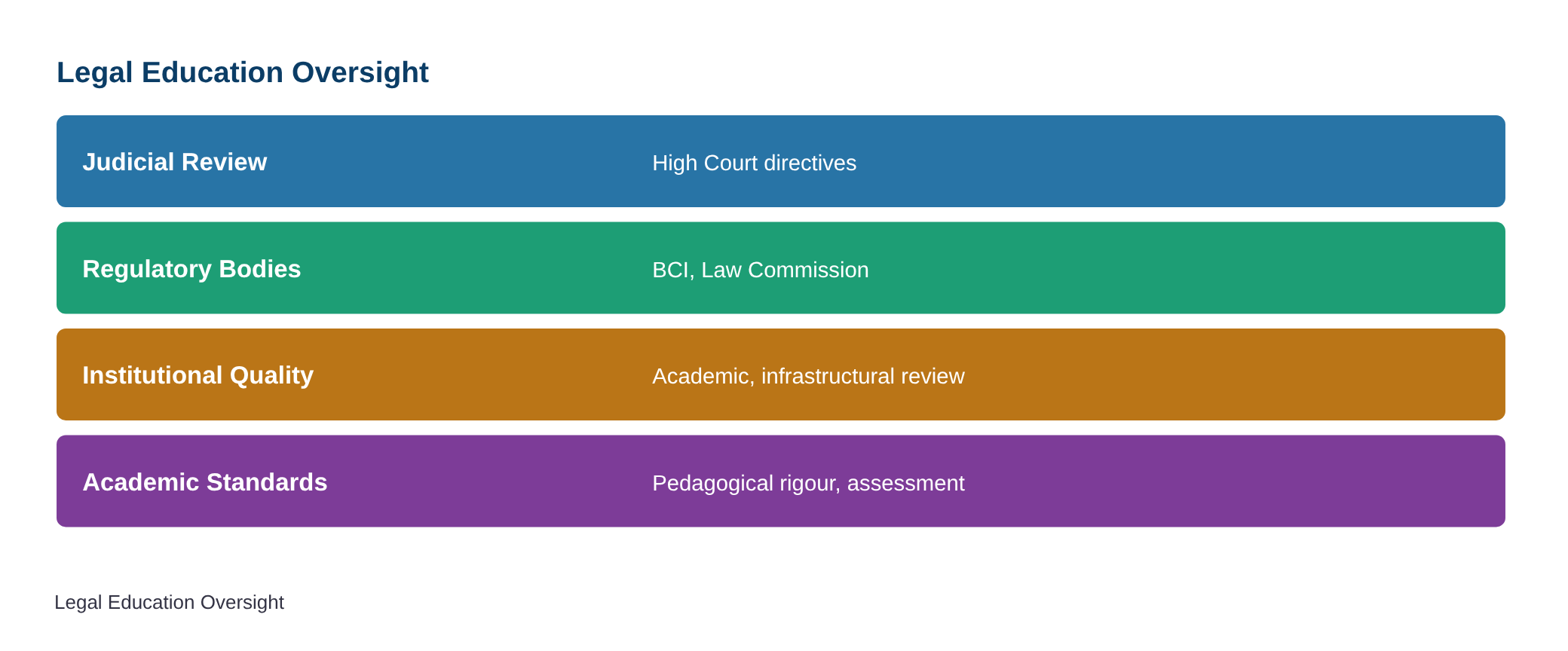
- However, the court took suo motu cognizance of the broader issue of declining standards in legal education, directing the Bar Council of India (BCI) to review the academic and infrastructural quality of the concerned institution.
- Additionally, the court recommended that the Law Commission of India conduct a comprehensive study on legal education standards in India and propose reforms to enhance pedagogical rigour and assessment mechanisms.
What is the Judicial Role in Regulating Legal Education Standards?
- The judiciary, under Article 226 of the Constitution, exercises writ jurisdiction to ensure that educational institutions adhere to constitutional and statutory norms, including fairness in evaluation processes.
- Judicial review in academic matters is limited to cases where there is evidence of procedural impropriety, arbitrariness, or violation of principles of natural justice, as reiterated in this judgment.
- The Bar Council of India (BCI), as the statutory body regulating legal education in India, is mandated under the Advocates Act, 1961, to prescribe standards of professional conduct, education, and examination for law students.
- The BCI’s role includes accrediting law colleges, monitoring curriculum design, and ensuring adherence to minimum infrastructure and faculty requirements, though enforcement mechanisms often face criticism.
- The Law Commission of India, a non-statutory body, periodically reviews legal education policies and recommends reforms, such as the 2008 report advocating for a national-level entrance test for law admissions (subsequently implemented as CLAT).
- The judgment highlights the intersection of judicial activism and institutional autonomy, where courts balance the need for accountability with the principle of non-interference in academic discretion.
- The case also underscores the importance of transparency in evaluation processes, as mandated by the Right to Information Act, 2005, which enables students to seek redressal for perceived injustices.
- The broader concern raised by the court—declining standards in legal education—aligns with critiques of rote learning, inadequate practical training, and the commercialization of legal education in India.
Key Features
| Feature | Significance |
|---|---|
| Judicial scrutiny of academic evaluation | Highlights the limits of judicial intervention in academic matters, ensuring that courts defer to institutional autonomy unless procedural impropriety or malafide intent is proven. |
| Bar Council of India’s oversight role | Underscores the statutory responsibility of the BCI to regulate legal education standards, infrastructure, and faculty quality in law schools across India. |
| Legal Education Review Mechanism | Emphasizes the need for periodic reviews by the Law Commission of India to assess and reform legal education curricula, pedagogy, and assessment methodologies. |
| Right to Information (RTI) in academic disputes | Demonstrates the application of RTI Act, 2005, in accessing answer scripts for re-evaluation, reinforcing transparency in examination processes. |
| Judicial concern over academic quality | Reflects the judiciary’s proactive stance in flagging systemic deficiencies in legal education, urging corrective measures at institutional and policy levels. |
Why it Matters
Judicial-Executive Interface in Education
- Reinforces the principle that judicial review in academic disputes must be limited to procedural fairness and cannot substitute for academic judgment.
- Highlights the judiciary’s role in safeguarding constitutional values such as fairness, transparency, and accountability in educational institutions.
- Demonstrates the interplay between the judiciary and statutory bodies like the Bar Council of India in regulating professional education.
Legal Education Ecosystem
- Exposes systemic gaps in legal education, including inadequate faculty training, outdated curricula, and inconsistent assessment standards.
- Underscores the need for a robust quality assurance framework in legal education to align with global benchmarks.
- Highlights the importance of interdisciplinary approaches in legal pedagogy, such as integrating environmental law (e.g., Biodiversity Protection Law) with traditional legal subjects.
Institutional Accountability
- Stresses the accountability of law schools and universities in ensuring fair and transparent evaluation processes.
- Reinforces the role of statutory bodies (BCI, UGC) in monitoring and improving academic standards in professional courses.
- Emphasizes the need for grievance redressal mechanisms within educational institutions to address student concerns promptly.
Challenges
1. Decline in Academic Rigor in Legal Education
- Inconsistent assessment standards across law schools, leading to arbitrary grading and erosion of academic credibility.
- Lack of specialized faculty in niche areas such as environmental law, biodiversity protection, and international law.
- Over-reliance on rote learning and inadequate focus on analytical and problem-solving skills in legal pedagogy.
- Inadequate infrastructure and resources in law schools, particularly in tier-2 and tier-3 institutions.
UPSC Link: GS2: Issues relating to development and management of Social Sector/Services relating to Education
2. Judicial Overreach vs. Institutional Autonomy
- Risk of judicial intervention in academic matters undermining the autonomy of educational institutions.
- Potential for excessive litigation in academic disputes, diverting judicial resources from critical constitutional matters.
- Need for clear guidelines to delineate the boundaries of judicial review in educational governance.
UPSC Link: GS2: Judiciary – Structure, Organization and Functioning
3. Transparency and Accountability in Examination Processes
- Lack of standardized answer evaluation criteria, leading to subjective grading and student grievances.
- Inadequate grievance redressal mechanisms within universities for re-evaluation and dispute resolution.
- Need for digitization of examination processes to ensure transparency and reduce human bias.
UPSC Link: GS2: Transparency & Accountability in Governance
4. Regulatory Gaps in Legal Education
- Fragmented regulatory oversight by multiple bodies (BCI, UGC, State Bar Councils) leading to inconsistencies in standards.
- Lack of periodic reviews and reforms in legal education curricula to align with evolving legal and societal needs.
- Inadequate enforcement of regulatory norms, particularly in private law schools.
UPSC Link: GS2: Statutory, Regulatory and various Quasi-judicial Bodies
Challenges — UPSC Perspective
| Issue | Concern |
|---|---|
| Inconsistent assessment standards | Arbitrary grading and erosion of academic credibility in law schools. |
| Lack of specialized faculty | Inadequate expertise in niche areas such as environmental law and biodiversity protection. |
| Judicial intervention in academic matters | Risk of undermining institutional autonomy and excessive litigation. |
| Transparency in examination processes | Subjective grading and inadequate grievance redressal mechanisms. |
| Regulatory fragmentation | Inconsistent enforcement of standards across law schools. |
| Outdated curricula | Lack of alignment with global legal education benchmarks and societal needs. |
Way Forward
- Strengthen the Bar Council of India’s regulatory framework to enforce uniform assessment standards across law schools.
- Mandate periodic reviews of legal education curricula by the Law Commission of India to incorporate interdisciplinary and contemporary legal subjects.
- Establish specialized faculty development programs to address gaps in niche areas such as environmental law and biodiversity protection.
- Digitize examination processes, including answer script evaluation, to ensure transparency and reduce human bias.
- Create robust grievance redressal mechanisms within universities for re-evaluation and dispute resolution in academic matters.
- Encourage law schools to adopt problem-based learning and clinical legal education to enhance analytical and practical skills.
- Promote collaboration between law schools and industry to align legal education with evolving professional demands.
- Enhance the role of the University Grants Commission (UGC) in monitoring and improving the quality of legal education.
UPSC Value Addition
Keywords for Mains Answer-Writing
Legal education standards in India · Judicial review of academic evaluation · Bar Council of India regulatory role · Law Commission of India reforms · Judicial intervention in examination disputes · Academic quality assurance in legal education · Judicial concern over zero marks in law examinations · Allahabad High Court judgment on legal education · Right to Information in academic grievances · Judicial scrutiny of examination evaluation processes
Constitutional & Policy Linkages
- Article 21: Right to Education (as part of the right to life and personal liberty).
- Article 14: Equality before law and equal protection of laws (ensuring fair assessment standards).
- Article 19(1)(g): Freedom to practice any profession (ensuring quality legal education for professional competence).
Concept Flow
Student scores zero marks in Biodiversity Protection Law → Files RTI to access answer script → Requests re-evaluation → University fails to act → Files writ petition in High Court. → High Court examines answer script and upholds zero marks, citing lack of legal reasoning and analysis → Expresses concern over declining academic standards in legal education. → High Court directs Bar Council of India and Law Commission of India to review legal education standards and infrastructure → Highlights systemic gaps in assessment, faculty, and curriculum. → Judicial scrutiny reinforces the need for regulatory oversight and institutional accountability in legal education. → Systemic reforms in legal education curricula, faculty training, and assessment methodologies are necessitated to restore academic rigor.
Prelims Practice Questions
Q1. Consider the following statements regarding the regulatory framework of legal education in India:
1. The Bar Council of India (BCI) is empowered to regulate legal education and prescribe standards for law colleges.
2. The Law Commission of India (LCI) is a statutory body tasked with the periodic review of legal education standards.
3. The University Grants Commission (UGC) has no jurisdiction over legal education institutions.
How many of the above statements are correct?
- Only one
- Only two
- All three
- None
Answer: All three — Statements 1 and 2 are correct. The Bar Council of India regulates legal education under the Advocates Act, 1961, while the Law Commission of India periodically reviews legal education standards. Statement 3 is incorrect as the UGC has jurisdiction over higher education institutions, including law colleges.
Q2. Assertion (A): Judicial intervention in academic evaluation processes is limited to cases of proven arbitrariness or malice.
Reason (R): Courts defer to the academic autonomy of educational institutions in matters of evaluation and grading.
Options:
A. Both A and R are true, and R is the correct explanation of A.
B. Both A and R are true, but R is not the correct explanation of A.
C. A is true, but R is false.
D. A is false, but R is true.
- A
- B
- C
- D
Answer: B — Both the assertion and reason are correct. Courts generally refrain from interfering in academic evaluation unless there is evidence of arbitrariness, malice, or violation of established procedures. The reason correctly explains the assertion.
Q3. Match the following regulatory bodies with their primary functions in legal education:
Column I
1. Bar Council of India
2. Law Commission of India
3. University Grants Commission
4. All India Council for Technical Education
Column II
A. Regulates technical and professional education
B. Prescribes standards for legal education and conduct of advocates
C. Periodically reviews legal education and suggests reforms
D. Regulates higher education institutions including law colleges
Select the correct match:
- 1-B, 2-C, 3-D, 4-A
- 1-C, 2-B, 3-D, 4-A
- 1-A, 2-C, 3-B, 4-D
- 1-D, 2-A, 3-C, 4-B
Answer: 1-B, 2-C, 3-D, 4-A — The correct matches are: 1-B (Bar Council of India regulates legal education and conduct of advocates), 2-C (Law Commission of India reviews legal education and suggests reforms), 3-D (UGC regulates higher education institutions including law colleges), and 4-A (AICTE regulates technical and professional education).
Mains Practice Question
✍ The Allahabad High Court, in a recent judgment, expressed grave concern over the declining standards of legal education in India after dismissing a petition filed by a law student who had scored zero marks in a subject. Critically examine the constitutional and statutory framework governing legal education in India, highlighting the roles of the Bar Council of India and the Law Commission of India. Also, discuss the judicial approach to disputes arising from academic evaluation in law examinations. (15 Marks)
Approach: MODEL-ANSWER SKELETON:
1. **Constitutional and Statutory Framework for Legal Education:**
– Article 30(1) of the Constitution guarantees autonomy to educational institutions, but legal education is regulated under the Advocates Act, 1961.
– Entry 77 of the Union List empowers Parliament to regulate legal education.
– The Bar Council of India (BCI), established under the Advocates Act, 1961, is the apex body for regulating legal education and prescribing standards for law colleges.
2. **Role of the Bar Council of India (BCI):**
– BCI prescribes minimum standards for legal education, including curriculum, faculty qualifications, and infrastructure.
– It conducts inspections and grants recognition to law colleges.
– BCI also regulates the conduct of advocates and legal education institutions.
3. **Role of the Law Commission of India (LCI):**
– LCI is a non-statutory body that reviews legal education periodically and suggests reforms.
– It examines gaps in legal education and recommends measures to improve standards.
– LCI’s reports are advisory and not binding, but they influence policy and regulatory changes.
4. **Judicial Approach to Academic Evaluation Disputes:**
– Courts generally refrain from interfering in academic evaluation unless there is evidence of arbitrariness, malice, or violation of established procedures (as held in *T.M.A. Pai Foundation v. State of Karnataka*).
– Judicial intervention is limited to cases where the evaluation process is flawed or violates principles of natural justice.
– The Allahabad High Court’s observation in the instant case underscores the need for judicial scrutiny of institutional failures in maintaining academic standards.
5. **Critical Analysis and Way Forward:**
– The judgment highlights systemic issues in legal education, including poor faculty quality, outdated curricula, and inadequate infrastructure.
– Strengthening the regulatory framework requires greater autonomy for BCI, stricter enforcement of standards, and periodic reviews by LCI.
– The judiciary’s role should be limited to ensuring fairness in evaluation while respecting institutional autonomy.
6. **Conclusion:**
– Legal education in India requires urgent reforms to align with global standards.
– The BCI and LCI must collaborate to address systemic deficiencies and ensure quality legal education.
Source: amarujala.com
Generated by AanyaAi for educational purpose.

- राज्यसभा उपचुनाव उत्तराखंड: 16 अक्तूबर को मतदान, जानें पूरा कार्यक्रम और महत्व - September 22, 2026
- राज्यसभा उपचुनाव उत्तराखंड: 16 अक्टूबर को मतदान, जानें प्रक्रिया और महत्व - September 22, 2026
- चार राज्यों में विधान परिषद चुनाव: निर्वाचन आयोग ने जारी की तिथियां, कब होगा मतदान? - September 22, 2026

No Comments