


07 Aug Allahabad HC Rejects Zero-Mark Petition: Highlights Legal Education Crisis in India
✎ The Allahabad High Court’s ruling reaffirms that judicial scrutiny of academic evaluations is limited to procedural fairness, while underscoring the BCI’s responsibility to enforce stringent standards in legal education to…
Subject Relevance — Where This Topic Fits
- GS Paper II — Judiciary and Constitutional Framework | GS Paper IV — Ethics in Governance and Educational Accountability
- Prelims: Bar Council of India (BCI), Legal Education Rules 2020, National Legal Services Authority (NALSA), All India Bar Examination (AIBE), University Grants Commission (UGC) Act 1956
- Essay: Judicial Activism vs. Academic Autonomy: Balancing Accountability in Legal Education, The Crisis of Competence: Reimagining Legal Pedagogy for a Just Society
Quick Revision: The Allahabad High Court’s ruling reaffirms that judicial scrutiny of academic evaluations is limited to procedural fairness, while underscoring the BCI’s responsibility to enforce stringent standards in legal education to prevent systemic incompetence.
Why is this in the news?
The Allahabad High Court dismissed a petition filed by a BA LLB student who had scored zero marks in the subject ‘Biodiversity Protection Law,’ expressing grave concerns over the deteriorating standards of legal education in India. The court’s observations underscore systemic failures in academic evaluation, institutional accountability, and the urgent need for regulatory reforms in legal pedagogy. This ruling has significant implications for the Bar Council of India (BCI), law universities, and the broader framework of legal education governance.
Background
- The case pertains to a BA LLB student in the ninth semester who was awarded zero marks in ‘Biodiversity Protection Law,’ despite claiming to have answered all questions. The student sought re-evaluation through RTI and university channels but received no redressal, prompting a High Court petition.
- The Allahabad High Court, in its judgment, highlighted the absence of logical reasoning, legal comprehension, or coherent analysis in the student’s answer scripts, validating the examiner’s decision to award zero marks.
- The court’s suo motu observations on the state of legal education reflect a growing judicial concern over the quality of law curricula, faculty competence, and examination standards across Indian law schools.
- Judicial interventions in academic matters are rare and typically limited to cases of procedural arbitrariness, malafide intent, or violation of statutory norms, as reiterated by the court in its judgment.
What is Legal Education in India? — Governance, Challenges, and Reforms
- Legal education in India is governed by the Bar Council of India (BCI) under the Advocates Act 1961, which regulates law colleges, syllabi, and professional standards for legal practitioners.
- Law degrees in India include 3-year LLB, 5-year integrated BA/BSc/BCom LLB, and LLM programs.
- Challenges in legal education include inadequate faculty training, rote-learning pedagogies, lack of interdisciplinary integration, and disparities between elite and regional law schools in infrastructure and resources.
- Judicial pronouncements, such as the Allahabad High Court’s ruling, highlight the need for stricter enforcement of BCI norms, periodic curriculum reviews, and mechanisms for student grievance redressal in academic evaluations.
- Reforms under discussion include the establishment of a National Law Commission to oversee legal education standards, mandatory clinical legal education, and the integration of technology-driven pedagogy.
Key Features
| Feature | Significance |
|---|---|
| Judicial scrutiny of academic evaluation | Establishes the principle that courts intervene in evaluation only when procedural illegality or arbitrariness is proven, not on merit grounds. |
| HC’s suo motu concern for legal education standards | Highlights systemic deficiencies in legal pedagogy and assessment mechanisms across institutions. |
| Right to Information (RTI) in academic redressal | Demonstrates the role of RTI in ensuring transparency in examination processes and answer-sheet evaluation. |
| Role of Bar Council of India (BCI) | BCI’s mandate to regulate legal education includes monitoring institutional infrastructure and academic standards. |
| Judicial emphasis on logical and coherent analysis | Reinforces the expectation of analytical rigor in legal education, aligning with competency-based learning outcomes. |
Why it Matters
Judicial-Executive Interface
- The judgment underscores the judiciary’s limited role in academic merit evaluation, deferring to institutional autonomy while ensuring procedural fairness.
- It signals a proactive stance by the judiciary in addressing systemic failures in professional education, particularly legal education.
- The HC’s directive to BCI and Law Commission reflects a collaborative approach between the judiciary and statutory bodies to reform education standards.
Legal Education Ecosystem
- Exposes critical gaps in the assessment framework of law schools, particularly in specialized subjects like Biodiversity Protection Law.
- Highlights the need for standardized evaluation criteria and faculty training to ensure consistency and fairness in grading.
- Raises questions about the adequacy of curriculum design and its alignment with contemporary legal challenges, such as environmental law.
Student Rights and Accountability
- Affirms the right of students to seek transparency in evaluation processes through mechanisms like RTI and judicial review.
- Emphasizes the responsibility of educational institutions to maintain robust grievance redressal mechanisms for academic disputes.
- Deters frivolous litigation while ensuring genuine cases of procedural injustice are addressed.
Challenges
1. Decline in Academic Standards in Legal Education
- Inconsistent grading standards across law schools undermine the credibility of legal education.
- Lack of specialized faculty and outdated curricula fail to equip students with contemporary legal knowledge.
- Inadequate infrastructure and assessment mechanisms exacerbate systemic deficiencies.
UPSC Link: GS Paper 2: Issues relating to development and management of Social Sector/Services relating to Education
2. Judicial Overreach vs. Institutional Autonomy
- Balancing judicial intervention with institutional autonomy remains a persistent challenge in education governance.
- Courts must avoid substituting their discretion for academic expertise in merit evaluation.
- Clearer guidelines are needed to delineate the scope of judicial review in academic matters.
UPSC Link: GS Paper 2: Separation of Powers between various organs
3. Transparency and Accountability in Evaluation
- Delayed or absent redressal mechanisms for academic grievances erode student trust in institutions.
- RTI applications for answer-sheets often face resistance, delaying justice.
- Need for digitalization of evaluation processes to ensure timely and transparent redressal.
UPSC Link: GS Paper 2: Transparency & Accountability in Governance
4. Faculty Competency and Training
- Inadequate faculty training in evaluation methodologies leads to subjective and inconsistent grading.
- Lack of domain expertise in specialized subjects like environmental law affects teaching quality.
- Professional development programs for law faculty are essential to align with evolving legal education standards.
UPSC Link: GS Paper 2: Issues relating to development and management of Social Sector/Services relating to Education
Challenges — UPSC Perspective
| Issue | Concern |
|---|---|
| Inconsistent grading standards | Undermines the credibility of legal education and professional readiness of graduates. |
| Lack of specialized faculty | Results in poor teaching quality in niche subjects like Biodiversity Protection Law. |
| Delayed redressal mechanisms | Erodes student trust and discourages the use of institutional grievance processes. |
| Judicial intervention in merit evaluation | Risks judicial overreach and undermines academic autonomy. |
| Outdated curricula | Fails to address contemporary legal challenges, such as environmental law and digital governance. |
Way Forward
- Bar Council of India (BCI) should formulate standardized evaluation guidelines for law schools to ensure consistency in grading.
- Law Commission of India should conduct a comprehensive review of legal education standards, focusing on curriculum design and faculty training.
- Law schools must invest in digital infrastructure to streamline answer-sheet evaluation and grievance redressal processes.
- Faculty development programs should be mandated to enhance teaching quality and domain expertise in specialized subjects.
- Institutions should establish transparent and time-bound mechanisms for addressing academic grievances, including RTI-based answer-sheet scrutiny.
- Judicial training programs should sensitize judges to the nuances of academic evaluation to avoid unnecessary intervention in merit disputes.
- Collaborative initiatives between law schools and industry should be encouraged to align legal education with contemporary professional demands.
UPSC Value Addition
Keywords for Mains Answer-Writing
Legal Education in India · Judicial Review of Academic Evaluation · Bar Council of India · Law Commission of India · Judicial Discretion in Examination Disputes · Quality Assurance in Legal Education · Judicial Activism vs. Judicial Restraint · Academic Integrity in Law Schools · Judicial Scrutiny of Zero Marks · Constitutional Remedies for Examination Grievances
Constitutional & Policy Linkages
- Article 21: Right to Education (implied right to fair evaluation)
- Article 14: Equality and fairness in evaluation processes
Concept Flow
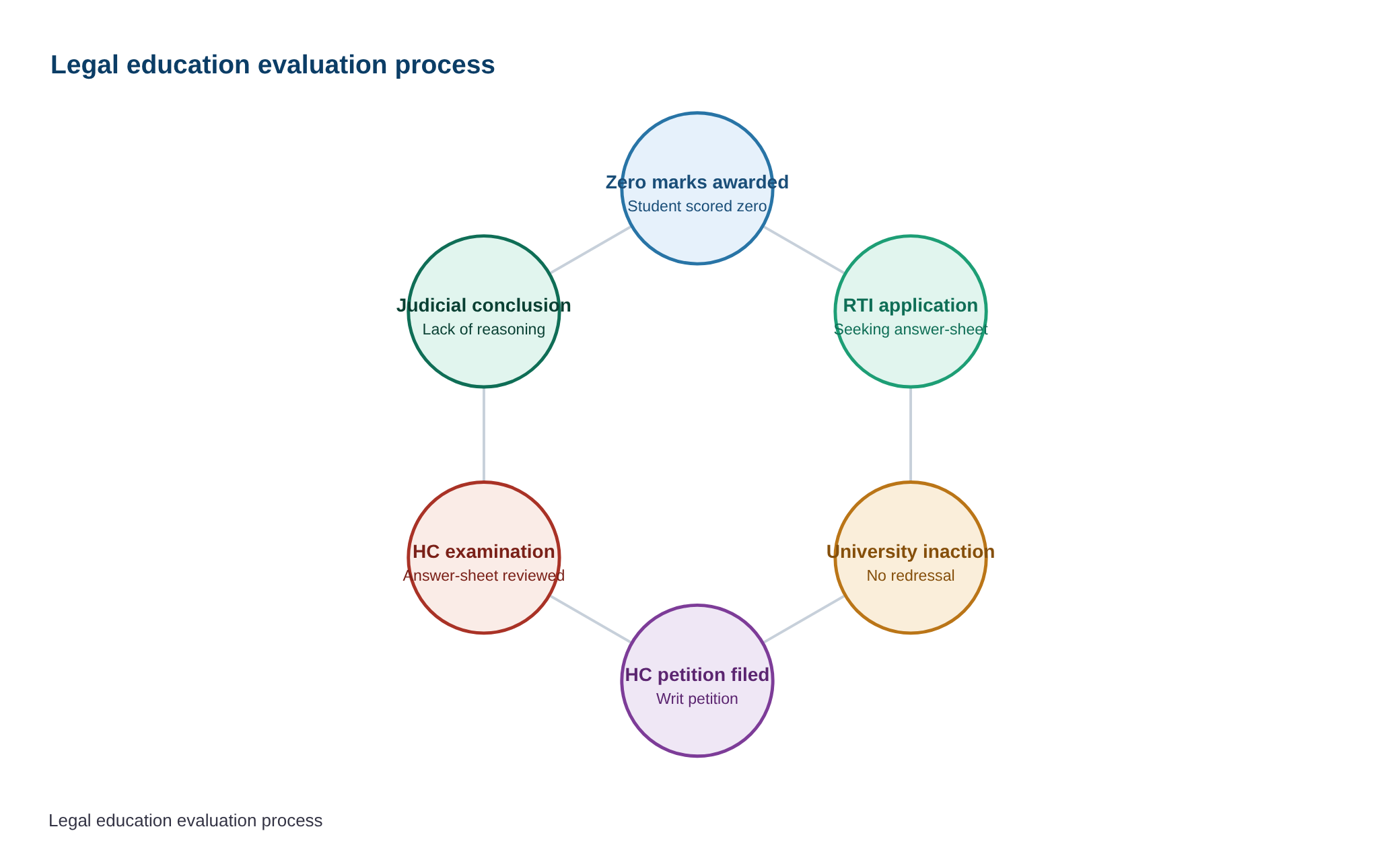
Student’s zero marks in Biodiversity Protection Law → RTI application to obtain answer-sheet → University’s inaction on re-evaluation request → Filing of writ petition in Allahabad High Court → HC’s examination of answer-sheet and question paper → Judicial conclusion of lack of legal reasoning and coherence → Dismissal of petition with directions to BCI and Law Commission
Prelims Practice Questions
Q1. Consider the following statements regarding the role of the Bar Council of India (BCI) in legal education:
1. The BCI is empowered to frame and enforce standards of legal education in India.
2. The BCI can conduct inspections of law colleges to ensure compliance with prescribed standards.
3. The BCI has the authority to revise the syllabus of LL.B. and LL.M. programmes.
4. The BCI can directly award degrees to law graduates.
How many of the above statements are correct?
- Only one
- Only two
- Only three
- All four
Answer: Only three — Statements 1, 2, and 3 are correct as per the Advocates Act, 1961. Statement 4 is incorrect because the BCI does not award degrees; universities and law schools do.
Q2. Assertion (A): The judiciary in India can intervene in academic evaluation processes only if there is evidence of malice or arbitrariness.
Reason (R): Judicial review of examination results is limited to procedural fairness and does not extend to the academic merit of the evaluation.
Options:
A. Both A and R are true, and R is the correct explanation of A.
B. Both A and R are true, but R is not the correct explanation of A.
C. A is true, but R is false.
D. A is false, but R is true.
Answer: ? — Both A and R are true. The judiciary intervenes only in cases of procedural impropriety or malice, not to reassess academic merit, as held in numerous judgments including the present case.
Q3. Match the following bodies with their respective functions in the context of legal education in India:
Column I
A. Bar Council of India
B. University Grants Commission
C. Law Commission of India
D. All India Bar Examination
Column II
1. Regulates higher education standards including law schools
2. Frames and enforces standards of legal education
3. Conducts research and recommends reforms in legal systems
4. Certifies advocates for practice after clearing a qualifying examination
Options:
A B C D
1 2 3 4
2 1 3 4
2 1 4 3
1 2 4 3
Answer: ? — A-2 (BCI frames and enforces standards), B-1 (UGC regulates higher education), C-3 (Law Commission recommends reforms), D-4 (AIBE certifies advocates).
Mains Practice Question
✍ The recent judgment of the Allahabad High Court dismissing a petition seeking re-evaluation of a law student’s answer sheet, which had received zero marks in a subject, underscores the delicate balance between judicial activism and judicial restraint in matters of academic evaluation. Critically examine the constitutional and legal framework governing judicial review of examination results in professional courses like law. Also, analyse the role of the Bar Council of India and the Law Commission of India in ensuring quality in legal education. (15 Marks)
Approach: MODEL-ANSWER SKELETON:
1. Introduction (2 marks):
– Briefly state the case and its context (zero marks in Biodiversity Protection Law).
– Define judicial review in academic evaluation and its constitutional basis (Article 226/227 of the Constitution).
2. Constitutional and Legal Framework (4 marks):
– Article 226/227: Power of High Courts to issue writs for enforcement of rights and for other purposes.
– Judicial restraint principle: Courts do not substitute their academic judgment for that of examiners (cited cases: *T.M.A. Pai Foundation v. State of Karnataka*, *Anand Mohan v. Bihar School Examination Board*).
– Conditions for judicial intervention: Procedural fairness, absence of malice, and violation of principles of natural justice.
3. Role of Bar Council of India (BCI) (4 marks):
– Statutory mandate under the Advocates Act, 1961 (Section 7(1)(h)) to frame and enforce standards of legal education.
– Powers: Inspection of law colleges, prescribing syllabi, and ensuring compliance with standards.
– Limitations: BCI does not award degrees; universities do. Recent initiatives like the All India Bar Examination (AIBE) for certification.
4. Role of Law Commission of India (3 marks):
– Advisory body under the Ministry of Law and Justice.
– Functions: Conducting research on legal reforms, including legal education standards.
– Recommendations: Periodic reviews of legal education, such as the 205th Report on legal education reforms.
5. Critical Analysis and Way Forward (2 marks):
– Balance between judicial restraint and accountability: Courts must not overstep into academic domains but ensure fairness.
– Need for systemic reforms: Strengthening BCI’s enforcement mechanisms, periodic reviews by the Law Commission, and transparency in evaluation processes.
– Conclude with the necessity of a collaborative approach involving judiciary, BCI, and educational institutions.
Source: amarujala.com
Generated by AanyaAi for educational purpose.

- अरुणाचल में सियांग मेगा बाँध सर्वेक्षण के लिए कैबिनेट ने किया पैनल का गठन - September 24, 2026
- Arunachal Cabinet Forms Panel for Siang Mega Dam Survey: Key Facts for UPSC - September 24, 2026
- सुप्रीम कोर्ट का ‘अंपायर’ वाला फैसला: चुनाव आयोग मामले में न्यायमूर्ति दत्ता की भूमिका - September 24, 2026

No Comments