


07 Aug Allahabad HC Rejects Zero-Mark Student Petition, Flags Legal Education Crisis
✎ The Bar Council of India (BCI) regulates legal education in India under the Advocates Act, 1961, and the judiciary’s role in academic disputes is limited to cases of proven arbitrariness or legal error, not mere dissatisfaction…
Subject Relevance — Where This Topic Fits
- GS Paper II — Governance, Constitution, Polity, Social Justice and International Relations (Judicial Review and Legal Education)
Quick Revision: The Bar Council of India (BCI) regulates legal education in India under the Advocates Act, 1961, and the judiciary’s role in academic disputes is limited to cases of proven arbitrariness or legal error, not mere dissatisfaction with marks.
Why is this in the news?
The Allahabad High Court recently dismissed a petition filed by a BA LLB student who scored zero marks in the subject ‘Biodiversity Protection Law’ for the ninth semester. The court, while rejecting the plea for re-evaluation, expressed grave concern over the declining standards of legal education in India. The judgment underscores the judiciary’s role in ensuring transparency and accountability in academic evaluation processes, particularly in professional legal education regulated by the Bar Council of India (BCI).
Background
- The petitioner, a final-year BA LLB student, received zero marks in the subject ‘Biodiversity Protection Law’ despite claiming to have answered all questions.
- The student sought re-evaluation through the Right to Information (RTI) Act but received no response from the university.
- The petitioner approached the Allahabad High Court, arguing that the zero marks were arbitrary and demanded a re-evaluation of the answer script.
- The High Court, in its judgment, examined the original question paper and answer script, finding no legal reasoning, coherent analysis, or subject-specific understanding in the responses.
- The court held that judicial intervention in academic evaluation is permissible only in cases of proven arbitrariness, malice, or legal error, none of which were established in this case.
- The High Court directed the Bar Council of India (BCI) to review the academic and infrastructural standards of the concerned institution and the Law Commission of India to study and recommend reforms in legal education standards.
Legal Education in India: Regulatory Framework and Challenges
- Legal education in India is governed by the Bar Council of India (BCI) under the Advocates Act, 1961, which sets the minimum standards for law degrees and regulates legal practice.
- The BCI prescribes the curriculum, examination patterns, and infrastructure requirements for law colleges, including integrated five-year LLB programs like BA LLB.
- The All India Bar Examination (AIBE) is a mandatory certification for law graduates to practice law in India, testing their professional competence.
- The National Law School of India University (NLSIU) model, with its five-year integrated LLB program, is often cited as a benchmark for legal education in India due to its interdisciplinary approach and rigorous pedagogy.
- Concerns persist regarding the quality of legal education, including rote learning, lack of practical training, inadequate faculty, and substandard infrastructure in many institutions.
- The Law Commission of India, in its 266th Report (2017), highlighted systemic issues such as commercialization of legal education, lack of uniformity in standards, and the need for continuous curriculum revision.
- The judiciary has occasionally intervened in cases of gross academic mismanagement, as seen in the Vishnu Priya v. State of Tamil Nadu (2020) case, where the Madras High Court directed re-evaluation after finding procedural lapses.
- Recent reforms, such as the introduction of the National Education Policy (NEP) 2020, aim to integrate legal education with interdisciplinary studies, emphasizing skill development and experiential learning.
Key Features
| Feature | Significance |
|---|---|
| Judicial scrutiny of academic evaluation | Ensures fairness in examination processes and upholds the integrity of academic institutions. |
| Judicial intervention in legal education standards | Highlights the judiciary’s role in safeguarding the quality of legal education and its impact on the legal profession. |
| Right to Information (RTI) in academic grievances | Empowers students to seek transparency and accountability in examination evaluations. |
| Academic re-evaluation mechanisms | Provides a structured process for students to challenge unjust evaluations, ensuring due process. |
| Judicial concern over institutional quality | Signals the judiciary’s proactive stance in addressing systemic deficiencies in legal education institutions. |
Why it Matters
Legal Education Ecosystem
- The judgment underscores the critical role of legal education in shaping competent legal professionals, essential for a functional justice delivery system.
- It reinforces the need for rigorous academic standards in law schools to prevent dilution of professional competence.
- The case highlights the judiciary’s concern over the declining standards in legal education, which could erode public trust in the legal system.
Judicial-Executive Synergy
- The High Court’s directive to the Bar Council of India and the Law Commission of India demonstrates judicial oversight over regulatory bodies.
- It sets a precedent for judicial intervention in matters of academic governance, ensuring accountability of regulatory authorities.
- The judgment may prompt systemic reforms in legal education policy, aligning it with contemporary legal challenges.
Student Rights and Accountability
- The case reaffirms the rights of students to seek redressal for perceived academic injustices through legal avenues.
- It emphasizes the importance of transparent evaluation mechanisms to prevent arbitrary grading practices.
- The judgment serves as a deterrent against institutional negligence in addressing student grievances.
Challenges
1. Decline in Legal Education Standards
- The judgment exposes systemic deficiencies in legal education institutions, including inadequate faculty, outdated curricula, and poor evaluation processes.
- It raises concerns about the quality of legal professionals entering the judiciary and legal services, potentially compromising justice delivery.
- The lack of standardized assessment frameworks in law schools contributes to inconsistent academic outcomes.
UPSC Link: GS-II: Issues relating to development and management of Social Sector/Services
2. Judicial Overreach vs. Academic Autonomy
- Balancing judicial intervention with institutional autonomy remains a contentious issue, particularly in matters of academic evaluation.
- The judgment may be perceived as encroaching on the domain of academic institutions, raising debates on separation of powers.
- It necessitates clear guidelines to delineate the boundaries of judicial scrutiny in academic matters.
UPSC Link: GS-II: Separation of Powers between various organs
3. Student Grievance Redressal Mechanisms
- The case highlights the inefficacy of existing grievance redressal mechanisms in law schools, including RTI and re-evaluation processes.
- It underscores the need for robust, time-bound, and transparent systems to address student grievances without recourse to litigation.
- Institutional apathy in addressing student concerns further erodes trust in academic governance.
UPSC Link: GS-II: Mechanisms, Laws, Institutions and Bodies constituted for the protection and betterment of vulnerable sections
4. Regulatory Oversight Deficiencies
- The Bar Council of India and the Law Commission of India face scrutiny for their role in maintaining academic standards in legal education.
- The judgment exposes gaps in regulatory oversight, including inadequate monitoring of law schools and enforcement of standards.
- Strengthening regulatory mechanisms is essential to ensure compliance with prescribed academic benchmarks.
UPSC Link: GS-II: Statutory, Regulatory and various quasi-judicial bodies
Challenges — UPSC Perspective
| Issue | Concern |
|---|---|
| Inadequate faculty expertise | Lack of qualified instructors in specialized legal domains, such as Biodiversity Protection Law. |
| Outdated curricula | Failure to incorporate contemporary legal developments and interdisciplinary approaches in legal education. |
| Arbitrary evaluation practices | Inconsistent grading standards and lack of transparency in assessment processes. |
| Institutional apathy | Reluctance of law schools to address student grievances or reform academic policies. |
| Regulatory gaps | Weak enforcement of standards by the Bar Council of India and other regulatory bodies. |
Way Forward
- The Bar Council of India must conduct a comprehensive review of law schools’ academic infrastructure and faculty qualifications.
- The Law Commission of India should undertake a nationwide study to assess legal education standards and recommend reforms.
- Law schools must implement transparent evaluation mechanisms, including standardized assessment rubrics and third-party audits.
- Institutional grievance redressal cells should be strengthened to address student concerns promptly and effectively.
- Judicial guidelines should be framed to delineate the scope of judicial intervention in academic disputes, ensuring balance with institutional autonomy.
- Continuous professional development programs for law faculty should be mandated to enhance teaching quality.
- Public-private partnerships should be explored to upgrade law school infrastructure and resources.
- Awareness campaigns should be launched to educate students about their rights and grievance redressal mechanisms.
UPSC Value Addition
Keywords for Mains Answer-Writing
Legal education in India · Judicial review of academic evaluation · Bar Council of India · Law Commission of India · Judicial standards in legal pedagogy · Academic integrity in higher education · Judicial activism vs judicial restraint · Evaluation systems in law colleges · Constitutional remedies for academic grievances · Judicial oversight of educational institutions
Concept Flow
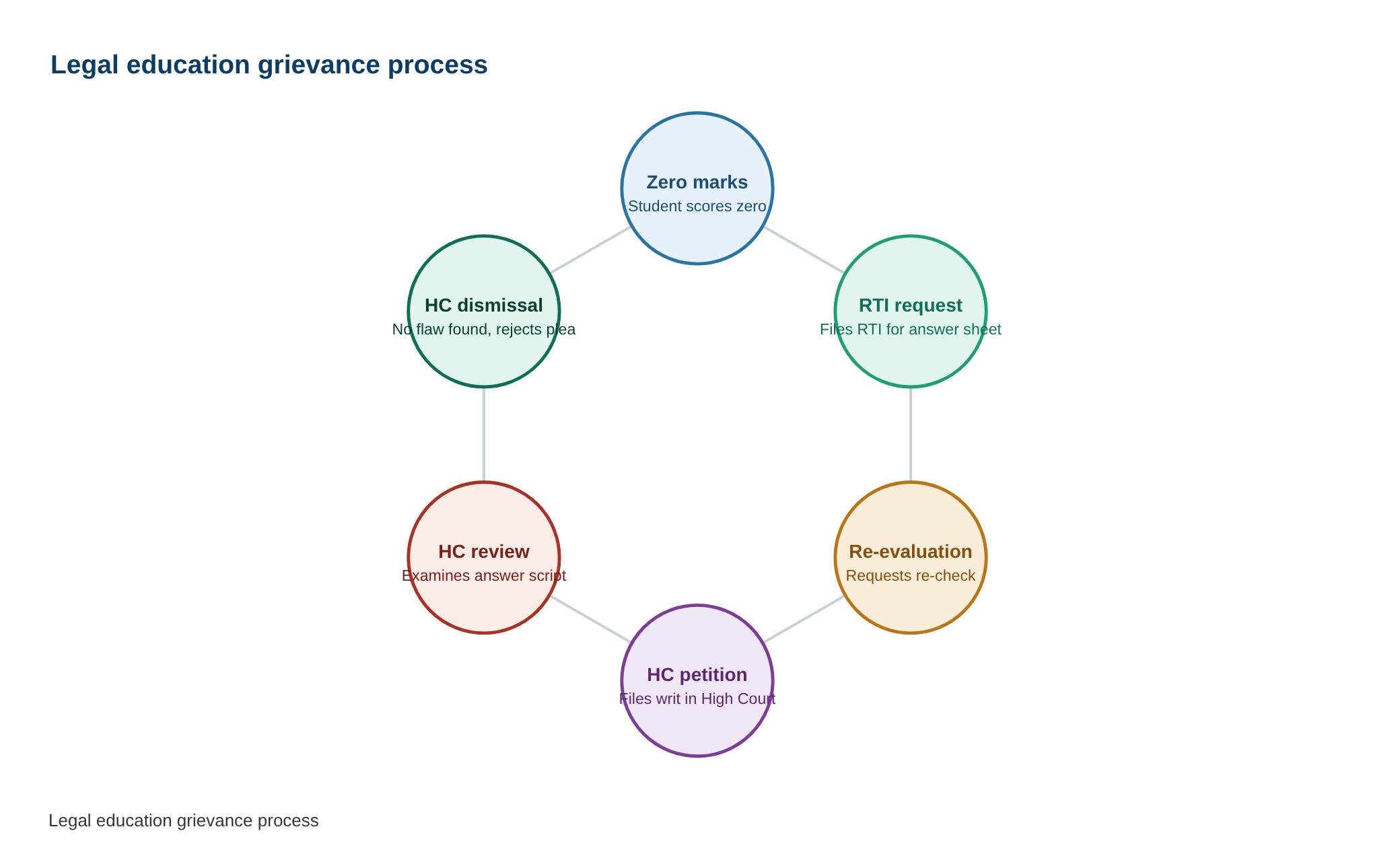
Student scores zero marks in Biodiversity Protection Law → Files RTI for answer sheet → Requests re-evaluation → University fails to act → Files writ petition in High Court → High Court examines answer sheet and evaluation process → Finds no legal or procedural flaw → Dismisses petition → High Court expresses concern over legal education standards → Directs Bar Council of India and Law Commission to review and recommend reforms → Regulatory bodies initiate review of law schools’ academic infrastructure and curricula → Recommend systemic reforms → Law schools implement reforms → Improve evaluation standards and faculty expertise → Enhance legal education quality
Prelims Practice Questions
Q1. Consider the following statements regarding the judicial review of academic evaluations in India:
1. The judiciary can intervene in academic evaluations only if there is evidence of malice or arbitrariness.
2. The Supreme Court has held that the evaluation process is purely academic and beyond judicial scrutiny.
3. The Allahabad High Court, in a recent judgment, expressed concern over the quality of legal education.
How many of the above statements are correct?
- Only one
- Only two
- All three
- None
Answer: Only two — Statement 1 is correct as judicial intervention in academic evaluations is permissible only in cases of malice, arbitrariness, or legal error. Statement 2 is incorrect because the judiciary does intervene in cases of fundamental rights violations or procedural irregularities. Statement 3 is correct as the Allahabad High Court recently expressed concern over legal education standards.
Q2. Assertion (A): The Bar Council of India (BCI) is empowered to regulate legal education and prescribe standards for law colleges.
Reason (R): The BCI derives its authority from the Advocates Act, 1961, which mandates it to promote legal education and set ethical standards for advocates.
Options:
A. Both A and R are true, and R is the correct explanation of A.
B. Both A and R are true, but R is not the correct explanation of A.
C. A is true, but R is false.
D. A is false, but R is true.
Answer: ? — Both the assertion and reason are true. The Bar Council of India (BCI) is indeed empowered to regulate legal education under the Advocates Act, 1961, and its role includes prescribing standards for law colleges. The reason correctly explains the assertion.
Q3. Match the following bodies with their respective roles in regulating legal education in India:
Column I
1. Bar Council of India
2. University Grants Commission
3. Law Commission of India
4. All India Council for Technical Education
Column II
A. Prescribes standards for technical education
B. Regulates legal education and sets ethical standards for advocates
C. Recommends reforms in legal education and judicial administration
D. Regulates higher education institutions and maintains standards
Options:
A. 1-B, 2-D, 3-C, 4-A
B. 1-A, 2-B, 3-D, 4-C
C. 1-C, 2-A, 3-B, 4-D
D. 1-D, 2-C, 3-A, 4-B
Answer: ? — 1-B: The Bar Council of India regulates legal education and sets ethical standards for advocates. 2-D: The University Grants Commission regulates higher education institutions. 3-C: The Law Commission of India recommends reforms in legal education and judicial administration. 4-A: The All India Council for Technical Education prescribes standards for technical education.
Mains Practice Question
✍ The Allahabad High Court, in a recent judgment, dismissed a petition filed by a law student who scored zero marks in the subject of Biodiversity Protection Law, while simultaneously expressing grave concern over the state of legal education in India. Critically examine the judicial standards governing academic evaluation in law colleges and the role of regulatory bodies such as the Bar Council of India and the Law Commission of India in ensuring quality legal education. (15 Marks)
Approach: MODEL-ANSWER SKELETON:
1. **Judicial Standards in Academic Evaluation**:
– Discuss the principle of judicial restraint in academic matters (reference: *T.M.A. Pai Foundation v. State of Karnataka*, 2002; *P.A. Inamdar v. State of Maharashtra*, 2005).
– Highlight exceptions where judicial intervention is permissible: malice, arbitrariness, violation of fundamental rights, or procedural irregularities.
– Explain the Allahabad High Court’s reasoning in dismissing the petition and its observations on the student’s answer script.
2. **Role of the Bar Council of India (BCI)**:
– Constitutional/statutory basis: Advocates Act, 1961, Section 7(1)(h) and (j).
– Functions: prescribing minimum standards for legal education, conducting inspections, and maintaining ethical standards for advocates.
– Critique: BCI’s effectiveness in enforcing standards, delays in inspections, and lack of transparency in evaluation systems.
3. **Role of the Law Commission of India**:
– Mandate: Recommend reforms in legal education, judicial administration, and legal services.
– Key reports: 18th Law Commission Report (2006) on legal education reforms, recommendations on curriculum design, and faculty development.
– Critique: Limited implementation of recommendations and lack of follow-up on policy suggestions.
4. **Judicial Activism vs. Judicial Restraint**:
– Balance between judicial oversight and academic autonomy.
– Need for judicial intervention in cases of systemic failures (e.g., arbitrary grading, lack of transparency).
5. **Way Forward**:
– Strengthening regulatory mechanisms (BCI, UGC, state bar councils).
– Mandatory publication of answer scripts and evaluation criteria.
– Faculty training programs and periodic reviews of curriculum.
– Role of the judiciary in monitoring compliance with standards.
Source: amarujala.com
Generated by AanyaAi for educational purpose.

- राज्यों द्वारा सरकारी प्रतिभूतियों की नीलामी में ₹16,750 करोड़ का सफल संग्रह - September 22, 2026
- RBI Auction Results: State Govt Securities Yield Trends & Implications for UPSC 2026 - September 22, 2026
- सुप्रीम कोर्ट का चुनाव आयोग से बड़ा सवाल: दिल्ली में 33 लाख मतदाताओं को नोटिस देने का क्या आधार है? - September 22, 2026

No Comments