


07 Aug Allahabad HC Rejects Zero-Mark Student’s Plea; Raises Legal Education Concerns
✎ The Allahabad High Court’s ruling underscores that judicial review of academic evaluation is permissible only in cases of manifest arbitrariness, procedural impropriety, or violation of legal principles, not to substitute…
Subject Relevance — Where This Topic Fits
- GS Paper II — Judiciary and Constitutional Framework | GS Paper IV — Ethics and Integrity in Governance
- Prelims: Judicial Review of Administrative Actions, Bar Council of India (BCI), Legal Education in India, Right to Information Act, 2005, Judicial Activism vs Judicial Restraint
- Essay: The Role of Judiciary in Upholding Educational Standards, Judicial Activism and Its Limits in Governance
Quick Revision: The Allahabad High Court’s ruling underscores that judicial review of academic evaluation is permissible only in cases of manifest arbitrariness, procedural impropriety, or violation of legal principles, not to substitute academic judgment.
Why is this in the news?
The Allahabad High Court, in a recent judgment, dismissed a petition filed by a BA LLB student who had scored zero marks in the subject ‘Biodiversity Protection Law’ and expressed grave concern over the declining standards of legal education in the country. The court observed that the student’s answer sheet reflected a complete absence of legal reasoning, logical analysis, and subject-matter comprehension, thereby validating the examiner’s decision. Additionally, the court directed the Bar Council of India (BCI) to review the academic infrastructure of the concerned institution and the Law Commission of India to study and recommend reforms in legal education standards, underscoring systemic deficiencies in evaluation mechanisms and institutional accountability.
Background
- The case pertains to a BA LLB student in the ninth semester who scored zero marks in the subject ‘Biodiversity Protection Law’ at a law college in Uttar Pradesh.
- The student, after exhausting internal remedies, filed a petition under Article 226 of the Constitution before the Allahabad High Court, seeking re-evaluation of the answer sheet.
- The student’s plea was based on the assertion that all questions were attempted, but no marks were awarded, prompting an RTI application to obtain the evaluated answer sheet.
- The university failed to act on the student’s request for re-evaluation, leading to the judicial intervention.
- The High Court examined the original question paper and the student’s answer sheet, finding no legal reasoning, coherent analysis, or subject-specific knowledge in the responses.
Legal Education in India: Governance, Challenges, and Reform Imperatives
- **Constitutional and Statutory Framework**: Legal education in India is governed by the Bar Council of India (BCI) under the Advocates Act, 1961, which sets standards for legal education, conduct of examinations, and recognition of law degrees.
- **Curriculum Design**: The BCI prescribes a five-year integrated BA LLB programme, with a curriculum that includes foundational subjects (e.g., Constitutional Law, Jurisprudence), specialized areas (e.g., Environmental Law, Intellectual Property Rights), and clinical legal education (e.g., moot courts, internships).
- **Evaluation Mechanisms**: Assessment in law colleges typically involves written examinations, viva voce, assignments, and practical components. However, concerns persist regarding the objectivity, transparency, and consistency of evaluation processes.
- **Institutional Accountability**: Law colleges are required to maintain academic infrastructure, faculty qualifications, and adherence to BCI norms. Non-compliance can lead to derecognition or penalties under the Advocates Act, 1961.
- **Judicial Oversight**: Courts have intervened in cases of arbitrary evaluation, procedural lapses, or denial of natural justice, as seen in this judgment. However, judicial review is limited to ensuring fairness and legality, not re-evaluating academic merit.
- **Systemic Challenges**: Persistent issues include outdated syllabi, lack of interdisciplinary integration, inadequate faculty development, commercialization of legal education, and disparities in quality across institutions.
- **Reform Initiatives**: The Law Commission of India and BCI have periodically recommended reforms, such as introducing semester-based evaluation, mandatory clinical legal education, and digitalization of examination processes to enhance transparency.
- **Global Benchmarks**: Comparatively, countries like the UK and the US emphasize practical training, peer review, and continuous assessment, which are areas where Indian legal education lags.
Key Features
| Feature | Significance |
|---|---|
| Judicial scrutiny of academic evaluation | Highlights the limits of judicial intervention in academic disputes, ensuring that courts defer to institutional autonomy unless malpractice or arbitrariness is proven. |
| Zero-mark assessment in legal education | Exposes systemic deficiencies in the evaluation of law students, particularly in specialised subjects like Biodiversity Protection Law. |
| Judicial concern over legal education standards | Underscores the judiciary’s role in flagging systemic issues in legal pedagogy, prompting calls for regulatory review. |
| RTI and re-evaluation mechanisms | Demonstrates the procedural safeguards available to students for redressal, though their effectiveness is contingent on institutional responsiveness. |
| Role of Bar Council of India (BCI) and Law Commission | Emphasises the constitutional and statutory bodies’ responsibility in maintaining academic standards in legal education. |
Why it Matters
Judicial-Executive Interface
- The judgment reinforces the principle that judicial intervention in academic matters is exceptional, requiring proof of procedural impropriety or arbitrariness.
- It signals the judiciary’s willingness to address systemic failures in legal education, even when individual grievances are not substantiated.
- The case exemplifies the judiciary’s role as a watchdog for institutional accountability in higher education.
Legal Education Ecosystem
- The ruling exposes critical gaps in the assessment mechanisms of law schools, particularly in niche areas like environmental law.
- It highlights the need for standardised evaluation frameworks to ensure fairness and transparency in grading.
- The judgment underscores the importance of faculty training and curriculum design in legal education.
Student Rights and Redressal
- The case illustrates the procedural avenues available to students for challenging academic evaluations, including RTI and judicial review.
- It raises questions about the efficacy of internal grievance redressal mechanisms in universities.
- The ruling may encourage students to seek judicial recourse in cases of perceived academic injustice.
Challenges
1. Academic Arbitrariness in Legal Education
- Inconsistent grading standards across law schools, particularly in specialised subjects.
- Lack of transparent evaluation criteria, leading to student grievances.
- Inadequate faculty training in assessment methodologies.
- Delayed or ineffective internal redressal mechanisms.
UPSC Link: GS2: Education – Issues Relating to Development and Management of Social Sector/Services relating to Education
2. Regulatory Oversight Deficiencies
- Bar Council of India’s limited capacity to monitor academic standards uniformly across institutions.
- Law Commission’s reactive rather than proactive role in addressing systemic issues in legal education.
- Absence of a national-level accreditation framework for law schools.
- Inadequate enforcement of existing regulations governing legal education.
UPSC Link: GS2: Statutory/Non-Statutory Bodies – Functions and Mandates
3. Judicial Intervention vs. Institutional Autonomy
- Balancing the need for judicial oversight with the principle of institutional autonomy in academic matters.
- Ensuring that judicial interventions do not undermine the academic freedom of institutions.
- Defining the threshold for judicial scrutiny in cases of academic disputes.
UPSC Link: GS2: Judiciary – Role and Functions
4. Student Grievance Redressal Mechanisms
- Ineffectiveness of internal grievance redressal mechanisms in universities.
- Lack of awareness among students about available redressal avenues.
- Delays in the resolution of academic disputes, leading to student frustration.
UPSC Link: GS2: Education – Issues Relating to Development and Management of Social Sector/Services relating to Education
Challenges — UPSC Perspective
| Issue | Concern |
|---|---|
| Inconsistent Grading Standards | Lack of uniformity in evaluation criteria across law schools, leading to student grievances. |
| Faculty Training Deficiencies | Inadequate preparation of law faculty in assessment methodologies, particularly in niche subjects. |
| Regulatory Oversight Gaps | Bar Council of India and Law Commission lack the capacity to enforce uniform academic standards. |
| Procedural Delays | Lengthy internal and external redressal processes discourage students from pursuing grievances. |
| Judicial Intervention Limits | Courts are reluctant to intervene in academic disputes unless malpractice is proven. |
| Student Awareness Deficit | Lack of knowledge about RTI and judicial recourse mechanisms among law students. |
Way Forward
- Bar Council of India (BCI) should formulate uniform grading guidelines for law schools, particularly in specialised subjects.
- Law Commission of India should conduct a comprehensive study on legal education standards and recommend reforms.
- Universities must establish transparent and accessible internal grievance redressal mechanisms for academic disputes.
- Faculty development programmes should be mandated for law teachers, focusing on assessment methodologies.
- The judiciary should issue guidelines clarifying the threshold for judicial intervention in academic disputes.
- Students should be educated about their rights under RTI and other redressal mechanisms through orientation programmes.
- Accreditation agencies like NAAC should include academic evaluation standards as a key criterion for law school accreditation.
- A national-level task force should be constituted to monitor and address systemic issues in legal education.
UPSC Value Addition
Keywords for Mains Answer-Writing
Legal education in India · Judicial review of academic evaluation · Bar Council of India · Law Commission of India · Judicial intervention in examination process · Academic standards in legal education · Allahabad High Court · Biodiversity Protection Law · BA LLB curriculum · Judicial concern over legal education quality
Constitutional & Policy Linkages
- [‘Article 21: Right to Education (Judicial Interpretation)’, ‘Ensures access to quality legal education as part of the right to life.’]
- [‘Article 14: Equality before Law’, ‘Mandates fairness in academic evaluation processes across institutions.’]
- [‘Article 38: Directive Principles of State Policy’, “Emphasises the state’s role in promoting education and reducing disparities.”]
Concept Flow
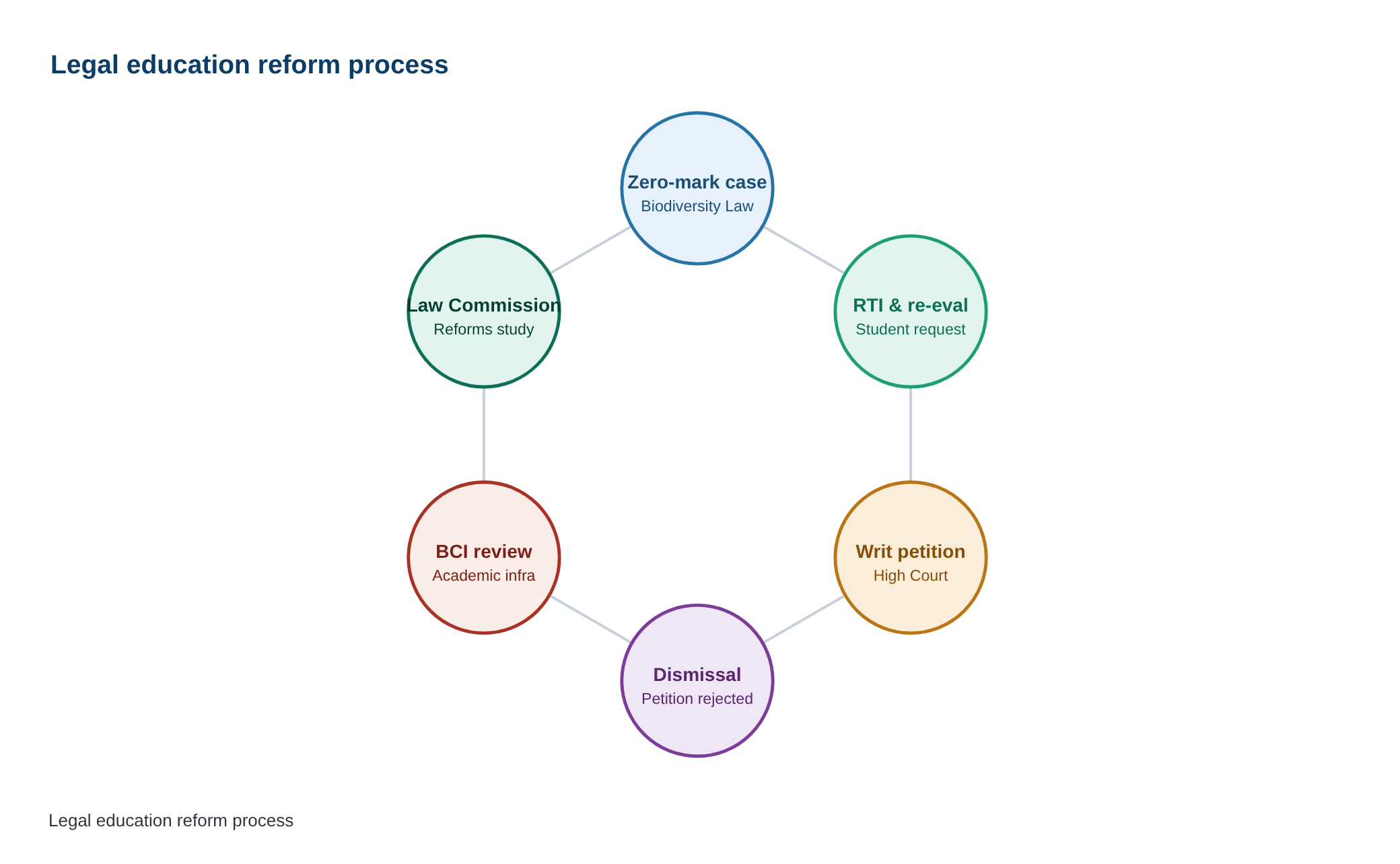
Zero-mark assessment in Biodiversity Protection Law → Student files RTI and seeks re-evaluation → University fails to act → Student files writ petition in High Court → Court dismisses petition but expresses concern over legal education standards → Court directs BCI and Law Commission to review standards → Systemic deficiencies in legal education exposed → Need for reforms in grading, faculty training, and regulatory oversight identified.
Prelims Practice Questions
Q1. Consider the following statements regarding the judicial review of academic evaluations in India:
1. The judiciary can intervene in the evaluation process if there is evidence of arbitrariness or malice.
2. The Allahabad High Court, in a recent judgment, directed the Bar Council of India to review the academic infrastructure of a law college.
3. The Supreme Court of India has held that judicial review of examination results is a matter of routine administrative discretion.
How many of the above statements are correct?
- Only one
- Only two
- All
- None
Answer: Only two — Statement 1 is correct as judicial intervention is permissible only in cases of arbitrariness or malice. Statement 2 is incorrect; the High Court directed the Bar Council of India to review academic standards, not infrastructure. Statement 3 is incorrect as judicial review of examination results is not routine but exceptional.
Q2. Assertion (A): The Bar Council of India is empowered to regulate legal education in India.
Reason (R): The Bar Council of India was established under the Advocates Act, 1961, to promote legal education and set standards for law colleges.
Options:
A. Both A and R are true, and R is the correct explanation of A.
B. Both A and R are true, but R is not the correct explanation of A.
C. A is true, but R is false.
D. A is false, but R is true.
Answer: ? — Both the Assertion (A) and Reason (R) are true. The Bar Council of India is indeed empowered to regulate legal education under the Advocates Act, 1961, and the Reason correctly explains the Assertion.
Q3. Match the following institutions with their respective roles in legal education regulation in India:
Column I
1. Bar Council of India
2. University Grants Commission
3. Law Commission of India
4. National Law School
Column II
A. Sets academic standards and approves law courses
B. Conducts research and recommends reforms in legal education
C. Grants affiliation and regulates higher education institutions
D. Imparts legal education and conducts examinations
Options:
1-A, 2-C, 3-B, 4-D
1-B, 2-A, 3-C, 4-D
1-A, 2-B, 3-C, 4-D
1-D, 2-C, 3-B, 4-A
- 1-A, 2-C, 3-B, 4-D
- 1-B, 2-A, 3-C, 4-D
- 1-A, 2-B, 3-C, 4-D
- 1-D, 2-C, 3-B, 4-A
Answer: 1-A, 2-C, 3-B, 4-D — 1-A: Bar Council of India sets academic standards and approves law courses. 2-C: University Grants Commission grants affiliation and regulates higher education institutions. 3-B: Law Commission of India conducts research and recommends reforms. 4-D: National Law Schools impart legal education and conduct examinations.
Mains Practice Question
✍ The Allahabad High Court, in a recent judgment, expressed grave concern over the declining standards of legal education in India while dismissing a petition seeking re-evaluation of a student’s answer sheet that had scored zero marks in Biodiversity Protection Law. Critically examine the role of the Bar Council of India and the Law Commission of India in addressing this issue. Also, discuss the judicial approach to academic evaluations and its implications for the autonomy of educational institutions. (15 Marks)
Approach: MODEL-ANSWER SKELETON:
1. **Judicial Concern and Context**:
– Reference the Allahabad High Court’s observation on the quality of legal education and the dismissal of the petition.
– Highlight the Court’s directive to the Bar Council of India (BCI) to review academic standards and the Law Commission of India to study reforms.
2. **Role of Bar Council of India (BCI)**:
– Statutory mandate under the Advocates Act, 1961: Regulation of legal education, setting standards, and approving law courses.
– Functions: Prescribing syllabi, accrediting law colleges, conducting inspections, and ensuring compliance with standards.
– Challenges: Inadequate enforcement, lack of periodic reviews, and resistance to reforms in curriculum and pedagogy.
3. **Role of Law Commission of India**:
– Advisory body under the Ministry of Law and Justice: Conducts research, reviews laws, and recommends reforms.
– Relevant reports: Past recommendations on legal education reforms, such as the need for interdisciplinary courses and practical training.
– Limitations: Non-binding nature of recommendations and slow implementation.
4. **Judicial Approach to Academic Evaluations**:
– Principle: Judicial intervention is permissible only in cases of arbitrariness, malice, or violation of principles of natural justice (e.g., Maneka Gandhi v. Union of India).
– Standard: Courts do not interfere with academic merit unless there is clear evidence of bias or procedural lapses (e.g., Allahabad High Court’s stance in this case).
– Implications: Preserves institutional autonomy but raises concerns about accountability in cases of systemic failures.
5. **Implications for Autonomy of Educational Institutions**:
– Autonomy vs. Accountability: The balance between institutional freedom and regulatory oversight.
– Need for systemic reforms: Strengthening BCI’s enforcement mechanisms, empowering the Law Commission for periodic reviews, and integrating feedback mechanisms from stakeholders.
6. **Conclusion**:
– The judiciary’s role is limited but critical in highlighting systemic issues.
– BCI and Law Commission must collaborate to implement robust reforms in legal education, including curriculum design, faculty development, and assessment methodologies.
Source: amarujala.com
Generated by AanyaAi for educational purpose.

- यूपीएससी के लिए महत्वपूर्ण: 91, 182 और 364 दिन के टी-बिल नीलामी परिणाम - September 23, 2026
- RBI Auction Results: Key Cuts in 91/182/364-Day T-Bill Yields Explained for UPSC - September 23, 2026
- विकलांग सैन्य कैडेटों को पेंशन देने से रोक रही सरकार की नीति: केंद्र ने सुप्रीम कोर्ट में बताया - September 23, 2026

No Comments