


07 Aug Allahabad HC Rejects Zero Marks Petition: Legal Education Quality Under Scrutiny
✎ Judicial review of academic evaluations is permissible only in cases of procedural impropriety or arbitrariness, not on merits of examiner discretion.
Subject Relevance — Where This Topic Fits
- GS Paper II — Judiciary and Constitutional Framework | GS Paper II — Governance, Transparency and Accountability
- Prelims: Judicial Review, Bar Council of India, Legal Education, Judicial Intervention in Academic Evaluation, Right to Information Act, Judicial Activism vs. Judicial Restraint
- Essay: Judicial Activism and Its Limits: Balancing Accountability and Judicial Restraint
Quick Revision: Judicial review of academic evaluations is permissible only in cases of procedural impropriety or arbitrariness, not on merits of examiner discretion.
Why is this in the news?
The Allahabad High Court dismissed a petition filed by a BA LLB student who scored zero marks in the subject ‘Biodiversity Protection Law’ and sought re-evaluation of his answer sheets. The court, while upholding the examiner’s decision, expressed grave concern over the state of legal education in India, directing the Bar Council of India and the Law Commission of India to review academic standards and infrastructure in law colleges. The judgment underscores the judiciary’s role in ensuring transparency and accountability in higher education, particularly in professional disciplines like law.
Background
- Legal education in India is governed by the Bar Council of India (BCI) under the Advocates Act, 1961, which sets standards for law colleges and prescribes curricula.
- The BCI is empowered to inspect law colleges and can derecognise institutions failing to meet prescribed norms, though enforcement has historically been inconsistent.
- The Law Commission of India, established in 1955, periodically reviews legal education and recommends reforms to the government.
- The Right to Information (RTI) Act, 2005, empowers students to seek access to answer sheets and other academic records, enabling scrutiny of evaluation processes.
- Judicial intervention in academic matters is constitutionally permissible only in cases of manifest arbitrariness, procedural impropriety, or violation of statutory norms.
- The Allahabad High Court’s observation reflects growing judicial concern over the quality of legal education, particularly in state-run and private law colleges.
Legal Education in India: Governance, Challenges, and Reform Imperatives
- Legal education in India is structured around a five-year integrated BA LLB programme, with the final year often including specialised subjects like ‘Biodiversity Protection Law’, which combine legal principles with interdisciplinary domains.
- The Bar Council of India (BCI) is the statutory body responsible for regulating legal education, licensing law colleges, and prescribing syllabi, examination patterns, and faculty qualifications.
- The BCI’s powers include the authority to inspect law colleges, grant recognition, and impose penalties, including derecognition, for non-compliance with standards.
- The Law Commission of India, an advisory body, periodically reviews legal education and submits recommendations to the government on reforms, including curriculum design, faculty development, and infrastructure upgrading.
- The Right to Information (RTI) Act, 2005, enables students to access answer sheets and other academic records, facilitating transparency in evaluation processes and enabling legal recourse against arbitrary grading.
- Judicial review of academic evaluations is constitutionally constrained; courts intervene only when there is evidence of procedural impropriety, manifest arbitrariness, or violation of statutory norms, as reiterated in the Allahabad High Court’s judgment.
- Concerns over legal education quality stem from issues such as inadequate faculty, outdated curricula, lack of practical training, and poor infrastructure in many law colleges, particularly in the private sector.
- The Allahabad High Court’s directive to the BCI and Law Commission reflects a judicial push for systemic reforms, emphasising the need for periodic reviews, stricter enforcement of standards, and enhanced accountability in legal education.
Key Features
| Feature | Significance |
|---|---|
| Judicial scrutiny of academic evaluation | Highlights the limited scope of judicial intervention in academic disputes, restricting it to cases of arbitrariness, malice, or legal error. |
| Zero-mark assessment in legal education | Raises concerns about the quality of legal pedagogy, particularly in specialized subjects like Biodiversity Protection Law. |
| Bar Council of India’s oversight role | Emphasizes the regulatory body’s responsibility to ensure academic and infrastructural standards in law colleges. |
| Right to Information (RTI) in academic disputes | Demonstrates the use of RTI to obtain answer scripts for re-evaluation, reinforcing transparency in examination processes. |
| Judicial concern over legal education standards | Signals systemic issues in legal education that may require policy-level interventions by bodies like the Law Commission of India. |
Why it Matters
Judicial and Constitutional
- Reaffirms the principle that judicial review of academic evaluations is circumscribed and cannot substitute for academic judgment unless procedural impropriety is proven.
- Highlights the judiciary’s role in identifying systemic deficiencies in legal education, which may necessitate constitutional or statutory interventions.
Educational and Pedagogical
- Exposes potential gaps in the teaching and assessment of specialized legal subjects, particularly environmental law, which demands interdisciplinary understanding.
- Underscores the need for law schools to adopt rigorous, outcome-based evaluation methods to ensure competence among future legal practitioners.
Regulatory and Governance
- Calls for enhanced oversight by the Bar Council of India (BCI) to monitor academic standards, faculty qualifications, and examination processes in law colleges.
- Urges the Law Commission of India to conduct a comprehensive study on legal education standards and propose reforms to address identified deficiencies.
Challenges
1. Decline in Legal Education Standards
- Inadequate pedagogical approaches in law schools, particularly in niche subjects like Biodiversity Protection Law, leading to superficial understanding among students.
- Lack of accountability in examination processes, as evidenced by the student’s inability to secure re-evaluation despite procedural failures.
- Systemic issues in regulatory oversight, with BCI and Law Commission failing to enforce consistent academic standards across institutions.
UPSC Link: GS Paper 2: Issues relating to development and management of Social Sector/Services relating to Education.
2. Judicial Intervention vs. Academic Autonomy
- Balancing the need for judicial scrutiny with respect for academic autonomy, as courts must avoid substituting their judgment for that of subject experts.
- Ensuring that judicial interventions in academic disputes do not undermine the integrity of examination systems or discourage merit-based evaluations.
UPSC Link: GS Paper 2: Judiciary and its role in governance.
3. Transparency in Examination Processes
- Insufficient mechanisms for students to challenge unfair evaluations, as highlighted by the student’s reliance on RTI to access answer scripts.
- Need for standardized, transparent re-evaluation procedures to address grievances without recourse to prolonged litigation.
UPSC Link: GS Paper 2: Transparency and accountability in governance.
4. Faculty Competence and Infrastructure
- Shortage of qualified faculty in specialized legal domains, leading to inadequate teaching and assessment methods.
- Inadequate infrastructural support in law colleges, including libraries, digital resources, and research facilities, exacerbating pedagogical deficiencies.
UPSC Link: GS Paper 2: Issues relating to development and management of Social Sector/Services relating to Education.
Challenges — UPSC Perspective
| Issue | Concern |
|---|---|
| Pedagogical gaps in niche legal subjects | Students lack substantive understanding of specialized areas like Biodiversity Protection Law. |
| Regulatory oversight failures | BCI and Law Commission have not enforced consistent academic standards across law colleges. |
| Lack of transparency in evaluations | Students face barriers in challenging unfair assessments, relying on RTI for redressal. |
| Judicial intervention constraints | Courts cannot substitute academic judgment, limiting scope for redressal of grievances. |
| Faculty and infrastructural deficiencies | Shortage of qualified faculty and inadequate resources hinder effective legal education. |
Way Forward
- Law schools must revise curriculum and pedagogy for specialized subjects like Biodiversity Protection Law to ensure interdisciplinary learning.
- Bar Council of India (BCI) should conduct periodic audits of law colleges to assess academic standards, faculty qualifications, and examination processes.
- Law Commission of India should undertake a comprehensive study on legal education reforms, including standardized evaluation methods and transparency in assessments.
- Institutions should establish grievance redressal mechanisms for students, including transparent re-evaluation procedures and access to answer scripts.
- Judiciary should issue guidelines clarifying the scope of judicial intervention in academic disputes to balance accountability with academic autonomy.
- Government should allocate funds for upgrading infrastructure in law colleges, including digital libraries and research facilities.
- Faculty development programs should be mandated to enhance teaching competencies in specialized legal domains.
UPSC Value Addition
Keywords for Mains Answer-Writing
Legal education standards in India · Judicial review of academic evaluation · Allahabad High Court observations · Bar Council of India regulatory role · Legal Education Committee of the Law Commission of India · Judicial intervention in academic disputes · Zero marks in examinations · Academic quality in law colleges · Judicial concern over legal pedagogy · Right to Information Act in education
Constitutional & Policy Linkages
- Article 21 (Right to Education) – Ensuring quality legal education as part of the right to life and personal liberty.
Concept Flow
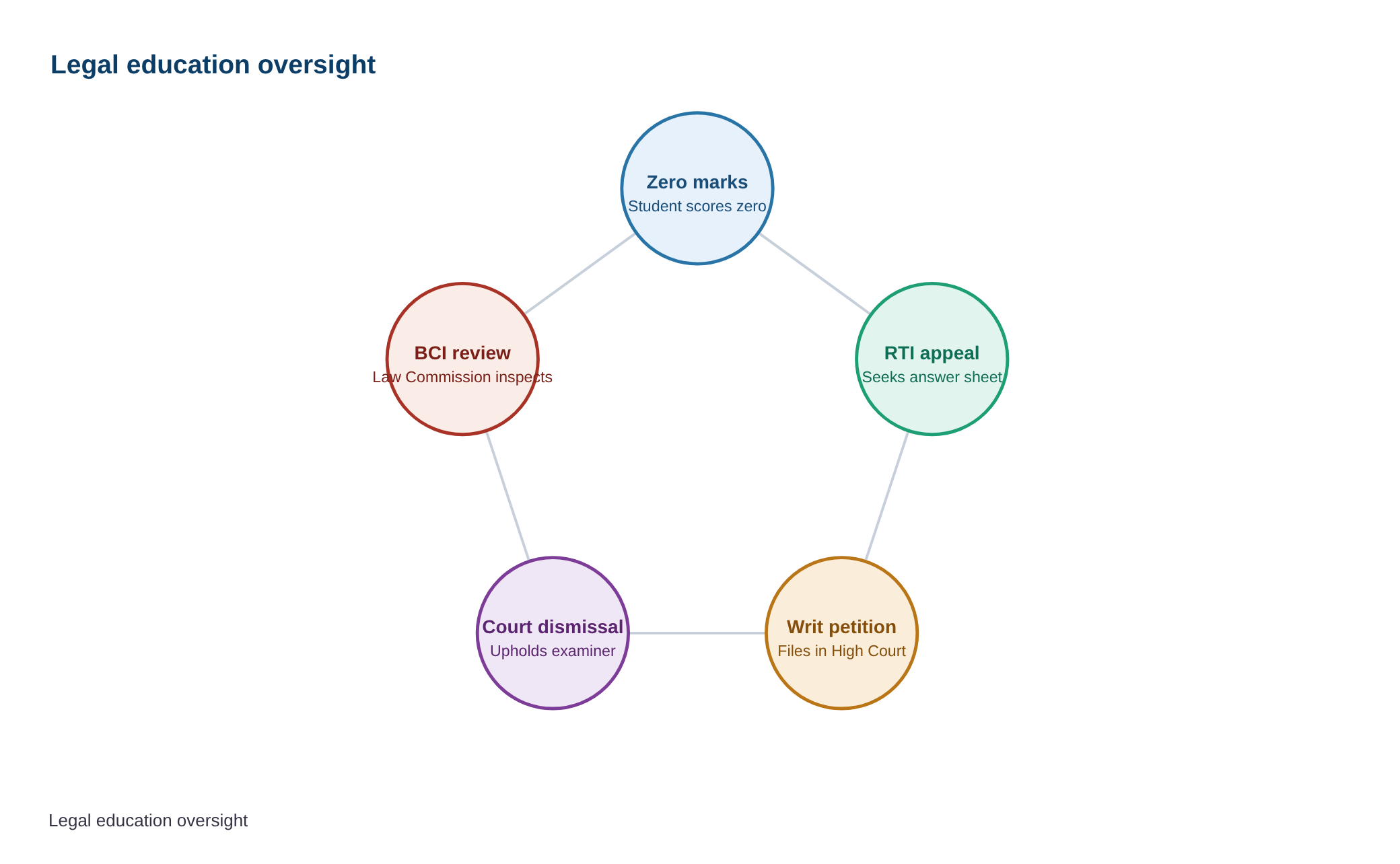
Student scores zero marks in Biodiversity Protection Law → Appeals for re-evaluation via RTI → No action by university → Files writ petition in High Court → Court dismisses petition, citing lack of procedural impropriety → Expresses concern over legal education standards → Calls for BCI and Law Commission review → Highlights systemic deficiencies in legal pedagogy.
Prelims Practice Questions
Q1. Consider the following statements regarding the regulatory framework for legal education in India:
1. The Bar Council of India (BCI) is statutorily empowered to regulate legal education and prescribe standards.
2. The Law Commission of India has a dedicated committee for examining legal education reforms.
3. The University Grants Commission (UGC) is the primary authority for accrediting law schools.
4. The Right to Information Act, 2005, can be invoked to obtain evaluated answer scripts of examinations.
How many of the above statements are correct?
- Only one
- Only two
- Only three
- All four
Answer: Only three — Statements 1, 2, and 4 are correct. Statement 3 is incorrect as the UGC does not accredit law schools; the BCI performs this role. The BCI regulates legal education under the Advocates Act, 1961, and the Law Commission has a Legal Education Committee. The RTI Act, 2005, allows access to answer scripts.
Q2. Assertion (A): The Allahabad High Court, in a recent judgment, expressed concern over the declining standards of legal education in India.
Reason (R): The Court observed that awarding zero marks to a law student without any legal reasoning in answer scripts reflects systemic academic deficiencies.
In the context of the above statements, which of the following is correct?
- Both A and R are true, and R is the correct explanation of A.
- Both A and R are true, but R is not the correct explanation of A.
- A is true but R is false.
- A is false but R is true.
Answer: Both A and R are true, and R is the correct explanation of A. — Both the assertion and reason are true, and the reason correctly explains the assertion. The High Court explicitly linked the zero-mark award to systemic deficiencies in legal education, necessitating judicial concern.
Mains Practice Question
✍ The Allahabad High Court has recently underscored grave deficiencies in India’s legal education ecosystem by dismissing a petition seeking re-evaluation of a law student’s answer script awarded zero marks. Critically examine the structural and institutional factors that have contributed to such systemic failures in legal pedagogy. Also, outline the constitutional and statutory safeguards available to students for addressing grievances in academic evaluation. (15 Marks)
Approach: Introduction: Briefly contextualise the High Court’s observation and its implications for legal education standards. Structural Factors: 1. Regulatory Gaps: Role of Bar Council of India (BCI) under Advocates Act, 1961; limitations in enforcement and monitoring of standards. 2. Institutional Deficiencies: Lack of rigorous teacher training, outdated curricula, and inadequate infrastructure in law colleges. 3. Examination System: Absence of standardised evaluation frameworks and transparency in assessment processes. Institutional Factors: 1. Autonomy vs Accountability: Tension between administrative autonomy of universities and need for regulatory oversight. 2. Faculty Shortages: Inadequate student-teacher ratios and reliance on contractual faculty. 3. Quality Assurance: Limited role of National Assessment and Accreditation Council (NAAC) and National Board of Accreditation (NBA) in law education. Constitutional and Statutory Safeguards: 1. Right to Education (Article 21A) and Right to Information Act, 2005: Access to answer scripts and grievance redressal mechanisms. 2. Judicial Review: Scope of judicial intervention in academic disputes under Article 226/227; limitations (e.g., no interference unless mala fide or procedural violation). 3. University Acts and Statutory Appeals: Internal grievance redressal mechanisms and provisions for re-evaluation. Conclusion: Emphasise the need for a multi-stakeholder approach involving BCI, UGC, universities, and judiciary to reform legal education and ensure accountability.
Source: amarujala.com
Generated by AanyaAi for educational purpose.

- उत्तराखंड में असिस्टेंट प्रोफेसर भर्ती: यूकेपीएससी करेगा चयन, जानिए बदलाव - September 22, 2026
- UKPSC to Recruit Assistant Professors in Uttarakhand Aided Colleges: Draft Policy - September 22, 2026
- हिमाचल में नदियों से रेत-बजरी निकालने पर सरकार ने लगाई रोक, जानिए नए नियम - September 22, 2026

No Comments