


30 Aug Andhra Pradesh Launches Centre of Excellence for Tribal NEET-JEE Aspirants
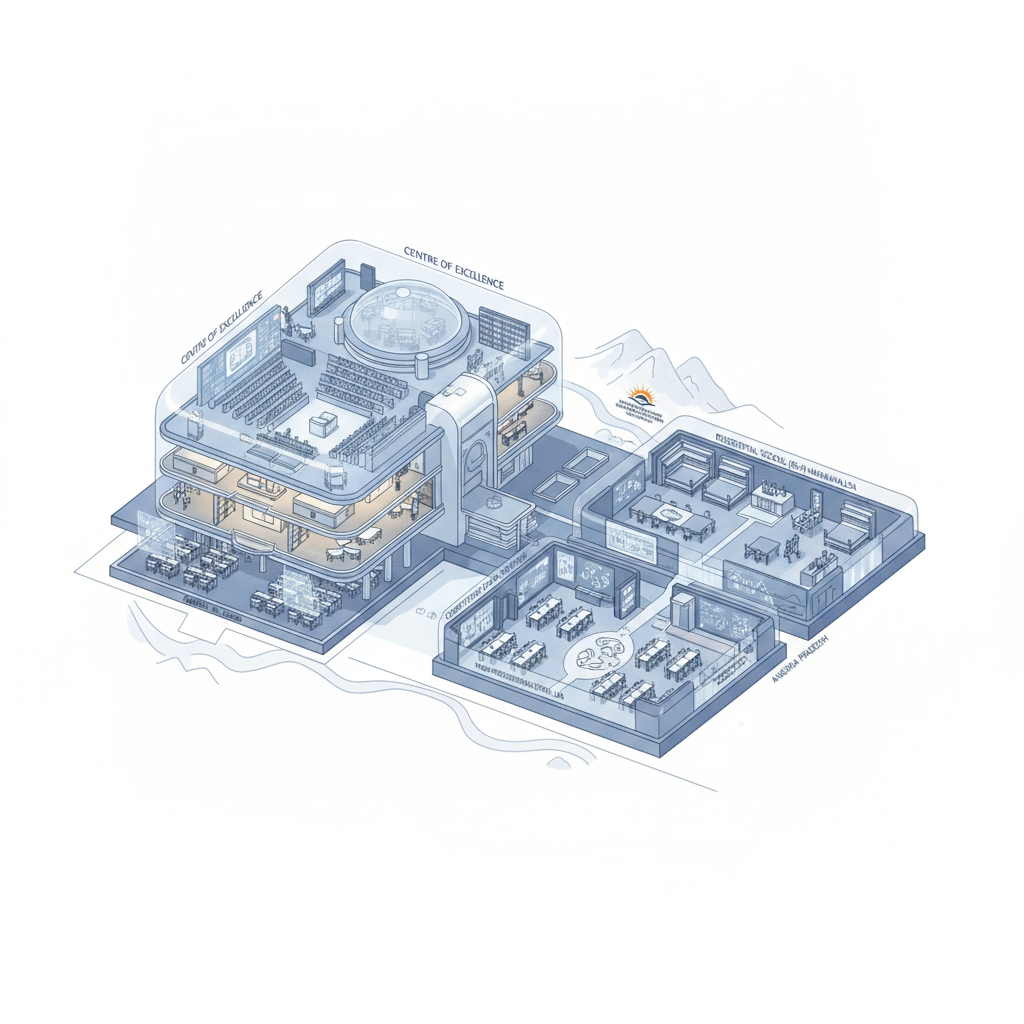
✎ The Centre of Excellence (CoE) in Marikavalasa, Andhra Pradesh, is a residential facility providing NEET and IIT-JEE coaching to 600 ST students, modelled on Eklavya Model Residential Schools (EMRS), with separate infrastructure…
Subject Relevance — Where This Topic Fits
- GS Paper II — Social Justice and Empowerment | GS Paper III — Human Resource Development
- Prelims: Eklavya Model Residential Schools (EMRS), National Eligibility-cum-Entrance Test (NEET), Indian Institutes of Technology Joint Entrance Examination (IIT-JEE), Scheduled Tribes (ST), Andhra Pradesh Tribal Welfare Residential Educational Institutions Society (APTWREIS)
- Essay: Education as a tool for social equity: Bridging the tribal-urban divide in India, Inclusive growth and the role of targeted educational interventions
Quick Revision: The Centre of Excellence (CoE) in Marikavalasa, Andhra Pradesh, is a residential facility providing NEET and IIT-JEE coaching to 600 ST students, modelled on Eklavya Model Residential Schools (EMRS), with separate infrastructure for boys and girls, enhanced security, and a merit-based selection process.
Why is this in the news?
The establishment of a Centre of Excellence (CoE) at the Residential School (RS-B) in Marikavalasa, Visakhapatnam, by the Government of Andhra Pradesh, has been highlighted as a significant initiative aimed at providing intensive coaching to Scheduled Tribe (ST) students for competitive examinations such as NEET and IIT-JEE. This move, announced on August 30, 2026, underscores the state’s commitment to enhancing educational outcomes and representation of tribal students in premier institutions, while also addressing concerns regarding the transition of students from existing residential schools.
Background
- The Government of Andhra Pradesh, through the Andhra Pradesh Tribal Welfare Residential Educational Institutions Society (APTWREIS), has operationalised a Centre of Excellence (CoE) at Marikavalasa to provide specialised coaching for ST students aspiring to enter medical and engineering streams.
- The initiative is modelled on the Eklavya Model Residential Schools (EMRS), which are designed to provide quality education to tribal students in a residential setting, with a focus on holistic development.
- The CoE in Marikavalasa has a sanctioned intake of 600 Intermediate students (300 boys and 300 girls), selected through a merit-based process, reflecting a structured approach to capacity-building.
- The selection of Marikavalasa as the location for the CoE is attributed to Visakhapatnam’s status as an educational hub, along with considerations of accessibility and infrastructure for students from both agency (tribal) and plain areas.
- The coaching agency, Physics Wallah, Noida, was engaged through a request-for-proposal (RFP) process, indicating a competitive and transparent selection mechanism for educational partners.
- The establishment of the CoE follows a phased transition of students from the erstwhile Residential School (RS-B), Marikavalasa, to other institutions, including the School of Excellence (Girls), Marikavalasa, and APTWREIS institutions in Srikrishnapuram, Sabbavaram, and Devarapalli.
What is the Centre of Excellence (CoE) in Marikavalasa?
- The Centre of Excellence (CoE) in Marikavalasa is a residential educational facility established by the Government of Andhra Pradesh under the APTWREIS to provide intensive coaching for ST students preparing for NEET and IIT-JEE examinations.
- The CoE operates on a co-educational model, similar to Eklavya Model Residential Schools (EMRS), but ensures separate dormitories and classrooms for boys and girls to maintain gender segregation and safety.
- The facility is equipped with CCTV surveillance, dedicated wardens, and enhanced security arrangements to ensure the safety and well-being of students, addressing concerns about the vulnerability of tribal students in residential settings.
- The CoE has a sanctioned capacity of 600 Intermediate students, selected through a merit-based process, ensuring that only the most deserving candidates receive specialised coaching.
- The coaching is provided by Physics Wallah, a reputed educational agency, through a competitive RFP process, ensuring high-quality teaching and preparation for competitive examinations.
- The CoE aims to increase the representation of ST students in premier educational institutions, particularly in medical and engineering streams, by providing targeted academic support and resources.
- The initiative is part of a broader strategy to bridge the educational gap between tribal and non-tribal students, aligning with the objectives of the EMRS framework and the National Education Policy (NEP) 2020.
- The phased transition of students from the erstwhile Residential School (RS-B) to the CoE and other institutions was conducted with parental consent and teacher supervision, ensuring minimal disruption to the students’ education.
Key Features
| Feature | Significance |
|---|---|
| Co-educational format with gender-segregated dormitories and classrooms | Ensures gender inclusivity while maintaining cultural sensitivity and safety for tribal students. |
| CCTV surveillance and dedicated wardens | Enhances security and monitoring, addressing concerns of parental apprehension regarding student safety. |
| Merit-based selection of 600 Intermediate students (300 boys, 300 girls) | Promotes equitable access and fosters competitive academic culture among Scheduled Tribe (ST) students. |
| Engagement of Physics Wallah as coaching agency via RFP process | Leverages external expertise to provide high-quality competitive exam preparation tailored to ST students’ needs. |
| Phased transition of students from RS (B), Marikavalasa | Minimises disruption while reallocating resources to optimise educational infrastructure and opportunities. |
Why it Matters
Educational Equity
- Addresses systemic underrepresentation of ST students in premier institutions (NEET, IIT-JEE) by providing targeted coaching and resources.
- Aligns with constitutional mandate under Article 46 to promote educational and economic interests of weaker sections, including Scheduled Tribes.
Institutional Innovation
- Demonstrates a model of adaptive governance by integrating residential schooling with competitive exam coaching, replicable in other tribal-dominated regions.
- Showcases collaboration between state agencies (APTWREIS) and private coaching providers to enhance educational outcomes.
Geographical and Logistical Considerations
- Strategic location in Visakhapatnam capitalises on existing educational infrastructure and transport connectivity for students from North Andhra agency areas.
- Phased relocation ensures continuity of education while mitigating logistical challenges for students from remote tribal belts.
Challenges
1. Resistance to Institutional Transition
- Protests by tribal organisations and parents highlight concerns over disruption of familiar educational environments.
- Requires sustained community engagement and transparent communication to address apprehensions regarding safety, quality, and accessibility.
UPSC Link: GS2: Centre-State relations; GS1: Tribal communities
2. Ensuring Quality and Inclusivity in Coaching
- Maintaining high academic standards while accommodating diverse learning paces among ST students from varied socio-economic backgrounds.
- Monitoring the efficacy of external coaching agencies to prevent commercialisation or dilution of educational objectives.
UPSC Link: GS2: Issues relating to development and management of Social Sector/Services
3. Infrastructure and Resource Allocation
- Balancing the demand for additional residential and academic infrastructure with budgetary constraints and regional priorities.
- Ensuring equitable distribution of resources across tribal and non-tribal educational institutions within the state.
UPSC Link: GS2: Government policies and interventions for development in various sectors
Challenges — UPSC Perspective
| Issue | Concern |
|---|---|
| Parental apprehension | Fear of loss of familiar educational environment and safety concerns. |
| Logistical disruptions | Phased transition may temporarily affect continuity of education for relocated students. |
| Quality assurance in coaching | Risk of commercialisation or mismanagement by external agencies. |
| Infrastructure gaps | Potential strain on existing facilities in Visakhapatnam due to increased intake. |
| Community resistance | Protests may escalate if grievances are not addressed through dialogue. |
Way Forward
- Conduct periodic reviews of the CoE’s academic performance and student feedback to identify areas for improvement.
- Organise community consultations with tribal leaders and parents to address concerns and build trust in the transition process.
- Expand the scope of the CoE to include preparatory courses for other competitive exams (e.g., UPSC, State PSC) to diversify opportunities.
- Strengthen monitoring mechanisms for the coaching agency to ensure adherence to educational standards and ethical practices.
- Develop a mentorship programme pairing ST students with alumni of premier institutions to provide role models and guidance.
- Enhance digital infrastructure to facilitate remote learning and access to supplementary study materials.
- Collaborate with central agencies (e.g., NCERT, NTA) to align the curriculum with national standards for competitive exams.
UPSC Value Addition
Keywords for Mains Answer-Writing
Scheduled Tribes (ST) educational empowerment · Centre of Excellence (CoE) for tribal students · Eklavya Model Residential Schools (EMRS) · NEET and IIT-JEE coaching for ST students · Andhra Pradesh Tribal Welfare Residential Educational Institutions Society (APTWREIS) · Residential schools for marginalised communities · Merit-based selection in educational institutions · Inclusive education policy for Scheduled Tribes
Constitutional & Policy Linkages
- [‘Article 46’, ‘Promotion of educational interests of weaker sections’]
- [‘Fifth Schedule’, ‘Administration and control of Scheduled Areas’]
Concept Flow
Identification of underrepresentation of ST students in premier institutions (NEET, IIT-JEE) → → State initiative to establish Centre of Excellence (CoE) at Marikavalasa → → Selection of students through merit-based process → → Integration of residential schooling with competitive exam coaching → → Implementation of gender-segregated infrastructure and enhanced security → → Phased transition of students from existing residential school → → Monitoring and review to ensure academic and social outcomes → → Long-term goal: Increased representation of ST students in premier educational institutions.
Prelims Practice Questions
Q1. Consider the following statements regarding the Centre of Excellence (CoE) established in Marikavalasa, Andhra Pradesh:
1. The CoE provides coaching for NEET and IIT-JEE examinations.
2. The CoE follows a co-educational format with separate dormitories and classrooms for boys and girls.
3. The CoE is exclusively for students belonging to the Scheduled Castes (SC) category.
4. The CoE has a sanctioned intake of 600 Intermediate students.
How many of the above statements are correct?
- Only one
- Only two
- Only three
- All four
Answer: Only three — Statements 1, 2, and 4 are correct. Statement 3 is incorrect as the CoE is for Scheduled Tribe (ST) students, not Scheduled Castes (SC).
Q2. Assertion (A): The Centre of Excellence in Marikavalasa, Andhra Pradesh, was established to enhance the representation of Scheduled Tribe (ST) students in premier educational institutions.
Reason (R): The CoE provides intensive coaching for competitive examinations like NEET and IIT-JEE, with a sanctioned intake of 600 students.
Options:
A. Both A and R are true, and R is the correct explanation of A.
B. Both A and R are true, but R is not the correct explanation of A.
C. A is true, but R is false.
D. A is false, but R is true.
Answer: ? — Both A and R are true, and R correctly explains A as the primary objective of the CoE is to increase ST representation in premier institutions through competitive exam coaching.
Q3. Match the following pairs related to educational initiatives for marginalised communities in India:
Column I (Initiative) | Column II (Description)
— | —
A. Eklavya Model Residential Schools (EMRS) | 1. Provides free residential education to ST students from Class VI to XII
B. Centre of Excellence (CoE), Marikavalasa | 2. Offers intensive coaching for NEET and IIT-JEE to ST students
C. Kasturba Gandhi Balika Vidyalaya (KGBV) | 3. Focuses on girls’ education in under-served areas
D. National Scheme for Inclusive Education for Disabled at Secondary Stage (IEDSS) | 4. Provides inclusive education for children with disabilities
Options:
A. A-1, B-2, C-3, D-4
B. A-2, B-1, C-4, D-3
C. A-3, B-4, C-1, D-2
D. A-4, B-3, C-2, D-1
Answer: ? — Correct matching: A-1 (EMRS provides residential education to ST students), B-2 (CoE provides NEET/JEE coaching), C-3 (KGBV focuses on girls’ education), D-4 (IEDSS supports inclusive education for disabled children).
Mains Practice Question
✍ The establishment of the Centre of Excellence (CoE) in Marikavalasa, Andhra Pradesh, for Scheduled Tribe (ST) students represents a significant policy intervention in addressing educational inequities. Critically examine the rationale behind such initiatives, their alignment with constitutional provisions, and the challenges they may face in achieving their objectives. (15 Marks)
Approach: MODEL-ANSWER SKELETON:
1. **Rationale for CoE Initiatives** (3 points):
– **Constitutional Imperative**: Reference Articles 46 (promotion of educational interests of weaker sections) and 342 (definition of Scheduled Tribes) of the Indian Constitution.
– **Social Justice**: Highlight the role of such initiatives in bridging the educational gap between ST communities and the general population, citing data on ST representation in higher education and competitive exams (e.g., NEET/JEE).
– **Eklavya Model Residential Schools (EMRS)**: Explain the EMRS framework (established under Tribal Affairs Ministry) as a template for residential education and holistic development of ST students.
2. **Policy Design and Implementation** (4 points):
– **Targeted Approach**: Discuss the merit-based selection process and the co-educational model with gender-segregated facilities, referencing the CoE’s intake of 600 students (300 boys, 300 girls).
– **Infrastructure and Safety**: Highlight provisions like CCTV monitoring, dedicated wardens, and phased student transition to ensure security and continuity.
– **Partnerships**: Explain the engagement of external agencies (e.g., Physics Wallah) for coaching, and its role in enhancing academic outcomes.
– **Geographical Considerations**: Justify the choice of Visakhapatnam as a hub for educational access and logistical feasibility for students from North Andhra agency areas.
3. **Challenges and Critiques** (5 points):
– **Cultural and Linguistic Barriers**: Discuss the potential disconnect between ST students’ socio-cultural backgrounds and the mainstream curriculum, citing anthropological studies on marginalised communities.
– **Resource Constraints**: Highlight issues like teacher shortages, infrastructure gaps, or uneven quality of coaching partnerships, referencing reports on tribal education (e.g., NITI Aayog’s Aspirational Districts Programme).
– **Community Resistance**: Address concerns over displacement or loss of localised educational opportunities, citing protests by tribal organisations.
– **Sustainability**: Question the long-term viability of such initiatives without concurrent efforts in primary education and socio-economic upliftment.
– **Accountability Mechanisms**: Discuss the role of bodies like APTWREIS in monitoring outcomes and ensuring transparency.
4. **Conclusion** (3 points):
– **Balanced View**: Acknowledge the potential of CoE initiatives to transform educational trajectories for ST students while cautioning against over-reliance on residential models without systemic reforms.
– **Recommendations**: Suggest measures like curriculum localisation, community engagement, and multi-stakeholder partnerships to enhance effectiveness.
– **Constitutional Alignment**: Reaffirm the alignment of such policies with the Directive Principles of State Policy (Articles 38, 39A) and the Right to Education (Article 21A).
Source: The Hindu
Generated by AanyaAi for educational purpose.
Related guides on our sites

- गुजरात में स्थापित होंगे भारत के 12 सेमीकंडक्टर संयंत्रों में से 6, जानिए कैसे? - September 14, 2026
- Gujarat to host 6 of India’s 12 semiconductor facilities: Key UPSC insights - September 14, 2026
- डब्ल्यूपीआई मुद्रास्फीति अगस्त में बढ़कर 9.92% हुई: मुख्य कारण क्या हैं? - September 14, 2026

No Comments