


30 Aug Andhra Pradesh Launches CoE for Tribal Students to Boost NEET-JEE Success
✎ The Centre of Excellence in Marikavalasa exemplifies a targeted governance intervention under the Eklavya Model Residential Schools framework to enhance competitive exam preparation for Scheduled Tribe students, aligning with…
Subject Relevance — Where This Topic Fits
- GS Paper I — Social Empowerment | GS Paper II — Government Policies and Interventions | GS Paper III — Human Resource Development
- Prelims: Scheduled Tribes (STs), Eklavya Model Residential Schools (EMRS), National Eligibility-cum-Entrance Test (NEET), Indian Institutes of Technology Joint Entrance Examination (IIT-JEE), APTWREIS, Residential Schools for Tribal Students
- Essay: Inclusive education as a tool for social transformation, Equity in access to higher education: Challenges and solutions
Quick Revision: The Centre of Excellence in Marikavalasa exemplifies a targeted governance intervention under the Eklavya Model Residential Schools framework to enhance competitive exam preparation for Scheduled Tribe students, aligning with national priorities for inclusive education.
Why is this in the news?
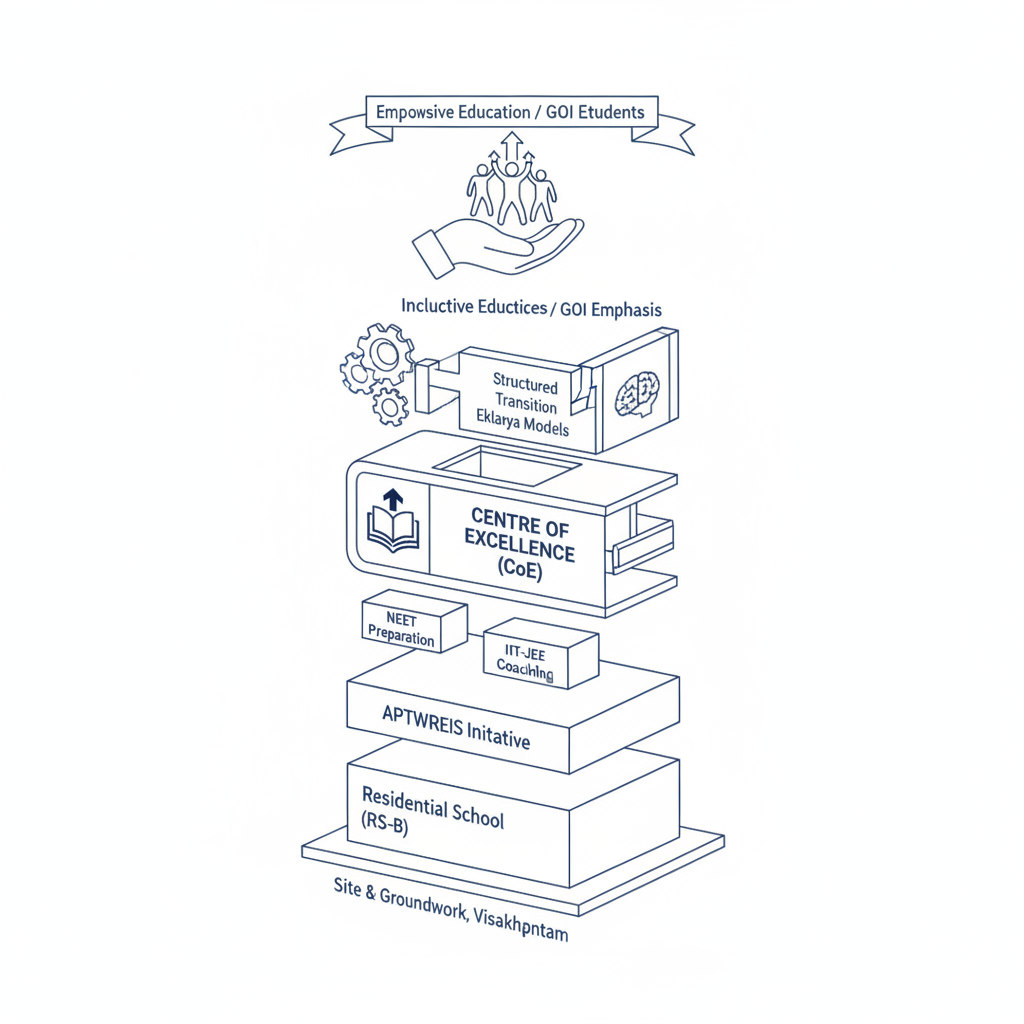
The establishment of a Centre of Excellence (CoE) at the Residential School (RS-B) in Marikavalasa, Visakhapatnam, by the Andhra Pradesh Tribal Welfare Residential Educational Institutions Society (APTWREIS) has been highlighted as a strategic initiative to enhance the competitive exam preparation of Scheduled Tribe (ST) students for NEET and IIT-JEE. This development is significant in the context of addressing historical educational disparities and improving representation of tribal students in premier higher education institutions. The initiative follows a structured transition process and incorporates best practices from existing models such as Eklavya Model Residential Schools.
Background
- The Government of India has consistently emphasised the need for inclusive education through targeted interventions for marginalised communities, including Scheduled Tribes (STs).
- The Eklavya Model Residential Schools (EMRS) scheme, launched under the Ministry of Tribal Affairs, serves as a benchmark for residential educational institutions catering to tribal students, focusing on quality education and holistic development.
- Andhra Pradesh has a significant tribal population, with a substantial proportion residing in agency areas, necessitating specialised educational infrastructure to bridge developmental gaps.
- The Tribal Welfare Residential Educational Institutions Societies (TWREIS) in Andhra Pradesh and Telangana have been instrumental in providing residential education to ST students, with a focus on academic excellence and socio-economic upliftment.
- Competitive examinations such as NEET and IIT-JEE are critical gateways for admission to premier medical and engineering institutions in India, where representation of ST students remains disproportionately low.
- The State government’s decision to establish a CoE aligns with national priorities under the National Education Policy (NEP) 2020, which advocates for equitable access to quality education.
What is the Centre of Excellence for Tribal Students in Marikavalasa?
- The Centre of Excellence (CoE) at Marikavalasa is a residential academic institution established by the Andhra Pradesh Tribal Welfare Residential Educational Institutions Society (APTWREIS) to provide intensive coaching for NEET and IIT-JEE examinations to Scheduled Tribe (ST) students.
- The CoE follows a co-educational format but ensures gender-segregated dormitories and classrooms, adhering to the principles of the Eklavya Model Residential Schools (EMRS) scheme.
- The institution has a sanctioned intake of 600 Intermediate students (300 boys and 300 girls), selected through a merit-based process to ensure high academic potential.
- The coaching agency engaged for the CoE is Physics Wallah, Noida, selected through a competitive Request-for-Proposal (RFP) process, indicating a focus on quality and accountability.
- The CoE is equipped with modern infrastructure, including CCTV surveillance, dedicated wardens, and enhanced security arrangements to ensure a safe and conducive learning environment.
- The initiative aims to increase the representation of ST students in premier educational institutions such as the Indian Institutes of Technology (IITs), National Institutes of Technology (NITs), and medical colleges across India.
- The transition of students from the existing Residential School (RS-B) to the CoE and other institutions was conducted in a phased manner, with parental consent and logistical support to minimise disruption.
- The CoE is strategically located in Visakhapatnam, an educational hub, to leverage existing transport and infrastructural facilities for students from North Andhra agency and plain areas.
Key Features
| Feature | Significance |
|---|---|
| Co-educational format with gender-segregated dormitories and classrooms | Balances inclusivity with cultural sensitivity, ensuring safety and privacy for tribal students while maintaining a unified learning environment. |
| CCTV surveillance and dedicated wardens | Enhances security and oversight, addressing concerns of parents and tribal communities regarding student safety in residential settings. |
| Merit-based selection of 600 Intermediate students (300 boys, 300 girls) | Ensures equitable access for high-performing Scheduled Tribe students, aligning with constitutional provisions for educational equity (Article 15(4)). |
| Coaching for NEET and IIT-JEE by Physics Wallah | Provides specialised preparation for competitive examinations, aiming to increase representation of ST students in premier technical and medical institutions. |
| Phased transition of students from RS-B, Marikavalasa | Minimises disruption to academic continuity while reallocating resources to optimise educational outcomes. |
Why it Matters
Educational Equity
- Addresses historical underrepresentation of Scheduled Tribe students in premier institutions by providing targeted coaching and residential support.
- Aligns with the constitutional mandate of Article 46 to promote educational advancement among weaker sections.
- Complements existing initiatives like Eklavya Model Residential Schools (EMRS) under the Ministry of Tribal Affairs.
Institutional Capacity Building
- Demonstrates state-led innovation in leveraging public-private partnerships (Physics Wallah) to enhance educational outcomes.
- Establishes a model for replicable centres of excellence in tribal education across India.
- Strengthens the role of state tribal welfare departments in implementing targeted educational interventions.
Social Inclusion
- Promotes gender parity in ST education through equal enrolment of boys and girls in competitive exam coaching.
- Ensures safety and dignity for tribal students in residential settings, addressing socio-cultural barriers to education.
- Facilitates mobility of students from agency areas to educational hubs, reducing regional disparities.
Challenges
1. Resistance from Tribal Communities
- Protests and demands for continuation of the original residential school highlight concerns over abrupt changes in institutional structure.
- Risk of alienating beneficiaries if transitions are perceived as top-down without adequate consultation.
- Potential erosion of trust in state-led educational initiatives if implementation lacks transparency.
UPSC Link: GS-II: Social Justice
2. Logistical and Operational Hurdles
- Phased transition of students requires meticulous planning to avoid academic disruption and ensure continuity of learning.
- Ensuring equitable access for students from remote agency areas may demand improved transport and infrastructure support.
- Maintaining high-quality coaching standards across batches of 600 students requires sustained faculty engagement and monitoring.
UPSC Link: GS-II: Governance
3. Sustainability of Model
- Long-term success depends on consistent funding, periodic evaluation, and adaptability to evolving educational needs.
- Risk of model becoming elitist if not scaled to include diverse tribal student profiles beyond high performers.
- Need for robust feedback mechanisms to address ground-level challenges in implementation.
UPSC Link: GS-II: Education
Challenges — UPSC Perspective
| Issue | Concern |
|---|---|
| Community Opposition | Perceived loss of localised educational infrastructure may erode trust in state initiatives. |
| Resource Allocation | High operational costs for residential support, security, and coaching require sustained budgetary commitment. |
| Quality Assurance | Ensuring consistent teaching standards across batches to prevent inequities in competitive exam outcomes. |
| Regional Disparities | Students from remote agency areas may face barriers in accessing preparatory resources and support. |
| Monitoring and Evaluation | Lack of robust data systems to track academic progress and socio-economic outcomes of beneficiaries. |
Government Initiatives — Must-Memorise for Prelims
- Eklavya Model Residential Schools (EMRS) under the Ministry of Tribal Affairs
- Andhra Pradesh Tribal Welfare Residential Educational Institutions Society (APTWREIS)
Way Forward
- Constitute a multi-stakeholder committee (state officials, tribal representatives, educators) to review transition processes and address community concerns.
- Develop a transparent grievance redressal mechanism for students and parents to report issues related to academic or residential facilities.
- Expand transport infrastructure to ensure seamless access for students from remote agency areas to the Centre of Excellence.
- Institutionalise periodic audits of coaching quality and student performance to identify gaps and implement corrective measures.
- Launch awareness campaigns in tribal communities to highlight benefits of the Centre and address misconceptions about institutional changes.
- Explore partnerships with additional coaching providers to diversify resources and enhance competitive exam preparation.
- Establish a dedicated helpline for students and parents to address logistical and academic queries in real time.
UPSC Value Addition
Keywords for Mains Answer-Writing
Scheduled Tribes (ST) educational empowerment · Centre of Excellence (CoE) for ST students · Eklavya Model Residential Schools (EMRS) · National Eligibility-cum-Entrance Test (NEET) · Indian Institutes of Technology Joint Entrance Examination (IIT-JEE) · APTWREIS and APSWREIS · Residential school infrastructure for tribal students · Gender-segregated dormitories and security in educational institutions · Merit-based selection for competitive exam coaching · State-led initiatives for tribal education
Constitutional & Policy Linkages
- Article 15(4): Special provisions for advancement of socially and educationally backward classes.
- Article 46: Promotion of educational and economic interests of weaker sections.
- Article 350-A: Facilities for instruction in mother tongue at primary stage.
Concept Flow
Identification of underrepresentation of Scheduled Tribe students in premier institutions (NEET/JEE) → → State government initiative to establish a Centre of Excellence (CoE) at Marikavalasa → → Selection of high-performing ST students through merit-based criteria → → Provision of residential support, gender-segregated facilities, and competitive exam coaching → → Phased transition of students from existing residential schools to CoE → → Implementation of security and monitoring systems to ensure student safety → → Monitoring of academic outcomes and community feedback to refine the model.
Prelims Practice Questions
Q1. Consider the following statements regarding the Centre of Excellence (CoE) established in Marikavalasa, Andhra Pradesh:
1. The CoE provides coaching for NEET and IIT-JEE examinations.
2. The CoE operates on the co-educational model of Eklavya Model Residential Schools.
3. The CoE has a sanctioned intake of 600 students, equally divided between boys and girls.
4. The coaching agency engaged for the CoE is the National Testing Agency (NTA).
How many of the above statements are correct?
- Only one
- Only two
- Only three
- All four
Answer: Only three — Statements 1, 2, and 3 are correct. Statement 4 is incorrect as the coaching agency engaged is Physics Wallah, Noida, not the NTA.
Q2. Assertion (A): The Centre of Excellence (CoE) in Marikavalasa, Andhra Pradesh, was established to enhance the representation of Scheduled Tribe (ST) students in premier educational institutions.
Reason (R): The CoE provides intensive coaching for competitive examinations such as NEET and IIT-JEE, with a focus on merit-based selection of students.
Code:
(A) Both A and R are true, and R is the correct explanation of A.
(B) Both A and R are true, but R is not the correct explanation of A.
(C) A is true, but R is false.
(D) A is false, but R is true.
- A
- B
- C
- D
Answer: A — Both Assertion (A) and Reason (R) are true, and R correctly explains A as the CoE’s objective is to improve ST students’ representation in premier institutions through competitive exam coaching.
Mains Practice Question
✍ The establishment of Centres of Excellence (CoEs) for Scheduled Tribe (ST) students in Andhra Pradesh exemplifies a state-led intervention to address educational disparities. Critically examine the significance of such initiatives in the context of constitutional provisions for tribal welfare and their potential to enhance socio-economic mobility. (15 Marks)
Approach: MODEL-ANSWER SKELETON:
1. **Constitutional Provisions**:
– Article 46 (Directive Principles of State Policy) mandates special care for weaker sections, including STs, to promote educational and economic interests.
– Article 29(1) and 30(1) guarantee cultural and educational rights, including the right to establish and administer educational institutions.
– Fifth and Sixth Schedules provide for tribal welfare and autonomous governance in scheduled areas.
2. **State Initiatives**:
– **Eklavya Model Residential Schools (EMRS)**: A centrally sponsored scheme to provide quality education to ST students in tribal areas, with a focus on residential infrastructure and competitive exam coaching.
– **APTWREIS and APSWREIS**: State-specific models (Andhra Pradesh Tribal Welfare Residential Educational Institutions Society) that align with EMRS principles, emphasizing gender-segregated dormitories, security, and merit-based selection.
3. **Significance of CoEs**:
– **Bridging Disparities**: Addresses the underrepresentation of ST students in premier institutions (e.g., IITs, AIIMS) due to socio-economic barriers and lack of access to quality coaching.
– **Holistic Development**: Provides a supportive ecosystem (CCTV, wardens, transport) that mitigates vulnerabilities faced by tribal students.
– **Socio-Economic Mobility**: Enhances employability and leadership opportunities, aligning with the constitutional goal of reducing inequalities (Article 38).
4. **Challenges and Critiques**:
– **Implementation Gaps**: Potential issues in transitioning students from existing institutions and ensuring continuity of education.
– **Sustainability**: Requires long-term funding, faculty retention, and alignment with national schemes (e.g., PM-POSHAN, NEP 2020).
– **Cultural Sensitivity**: Ensuring curricula and pedagogy respect tribal languages and knowledge systems while preparing for competitive exams.
5. **Conclusion**:
– CoEs are a positive step toward fulfilling constitutional obligations and SDG 4 (Quality Education). However, their success hinges on robust monitoring, community participation, and integration with broader tribal development policies.
Source: The Hindu
Generated by AanyaAi for educational purpose.
Related guides on our sites
- Best Neet coaching
- Best neet coaching
- Best sociology optional coaching
- Best coaching for sociology optional

- झारखंड का 1.36 लाख करोड़ का बकाया खत्म! केंद्र बनाम राज्य अब सुप्रीम कोर्ट में - September 14, 2026
- Jharkhand’s ₹1.36 Lakh Crore Dues: Supreme Court Battle Over MMDRA Amendment - September 14, 2026
- गुजरात में स्थापित होंगे भारत के 12 सेमीकंडक्टर संयंत्रों में से 6, जानिए कैसे? - September 14, 2026

No Comments