


05 Sep Andhra Pradesh Targets 100% Literacy by 2027: Key Reforms & AI Focus
✎ Andhra Pradesh’s 100% literacy target by 2027 is a state-led reform initiative integrating technological advancements in education while emphasizing teacher empowerment, experiential learning, and value-based instruction to align…
Subject Relevance — Where This Topic Fits
- GS Paper II — Social Justice (Education) | GS Paper III — Science and Technology (AI, Quantum Computing, Robotics) | GS Paper IV — Ethics (Role of Teachers in Value-Based Education)
- Prelims: Sarva Shiksha Abhiyan (SSA), National Education Policy (NEP) 2020, Digital India, AI in education, UNESCO Global Education Monitoring Report, Teacher recruitment, No Bag Day, experiential learning
- Essay: Role of Education in Nation-Building, Technology and Human Values: Striking the Right Balance
Quick Revision: Andhra Pradesh’s 100% literacy target by 2027 is a state-led reform initiative integrating technological advancements in education while emphasizing teacher empowerment, experiential learning, and value-based instruction to align with NEP 2020.
Why is this in the news?
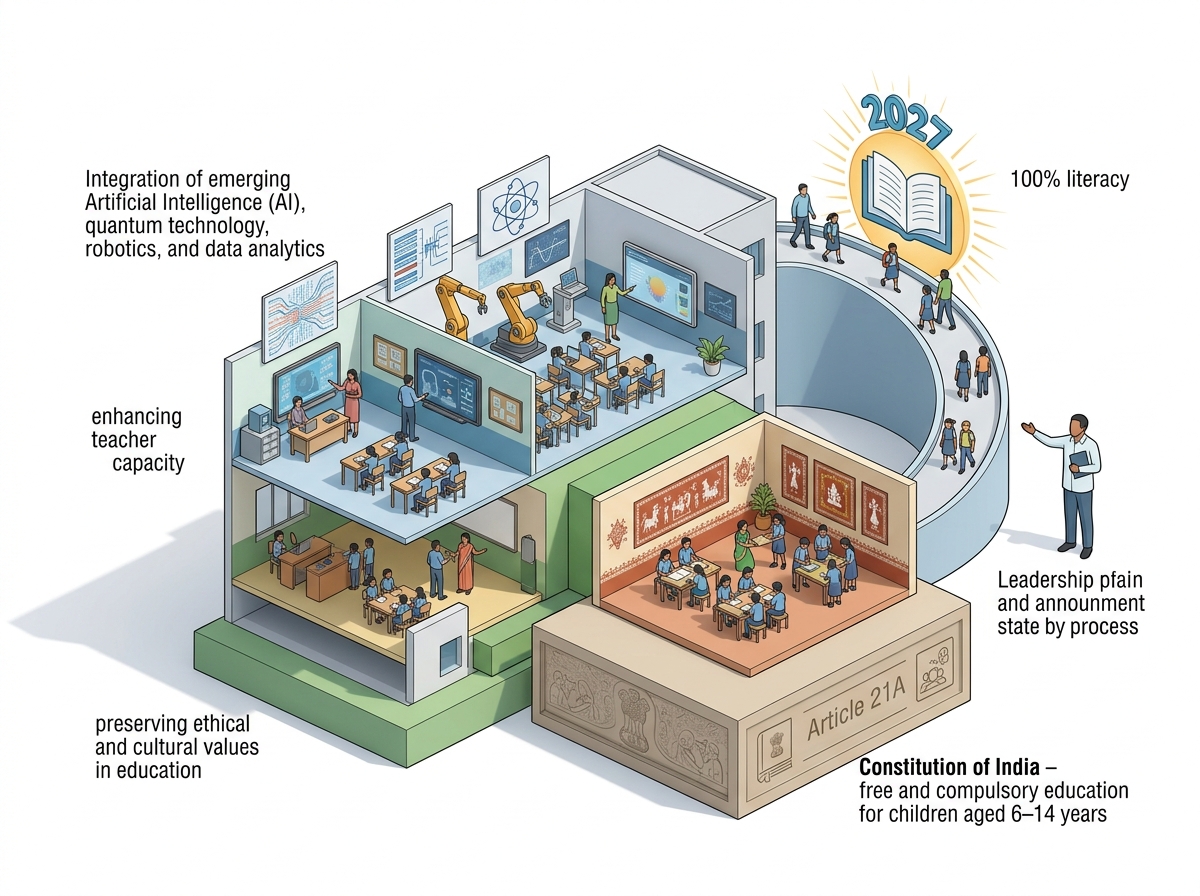
The Chief Minister of Andhra Pradesh announced a state-wide initiative to achieve 100% literacy by 2027, accompanied by sweeping reforms in the education system to align with emerging technological advancements such as Artificial Intelligence (AI), quantum technology, robotics, and data analytics. The announcement, made during Teachers’ Day celebrations, underscores the state’s commitment to restructuring curricula from the school level, enhancing teacher capacity, and integrating experiential learning while preserving ethical and cultural values in education.
Background
- The Constitution of India, under Article 45 (as originally inserted) and later through the 86th Amendment Act, 2002 (Article 21A), mandates free and compulsory education for children aged 6–14 years, forming the legal foundation for literacy and education policies in India.
- The National Education Policy (NEP) 2020 emphasizes holistic and multidisciplinary education, flexibility in curricula, and the integration of technology in teaching-learning processes, providing a policy framework for state-level reforms.
- The use of digital tools in education has gained prominence globally, with initiatives like the ‘Digital India’ programme aiming to bridge the digital divide and enhance learning outcomes through technology-enabled platforms.
What is Andhra Pradesh’s 100% Literacy Initiative by 2027?
- The initiative is a state-led target to eradicate illiteracy and ensure 100% literacy by 2027.
- The reform agenda includes restructuring school and higher education curricula to incorporate emerging technologies such as AI, quantum computing, robotics, and data analytics, ensuring students are prepared for future workforce demands.
- The initiative emphasizes the role of teachers as central agents of change, with a focus on their professional development, capacity-building, and recognition through awards for excellence in teaching.
- Curricular reforms aim to move beyond theoretical instruction by promoting experiential learning, practical exposure, and skills such as problem-solving, creativity, and leadership through initiatives like ‘No Bag Day’ (Saturdays dedicated to co-curricular activities).
- The integration of AI tools such as ‘Clicker’ and ‘AI Tutor’ is proposed to transform teaching methodologies, personalize learning, and enhance student engagement while maintaining the irreplaceable human element of education.
- The initiative underscores the importance of value-based education, including patriotism, cultural awareness, environmental consciousness, and ethical reasoning, alongside technological proficiency.
- The state government has highlighted the alignment of educational reforms with industrial requirements to ensure employability and economic growth, reflecting a demand-driven approach to education.
- The initiative is framed within a broader national vision of positioning India as a global leader (‘Vishwaguru’) by 2047, with education identified as the foundational pillar for achieving this goal.
Key Features
| Feature | Significance |
|---|---|
| 100% Literacy Target (2027) | Establishes a clear, time-bound objective to eliminate illiteracy in Andhra Pradesh, aligning with SDG 4 (Quality Education) and enhancing human capital for socio-economic development. |
| Curriculum Restructuring | Integration of emerging technologies (AI, quantum computing, robotics, data analytics) from school level to higher education, ensuring alignment with future industrial and technological demands. |
| Teacher Empowerment Initiatives | Recognition of teachers’ pivotal role through felicitations and emphasis on continuous professional development to adapt to evolving pedagogical and technological paradigms. |
| Experiential Learning Framework | Implementation of ‘No Bag Day’ (Saturdays) for outdoor activities (tree plantation, field visits) to foster holistic development beyond classroom theory. |
| Technology-Enhanced Pedagogy | Adoption of AI tools (e.g., Clicker, AI Tutor) to personalize learning, improve accessibility, and bridge educational gaps in remote or underserved regions. |
Why it Matters
Human Capital Development
- Elevates the state’s demographic dividend by ensuring universal foundational literacy and numeracy, critical for employability in a technology-driven economy.
- Reduces intergenerational transmission of poverty by equipping future generations with cognitive and technical competencies aligned with global standards.
- Enhances gender parity in education, particularly in rural Andhra Pradesh, where female literacy rates lag behind national averages.
Economic Competitiveness
- Positions Andhra Pradesh as a hub for skilled labor, attracting investment in high-tech industries (e.g., semiconductor manufacturing, AI startups) by producing a workforce proficient in emerging technologies.
- Supports the state’s ambition to become a ‘No. 1 State’ by 2047, leveraging education as a catalyst for innovation and economic growth.
- Facilitates alignment with India’s broader goal of becoming a ‘Vishwaguru’ by 2047, with Andhra Pradesh serving as a model for educational reform.
Institutional Strengthening
- Demonstrates the state government’s commitment to institutionalizing meritocracy in education through transparent teacher recruitment (e.g., Mega DSC exam) and professional recognition.
- Highlights the role of decentralized governance in education, where local leadership (e.g., teachers, district officials) is empowered to innovate and adapt curricula to regional needs.
- Showcases the integration of public-private partnerships (e.g., AI tool adoption) to modernize teaching methodologies without compromising equity.
Sustainable Development Goals (SDGs)
- Directly advances SDG 4.1 (universal primary and secondary education) and SDG 4.4 (relevant skills for employment), with spillover effects on SDG 5 (gender equality) and SDG 8 (decent work and economic growth).
- Indirectly supports SDG 13 (climate action) through experiential learning initiatives (e.g., tree plantation) that foster environmental stewardship among students.
Challenges
1. Regional Disparities in Literacy
- Persistent gaps between urban and rural districts in Andhra Pradesh, with tribal and coastal regions exhibiting lower literacy rates due to socio-economic barriers and limited infrastructure.
- Need for targeted interventions (e.g., mobile literacy units, community schools) to reach marginalized populations, including migrant workers and children with disabilities.
UPSC Link: GS2: Social Justice – Education and Human Resource Development
2. Teacher Shortages and Quality Gaps
- Despite Mega DSC recruitment, shortages persist in remote areas, exacerbated by high teacher attrition rates and inadequate training in modern pedagogical techniques.
- Disparities in teacher quality across government and private schools, with rural schools often facing underqualified staff and high pupil-teacher ratios.
UPSC Link: GS2: Governance – Teacher Training and Educational Standards
3. Curriculum-Infrastructure Mismatch
- Rapid technological integration (e.g., AI, robotics) outpaces the availability of requisite infrastructure (e.g., labs, digital devices) in government schools, particularly in low-income districts.
- Lack of standardized assessment frameworks to evaluate proficiency in emerging skills, risking superficial adoption of technology without measurable outcomes.
UPSC Link: GS3: Science and Technology – Skill Development and Innovation
4. Digital Divide and Accessibility
- Unequal access to digital tools (e.g., internet connectivity, devices) among students, disproportionately affecting girls and children from economically weaker sections.
- Cybersecurity risks and data privacy concerns associated with AI-driven learning platforms, necessitating robust safeguards and digital literacy programs.
UPSC Link: GS3: Digital India – Bridging the Digital Divide
5. Cultural and Linguistic Barriers
- Multilingualism in Andhra Pradesh (e.g., Telugu, Urdu, tribal languages) complicates the implementation of uniform curricula and standardized assessments.
- Cultural resistance to certain aspects of modern education (e.g., gender sensitization, environmental education) in conservative communities, requiring community engagement strategies.
UPSC Link: GS1: Society – Language and Education Policies
Challenges — UPSC Perspective
| Issue | Concern |
|---|---|
| Infrastructure Deficit | Lack of labs, digital devices, and internet connectivity in rural schools hinders practical exposure to AI, robotics, and data analytics. |
| Teacher Training Gaps | Inadequate pre-service and in-service training in emerging technologies limits teachers’ ability to integrate them into pedagogy effectively. |
| Assessment Limitations | Traditional examination systems fail to evaluate skills like creativity, problem-solving, and adaptability required in the 21st-century workforce. |
| Equity in Access | Digital divide exacerbates socio-economic inequalities, with marginalized groups (e.g., SC/ST, girls) at higher risk of exclusion. |
| Curriculum Rigidity | Outdated syllabi and rigid examination structures resist rapid updates to incorporate futuristic technologies. |
| Community Resistance | Conservative attitudes toward certain educational reforms (e.g., co-education, environmental activism) may impede implementation. |
Government Initiatives — Must-Memorise for Prelims
- No Bag Day Initiative (Saturday experiential learning programs)
- AI Tutor and Clicker (Technology-enabled teaching tools)
Way Forward
- Accelerate the establishment of ‘Future Skills Labs’ in government schools, equipped with AI, robotics, and data analytics tools, with phased rollout prioritizing high-need districts.
- Launch a state-wide ‘Teacher Digital Literacy Mission’ to upskill educators in emerging technologies, with certification tied to career progression.
- Develop a standardized ’21st-Century Skills Framework’ for Andhra Pradesh, integrating AI, critical thinking, and socio-emotional learning into the curriculum from Class VII onward.
- Strengthen public-private partnerships to bridge the digital divide, including corporate social responsibility (CSR) initiatives for device distribution and internet connectivity in rural schools.
- Institute a ‘Literacy Mission 2027’ with district-level task forces to monitor progress, leveraging data analytics for targeted interventions in underperforming regions.
- Expand ‘No Bag Day’ activities to include vocational skill training (e.g., coding, renewable energy workshops) and environmental projects (e.g., afforestation drives).
- Establish a ‘State Education Innovation Fund’ to support grassroots-level experiments in pedagogy, with grants for schools demonstrating measurable improvements in learning outcomes.
- Conduct annual ‘Education Forums’ with stakeholders (teachers, parents, industry leaders) to align curricula with evolving industrial demands and societal needs.
UPSC Value Addition
Keywords for Mains Answer-Writing
Andhra Pradesh literacy mission · NEP 2020 and school curriculum reforms · Artificial Intelligence in school education · National Education Policy 2020 · teacher empowerment and recruitment · foundational literacy and numeracy · experiential learning in education · AI literacy at school level · education-industry alignment · Vishwaguru vision and global leadership · Mega DSC teacher recruitment · no-bag day and experiential pedagogy
Constitutional & Policy Linkages
- Article 45 (DPSP – Provision for Free and Compulsory Education)
Concept Flow
State Government announces 100% literacy target by 2027 → → Calls for sweeping education reforms to align with technological advancements → → Restructures curriculum to include AI, robotics, and data analytics from school level → → Empowers teachers through recognition and upskilling initiatives → → Implements experiential learning frameworks (e.g., ‘No Bag Day’) → → Integrates technology-enabled pedagogy (e.g., AI Tutor) → → Monitors progress through district-level task forces and data analytics → → Achieves universal literacy and equips workforce for future economic demands
Prelims Practice Questions
Q1. Consider the following statements regarding the National Education Policy (NEP) 2020 and its implementation in states:
1. The NEP 2020 mandates the integration of Artificial Intelligence (AI) into school curricula from Class VII onwards.
2. The policy emphasizes experiential learning and the reduction of rote memorization.
3. The NEP 2020 does not address the recruitment of teachers or the professional development of educators.
How many of the above statements are correct?
- Only one
- Only two
- All three
- None
Answer: Only two — Statement 1 is incorrect: NEP 2020 recommends exposure to AI and related technologies but does not mandate integration from Class VII. Statement 2 is correct: experiential learning and reduction of rote memorization are core principles of NEP 2020. Statement 3 is incorrect: NEP 2020 includes provisions for teacher recruitment, training, and professional development.
Q2. Assertion (A): The Mega DSC (District Selection Committee) recruitment process in Andhra Pradesh was initiated to address the shortage of teachers in government schools.
Reason (R): The recruitment process was delayed due to over 350 legal petitions filed against it, which were ultimately resolved by the state government.
- Both A and R are true, and R is the correct explanation of A.
- Both A and R are true, but R is not the correct explanation of A.
- A is true, but R is false.
- A is false, but R is true.
Answer: Both A and R are true, but R is not the correct explanation of A. — Assertion (A) is true: the Mega DSC was launched to recruit teachers and address shortages. Reason (R) is also true: the recruitment faced legal hurdles, but these were not the cause of the teacher shortage; rather, they were obstacles to recruitment.
Q3. Match the following initiatives or concepts with their respective domains:
| Column I (Initiative/Concept) | Column II (Domain) |
|———————————————|—————————————-|
| 1. Mega DSC | A. Experiential Learning |
| 2. No Bag Day | B. Teacher Recruitment |
| 3. AI Tutor | C. Digital Pedagogy |
| 4. Vishwaguru Vision | D. National Education Policy (NEP) |
| 5. Foundational Literacy | E. Global Educational Leadership |
Select the correct match:
- 1-B, 2-A, 3-C, 4-E, 5-D
- 1-D, 2-C, 3-B, 4-E, 5-A
- 1-A, 2-B, 3-D, 4-C, 5-E
- 1-E, 2-A, 3-C, 4-D, 5-B
Answer: 1-B, 2-A, 3-C, 4-E, 5-D — 1-B: Mega DSC is a teacher recruitment initiative. 2-A: No Bag Day is linked to experiential learning. 3-C: AI Tutor falls under digital pedagogy. 4-E: Vishwaguru Vision pertains to global educational leadership. 5-D: Foundational Literacy is a core component of NEP 2020.
Mains Practice Question
✍ The Government of Andhra Pradesh has announced a target of achieving 100% literacy by 2027, alongside sweeping reforms in the school curriculum to integrate emerging technologies such as Artificial Intelligence, quantum computing, robotics, and data analytics. Critically examine the feasibility of this target and the challenges involved in aligning school education with the demands of the Fourth Industrial Revolution. Also, discuss the role of teachers in this transformation, with reference to the provisions of the National Education Policy (NEP) 2020. (15 Marks)
Approach: 1. **Feasibility of 100% literacy by 2027**:
– Current literacy rate in Andhra Pradesh (latest official data).
– Challenges: out-of-school children, adult illiteracy, socio-economic barriers, and regional disparities.
– Government measures: literacy missions, adult education programs, and inclusion strategies.
2. **Curriculum reforms for Fourth Industrial Revolution (4IR)**:
– NEP 2020’s emphasis on multidisciplinary education, critical thinking, and digital literacy.
– Integration of AI, robotics, and data analytics: pedagogical challenges, teacher training, and resource constraints.
– Alignment with industrial requirements: skilling for future jobs, industry-academia partnerships.
3. **Role of teachers**:
– Teacher empowerment: recruitment (Mega DSC), professional development, and incentives.
– Teachers as facilitators: shifting from rote teaching to experiential and inquiry-based learning.
– Ethical and value-based education: balancing technological skills with cultural and environmental awareness.
4. **Comparative perspective**:
– Lessons from other states or countries with successful literacy and curriculum reforms (e.g., Kerala’s literacy mission, Estonia’s digital education model).
5. **Conclusion**:
– Balancing ambition with ground realities; the need for sustained funding, political will, and community participation. Highlight the centrality of teachers in achieving both literacy and 4IR readiness.
Source: The Hindu
Andhra Pradesh PCS (APPSC) — State PCS Practice
Prelims: As per the recent announcement by the Chief Minister of Andhra Pradesh, the state aims to achieve 100% literacy by which year?
- 2025
- 2027
- 2030
- 2035
Answer: 2027 — The Chief Minister of Andhra Pradesh has set the target of achieving 100% literacy in the state by the year 2027.
Mains: Discuss the key challenges and strategies that the Government of Andhra Pradesh may need to address to achieve the goal of 100% literacy by 2027. Highlight the role of technology, community participation, and policy interventions in this endeavor.
Generated by AanyaAi for educational purpose.
Related guides on our sites
- Current affairs for upsc 2026
- Best teacher of sociology optional for upsc
- Best sociology optional teacher
- Best sociology optional teacher

- ग्रामीण विकास विभाग ने विशेष अभियान 6 के तहत 76% फाइलों की समीक्षा पूरी की - October 24, 2026
- 2030 तक 250 बिलियन डॉलर इंजीनियरिंग निर्यात: नीति निर्माताओं की रणनीति - October 24, 2026
- बस्तर दशहरा में राष्ट्रपति मुर्मु: जनजातीय समाज और विकास के पथ पर नया अध्याय - October 24, 2026

No Comments