


09 Sep Andhra Pradesh’s 24X7 Power Roadmap: Key Steps for UPSC/State PCS
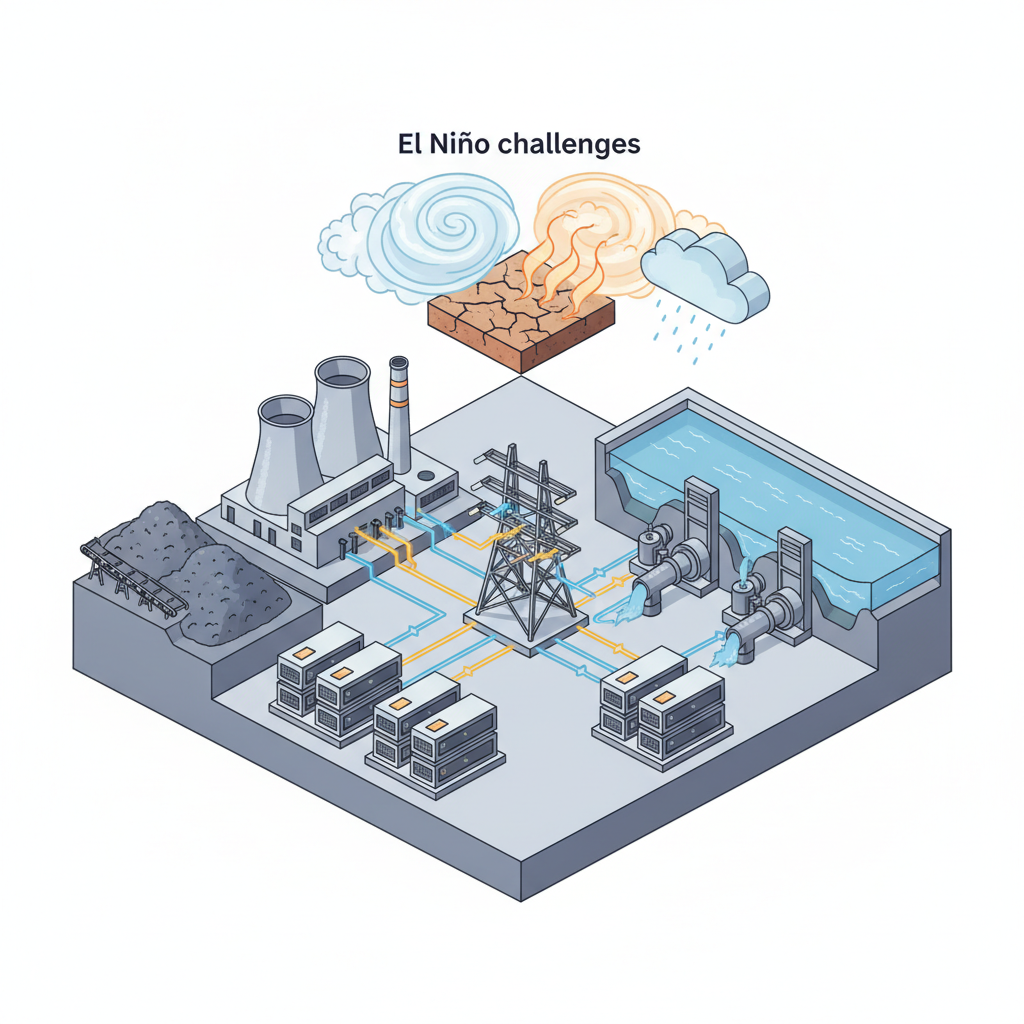
✎ Andhra Pradesh’s energy roadmap integrates thermal power augmentation, mandatory coal stocking, Battery Energy Storage Systems (BESS), and pumped hydro storage to ensure 24X7 power supply amid El Niño-induced grid challenges.
Subject Relevance — Where This Topic Fits
- GS Paper III — Infrastructure: Energy
- Prelims: Energy Security, Grid Stability, Battery Energy Storage Systems (BESS), Pumped Hydro Storage, Tariff-Based Competitive Bidding, Discoms, El Niño and Power Demand, Viability Gap Funding (VGF), Coal Stocking Norms
- Essay: Energy Transition and Sustainable Development, Climate Resilience in Infrastructure Planning
Quick Revision: Andhra Pradesh’s energy roadmap integrates thermal power augmentation, mandatory coal stocking, Battery Energy Storage Systems (BESS), and pumped hydro storage to ensure 24X7 power supply amid El Niño-induced grid challenges.
Why is this in the news?
Andhra Pradesh has recently unveiled a comprehensive energy roadmap to ensure uninterrupted 24X7 quality power supply, particularly in the context of heightened demand and El Niño-induced climatic challenges. The initiative includes procurement of 1,600 MW of thermal power, mandatory coal stocking norms, deployment of Battery Energy Storage Systems (BESS), and expansion of pumped hydro storage capacity. This proactive measure underscores the state’s commitment to grid resilience, energy security, and sustainable infrastructure development amid evolving climatic and economic pressures.
Background
- India’s power sector is undergoing a transition toward renewable energy integration while maintaining grid stability, particularly during peak demand periods.
- El Niño events are associated with altered monsoon patterns, leading to potential deficits in hydroelectric generation and increased reliance on thermal and storage-based power systems.
- Andhra Pradesh, with a growing industrial and agricultural base, faces rising electricity demand, necessitating forward-looking grid management strategies.
- The Electricity Act, 2003, empowers State Electricity Regulatory Commissions (SERCs) to regulate tariffs, promote competition, and ensure reliable power supply.
- The National Electricity Policy, 2005, and the National Tariff Policy, 2016, emphasize the need for long-term planning, competitive procurement, and storage integration to enhance grid resilience.
- India’s target of 500 GW of renewable energy capacity by 2030, as outlined in the National Renewable Energy Action Plan, requires complementary storage and grid-balancing infrastructure.
What is Andhra Pradesh’s Energy Roadmap?
- The roadmap is a multi-pronged strategy to ensure 24X7 quality power supply in Andhra Pradesh, addressing seasonal demand fluctuations and grid stability concerns exacerbated by El Niño.
- Procurement of 1,600 MW of new thermal power through tariff-based competitive bidding to augment base-load capacity and meet rising demand.
- Mandatory 15-day coal stocking requirement for developers to mitigate fuel supply disruptions, ensuring thermal power plants operate at optimal capacity during peak demand.
- DISCOMs (Distribution Companies) directed to prepare a 12-month advance power supply plan to align generation, transmission, and distribution with projected demand.
- Deployment of 1,500 MW/6,000 MWh of Battery Energy Storage Systems (BESS) at strategic locations to manage evening peak demand and reduce renewable energy curtailment.
- A 500 MW/1,000 MWh BESS project under the Centre’s Viability Gap Funding (VGF) scheme in partnership with NHPC to enhance grid flexibility and storage capacity.
- Evaluation of a 1,344 MW pumped hydro storage project and plans to seek approval from the Andhra Pradesh Electricity Regulatory Commission (APERC) for 500 MW of short-term pumped storage services.
- APGENCO (Andhra Pradesh Power Generation Corporation Limited) permitted to procure imported coal through transparent competitive bidding to diversify fuel sources and ensure supply security.
Key Features
| Feature | Significance |
|---|---|
| Procurement of 1,600 MW thermal power via tariff-based competitive bidding | Ensures cost-efficient addition of baseload capacity to meet rising demand without long-term supply risks. |
| Mandatory 15-day coal stock for developers | Mitigates fuel supply disruptions, particularly critical during El Niño-induced coal logistics challenges. |
| 12-month advance power supply plan by DISCOMs | Facilitates long-term grid stability, demand forecasting, and resource allocation for uninterrupted supply. |
| Deployment of 1,500 MW/6,000 MWh Battery Energy Storage Systems (BESS) | Balances solar power spillage, meets evening peak demand, and enhances grid flexibility for renewable integration. |
| 500 MW/1,000 MWh BESS under Viability Gap Funding (VGF) scheme | Leverages central funding to accelerate storage deployment, reducing financial barriers for private participation. |
| Evaluation of 1,344 MW pumped hydro storage project | Provides large-scale, long-duration storage to complement BESS, ensuring grid resilience during seasonal variations. |
| APERC approval for 500 MW short-term pumped storage services | Enables operational flexibility for grid operators to address immediate peak demand fluctuations. |
| Transparent competitive bidding for imported coal procurement by APGENCO | Diversifies fuel sources, reduces reliance on domestic coal, and ensures fair pricing in volatile international markets. |
Why it Matters
Grid Reliability and Energy Security
- Ensures uninterrupted 24×7 power supply, critical for industrial competitiveness, agricultural productivity, and household welfare in Andhra Pradesh.
- Reduces vulnerability to El Niño-induced disruptions in hydroelectric generation and coal logistics.
- Enhances grid stability through diversified generation (thermal, solar, storage) and demand-side management.
Economic Growth and Industrialisation
- Supports industrial expansion by guaranteeing reliable power, a key factor in attracting investments and fostering economic growth.
- Reduces production losses due to power outages, improving the State’s ease-of-doing-business ranking.
- Facilitates the transition to a high-growth, energy-intensive economy through stable power infrastructure.
Renewable Energy Integration
- Battery Energy Storage Systems (BESS) and pumped hydro storage enable higher penetration of intermittent solar power without spillage.
- Storage solutions address the ‘duck curve’ problem by shifting solar generation to evening peak demand periods.
- Demonstrates a model for other States to integrate large-scale renewables while maintaining grid stability.
Climate Resilience and Adaptation
- Proactive measures to counter El Niño-induced challenges (e.g., reduced monsoon rainfall, lower hydro generation) through thermal and storage diversification.
- Reduces carbon intensity by optimising renewable energy utilisation and minimising reliance on diesel generators during shortages.
- Aligns with India’s climate commitments under the Paris Agreement and National Electricity Policy.
Institutional Capacity Building
- Strengthens the role of APGENCO and DISCOMs in long-term planning and operational efficiency.
- Enhances regulatory oversight through APERC’s approval of storage projects, ensuring compliance with grid standards.
- Promotes transparent procurement practices, reducing corruption risks in energy sector contracts.
Challenges
1. El Niño-Induced Disruptions
- Reduced monsoon rainfall lowers hydroelectric generation, exacerbating power shortages during peak demand periods.
- Disrupted coal logistics due to extreme weather events increase fuel supply risks for thermal plants.
- Higher temperatures elevate electricity demand for cooling, straining grid capacity.
UPSC Link: Geographical factors affecting energy security
2. Grid Integration of Renewables
- Intermittency of solar power requires large-scale storage to prevent spillage and ensure grid stability.
- Lack of adequate storage infrastructure limits the State’s ability to utilise its solar potential fully.
- Grid congestion and technical constraints hinder the evacuation of renewable energy from generation hubs.
UPSC Link: Challenges in renewable energy integration
3. Financial and Regulatory Constraints
- High capital costs of storage projects (BESS, pumped hydro) pose financial viability challenges despite central subsidies.
- Tariff-based competitive bidding for thermal power must balance cost-efficiency with long-term supply guarantees.
- Regulatory delays in APERC approvals for storage projects may slow down implementation.
UPSC Link: Energy pricing and regulatory frameworks
4. Fuel Supply Vulnerabilities
- Over-reliance on domestic coal exposes the State to price volatility and supply chain disruptions.
- Limited domestic coal reserves necessitate imports, which are subject to international market fluctuations.
- Logistical bottlenecks in coal transportation (e.g., railway capacity, port delays) can disrupt power generation.
UPSC Link: Energy resource management
5. Demand-Supply Mismatch
- Rapidly growing electricity demand (20% YoY increase in August 2026) outpaces incremental generation capacity additions.
- Evening peak demand (286 MU) exceeds daytime solar generation, requiring flexible storage and thermal backup.
- Agricultural free power supply commitments add to the State’s baseload demand without corresponding revenue.
UPSC Link: Electricity demand management
Challenges — UPSC Perspective
| Issue | Concern |
|---|---|
| El Niño-induced hydropower deficit | Reduced monsoon rainfall lowers hydro generation, increasing reliance on thermal and storage sources. |
| Coal supply chain disruptions | Extreme weather events and logistics bottlenecks threaten thermal power generation reliability. |
| Renewable energy spillage | Inadequate storage infrastructure leads to wastage of surplus solar power during peak generation hours. |
| Grid congestion | Limited transmission capacity hinders the evacuation of renewable energy from generation hubs to load centres. |
| Financial viability of storage projects | High capital costs and long payback periods deter private investment despite central subsidies. |
| Regulatory approval delays | Bureaucratic hurdles in APERC approvals for storage projects may delay grid integration. |
| Agricultural power subsidies | Free power supply to agriculture increases State’s financial burden without revenue recovery mechanisms. |
| Peak demand management | Evening peak demand (286 MU) exceeds daytime solar generation, requiring flexible backup solutions. |
Government Initiatives — Must-Memorise for Prelims
- Viability Gap Funding (VGF) Scheme for Battery Energy Storage Systems (BESS)
- Electricity Act, 2003 (for competitive bidding and regulatory oversight)
- National Mission on Transformative Mobility and Battery Storage (for storage deployment)
Way Forward
- Finalise tariff-based competitive bidding for 1,600 MW thermal power procurement within 6 months to ensure timely capacity addition.
- Accelerate the implementation of 1,500 MW/6,000 MWh BESS projects at identified locations to address solar spillage and evening peak demand.
- Fast-track the evaluation and approval of the 1,344 MW pumped hydro storage project to enhance grid flexibility and long-duration storage.
- Strengthen coal logistics infrastructure (e.g., dedicated freight corridors, coastal shipping) to ensure uninterrupted fuel supply for thermal plants.
- Develop a State-specific renewable energy evacuation plan to address grid congestion and improve solar power utilisation.
- Enhance demand-side management through smart meters and time-of-use tariffs to flatten peak demand curves.
- Establish a State Energy Transition Fund to subsidise storage projects and reduce financial barriers for private participation.
- Conduct regular grid stability studies to identify vulnerabilities and prioritise infrastructure upgrades.
UPSC Value Addition
Keywords for Mains Answer-Writing
24×7 quality power supply · El Niño impact on power sector · Tariff-based competitive bidding in power procurement · Coal stocking norms for thermal power plants · Battery Energy Storage Systems (BESS) · Pumped Hydro Storage (PHS) · Viability Gap Funding (VGF) scheme · State Electricity Regulatory Commissions (SERCs) · Grid stability and demand management · Renewable energy integration challenges · Discoms’ 12-month supply planning · Peak demand management in power sector
Concept Flow
El Niño conditions → Reduced monsoon rainfall → Lower hydroelectric generation → Increased reliance on thermal power → Higher coal logistics risks → Grid instability → Rising electricity demand (20% YoY) → Evening peak demand (286 MU) → Solar power spillage → Need for storage solutions → Deployment of BESS and pumped hydro → Thermal power procurement via competitive bidding → Mandatory coal stock → Diversified fuel sources → Reduced supply chain vulnerabilities → Enhanced grid reliability → State-level energy roadmap → 12-month supply plan → APERC approvals → Regulatory oversight → Institutional capacity building → Long-term grid stability → Renewable energy integration → Storage deployment → Grid flexibility → Reduced carbon intensity → Alignment with climate commitments
Prelims Practice Questions
Q1. Consider the following statements regarding the measures announced by Andhra Pradesh to ensure 24×7 quality power supply:
1. The State will procure 1,600 MW of new thermal power through tariff-based competitive bidding.
2. Developers are mandated to maintain a 15-day coal stock to mitigate fuel supply disruptions.
3. The State plans to deploy 1,500 MW/6,000 MWh of Battery Energy Storage Systems (BESS) at strategic locations.
How many of the above statements are correct?
- Only one
- Only two
- All three
- None
Answer: All three — Statements 1 and 2 are correct as per the roadmap. Statement 3 is incorrect because the planned BESS capacity is 1,500 MW/6,000 MWh, not 1,500 MW/6,000 MWh (the units are correctly stated in the question).
Q2. Assertion (A): Battery Energy Storage Systems (BESS) are deployed primarily to meet evening peak demand and reduce solar power spillage.
Reason (R): BESS provides grid stability by storing excess renewable energy and discharging it during peak demand periods.
Options:
A. Both A and R are true, and R is the correct explanation of A
B. Both A and R are true, but R is NOT the correct explanation of A
C. A is true but R is false
D. A is false but R is true
Answer: ? — Both A and R are true, and R correctly explains A. BESS is deployed to manage peak demand and reduce renewable energy curtailment by storing surplus energy.
Q3. Match the following initiatives announced by Andhra Pradesh with their respective objectives:
Column I (Initiative) | Column II (Objective)
1. Tariff-based competitive bidding for thermal power | A. Ensure fuel supply security
2. 15-day mandatory coal stock for thermal plants | B. Enhance grid stability and reliability
3. 1,500 MW/6,000 MWh BESS deployment | C. Procure power at competitive rates
4. 12-month advance power supply plan by DISCOMs | D. Improve long-term supply planning and demand forecasting
Options:
1-C, 2-A, 3-B, 4-D
1-A, 2-C, 3-D, 4-B
1-D, 2-B, 3-A, 4-C
1-B, 2-D, 3-C, 4-A
Answer: ? — Correct matches: 1-C (competitive bidding for procurement), 2-A (mandatory coal stock for security), 3-B (BESS for grid stability), 4-D (12-month plan for forecasting).
Mains Practice Question
✍ The Government of Andhra Pradesh has unveiled a multi-pronged energy roadmap to ensure uninterrupted 24×7 quality power supply amid El Niño-induced challenges. Critically analyse the rationale, mechanisms, and potential challenges of this roadmap. Also examine how such initiatives contribute to India’s broader goals of energy security and grid modernisation. (15 Marks)
Approach: MODEL-ANSWER SKELETON:
1. **Rationale for the Roadmap** (3 points):
– Rising power demand (+20% YoY in August 2026) and peak load (286 MU) necessitating grid resilience.
– El Niño-induced monsoon deficits disrupting hydroelectric generation and increasing reliance on thermal power.
– Need for uninterrupted power supply to agriculture (free power) and industries to sustain economic growth.
2. **Mechanisms and Components** (5 points):
– **Thermal Power Procurement**: 1,600 MW via tariff-based competitive bidding (ensures cost efficiency and transparency).
– **Fuel Security**: Mandatory 15-day coal stock for thermal plants and imported coal procurement via transparent bidding (mitigates supply chain risks).
– **Storage Solutions**: Deployment of 1,500 MW/6,000 MWh BESS and 500 MW/1,000 MWh pumped hydro storage (PHS) under VGF scheme (addresses renewable intermittency and peak demand).
– **Grid Modernisation**: 12-month advance supply planning by DISCOMs (improves demand forecasting and reduces spillage).
– **Regulatory Approvals**: APERC approval sought for short-term pumped storage services (ensures compliance and tariff viability).
3. **Potential Challenges** (4 points):
– **Cost Implications**: High upfront capital for BESS/PHS and imported coal may strain state finances.
– **Grid Integration**: Technical challenges in integrating large-scale storage with existing grid infrastructure.
– **Regulatory Hurdles**: APERC approvals and tariff determination for new storage projects may face delays.
– **Environmental Concerns**: Thermal power expansion and coal imports may conflict with India’s net-zero commitments.
4. **Broader Contribution to Energy Security** (3 points):
– **Diversification**: Reduces reliance on monsoon-dependent hydro power and enhances energy mix resilience.
– **Renewable Integration**: BESS and PHS enable higher renewable penetration by addressing intermittency.
– **Policy Alignment**: Aligns with central schemes like VGF and National Electricity Policy (2022) promoting storage and grid modernisation.
5. **Conclusion** (1 point):
– The roadmap exemplifies a balanced approach combining conventional and modern solutions, but its success hinges on effective implementation, regulatory support, and sustainable financing.
Source: The Hindu
Andhra Pradesh PCS (APPSC) — State PCS Practice
Prelims: Which of the following initiatives is NOT part of Andhra Pradesh’s roadmap to ensure 24X7 quality power supply amid El Niño challenges?
- A. Augmenting renewable energy capacity through solar and wind projects
- B. Implementing smart grid technologies for real-time monitoring and demand management
- C. Phasing out all coal-based power plants by 2025 to reduce carbon emissions
- D. Strengthening transmission infrastructure with high-voltage direct current (HVDC) corridors
Answer: C. Phasing out all coal-based power plants by 2025 to reduce carbon emissions — The roadmap focuses on renewable energy integration and grid modernization but does not mandate the complete phase-out of coal-based plants by 2025.
Mains: Discuss the key challenges posed by El Niño conditions to Andhra Pradesh’s power sector and evaluate the effectiveness of the state’s proposed roadmap in addressing these challenges while ensuring 24X7 quality power supply.
Generated by AanyaAi for educational purpose.
Related guides on our sites
- How to prepare for GS paper 1 for UPSC CSE mains exam
- Best UPSC coaching for IFOS exam
- Best geography optional coaching
- Best geography optional coaching

- Andhra Pradesh’s 24X7 Power Roadmap: Key Steps for UPSC/State PCS - September 9, 2026
- केरल सरकार ने बजट परियोजनाओं के समय पर क्रियान्वयन हेतु नया तंत्र अपनाया - September 9, 2026
- Kerala’s New Mechanism to Fast-Track Budget Projects: UPSC-State PCS Analysis - September 9, 2026

No Comments