


08 Aug Anil Akkara Demands CBI Probe in Kerala LIFE Mission Scam Case
✎ Former MLA Anil Akkara has demanded the transfer of all investigation files related to the Kerala LIFE Mission housing scam from the State Vigilance and Anti-Corruption Bureau (VACB) to the Central Bureau of Investigation (CBI)…
Subject Relevance — Where This Topic Fits
- GS Paper II — Functions and Responsibilities of the Union and the States, including the Challenges Pertaining to the Federal Structure | GS Paper III — Challenges to Internal Security through Communication Networks, Role of State and Central Agencies | GS Paper IV — Ethical Issues in Governance: Conflict of Interest, Transparency, and Accountability
- Prelims: Central Bureau of Investigation (CBI), Vigilance and Anti-Corruption Bureau (VACB), LIFE Mission, Federal Structure, Supreme Court’s Role in Transfer of Cases, Chargesheet, Rule of Law, Public Interest Litigation (PIL), Money Laundering, Corruption in Public Procurement
- Essay: Ethical governance and institutional integrity: The case for single-window investigations in high-stakes corruption cases, Federalism in crisis: Balancing autonomy and accountability in investigative agencies
Why is this in the news?
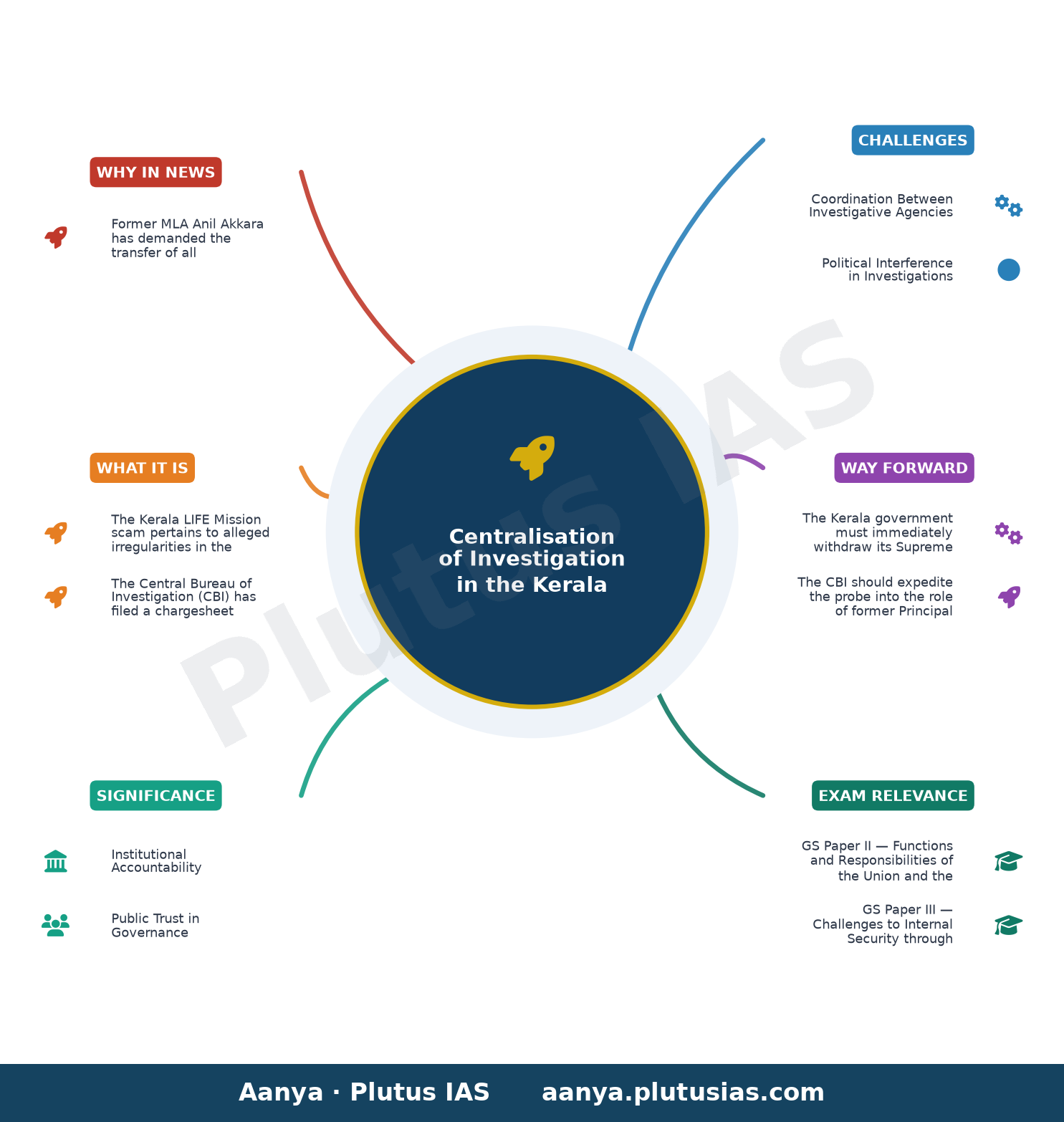
Former MLA Anil Akkara has demanded the transfer of all investigation files related to the Kerala LIFE Mission housing scam from the State Vigilance and Anti-Corruption Bureau (VACB) to the Central Bureau of Investigation (CBI), citing concerns over parallel investigations, inefficiency, and lack of coordination. The demand follows allegations that the VACB has withheld critical documents, including those linked to senior bureaucrats, despite the CBI’s ongoing chargesheet in the case. This development underscores broader debates on the efficacy of federal policing structures, institutional accountability, and the need for unified investigative mechanisms in high-profile corruption cases.
Background
- The Kerala LIFE Mission was launched in 2018 as a rehabilitation initiative following the devastating floods in Kerala, aimed at providing housing and infrastructure to flood-affected communities.
- The project involved a ₹21 crore agreement between the LIFE Mission and the UAE-based Red Crescent for constructing a housing complex and hospital at Wadakkanchery, awarded to Kochi-based firms Unitac Builders and Sane Ventures, owned by businessman Santhosh Eappen.
- The CBI filed a chargesheet in the case, naming Santhosh Eappen, Sane Ventures, and the LIFE Mission as accused, alleging large-scale irregularities in the award of the contract.
- The case gained prominence due to the involvement of high-profile individuals, including former Principal Secretary M. Sivasankar, former Chief Minister Pinarayi Vijayan, and former Minister A.C. Moideen, with the LIFE Mission itself arraigned as an accused entity.
- The State Vigilance and Anti-Corruption Bureau (VACB) initiated parallel investigations, leading to allegations of obstruction and lack of coordination with the CBI.
- The Supreme Court is currently seized of a petition filed by the State government, which the former MLA has urged to be withdrawn to facilitate the CBI’s investigation.
What is the Kerala LIFE Mission Scam and the Role of Investigative Agencies?
- The Kerala LIFE Mission scam pertains to alleged irregularities in the award of a ₹21 crore housing project contract to Unitac Builders and Sane Ventures, owned by Santhosh Eappen, under the LIFE Mission rehabilitation programme post-2018 Kerala floods.
- The Central Bureau of Investigation (CBI) has filed a chargesheet naming Santhosh Eappen, Sane Ventures, and the LIFE Mission as accused, with allegations of corruption, money laundering, and abuse of official position.
- The CBI’s investigation has also implicated individuals such as Swapna Suresh (involved in the gold smuggling case) and former UAE Consulate officials, indicating potential transnational dimensions to the scam.
- The State Vigilance and Anti-Corruption Bureau (VACB) has conducted parallel investigations, raising concerns about duplication of efforts, lack of coordination, and potential suppression of evidence.
- The demand for transferring all Vigilance files to the CBI stems from the need for a unified, transparent, and credible investigation to ensure judicial efficiency and public trust in the justice delivery system.
- The scam also raises ethical questions about the role of public servants, conflict of interest, and the need for stringent safeguards in public procurement processes to prevent corruption.
Key Features
| Feature | Significance |
|---|---|
| LIFE Mission housing project | A rehabilitation initiative launched by the Kerala government post-2018 floods to provide housing and healthcare infrastructure for displaced communities. |
| Vigilance and Anti-Corruption Bureau (VACB) | State-level investigative agency responsible for probing corruption allegations; its parallel investigation is seen as complicating the probe. |
| Central Bureau of Investigation (CBI) | Central investigative agency with jurisdiction over major corruption cases; its chargesheet names multiple accused in the LIFE Mission scam. |
| Parallel investigations | Simultaneous probes by state and central agencies into the same case, leading to concerns over coordination, efficiency, and credibility of the investigation. |
| Supreme Court intervention | State government’s petition pending before the Supreme Court, which the complainant urges to be withdrawn to facilitate CBI’s investigation. |
Why it Matters
Institutional Accountability
- Demonstrates the tension between state and central investigative agencies in high-profile corruption cases, raising questions about federalism and cooperative federalism.
- Highlights the need for a single, unified investigative authority to ensure transparency and credibility in probes involving high-ranking officials.
- Underscores the role of the judiciary in resolving jurisdictional disputes between state and central agencies.
Public Trust in Governance
- Erosion of public confidence in anti-corruption mechanisms due to perceived delays, lack of coordination, and potential cover-ups.
- The case exemplifies how corruption scandals in rehabilitation projects can undermine citizen trust in government welfare schemes.
- Emphasizes the importance of swift, transparent, and impartial investigations to restore faith in the justice delivery system.
Federalism and Centre-State Relations
- The demand for CBI intervention reflects concerns over state-level agencies’ ability to conduct impartial investigations, particularly when high-ranking officials are involved.
- Raises questions about the constitutional balance between state autonomy and central oversight in corruption cases.
- Illustrates the challenges in maintaining cooperative federalism when state and central agencies are at loggerheads over investigative jurisdiction.
Economic Implications of Corruption
- Corruption in rehabilitation projects diverts public funds meant for disaster relief, exacerbating the suffering of affected communities.
- The misuse of ₹21 crore sanctioned for the LIFE Mission project highlights the economic cost of graft in welfare schemes.
- Such scandals deter private sector participation in public-private partnerships (PPPs), stifling economic recovery post-disaster.
Challenges
1. Coordination Between Investigative Agencies
- Parallel investigations by VACB and CBI risk duplication of efforts, conflicting findings, and procedural delays.
- Lack of seamless data sharing between state and central agencies hampers the probe’s efficiency.
- The absence of a standardized protocol for inter-agency coordination complicates high-stakes corruption cases.
UPSC Link: GS2: Centre-State Relations
2. Political Interference in Investigations
- Allegations of state agencies withholding evidence to protect political allies underscore the risk of politicization of corruption probes.
- The involvement of high-ranking officials in the case raises concerns about the independence of investigative agencies.
- Public perception of bias in investigations can further erode trust in democratic institutions.
UPSC Link: GS4: Probity in Governance
3. Credibility of State-Level Anti-Corruption Mechanisms
- The demand for CBI intervention suggests a lack of faith in the VACB’s ability to conduct impartial investigations.
- State-level agencies may face pressure to dilute findings in cases involving ruling party members or allies.
- Weak institutional capacity at the state level can undermine the fight against corruption.
UPSC Link: GS2: Judiciary and its Role
4. Judicial Overreach and Delayed Justice
- Pending Supreme Court petitions create uncertainty and prolong the investigation, delaying justice for victims of corruption.
- Judicial intervention is necessary to resolve jurisdictional disputes but may inadvertently delay the probe.
- The case highlights the need for expedited judicial processes in high-profile corruption matters.
UPSC Link: GS2: Separation of Powers
5. Public-Private Partnership (PPP) Vulnerabilities
- Corruption in PPPs, such as the LIFE Mission project, can deter private sector participation in disaster relief and infrastructure development.
- Weak regulatory oversight in PPPs creates opportunities for graft, particularly in post-disaster rehabilitation projects.
- The case underscores the need for robust transparency mechanisms in PPP agreements.
UPSC Link: GS3: PPPs and Infrastructure
6. Restoration of Public Trust in Welfare Schemes
- Scandals in rehabilitation projects like LIFE Mission can deter beneficiaries from availing government schemes, exacerbating socio-economic vulnerabilities.
- Lack of accountability in such cases undermines the credibility of disaster relief initiatives.
- Restoring trust requires transparent investigations, swift corrective actions, and visible penalties for the guilty.
UPSC Link: GS4: Ethical Governance
Challenges — UPSC Perspective
| Issue | Concern |
|---|---|
| Parallel investigations | Risk of conflicting findings, procedural delays, and compromised efficiency in the probe. |
| Political interference | Perceived bias in state-level investigations, particularly when high-ranking officials are involved. |
| Judicial delays | Pending Supreme Court petitions prolong uncertainty and delay justice in the case. |
| Data sharing gaps | Lack of seamless coordination between VACB and CBI hampers evidence collection and analysis. |
| Public trust erosion | Corruption scandals in welfare schemes deter beneficiaries and undermine governance credibility. |
| PPP vulnerabilities | Weak regulatory oversight in public-private partnerships creates opportunities for graft in rehabilitation projects. |
Way Forward
- The Kerala government must immediately withdraw its Supreme Court petition and extend full cooperation to the CBI to ensure a unified and credible investigation.
- The CBI should expedite the probe into the role of former Principal Secretary M. Sivasankar and former LIFE Mission CEO U.V. Jose, ensuring no stone is left unturned.
- Strengthen inter-agency coordination mechanisms between state and central investigative bodies to prevent duplication and delays in high-stakes cases.
- Enhance transparency in public-private partnerships (PPPs) by mandating real-time monitoring, audits, and public disclosures of project finances.
- Implement a time-bound framework for judicial resolution of jurisdictional disputes between state and central agencies to prevent prolonged delays.
- Conduct a comprehensive audit of all rehabilitation projects in Kerala to identify systemic vulnerabilities and prevent future corruption.
- Introduce whistleblower protection laws to encourage insiders to report irregularities without fear of retaliation.
- Establish an independent oversight body to monitor the functioning of state-level anti-corruption agencies and ensure their impartiality.
UPSC Value Addition
Keywords for Mains Answer-Writing
Central Bureau of Investigation (CBI) · State Vigilance and Anti-Corruption Bureau (VACB) · LIFE Mission housing project · parallel investigations · cooperative federalism · rule of law · public trust in institutions · investigative agencies · corruption in public procurement · judicial oversight of investigative agencies · federal structure of criminal investigation · transparency in governance · Supreme Court’s role in inter-agency disputes · Kerala floods rehabilitation schemes · political accountability in corruption cases
Concept Flow
2018 Kerala floods → Launch of LIFE Mission rehabilitation project → ₹21 crore sanctioned for housing and hospital → Award of contract to Unitac Builders and Sane Ventures → Alleged irregularities in contract award → Parallel investigations by VACB and CBI → Demand for CBI takeover due to perceived inefficiency and bias → Supreme Court intervention sought by state government → CBI chargesheet filed naming accused → Allegations of political interference and withholding of evidence → Public demand for transparent and unified probe → Way forward: judicial cooperation, inter-agency coordination, and systemic reforms.
Prelims Practice Questions
Q1. Consider the following statements regarding the Central Bureau of Investigation (CBI) in India:
1. The CBI is a statutory body established under the Delhi Special Police Establishment Act, 1946.
2. The CBI derives its powers from the Code of Criminal Procedure, 1973, but does not have suo motu powers to investigate offences.
3. The CBI can investigate cases referred to it by the Supreme Court or High Courts.
4. The CBI is under the administrative control of the Ministry of Home Affairs, Government of India.
How many of the above statements are correct?
- Only one
- Only two
- Only three
- All four
Answer: Only three — Statements 1 and 3 are correct. Statement 2 is incorrect because the CBI has suo motu powers to investigate offences under the DSPE Act. Statement 4 is incorrect as the CBI is under the administrative control of the Department of Personnel and Training (DoPT), Ministry of Personnel, Public Grievances and Pensions.
Q2. Assertion (A): The State Vigilance and Anti-Corruption Bureau (VACB) is a constitutional body mandated to investigate corruption cases in the states.
Reason (R): The VACB operates under the administrative control of the State Government and derives its powers from the Prevention of Corruption Act, 1988.
Options:
A. Both A and R are true, and R is the correct explanation of A.
B. Both A and R are true, but R is not the correct explanation of A.
C. A is true, but R is false.
D. A is false, but R is true.
Answer: ? — Assertion (A) is false because the VACB is not a constitutional body; it is a statutory body established by state legislatures. Reason (R) is true as the VACB operates under state government control and derives powers from the Prevention of Corruption Act, 1988.
Q3. Match the following investigative agencies with their respective jurisdictions:
Column I (Agency) Column II (Jurisdiction)
A. Central Bureau of Investigation (CBI) 1. Investigates cases of corruption and other offences under the Prevention of Corruption Act, 1988, within the state.
B. State Vigilance and Anti-Corruption Bureau (VACB) 2. Investigates offences related to inter-state and central government matters, as well as cases referred by the Supreme Court or High Courts.
C. Enforcement Directorate (ED) 3. Investigates economic offences, including money laundering and foreign exchange violations.
D. National Investigation Agency (NIA) 4. Investigates offences affecting the sovereignty, security, and integrity of India, including terrorism.
Options:
A. A-2, B-1, C-3, D-4
B. A-1, B-2, C-3, D-4
C. A-3, B-1, C-2, D-4
D. A-4, B-2, C-3, D-1
Answer: ? — The correct match is: A-2 (CBI), B-1 (VACB), C-3 (ED), D-4 (NIA).
Mains Practice Question
✍ The demand for transferring all investigative files from the State Vigilance and Anti-Corruption Bureau (VACB) to the Central Bureau of Investigation (CBI) in the Kerala LIFE Mission case reflects broader tensions in India’s federal structure of criminal investigation. Critically examine the constitutional and institutional implications of such parallel investigations by multiple agencies into the same case. Also, analyse how the Supreme Court’s role in resolving inter-agency disputes upholds the rule of law. (15 Marks)
Approach: MODEL-ANSWER SKELETON:
1. **Introduction (2 Marks)**
– Briefly define the LIFE Mission case and the demand for transferring files to the CBI.
– State the broader issue: tensions between federalism and investigative autonomy in corruption cases.
2. **Constitutional and Institutional Framework (4 Marks)**
– **Federal Structure**: Explain the division of powers under the Constitution (State List vs. Union List) and the role of investigative agencies.
– **CBI’s Jurisdiction**: Cite the Delhi Special Police Establishment Act, 1946, and its powers under the Code of Criminal Procedure, 1973.
– **VACB’s Role**: Highlight its statutory basis under state laws and its mandate under the Prevention of Corruption Act, 1988.
– **Conflict of Jurisdiction**: Discuss how parallel investigations can lead to duplication, inefficiency, and legal conflicts (e.g., conflicting chargesheets).
3. **Challenges of Parallel Investigations (4 Marks)**
– **Efficiency and Coordination**: Cite the Supreme Court’s observations in *State of West Bengal v. Committee for Protection of Democratic Rights* (2010) on the need for coordination.
– **Public Trust**: Discuss how parallel probes erode public confidence in institutions (e.g., perception of political interference).
– **Legal Precedents**: Reference the *Hazari Lal Gupta v. Rameshwar Prasad* (1972) case, where the Supreme Court emphasized the need for a single agency to avoid conflicting orders.
4. **Supreme Court’s Role in Resolving Disputes (3 Marks)**
– **Judicial Oversight**: Explain the Supreme Court’s power under Article 32 and Article 136 to intervene in inter-agency disputes.
– **Doctrine of Judicial Deference**: Discuss how the Court balances federalism with the need for a unified investigation (e.g., *State of Karnataka v. Union of India* (2007)).
– **Recent Trends**: Cite cases like *Common Cause v. Union of India* (2018) on the CBI’s autonomy and the need for judicial supervision.
5. **Way Forward and Conclusion (2 Marks)**
– **Reforms**: Suggest measures such as a **Memorandum of Understanding (MoU)** between the CBI and state agencies for joint investigations.
– **Constitutional Safeguards**: Propose amendments to the DSPE Act to clarify jurisdiction in cases involving both central and state interests.
– **Conclusion**: Emphasise the need for a **cooperative federalism** model to ensure transparency, efficiency, and accountability in corruption investigations.
Source: The Hindu
Generated by AanyaAi for educational purpose.

- आरबीआई ने सरकारी प्रतिभूतियों की ओएमओ बिक्री की घोषणा, जानिए पूरा विवरण - September 23, 2026
- RBI to Sell ₹25,000 Crore Govt Securities via OMO on Sept 28, 2026 - September 23, 2026
- भारत-श्रीलंका नौसैनिक अभ्यास ‘स्लाईनेक्स-26’: विशाखापत्तनम में संपन्न, जानें प्रमुख बिंदु - September 23, 2026

No Comments