


22 Apr Anthropology vs Economics which is better optional for UPSC CSE exam?
Anthropology or Economics: Which Optional Subject is Better for UPSC CSE?
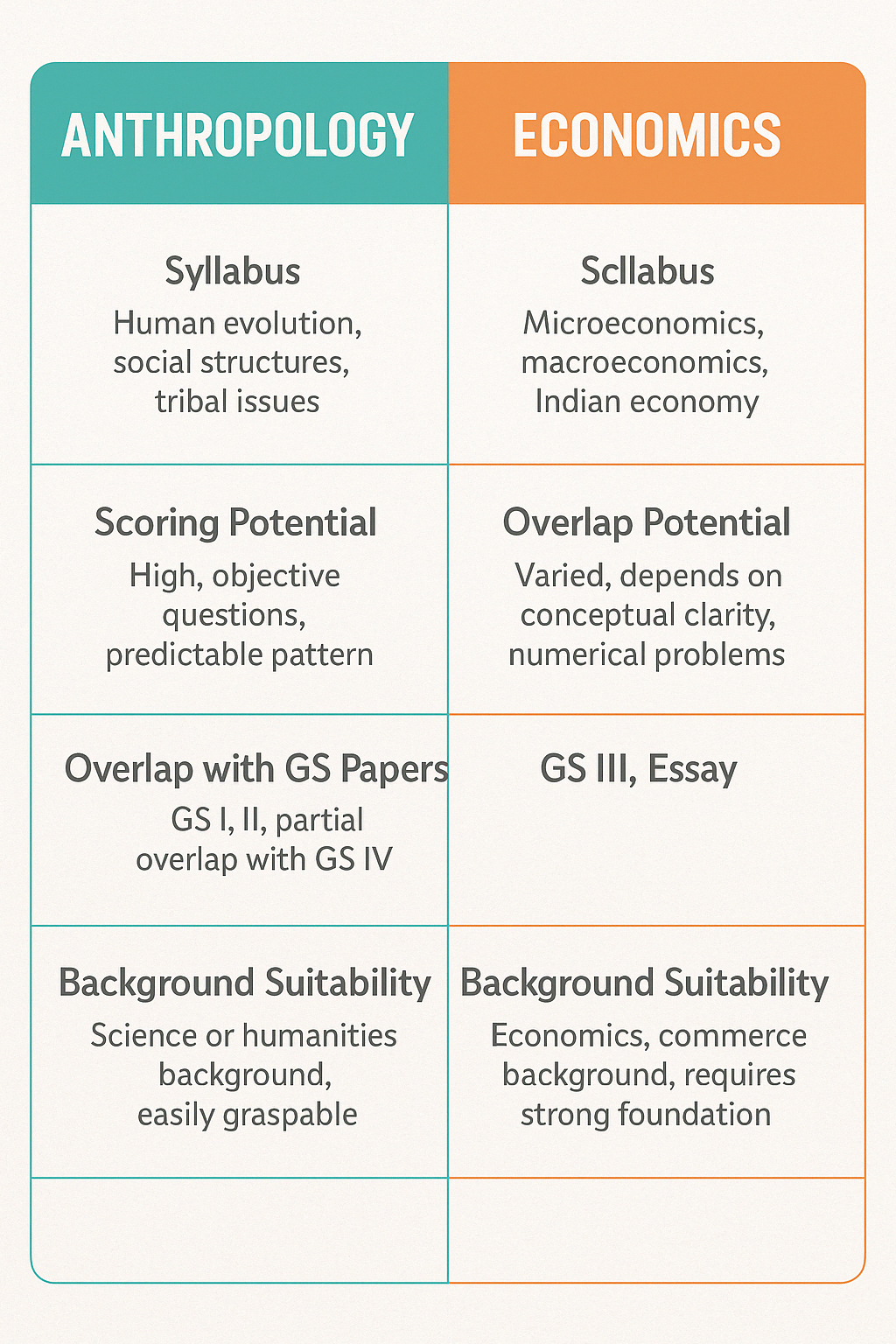
Choosing the right optional subject is one of the most critical decisions for UPSC Civil Services Examination (CSE) aspirants. The optional subject carries 500 marks in Mains and can significantly influence your overall score and rank. Among the many choices, Anthropology and Economics stand out — Anthropology for its concise syllabus and scoring potential, and Economics for its analytical approach and relevance to governance and development.
But which one is better for you? In this article, we provide a comprehensive comparison of Anthropology vs Economics optional for UPSC CSE to help you make the right decision based on syllabus structure, scoring trends, GS overlap, and coaching availability.
1. Understanding the Subjects
Anthropology is the holistic study of human evolution, biological aspects, culture, societies, and tribal communities. It offers a unique blend of natural and social sciences and is considered diagram-friendly and factual in approach. Many aspirants from science, engineering, and humanities backgrounds find it beginner-friendly.
Economics deals with microeconomics, macroeconomics, Indian economy post-independence, growth and development theories, and international economics. It is a dynamic subject and requires a deep understanding of concepts, graphs, and problem-solving abilities.
2. Syllabus Comparison
Anthropology syllabus:
- Paper I: General Anthropology — Physical, Socio-cultural, Archaeological, and Linguistic Anthropology
- Paper II: Indian Anthropology — Tribal issues, development programs, constitutional safeguards for tribal communities
Economics syllabus:
- Paper I: Microeconomics, Macroeconomics, International Trade, and Growth Theories
- Paper II: Indian Economy since Independence, Planning, Economic Reforms, Agriculture, Industry, and Foreign Trade
Verdict: Anthropology offers a concise and mostly static syllabus, while Economics requires mastery of technical concepts and current economic developments.
3. Scoring Potential and Past Performance
In recent years, Anthropology has proven to be a high-scoring optional. Many candidates have achieved 270+ marks due to its objective nature, predictable questions, and diagram-based answers. Toppers like Anudeep Durishetty (AIR 1, 2017) chose Anthropology and highlighted its scoring efficiency.
Economics can be highly rewarding for aspirants with a solid academic background in economics or commerce. However, scoring is less predictable due to the analytical and numerical nature of the subject.
As per a best Anthropology coaching, students consistently achieve high scores when supported by quality test series and proper answer writing guidance.
4. Overlap with General Studies and Essay
Anthropology overlaps with:
- GS Paper I: Indian Society, Tribal Issues, Cultural Heritage
- GS Paper II: Tribal Policies and Development Schemes
- GS Paper IV: Ethics (Human values, Social justice)
- Essay: Topics related to culture, society, and development
Economics overlaps with:
- GS Paper III: Indian Economy, Budget, Economic Survey, Growth and Development
- Essay: Economic reforms, globalization, inclusive growth, and related topics
- Interview: Enhances understanding of economic policy questions
Verdict: Anthropology helps with GS I, II, IV, and Essay, while Economics strengthens GS III, Essay, and Interview preparation.
5. Background Suitability
Anthropology is suitable for aspirants from any background — science, engineering, humanities, or commerce. Biology graduates may find Paper I easier due to human evolution and genetics portions.
Economics is ideal for aspirants with a background in economics, commerce, or mathematics. Non-economics students may face difficulty understanding advanced economic theories, graphs, and numerical concepts without prior knowledge.
Refer to this best Economics optional coaching to find mentors and resources if you are considering Economics as your optional.
6. Time Management and Preparation Strategy
Anthropology: With a static and well-structured syllabus, it can be completed within 3-4 months with proper planning. Answer writing practice and diagram enrichment are the keys to high scoring.
Economics: Requires longer preparation time, especially for non-economics graduates. In-depth understanding of both theoretical concepts and current affairs (budget, economy updates) is necessary.
7. Answer Writing and Paper Presentation
Anthropology answers: Structured, enriched with diagrams, flowcharts, and ethnographic examples. Diagrams in almost every answer are recommended for better marks.
Economics answers: Require clarity in presentation of economic theories, use of graphs, and precise explanation. Good mathematical reasoning and analytical writing are essential for securing high marks.
8. Guidance and Mentorship Availability
Top-notch faculty and test series are available for both subjects. For Anthropology, mentorship from experts like Dr. Huma Hassan from PlutusIAS is amongst best Anthropology optional teacher helps students with personalized guidance and test series.
For Economics, few good mentors are available, including Prateek Tripathi at Plutus IAS, known for structured preparation programs for Economics optional.
9. Previous Year Question Trends
Before finalizing your optional, analyzing previous year questions gives clarity on the paper’s depth and style. Visit the UPSC official previous year question papers segment to compare Anthropology and Economics paper trends.
10. Final Verdict: Anthropology vs Economics – Which One Should You Choose?
Both Anthropology and Economics have their own strengths and challenges. The decision depends on your academic background, interest level, and time commitment.
Choose Anthropology if:
- You want a scoring subject with a static syllabus and less dependency on current affairs.
- You are from any academic background and prefer factual, diagram-based answers.
- You are looking for GS overlap across GS I, II, IV, and Essay.
Choose Economics if:
- You have a background in economics, commerce, mathematics, or related fields.
- You enjoy analytical writing, problem-solving, and interpreting graphs.
- You want strong overlap with GS Paper III and enhance your economic policy understanding for interviews.
Conclusion
There is no universally “best optional.” The right choice depends on your own strengths, academic comfort, and passion for the subject. Both Anthropology and Economics have produced UPSC toppers in the past. With focused preparation, regular test practice, and good mentorship, success is achievable in either.
Explore the following helpful resources:
- Top Anthropology Coaching for UPSC
- Best Economics Optional Coaching for UPSC
- UPSC Previous Year Papers – Official Website
- Best Teachers and Mentors for UPSC Optionals

- HAL ने IAF को दो LCA ट्रेनर विमान सौंपे: सुरक्षा तैयारी में बड़ा कदम - September 19, 2026
- HAL delivers two LCA trainer jets to IAF: Key for UPSC & State PCS - September 19, 2026
- एनसीएल द्वारा शुरू हुआ ‘विशेष अभियान 6.0’: स्वच्छता और ई-कचरा प्रबंधन पर जोर - September 19, 2026

No Comments