


18 Mar Atomic Clock Failure in IRNSS-1F: Implications for India’s Strategic Autonomy
This article covers “Daily Current Affairs” and From Atomic Clock Failure in IRNSS-1F: Implications for India’s Strategic Autonomy
SYLLABUS MAPPING
GS-3- Science & Technology-Atomic Clock Failure in IRNSS-1F: Implications for India’s Strategic Autonomy
FOR PRELIMS
What are the implications of the IRNSS-1F failure on India’s NavIC?
FOR MAINS
What are the challenges faced by India’s navigation system?
Why in the News?
“IRNSS-1F satellite launched in March 2016 has completed its design mission life of 10 years on 10th March 2026. On 13th March 2026, procured on-board Atomic clock stopped functioning. However, the satellite will continue to function in-orbit for various societal applications to provide one way broadcast messaging services.”
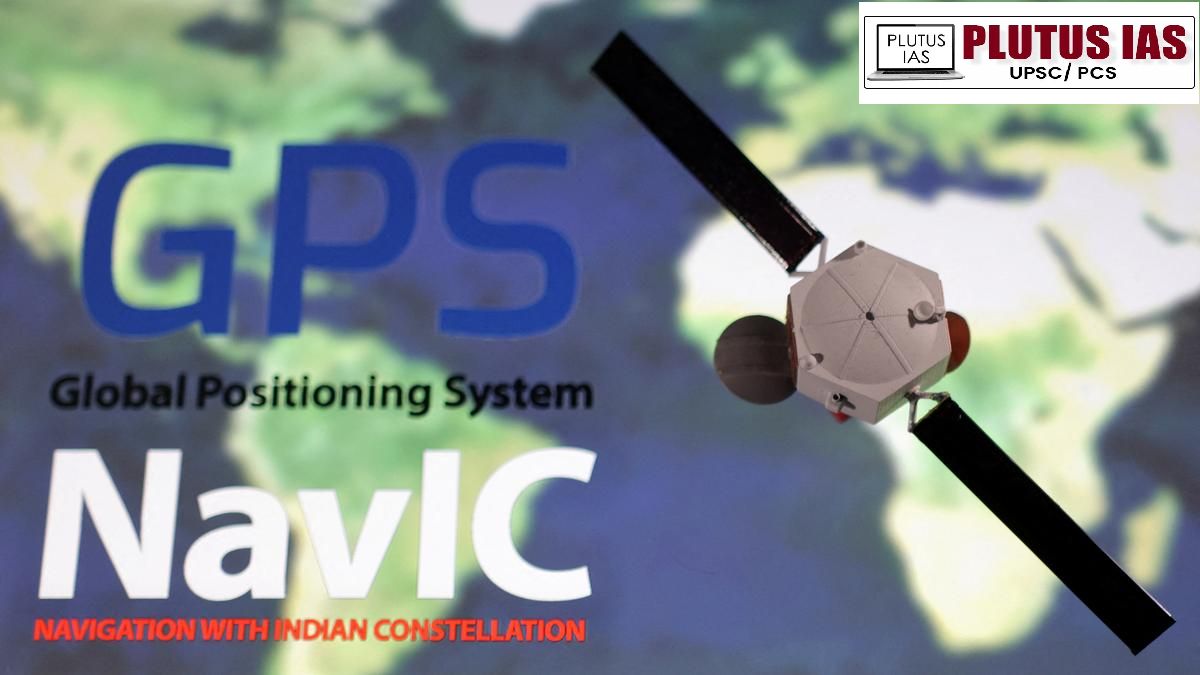
Technical Dimension: What Failed and Why It Matters
Each NavIC satellite carries 3 rubidium atomic clocks (highly precise, losing ~1 second in millions of years) for redundancy.
IRNSS-1F had already lost two clocks earlier; the third (last) clock failed on March 13, 2026 — shortly after end-of-design-life.
Impact: Satellite can no longer transmit accurate timestamps needed for Positioning, Navigation, and Timing (PNT) via trilateration.
Why atomic clocks are critical: GNSS relies on precise time synchronization (speed-of-light distance calculation). Failure = no reliable PNT from that satellite.
Constellation Status (as of March 2026)
Original Design: 7 satellites (3 GEO + 4 GSO) for India + 1,500 km coverage.
Total Launched: 11 satellites (including NVS series) since 2013.
Historical Failures: 6 satellites lost navigation capability (mostly imported clock failures + orbital issues like NVS-02 stuck in wrong orbit).
Pre-failure (July 2025 Parl reply): 4 satellites for full PNT; 4 for one-way messaging; 1 decommissioned; 2 failed to reach orbit.
Post-IRNSS-1F failure: Only 3 satellites provide PNT — IRNSS-1B (2014), IRNSS-1L (likely typo in some reports for 1I/2018), NVS-01 (2023, first indigenous clock).
Critical Threshold: Minimum 4 satellites required for accurate 3D positioning + time (trilateration principle). Below 4 → system “below optimal”, inconsistent coverage, degraded accuracy (not 24×7 reliable), potential outages.
Strategic & Security Dimension
Self-Reliance (Atmanirbhar Bharat): NavIC offers independence from US-controlled GPS (jamming/vulnerability in conflict).
Military Applications: Critical for missiles, drones, naval ops, border surveillance (better accuracy in Indian Ocean/region via S-band + L5).
Risk Exposed: With only 3 satellites, wartime denial/jamming becomes easier; forces may fallback to foreign GNSS → strategic vulnerability.
Civilian Dependence: Fisheries (alerts), precision agriculture, disaster management (GAGAN integration), transport, banking (timing), railways.
Key Features
1. Space & Aeronautics: NASA’s ISS spacewalks (94 & 95) to install solar arrays for extended operations Progress in X-59 quiet supersonic aircraft. Advancements in Artemis Programme for Moon missions
ISRO using RISAT & Cartosat satellites for glacier monitoring
2. Artificial Intelligence: AI systems outperforming humans in medical diagnosis. Expansion of AI in coding, research, and automation. China’s focus on AI leadership under its 15th Five-Year Plan (2026–2030)
3. Energy & Nuclear: Development of Small Modular Reactors (SMRs). Emergence of Sodium-ion batteries as alternatives to lithium-ion
4. Strategic & Navigation Systems: NavIC atomic clock failure raising reliability concerns Importance of indigenous navigation systems for strategic autonomy
5. Emerging Technologies: Advancements in quantum computing Innovations in biotechnology and enzyme research
Significance
1. Strengthening National Security: Enhances surveillance, intelligence gathering, and secure communication through advanced space, cyber, and navigation systems.
2. Effective Disaster Management: Enables early warning and monitoring of disasters, including glacier-related risks like Glacial Lake Outburst Flood.
3. Promoting Self-Reliance (Atmanirbharta): Reduces dependence on foreign technologies by boosting indigenous capabilities under Atmanirbhar Bharat.
4. Driving Economic Growth & Innovation: Stimulates high-tech industries, startups, and research, contributing to economic development and job creation.
5. Enhancing Global Competitiveness: Strengthens India’s position in global technological and strategic competition.
6. Expanding Civilian Applications: Improves public services like navigation through NavIC and supports sectors such as agriculture and urban planning.
Challenges & Root Causes
1. Repeated Clock Failures: Early IRNSS had high failure rate (imported clocks); pattern persists even post-design life.
2. Launch & Orbital Delays: NVS-02 failure (wrong orbit); slow NVS series (NVS-03 in assembly; 04–05 delayed).
3. Transparency Issues: No public NavIC performance reports since Q1 2021; ISRO avoids exact operational numbers.
4. Expansion Lag: Proposed MEO augmentation (12+ satellites for global coverage) not yet approved/launched.
5. Redundancy Shortfall: Aging first-gen satellites (1B from 2014) at risk of further failure.
Way Forward
1. Strengthening Indigenous R&D: Promote advanced research and innovation to build self-reliant capabilities in critical technologies.
2. Boosting Public-Private Partnerships: Enhance collaboration between government, industry, and startups for faster technological development.
3. Investing in Emerging Technologies: Prioritize sectors like AI, quantum computing, and space technology for future readiness.
4. Ensuring Data Protection & Ethical AI: Develop robust frameworks for data security and responsible use of artificial intelligence.
5. Building Climate-Resilient Infrastructure: Strengthen systems to manage climate risks and disasters effectively.
6. Enhancing Skill Development: Develop a skilled workforce aligned with next-generation technologies and innovation needs.
Conclusion
The failure of the atomic clock onboard IRNSS-1F highlights critical vulnerabilities in India’s NavIC system, particularly in terms of reliability and redundancy. With the constellation currently operating below the minimum threshold for accurate positioning, concerns over strategic autonomy and service reliability have intensified.
However, ongoing efforts toward indigenisation, especially with the NVS series and indigenous atomic clocks, signal a positive shift. Moving forward, timely satellite launches, technological upgrades, and enhanced transparency will be essential to ensure that NavIC evolves into a robust, self-reliant, and globally competitive navigation system.

Best ias coaching in delhi Best ias coaching in chandigarh
Prelims question:
Q. With reference to India’s technological and strategic advancements, consider the following statements:
1. NavIC is India’s indigenous navigation system used for both civilian and military purposes.
2. Atmanirbhar Bharat aims to reduce dependence on foreign technologies.
3. Glacial Lake Outburst Flood is primarily caused by volcanic eruptions.
Which of the statements given above is/are correct?
A. 1 and 2 only
B. 2 and 3 only
C. 1 only
D. 1, 2 and 3
Answer: A
Q. Discuss the significance of technological self-reliance in strengthening India’s national security, economic growth, and global competitiveness. Suggest suitable measures for achieving this goal.
(250 words)

- RBI’s Shrinking Real-Rate Cushion Amid Rising Inflation and Strong Demand - September 21, 2026
- India’s NGOs at a New Funding Crossroads - September 21, 2026
- Deep-Sea Discovery, Environmental Responsibility - September 19, 2026

No Comments