


13 Jun Axiom Mission-4: Strengthening India’s Role in International Human Spaceflight
This article covers “Daily Current Affairs” and the Topic Axiom Mission-4: Strengthening India’s Role in International Human Spaceflight
SYLLABUS MAPPING:
GS-3- Science and technology- Axiom Mission-4: Strengthening India’s Role in International Human Spaceflight
FOR PRELIMS
What is Axiom Mission-4? What is the importance of human spaceflight for India?
FOR MAINS
What is the role of ISRO in promoting global peace and cooperation in space?
Why in the News?
The Indian Space Research Organisation (ISRO) is actively collaborating with Axiom Space, NASA, and SpaceX following the delay of the Axiom Mission 4 (Ax-4) to the International Space Station (ISS). The postponement was necessitated due to technical issues, including a liquid oxygen (LOx) leak in the Falcon 9 rocket identified during post static fire inspections, and concerns related to the ISS Zvezda module. SpaceX announced the delay on June 11, emphasizing the need for additional time to carry out necessary repairs. ISRO, through a statement by its Chairman V. Narayanan, reaffirmed that the safety and integrity of the mission remain their top priorities as efforts continue to address these concerns responsibly.
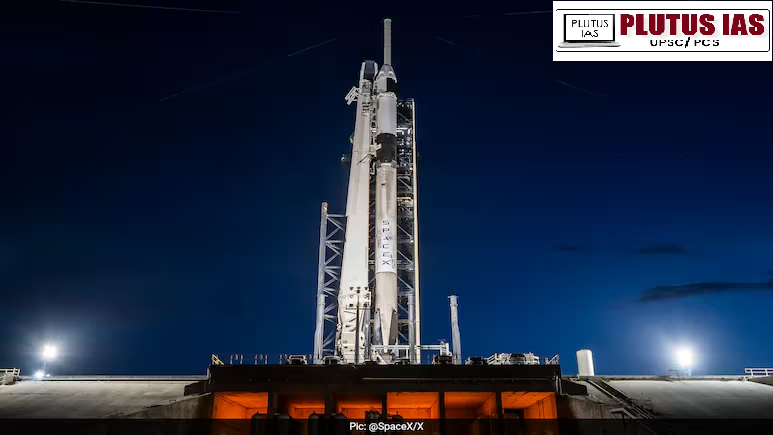
About Axiom-4 Mission
Mission Objectives
1. Conduct Microgravity Research: Perform advanced scientific experiments in life sciences, materials science, and biomedicine aboard the ISS.
2. Strengthen International Collaboration: Mark the first government-backed spaceflights for India, Poland, and Hungary, promoting global partnerships in space exploration.
3. Support Human Spaceflight Training: Provide real spaceflight experience to astronauts from emerging space nations, aiding future national missions like India’s Gaganyaan.
4. Test New Technologies: Validate critical technologies in space conditions, contributing to the development of future deep-space and commercial missions.
5. Advance Commercial Space Goals: Move toward Axiom Space’s vision of building the world’s first private space station by demonstrating commercial crewed mission capabilities.
6. Foster Peaceful Space Diplomacy: Strengthen cooperation among nations through joint missions, reinforcing the peaceful use of outer space.
7. Promote STEM Outreach: Inspire global youth and educators through live educational programs and demonstrations from space.
8. Prepare for Post-ISS Operations: Help establish operational models for commercial Low Earth Orbit missions after the ISS’s expected retirement by 2030.
Role of ISRO and India in the Ax-4 Mission
1. Astronaut Representation: The Ax-4 mission includes Group Captain Shubhanshu Shukla from the Indian Air Force, representing India’s growing role in international human spaceflight missions.
2. Support for Gaganyaan Preparation: Shukla’s participation provides valuable flight experience ahead of India’s indigenous human spaceflight program, Gaganyaan, enhancing operational readiness.
3. ISRO’s Coordination with Global Partners: ISRO is actively coordinating with Axiom Space, NASA, and SpaceX to ensure safety, mission success, and technical cooperation for Ax-4.
4. Strengthening India’s Global Space Presence: Through Ax-4, India demonstrates its commitment to space diplomacy and international collaboration in the domain of human space exploration.
5. Scientific Contribution: ISRO is facilitating the development of Indian scientific payloads and research modules to be conducted aboard the ISS by Shukla during the mission.
6. Public Engagement and Inspiration: The mission is expected to inspire Indian youth, promote STEM education, and raise awareness about India’s emerging status in the global space sector.
7. Pioneering Step in International Missions: This marks a historic first for India, with a government-sponsored astronaut participating in an international commercial space mission, setting the stage for deeper integration into future multilateral space ventures.
International Cooperation in Space Missions
1. Shared Scientific Goals: Countries collaborate to advance research in areas like climate change, deep space, and planetary science, boosting global scientific knowledge.
2. Cost and Risk Sharing: Joint missions help share the high financial and technical risks of space exploration, making large-scale projects like the ISS viable.
3. Strengthening Diplomacy: Space partnerships foster peaceful international ties, as seen in missions like Ax-4, NISAR (ISRO-NASA), and Chandrayaan-3 support by NASA.
4. Technology Transfer & Capacity Building: Emerging nations gain access to advanced technologies, training, and expertise, helping them build indigenous space capabilities.
5. Standardization & Data Sharing: Collaboration ensures system compatibility and global data exchange—vital for disaster response, Earth observation, and communications.
6. Boost to Commercial Space Sector: Cooperation enables private players like SpaceX to partner with global agencies, spurring innovation and growth in the space economy.
7. Future Space Governance: With ISS nearing retirement, joint missions are shaping post-ISS strategies and promoting a peaceful, rule-based space order.
India’s Growing Role in Global Space Missions
1. Axiom Mission-4 Participation: Group Captain Shubhanshu Shukla’s role marks India’s first government-backed astronaut in a global commercial mission.
2. Boost to Gaganyaan: International missions offer real-time experience, aiding India’s upcoming human spaceflight program.
3. Strategic Collaborations: ISRO partners with NASA (NISAR), CNES (Megha-Tropiques), and others, reinforcing global trust.
4. Commercial Launch Hub: Over 430 foreign satellites launched by ISRO highlight its role as a low-cost, reliable launch provider.
5. Scientific Contributions: Missions like Chandrayaan and Mangalyaan have enriched global space science with valuable data.
6. Advanced Payload Development: India provides sophisticated instruments to international missions, enhancing technological reputation.
7. Space Diplomacy: India advocates peaceful, inclusive space use, gaining leadership among developing nations
Conclusion
India’s participation in Ax-4 highlights its rising global profile in space exploration, combining scientific ambition, international cooperation, and technological capability. As the world moves toward commercial space stations and post-ISS missions, India is positioning itself as a vital player in the future of human spaceflight and space diplomacy.
Prelims Questions
Q. Consider the following statements regarding the Axiom Mission-4 (Ax-4):
1. It involves collaboration between ISRO, NASA, SpaceX, and Axiom Space.
2. It marks the first time a government-sponsored Indian astronaut is participating in an ISS mission.
3. It aims to conduct scientific experiments aboard the ISS in a microgravity environment.
Which of the statements given above are correct?
(a) 1 and 2 only
(b) 2 and 3 only
(c) 1 and 3 only
(d) 1, 2 and 3
Answer: D
Mains Questions
Q. India’s participation in the Axiom Mission-4 marks a milestone in its space diplomacy and human spaceflight capability. Discuss the significance of this mission in the context of India’s broader space ambitions and international collaborations.
(250 words, 15 marks)

- Europe’s AI Rules May Become India’s Opportunity - August 14, 2026
- Transparency as the Foundation of Trust in Medicine - August 14, 2026
- A Timely Reset for the Food Security Act: From Foodgrain Security to Nutrition Security - August 13, 2026

No Comments