


03 Nov Ayushman Bharat: Advancing Universal Health Coverage for a Healthy and Resilient India
This article covers “Daily Current Affairs” and From Ayushman Bharat: Advancing Universal Health Coverage for a Healthy and Resilient India
SYLLABUS MAPPING
GS- 2 – Governance, Social Justice, and Welfare Schemes- Ayushman Bharat: Advancing Universal Health Coverage for a Healthy and Resilient India
FOR PRELIMS
What is Ayushman Bharat?
FOR MAINS
What are the major components of the Ayushman Bharat programme?
Why in the News?
The Government of India has reaffirmed its commitment to achieving Universal Health Coverage (UHC) as part of the Viksit Bharat@2047 vision. Emphasizing that investing in healthcare strengthens community resilience and productivity, the government continues to expand access to affordable, quality healthcare through flagship initiatives like Ayushman Bharat – Pradhan Mantri Jan Aarogya Yojana (AB-PMJAY).
Launched on September 23, 2018, AB-PMJAY has become the world’s largest public health insurance scheme, providing cashless treatment to crores of vulnerable families. Guided by the National Health Policy 2017, this renewed focus aims to ensure “Sabka Saath, Sabka Vikas” by bridging healthcare gaps, addressing both communicable and non-communicable diseases, and moving India closer to its goal of Healthy India, Viksit Bharat.
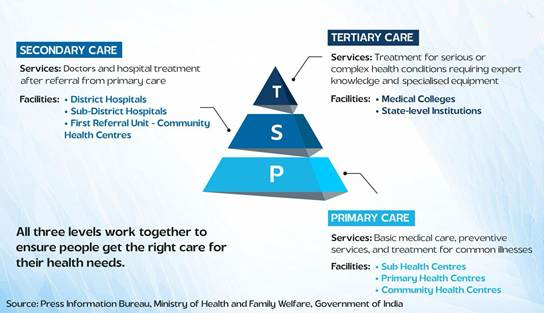
Ayushman Bharat – Pradhan Mantri Jan Arogya Yojana
AB-PMJAY provides healthcare coverage up to Rs. 5 lakhs per year for secondary and tertiary care services and hospitalization to enrolled socio-economically deprived families, saving them from catastrophic medical bills. The scheme provides cashless treatment across empanelled government-funded and private hospitals.
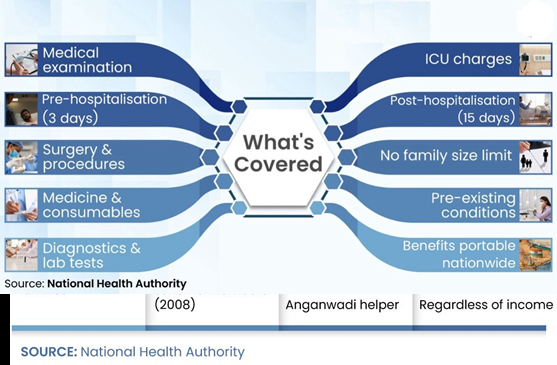
Progress on AB-PMJAY Scheme
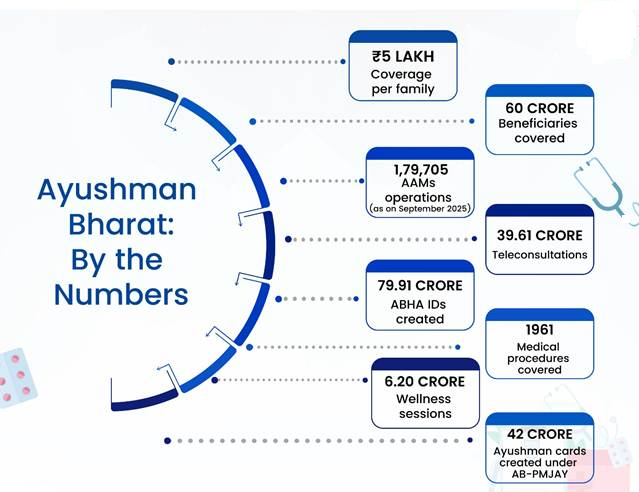
Since its launch, AB-PMJAY has saved families over Rs. 1.52 lakh crores in out-of-pocket healthcare expenses, according to the latest Economic Survey of India (2024-25). As of Oct. 1, 2025, AB-PMJAY has over 42 crore people enrolled, according to the Ayushman cards created for the scheme’s beneficiaries. More than 86.51 lakh senior citizens over 70 years have been provided Ayushman Vay Vandana (VVS) Cards. Over 33,000 hospitals across the country – 17,685 public and 15,380 private – are empaneled under AB-PMJAY.
Lakhs of people availed all kinds of healthcare services under the scheme (as on Oct. 28, 2025).
| Speciality Name | Total Count (No. of Beneficiaries) | Total Amount (in ₹) |
|---|---|---|
| General Medicine | 2,17,41,389 | 1,83,72,55,35,263 |
| Ophthalmology | 44,99,544 | 25,21,85,29,234 |
| Medical Oncology | 41,41,188 | 45,97,11,90,452 |
| Obstetrics & Gynaecology | 35,64,071 | 26,92,15,05,469 |
| General Surgery | 33,34,123 | 51,35,98,83,676 |
| Orthopaedics | 24,45,678 | 81,18,52,82,099 |
| Urology | 19,95,470 | 36,60,39,74,579 |
| Emergency Room Packages (less than 12 hrs stay) | 19,76,059 | 3,09,70,80,136 |
| Cardiology | 12,82,206 | 86,73,06,06,349 |
| Neo-natal Care | 11,04,752 | 23,20,06,53,194 |
AB-PMJAY Budget
The scheme is fully funded by the Government of India and respective state and union-territory governments, both sharing the costs of implementation. The union government’s budget estimates have increased over the past few years, with a budget of Rs. 9,406 crore estimated for 2025-26.
Union Budget for AB-PMJAY over the years:
| Financial Year | Budget Estimate (₹ in crore) |
|---|---|
| 2019–20 | 6,556 |
| 2020–21 | 6,429 |
| 2021–22 | 6,401 |
| 2022–23 | 7,857 |
| 2023–24 | 7,200 |
| 2024–25 | 7,500 |
| 2025–26 | 9,406 |
Ayushman Arogya Mandirs
Ayushman Arogya Mandirs (AAM), the second pillar of Ayushman Bharat, makes primary healthcare more accessible and closer to people’s homes. They are envisaged to deliver expanded range services that go beyond maternal and child health care services to include care for non-communicable diseases, palliative and rehabilitative care, oral, eye and ENT care, mental health and first-level care for emergencies and trauma, including free essential drugs and diagnostic services.
AAMs, which include primary and sub-health care centres, are equipped with all the required resources including:
Upgraded infrastructure
Additional human resources
Essential drugs and diagnostics
IT systems, etc.
Teleconsultation services are also available at all operational AAMs across the country, including in rural areas. More than 39.61 crore teleconsultations were conducted at the AAMs (as of Sept. 2025).
Ayushman Bharat Digital Mission
ABHA creates unique health identification numbers for people in the healthcare ecosystem. This enables continuity of care across the various levels of healthcare and the availability of services everywhere, including in remote and rural areas.
Progress on the scheme (as of Aug. 5, 2025):
79,91,18,072 ABHAs accounts created
4,18,964 health facilities have been registered on HFR
6,79,692 healthcare professionals have been registered on HPR
67,19,65,690 health records have been linked with ABHA\
PM–Ayushman Bharat Health Infrastructure Mission
During COVID-19, the Indian government responded quickly using a whole-of-government approach. The pandemic showed that India’s health systems needed better facilities at all levels – from local clinics to major hospitals. To address these gaps, the PM-Ayushman Bharat Health Infrastructure Mission (PM-ABHIM) was launched on Oct. 25, 2021, as part of the Budget 2021-22.
The main goal of PM-ABHIM is to fix critical gaps in health infrastructure, disease monitoring, and health research across both cities and villages, so India can handle future pandemics independently. It is the largest public health infrastructure scheme in India since 2005, with a total budget of Rs. 64,180 crore for the period 2021-2026. Of this amount, Rs. 54,205 crore is allocated for state-level programs, while Rs. 9,340 crore is for central programs. This is a major 5-year plan to upgrade India’s hospitals, clinics, and health research facilities nationwide, making the country better prepared for future health emergencies.
Ayushman Bharat Scheme: Performance Overview
Progress on the scheme as of 2025:
Between the fiscal years 2022-23 and 2024-25, states and union territories collectively spent over Rs. 5,000 crore on the development and operation of Ayushman Arogya Mandirs.
Conclusion
AB-PMJAY ensures the vulnerable sections of society get access to quality and affordable healthcare, and the Ayushman Arogya Mandirs bring primary healthcare closer to people’s homes. The ABHA (Ayushman Bharat Health Account) scheme provides every citizen with a unique digital health ID to maintain their health records seamlessly across facilities. PM- ABHIM strengthens the underlying healthcare infrastructure—building hospitals, labs, and health centres from village to district level—to ensure the system can deliver quality care and respond to emergencies.
Together, these schemes under Ayushman Bharat and the Ministry of Health and Family Welfare provide affordable, good quality and comprehensive healthcare, ensuring universal health coverage for all.
Prelims question:
Q. Consider the following statements regarding Ayushman Bharat – Pradhan Mantri Jan Arogya Yojana (AB-PMJAY):
1. It provides health coverage of up to ₹5 lakh per family per year for secondary and tertiary care hospitalization.
2. The scheme is fully funded by the Central Government only.
3. Beneficiaries can avail of cashless treatment at both public and private empanelled hospitals.
Which of the statements given above is/are correct?
(a) 1 and 3 only
(b) 2 and 3 only
(c) 1 only
(d) 1, 2 and 3
Answer: A
Mains Question:
Q. Discuss how Ayushman Bharat and its sub-missions, PMJAY, Ayushman Arogya Mandirs, Ayushman Bharat Digital Mission, and PM-Ayushman Bharat Health Infrastructure Mission collectively contribute to achieving Universal Health Coverage in India.
(250 words)

- Europe’s AI Rules May Become India’s Opportunity - August 14, 2026
- Transparency as the Foundation of Trust in Medicine - August 14, 2026
- A Timely Reset for the Food Security Act: From Foodgrain Security to Nutrition Security - August 13, 2026

No Comments