


10 Jan Bal Vivah Mukt Bharat Initiative: A Renewed National Push to Eliminate Child Marriage
This articlecovers “Daily Current Affairs” and From Bal Vivah Mukt Bharat Initiative: A Renewed National Push to Eliminate Child Marriage
SYLLABUS MAPPING
GS-1- Indian Society & Social Issues- Bal Vivah Mukt Bharat Initiative: A Renewed National Push to Eliminate Child Marriage
FOR PRELIMS
What is child marriage? Why does it continue in India despite legal prohibition?
FOR MAINS
What are the key provisions of the Prohibition of Child Marriage Act, 2006?
Why in the News?
Despite being legally prohibited, child marriage continues to remain a deep-rooted social challenge in India, undermining the health, dignity, and future of millions of children—particularly girls. Early marriage exposes girls to life-threatening early pregnancies, domestic violence, school dropouts, and inter-generational poverty. According to NFHS-5 (2019–21), 23% of women aged 20–24 were married before 18, reflecting the persistence of this practice despite legal safeguards. Against this backdrop, the Bal Vivah Mukt Bharat (BVMB) initiative represents a decisive national commitment to eliminate child marriage and uphold children’s constitutional and human rights.
What Constitutes Child Marriage in India
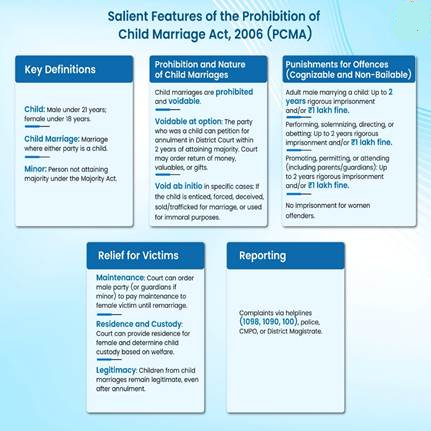
Under the Prohibition of Child Marriage Act (PCMA), 2006, a child marriage is defined as any marriage where:
the female is below 18 years, or
the male is below 21 years.
Child marriage is not merely a social evil but a serious criminal offence. The Bharatiya Nyaya Sanhita, 2023 clarifies that sexual relations with a wife below 18 years constitute rape, while the Supreme Court of India has further ruled that sexual assault by a husband on a minor wife amounts to aggravated penetrative sexual assault under the POCSO Act, 2012. Thus, child marriage is now firmly embedded within India’s criminal justice framework.
India’s Long Struggle Against Child Marriage
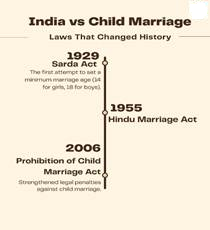
India’s fight against child marriage dates back to the 19th-century social reform movement, led by reformers such as Raja Rammohan Roy, Ishwar Chandra Vidyasagar, and Jyotirao Phule. Legislative milestones include:
Age of Consent Act, 1891
Child Marriage Restraint (Sarda) Act, 1929
Amendments in 1948 and 1978, raising the minimum age
Prohibition of Child Marriage Act, 2006, shifting the focus from restraint to prohibition
Complementing legal reforms, flagship initiatives like Beti Bachao Beti Padhao (2015) sought to transform societal attitudes, promote girls’ education, and empower communities.
Prohibition of Child Marriage Act, 2006: Key Provisions
The PCMA, 2006 provides a robust legal framework:
1. Child marriages are voidable at the option of the child
2. Void ab initio in cases involving trafficking, force, or deceit
3. Cognizable and non-bailable offences, with penalties up to 2 years imprisonment and/or ₹1 lakh fine
4. Appointment of Child Marriage Prohibition Officers (CMPOs)
5. Powers to issue injunctions to prevent impending child marriages
Bal Vivah Mukt Bharat (BVMB): Vision and Objectives
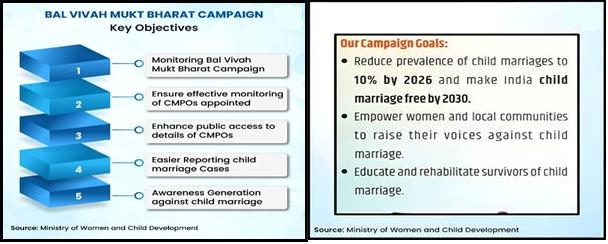
Launched on 27 November 2024 by the Ministry of Women and Child Development, Bal Vivah Mukt Bharat aims to:
Reduce child marriage prevalence by 10% by 2026
Eliminate child marriage completely by 2030
The initiative aligns with:
- SDG 5.3 (Elimination of harmful practices)
- Article 21 of the Constitution
- UN Convention on the Rights of the Child
BVMB adopts a technology-driven, multi-sectoral, prevention-first approach, integrating legal enforcement with education, health, nutrition, and rural development.
Supreme Court’s 2024 Landmark Judgment
In Society for Enlightenment and Voluntary Action vs Union of India (2024), the Supreme Court issued comprehensive directions:
1. Prohibition of child betrothals
2. Appointment of full-time CMPOs
3. Establishment of Special Child Marriage Prohibition Units
4. Mandatory awareness campaigns through schools, Anganwadis, NGOs, and religious leaders
5. Technology-enabled reporting and district-level risk mapping
100-Day National Campaign (December 2025–March 2026)
To generate momentum, a 100-day special drive was launched nationwide, featuring:
1. Monthly thematic outreach
2. National pledge-taking ceremonies
3. Community-level monitoring
Incentive Mechanisms
1. Child Marriage-Free Village Certificate
2. Bal Vivah Mukt Bharat Yodha Award for top-performing districts
Bal Vivah Mukt Bharat Portal
The BVMB portal serves as a centralized digital platform for:
1. Listing CMPOs across India
2. Real-time case reporting
3. Monitoring awareness activities
4. Geo-tagged progress tracking
Implementation and Convergence (BVMB)
1. State-led execution: State governments act as the primary implementing agencies, ensuring contextualised and decentralised action against child marriage.
2. District-level task forces: Constituted under the supervision of Chief Secretaries, involving District Magistrates, CMPOs, police, NGOs, and PRIs for coordinated prevention.
3. Dedicated monitoring mechanism: Weekly reviews and geo-tagged reporting through the BVMB portal enable real-time tracking and early intervention.
4. Targeted district approach: Focus on 257 high-burden districts identified by NFHS-5, allowing resource prioritisation and risk-based planning.
Multi-sectoral convergence:
1. Education: Prevent school dropouts, promote girls’ secondary education.
2. Health & Nutrition: Anganwadis, ASHAs, POSHAN Abhiyaan address early pregnancy, anaemia, and maternal risks.
3. Panchayati Raj Institutions: Gram Sabhas, SHGs, and local leaders act as community watchdogs and change agents.
Progress and Global Recognition
1. Proactive enforcement: Heightened vigilance during high-risk periods (e.g., Akshaya Tritiya 2025) prevented mass child marriages.
2. Legal interventions: Increased use of injunctions under PCMA, counselling of families, and FIRs where required.
3. Strengthened institutional capacity: Full-time Child Marriage Prohibition Officers (CMPOs) and linkage with Child Helpline 1098 improved response time.
4. Shift in approach: From punitive action to prevention, protection, and rehabilitation of vulnerable children.
5. Global endorsement:
UNICEF support for data analytics, district risk mapping, and capacity building.
Alignment with SDG 5.3, positioning India as a regional leader in South Asia on eliminating child marriage.
Chhattisgarh: Model State for Child Marriage-Free India
1. Balod district milestone: First child marriage-free district in India (2025) with zero cases for two consecutive years.
2. Comprehensive coverage: Success across 436 Gram Panchayats and urban local bodies through enforcement and awareness.
3. Surajpur district achievement: 75 Child Marriage-Free Panchayats declared in September 2025 during Poshan Maah.
4. Community-led vigilance: Active role of PRIs, schools, SHGs, and frontline workers in prevention.
5. Future vision: Chhattisgarh aims to become entirely child marriage-free by 2028–29, offering a replicable governance model.
Conclusion
India’s journey from colonial-era reforms to the transformative Bal Vivah Mukt Bharat mission reflects a growing commitment to child rights and gender justice. Strengthened by the 2024 Supreme Court judgment, technology-enabled governance, grassroots participation, and inter-sectoral convergence, BVMB represents a decisive leap towards prevention rather than mere penalisation. As India marches towards Viksit Bharat 2047, eliminating child marriage is not only a legal or moral imperative but a foundational step toward inclusive development, gender equality, and human dignity. With sustained political will and community ownership, a child marriage-free India by 2030 is an achievable reality.
link: Best ias coaching in delhi Best ias coaching in delhi
Prelims question:
Q. With reference to the Bal Vivah Mukt Bharat (BVMB) initiative, consider the following statements:
1. It aims to eliminate child marriage in India completely by the year 2030.
2. The initiative is aligned with Sustainable Development Goal (SDG) 5.3.
3. Under the Prohibition of Child Marriage Act, 2006, all child marriages are void ab initio.
4. The BVMB portal enables real-time reporting and geo-tagged monitoring of child marriage cases.
Which of the statements given above are correct?
(a) 1, 2 and 4 only
(b) 1 and 3 only
(c) 2, 3 and 4 only
(d) 1, 2, 3 and 4
Answer: A
Q. Despite a strong legal framework, child marriage continues to persist in India. In this context, examine the significance of the Bal Vivah Mukt Bharat initiative in addressing the structural and social dimensions of child marriage.
(250 words)

- RBI’s Shrinking Real-Rate Cushion Amid Rising Inflation and Strong Demand - September 21, 2026
- India’s NGOs at a New Funding Crossroads - September 21, 2026
- Deep-Sea Discovery, Environmental Responsibility - September 19, 2026

No Comments