22 Aug Balancing Innovation with Protection: The Online Gaming Bill, 2025
Posted at 22 Aug 2025
in
Current Affairs
by Suhani
This article covers “Daily Current Affairs” and the Balancing Innovation with Protection: The Online Gaming Bill, 2025
SYLLABUS MAPPING:
GS-2 and 3- Governance and Technology- Balancing Innovation with Protection: The Online Gaming Bill, 2025
FOR PRELIMS
What challenges may arise in the implementation of the Bill?
FOR MAINS
What are the key objectives of the Promotion and Regulation of Online Gaming Bill, 2025?
Why in the News?
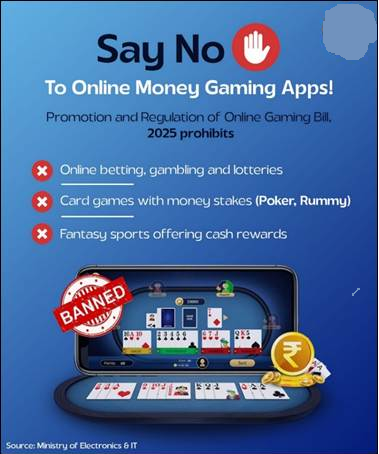
The Promotion and Regulation of Online Gaming Bill, 2025, passed by the Parliament on 21st August 2025, marks a landmark move to shield citizens from the menace of online money games while promoting and regulating other kinds of online games. This legislation is designed to curb addiction, financial ruin and social distress caused by predatory gaming platforms that thrive on misleading promises of quick wealth. It reflects the Government’s resolve to safeguard families while guiding the digital economy towards safe and constructive growth.
The seriousness of the issue is recognised globally. The World Health Organization classifies gaming disorder as a health condition in its International Classification of Diseases, describing it as a pattern of play marked by loss of control, neglect of other daily activities, and persistence despite harmful consequences. This highlights why decisive action is necessary in India as well.
Online money gaming platforms have caused widespread harm. Families have lost their savings. Young people have fallen into addiction. In some heartbreaking cases, financial distress linked to these games has even led to suicides. The Government has recognised these dangers and responded with strong legislation.
At the same time, the Bill takes a balanced approach. It recognizes the online gaming sector as one of the most dynamic segments of the digital and creative economy, with significant opportunities for innovation, cognitive development, employment generation, technological advancement and global competitiveness. It encourages e-sports, which are organised competitive video games, and promotes safe online social and educational games. It clearly separates constructive digital recreation from betting, gambling and fantasy money games that exploit users with false promises of profit.
Understanding the Online Gaming Sector
1. Esports: This refers to competitive digital sports where teams or individuals participate in organised tournaments. Success in esports requires strategy, coordination, and advanced decision-making skills.
2. Online Social Games: These are casual games that form part of everyday recreation. They are primarily skill-based and designed for entertainment, learning, or social interaction. Such games are generally considered safe and do not cause negative social consequences.
3. Online Money Games: This segment involves games where financial stakes are involved, whether based on chance, skill, or a combination of both. These platforms have raised serious concerns due to reports of addiction, financial losses, money laundering, and even cases of suicide linked to heavy monetary losses.
Why the Bill Was Needed
The rapid spread of online money games has created serious risks for individuals, families and the nation. While digital technology has brought many benefits, these games have exploited loopholes in the law and caused deep social harm. Speaking in the Rajya Sabha, Union Minister for Electronics and Information Technology, Shri Ashwini Vaishnaw, said that according to an estimate, 45 crore people are negatively affected by online money games and faced a loss of more than Rs. 20,000 crores because of it. The Government has acted to close these gaps and protect citizens.
At the same tim,e the online gaming sector is one of the most dynamic and fast-growing segments of the digital and creative economy. India is emerging as a major game-making hub with rapidly developing capabilities. The sector offers immense opportunities for innovation, employment generation, and global competitiveness. However, there is a lack of a coherent and enabling legal framework that can promote structured growth of the sector and allow responsible gaming practices to evolve. Urgent policy intervention was therefore required for the sector.
Further, many gaming platforms operate from offshore jurisdictions.
The key reasons are:
1. Addiction and Financial Ruin: Online money games encourage compulsive playing. Many players lose their entire savings chasing the illusion of quick profits. Families have been pushed into debt and distress.
2. Mental Health and Suicides: The stress of heavy financial loss has led to cases of depression and even suicide. The Bill seeks to prevent such tragedies by banning these exploitative platforms.
3. Fraud and Money Laundering; Several platforms have been misused for illegal activities. Money laundering, which means moving illegal earnings through legal channels to hide their source, has been a major concern.
4. Threat to National Security: Investigations have shown that some gaming platforms were being used for terror financing and illegal messaging, which compromise the country’s security.
5. Closing Legal Loopholes: Gambling and betting are already restricted under Indian laws such as the Bharatiya Nyaya Sanhita, 2023, and by various state legislations. But the online domain remained largely unregulated. The Bill ensures that the same standards apply in both physical and digital spaces.
6. Encouraging Healthy Alternatives: The Bill also makes space for positive digital engagement. E-sports will be promoted as a legitimate sport, while social and educational games that build skills and cultural values will receive government support.
Promotion and Regulation of Online Gaming Bill, 2025 – Key Provisions
| S. No. |
Provision |
Key Details |
| 1 |
Applicability |
Applies across India.
Covers services offered within India as well as those operated from outside but accessible in the country. |
| 2 |
Promotion and Recognition of E-Sports |
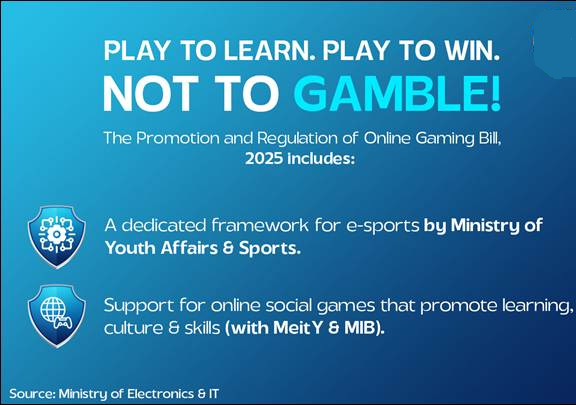
E-sports recognised as a legitimate competitive sport.
Ministry of Youth Affairs & Sports to frame guidelines and standards.
Establishment of academies, research centres, technology platforms.
Incentives and awareness programmes to integrate e-sports with national sports policy. |
| 3 |
Promotion of Social & Educational Games |
Central Govt. empowered to recognise and register safe, age-appropriate social games.
Focus on education, culture, skill development.
Dedicated platforms for content distribution.
Awareness campaigns to promote digital literacy & healthy recreation. |
| 4 |
Prohibition of Harmful Online Money Games |
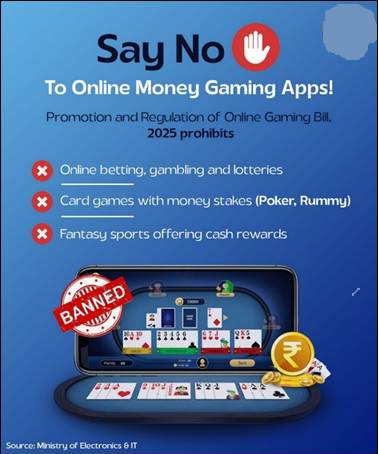
Complete ban on money-based games (chance, skill, hybrid).
Advertising & promotion prohibited.
Banks & payment systems barred from processing transactions.
Authorities can block unlawful platforms under IT Act, 2000. |
| 5 |
Establishment of Online Gaming Authority |
National-level authority to be created (or existing one designated).
Functions: register & categorise games, decide if a game is money-based, handle public grievances, issue codes of practice. |
| 6 |
Offences & Penalties |
Offering/facilitating money games: 3 yrs jail + ₹1 crore fine.
Related financial transactions: same punishment.
Advertising: 2 yrs jail + ₹50 lakh fine.
Repeat offences: 5 years jail + ₹2 crore fine.
Offences cognisable & non-bailable. |
| 7 |
Corporate & Institutional Liability |
Companies & officers accountable.
Independent/non-executive directors exempt if due diligence shown. |
| 8 |
Powers of Investigation & Enforcement |
Govt. officers authorised to investigate, search, and seize property.
Power to enter premises & arrest without warrant in serious cases.
Investigations under Bharatiya Nagarik Suraksha Sanhita, 2023. |
| 9 |
Rule-Making Powers |
Central Govt. can make rules on:
• Promotion of e-sports & social games.
• Recognition & registration of online games.
• Functioning of Online Gaming Authority.
• Any other matter under the law. |
Promotion and Regulation of Online Gaming Bill, 2025 – Benefits to Society
| S. No. |
Benefit Area |
Key Details |
| 1 |
Boost to Creative Economy |
Strengthens India’s position as a digital creativity hub.
Promotes exports, jobs, start-ups, and innovation.
Expands India’s share in the global digital economy. |
| 2 |
Empowering Youth |
Provides safe and constructive digital avenues.
E-sports and skill-based games enhance confidence, teamwork, and discipline.
Opens career pathways for talented young players. |
| 3 |
Safer Digital Environment |
Protects families from predatory money gaming practices.
Prevents financial losses, addiction, and distress.
Ensures a healthier and more secure digital ecosystem. |
| 4 |
Strengthening Global Leadership |
Positions India as a global leader in responsible gaming policy.
Balances innovation with social protection.
Serves as a model for other nations facing similar challenges. |
Other Notable Initiatives to Counter the Risks of Online Gaming
The Government has introduced several measures to protect citizens from the dangers of online gaming. These include addiction, financial fraud, money laundering and cybercrime.
Existing Legal and Regulatory Framework on Online Gaming in India
| Law / Mechanism |
Key Provisions / Steps Taken |
| Information Technology Act, 2000 & IT Rules (2021, amended 2023) |
– Online gaming intermediaries must ensure no unlawful/illegal content is shared.
– Money game intermediaries must register with Self-Regulatory Bodies (SRBs).
– SRBs verify whether a game is permissible or not.
– Section 69A empowers govt. to block illegal websites/links.
– 1,524 betting & gambling sites/apps blocked (2022–June 2025). |
| Bharatiya Nyaya Sanhita (BNS), 2023 |
– Section 111: Penalises unlawful economic activities & cybercrimes.
– Section 112: Punishment for unauthorised betting & gambling → 1–7 years imprisonment + fines. |
| Integrated Goods & Services Tax Act (IGST), 2017 |
– Offshore/illegal platforms regulated under IGST Act.
– Online money gaming suppliers must register under Simplified Registration Scheme.
– Directorate General of GST Intelligence can block unregistered/non-compliant platforms.
– Ensures digital entities follow taxation rules like physical businesses. |
| Consumer Protection Act, 2019 |
– Prohibits misleading and surrogate advertisements.
– CCPA empowered to investigate, penalise, and take action.
– Advisories issued to prevent celebrities/influencers from endorsing betting platforms. |
| Advisories by Ministries |
– MIB (2022–2024): Warnings to media, advertisers, influencers against misleading online betting ads.
– Ministry of Education: Issued guidelines for parents/teachers on safe gaming habits. |
| Reporting of Cybercrimes |
– Citizens can report via National Cyber Crime Reporting Portal (cybercrime.gov.in).
– Complaints forwarded to state/UT law enforcement.
– Special section for financial frauds.
– Toll-free helpline 1930 available for quick reporting. |
Conclusion
The Promotion and Regulation of Online Gaming Bill, 2025, marks a decisive step in India’s digital journey. It recognises the dangers of unregulated money gaming and responds with firm safeguards to protect citizens. At the same time, it carves out space for e-sports and educational games that nurture skills and creativity. By balancing innovation with responsibility, the Bill sets the tone for a safer and healthier digital future. It also strengthens India’s standing as a nation that can lead in shaping global digital policy. Most importantly, it ensures that technology serves society rather than harms it.
Prelims Questions
Q. With reference to the “Promotion and Regulation of Online Gaming Bill, 2025”, consider the following statements:
1. The Bill completely prohibits online money games, whether based on skill, chance, or hybrid formats.
2. It establishes a national-level Online Gaming Authority to regulate and categorise games.
3. The Bill empowers the Central Government to frame rules for the promotion of e-sports and educational games.
4. Advertising and promotion of e-sports tournaments will require prior approval of the Reserve Bank of India (RBI).
Which of the statements given above is/are correct?
(a) 1 and 2 only
(b) 1, 2, and 3 only
(c) 2, 3 and 4 only
(d) 1, 2, 3 and 4
Answer: B
Mains Questions
Q. The Promotion and Regulation of Online Gaming Bill, 2025 seeks to balance digital innovation with social protection. Discuss the key provisions of the Bill and analyse its significance in addressing challenges of online gaming in India
(250 words, 15 marks)





No Comments