


20 Sep Balancing Power in West Asia: India’s Response to the Saudi–Pakistan Defense Pact
This article covers “Daily Current Affairs” and Topic details ” Balancing Power in West Asia: India’s Response to the Saudi–Pakistan Defense Pact
SYLLABUS MAPPING:
GS– 2 and 3 -International Relations & Security dimensions- Balancing Power in West Asia: India’s Response to the Saudi–Pakistan Defense Pact
FOR PRELIMS
What are the main provisions of the Saudi–Pakistan defense agreement?
FOR MAINS
What is the significance of linking economic support with defense cooperation in this pact?
Why in the News?
Saudi Arabia and Pakistan signed a Strategic Mutual Defense Agreement in Riyadh, marking a significant shift in the security dynamics of West Asia. The pact has been announced at a time when Gulf nations are increasingly concerned about Israel’s recent military strikes and the possibility of Iran acquiring nuclear weapons, both of which pose serious threats to regional stability. The agreement is viewed as a strategic move that combines Saudi Arabia’s vast financial resources with Pakistan’s nuclear-capable military strength, thereby altering the balance of power and raising wide-ranging implications not only for the Gulf but also for South Asia and the broader global security architecture. 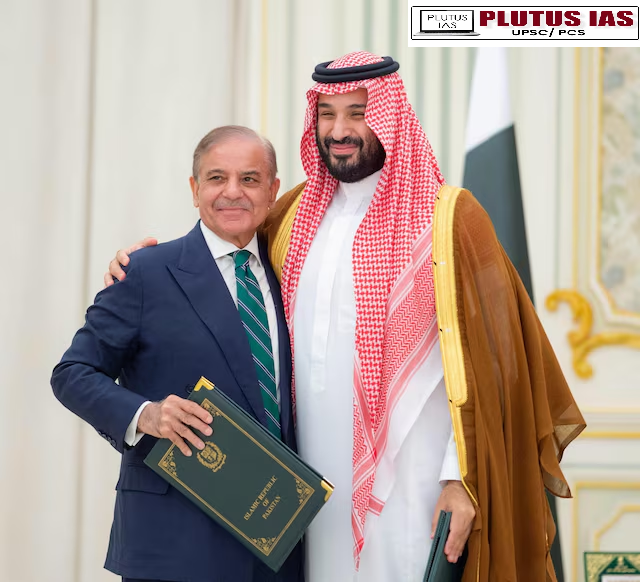
What is the Deal?
Official name: Strategic Mutual Defense Agreement (SMDA).
Signed between Pakistan and Saudi Arabia to strengthen defense ties and ensure joint deterrence.
Core principle: “An aggression against one shall be considered an aggression against both.”
Seen as a shift away from dependence on the U.S. security umbrella in West Asia.
Provisions of the Deal
1. Mutual Defense Clause: Both countries pledge to respond jointly to any external aggression.
2. Military Cooperation: Expansion of training, joint exercises, and stationing of Pakistani forces in Saudi Arabia.
3. Potential Gulf Expansion: Pact may extend to cover other Gulf states under Saudi leadership.
4. Nuclear Ambiguity: Pakistan officially denies a nuclear dimension, but Saudi hints suggest a de facto nuclear shield.
5. Economic–Security Linkage: Saudi financial support (loans, investments) expected to bolster Pakistan’s economy and defense modernization.
6. Defense Industrial Collaboration: Possible joint ventures in defense production, arms procurement, and technology sharing between Saudi Arabia and Pakistan.
7. Counterterrorism Cooperation: Strengthening intelligence-sharing, border security, and coordinated operations against non-state armed groups that threaten either country.
Implications on India’s West Asia Diplomacy
1. Security Concerns: The Possibility of Pakistan’s nuclear deterrence indirectly projecting into West Asia. Adds to India’s strategic worries, already balancing ties with Israel, Iran, and the Gulf states.
2. Regional Balancing: India has built strong defense and energy ties with Saudi Arabia, the UAE, and Israel. A Saudi–Pakistani military bloc could dilute India’s strategic influence in the Gulf.
3. Iran Angle: India’s Chabahar port project with Iran could face greater scrutiny if Gulf–Pakistan–Saudi ties harden against Tehran.
4. Geopolitical Polarisation: Risk of emerging blocs- Saudi–Pakistan–Gulf vs India–Israel–U.S. (potential alignment). India may be forced to navigate complex trilateral rivalries.
5. Economic Interests: The Gulf hosts 9 million+ Indian diaspora and is India’s top energy supplier. Any regional instability could affect remittances, energy security, and trade.
India’s Ways to Manage Implications
1. Strategic Balancing: Continue balancing ties with Saudi Arabia, UAE, Israel, and Iran, avoiding taking sides.
2. Defense Diplomacy: Expand India’s role in Gulf security through naval exercises, defense exports, and technology sharing.
3. Energy Diplomacy: Secure long-term oil and LNG deals to insulate against political shocks.
4. Diaspora Safety: Strengthen evacuation and protection frameworks for Indian workers in Gulf states.
5. Multilateral Engagement: Use forums like IORA, SCO, and BRICS+ to promote regional stability and dialogue.
6. Backchannel Diplomacy: Quietly engage with Riyadh to ensure the pact does not undercut India’s security or energy interests.
Conclusion
The Saudi–Pakistan defense pact marks a strategic shift in West Asia’s security landscape, reflecting Gulf distrust of U.S. protection and growing reliance on Pakistan’s military. For India, it poses challenges by enhancing Pakistan’s regional role and complicating its delicate balance between Iran, Israel, and the Arab states. India must adopt a multi-vector strategy—deepening economic interdependence, leveraging diaspora ties, and enhancing defense diplomacy—to safeguard its national security and sustain influence in West Asia.
Prelims question:
Q. Which of the following natural heritage sites from India were recently added to UNESCO’s Tentative List of World Heritage Sites in 2025?
1. Deccan Traps
2. Varkala Cliffs
3. Tirumala Hills
4. Kaziranga National Park
Options:
(a) 1, 2 and 3 only
(b) 2 and 4 only
(c) 1 and 4 only
(d) 1, 2, 3 and 4
Answer: A
Mains Question:
Q. The inclusion of seven new natural heritage sites in UNESCO’s Tentative List reflects India’s growing heritage diplomacy. Discuss the significance of this achievement, the challenges in heritage conservation, and the policy measures needed for sustainable management.
(250 words)

- Europe’s AI Rules May Become India’s Opportunity - August 14, 2026
- Transparency as the Foundation of Trust in Medicine - August 14, 2026
- A Timely Reset for the Food Security Act: From Foodgrain Security to Nutrition Security - August 13, 2026

No Comments